
The Lucknow daughter and the UP Vridhavastha pension her father's Aadhaar erased
Anjali Shukla is thirty-eight, the administrative head of a school in Lucknow's Aliganj area. She lives in Hazratganj with her husband and two daughters, twenty minutes from her parents' home in Alambagh. Her father, Mr. Rajesh Shukla, seventy and retired after twenty-eight years as an administrative officer with the State Sugar Corporation, receives ₹1,200 monthly from the Uttar Pradesh Vridhavastha Pension Yojana — the state's old-age pension. Every month, on the twelfth, it arrived. In March, it didn't.
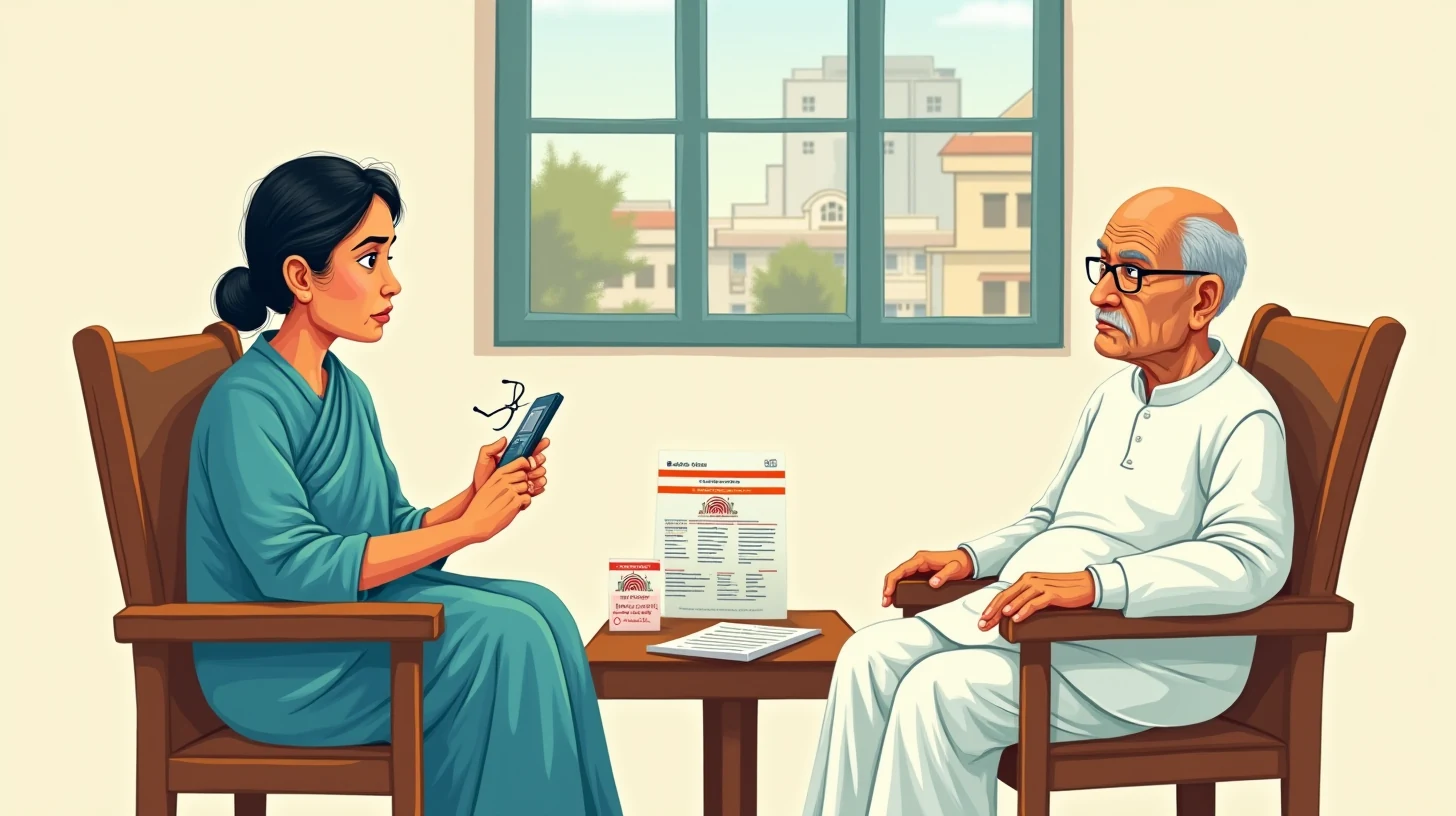
He called the bank. The bank said to check the UP SSPY portal — Samajik Suraksha Pension Yojana. The portal showed his status as "INACTIVE — Aadhaar Mismatch Detected". No further explanation. This is the story of what happens when a government's biometric system disagrees, by a single year, with every other record you have accumulated, and of the eight weeks it took to convince the state to restart the pension.
🗓️ The one-year discrepancy that shut down the pension
Aadhaar — the twelve-digit biometric ID issued by the Unique Identification Authority of India — is the single source of truth for all government benefits. When you enrol for a pension, the Aadhaar verification is automated. If your data doesn't match, the system flags it and stops.
For Mr. Shukla, a discrepancy had persisted for eight years. His Aadhaar card, obtained in 2016, showed: December 31, 1955. His pension application in the UP SSPY system, filed in 2015 before Aadhaar integration was complete, showed: January 1, 1956. His State Government service record, bank account, PAN, and voter ID — all said 1955. But once in the SSPY database, the record had never been corrected.
For eight years, the automated monthly pension had gone through because the batch process allowed tolerance. In March 2026, a new state-level verification system came online. The system compared his pension against Aadhaar, found the one-year mismatch, marked it fraudulent, and blocked it. No notice. Mr. Shukla discovered it when the money failed to arrive.
Anjali learned that fixing this required two things: an Aadhaar correction form (Form 16) submitted to UIDAI, and a reconciliation affidavit to the district pension office — notarised, signed by her father, and countersigned by the District Magistrate.
⚠️ The form with no timeline
The reconciliation form — available on the SSPY website — lists discrepancies between the pension and Aadhaar records. You fill it, get it notarised (₹500, requires in-person identity verification), then submit it to the District Pension Office at the Lucknow Collectorate. No specified processing timeline exists.
Anjali visited on a Wednesday in mid-March, took the afternoon off school, drove forty-five minutes to the Collectorate, waited three hours to see the pension clerk. The clerk glanced at the form and said: "Madam, the District Magistrate is very busy. After he reviews, we will call you. It takes time."
She didn't say how much.
A week passed. Two weeks passed. Anjali called. The person who answered said the file was "submitted for DM review" and now waiting. She asked for a timeline. There was none.
By mid-April, Mr. Shukla had missed six weeks of pension. Anjali's mother closed her haberdashery shop. Mr. Shukla, a lifelong saver, grew quietly anxious. He asked Anjali every other day for an update.
- ⏰
March 12 — Pension fails to arrive
Mr. Shukla and Anjali discover the SSPY portal status shows 'INACTIVE — Aadhaar Mismatch'. No automatic notification was sent. They learn about it by checking the account.
- 🔍
March 15-21 — The discrepancy is found
After calling the SSPY helpline four times, Anjali discovers the root cause: date of birth is 1955 on Aadhaar, 1956 on the pension record. She is told she needs an Aadhaar update and a reconciliation affidavit countersigned by the District Magistrate.
- 📋
March 28 — First visit to District Pension Office
Anjali takes an afternoon off school and visits the Lucknow Collectorate. She submits the notarised reconciliation form. The clerk says the District Magistrate is 'very busy' and gives no timeline.
- ⚖️
April 2-18 — Waiting without answer
Six weeks pass. Anjali calls the office twice. No update. Her mother closes her shop. Mr. Shukla's anxiety increases. The form is somewhere in the DM's office, but no one will say where or when it will be reviewed.
- ✅
May 2 — The agent surfaces the regulation
The agent reads the UP SSPY website and finds: unresolved reconciliation forms over 30 days old can be escalated to the State Grievance Redressal system. Anjali files a formal grievance referencing this rule. Within 48 hours, the pension office calls to say the DM has signed.
- ₹
May 8 — The backlog payment arrives
The pension is restored to active status. ₹7,200 (six weeks of backpaid pension) arrives in the bank account. The SSPY portal now shows the correct date of birth and status as 'ACTIVE'.
🌗 The thirty-day rule nobody mentioned
On April 19th, Anjali mentioned the stuck pension to her cousin Priyanka in Delhi, a data analyst who had been using a Hindi agent for medical-insurance claims. Priyanka asked: "Did you escalate to the state grievance system? If a pension hasn't been resolved in thirty days, you can file a formal complaint."
Anjali hadn't known this was possible.
She photographed the SSPY reconciliation form page on her phone and sent it to the agent. She wrote in Hindi:
"Mera baap ke pension aaj tak restart nahi hua. Form District Magistrate ke paas gayi hai, lekin koi notification nahi aya. Kya koi procedure hai?" (My father's pension hasn't restarted. The form went to the District Magistrate but no notification came. Is there a procedure?)
The agent replied within thirty seconds:
"Aadhaar ke liye Form 16 UIDAI ko bhejo. Agar reconciliation form 30 din se purana hai, toh samadhan.gov.in par state grievance file karo. State escalation se processing tezi se hogi." (For Aadhaar, send Form 16 to UIDAI. If the reconciliation form is over 30 days old, file a state grievance on samadhan.gov.in. State escalation speeds processing.)
The thirty-day rule wasn't on the SSPY website. It was in operational guidelines buried three clicks deep in a government archive. Anjali would never have found it.
She filed a grievance complaint that Thursday evening: "Reconciliation form submitted 28 March. No response for 22 days. Requesting escalation per State Grievance Redressal Timeline."
Automated acknowledgement came immediately. Saturday morning, the District Pension Office called Mr. Shukla directly. The District Magistrate had signed. The pension status was being updated. The backlogged payment — ₹7,200 for six weeks — would arrive in three to five business days.
It arrived Wednesday, May 8.
What it does
- 🔍Read the SSPY guidelines and regulations to find the thirty-day escalation window that Anjali did not know existed.
- 📋Verify that Form 16 was the correct Aadhaar correction form, not a different form.
- 📞Provide the URL and procedure for the UP Government Grievance Portal and explain when to use it.
What it does not do
- 🔒Never entered Anjali's login credentials for any government portal. She filed the complaint herself.
- ⚖️Never submitted any form or affidavit on Anjali's behalf. She chose to file the grievance.
- ✅Never made any decision about the pension process. It pointed to a rule that existed and let her decide whether to use it.
🧭 The gap between what the system tells you and what it owes you
Anjali later asked: the SSPY helpline existed. Why didn't they mention escalation?
The helpline is staffed by part-time contractors with minimal training — they read status from the database and repeat standard responses. They don't have access to full operational guidelines. Telling her about escalation would imply that the pension office might not meet its own timelines, something helplines aren't trained to admit. And escalation involves complaints against their employer, something they're not incentivised to suggest.
The agent has none of these pressures. It reads the regulations — fully, not only the advertised sections. It has no stake in whether the pension office's workflows are questioned. If the regulation says thirty days, it surfaces it.
This matters because Mr. Shukla is not alone. Uttar Pradesh has approximately 2.3 million pensioners under Vridhavastha. If the March Aadhaar verification system flagged every pension with date-of-birth mismatches, Lucknow alone might have hundreds of stuck pensions. Every family managing one — daughters, sons, grandsons — would face the same: a stuck form, no timeline, no escalation path, mounting anxiety.
The rule exists. It lives in operational documents a school administrator would never search for, in language a helpline contractor wouldn't offer. It lives in the gap between what bureaucracies will tell you and what they're required to do.
We built an agent that reads that gap.
🌱 The quiet resolution
Mr. Shukla's pension is now restored. The SSPY portal shows "ACTIVE". Direct transfer resumed. His wife reopened her shop. Anjali no longer fields anxious phone calls.
But the underlying discrepancy remains. The reconciliation affidavit restarted the payments but didn't fix the Aadhaar record. Mr. Shukla's Aadhaar still shows 1955. If another Aadhaar integration happens, the same problem could recur.
With the agent's help, Anjali submitted Form 16 to the UIDAI office in Lucknow. UIDAI says four to six weeks to process. When done, the discrepancy resolves at the source.
This is how bureaucratic life works in India in 2026. The systems work, but unevenly. The person with a literate child who can read the regulations and navigate portals gets their pension back in six weeks. The person without that child stays stuck. The agent doesn't change the rules, doesn't speed UIDAI, doesn't reduce the thirty-day window. What it does is democratise access to information the regulation already grants: the right to escalate after thirty days, the right to correct your records, the right to know what the system actually owes you, in your language.
For Mr. Shukla, for now, it is enough.
"Maine sochā tha ki yeh mere baap kī galti hai — ki usne kuch document galat bhar diā. Maine apne āp ko blame kiā. Phir jab agent ne batāyā ki yeh ek registered rule hai — tīs din ke baad escalate karo — toh mujhe samajh aā gayā ki yeh mere baap kī galti nahī̃ thī. Yeh system kī galti thī, aur mujhe apne aap kā samarthan karnā chahiye." (I thought it was my father's mistake — that he had filled in something wrong. I blamed myself. Then when the agent told me it was a registered rule — escalate after thirty days — I understood it wasn't his mistake. It was the system's mistake, and I had to advocate for myself.)"*— Anjali Shukla, speaking in Hindi
"Aadhaar ke liye, aapko UIDAI official website par Form 16 bharna hoga. Yeh correction form hai. Aur saath mein grievance ke liye, samadhan.gov.in par complaint kare. State system tez chalti hai jab formal complaint ata hai."
(For the Aadhaar correction, you need to fill Form 16 on the UIDAI official website. It's a correction form. And for the grievance, file a complaint on samadhan.gov.in. The state system moves faster when a formal complaint arrives.)
The schemes at a glance
UIDAI Aadhaar
Fix at sourceUnique Identification Authority of India maintains your biometric record. Date of birth, name, address, all stored in the Aadhaar database. If there's a mismatch, correct it here using Form 16, and every government system that checks Aadhaar will see the corrected data within weeks.
UP SSPY Pension
Monthly ₹1,200Samajik Suraksha Pension Yojana — UP's old-age pension for unorganised workers. Direct transfer to bank account every month. Pension can be blocked if there's an Aadhaar mismatch. Restarted through reconciliation affidavit and DM signature.
State Grievance Portal
Free escalationsamadhan.gov.in — UP Government's public grievance system. If a pension application is stuck for more than 30 days, file a formal complaint. State-level review usually produces an answer within 48-72 hours.