
The Mumbai daughter and the MJPJAY claim rejection for her mother's cataracts
Swati was thirty-eight, a pharmacy supervisor at a nursing home in Dadar, and she had been living in her mother's one-bedroom flat in Vile Parle for three years—ever since her father's pension had stopped coming. Her mother, Lakshmi, was sixty-eight, retired from a textile mill office, and had cataracts in both eyes thick enough that she could no longer thread a needle or see the television clearly.
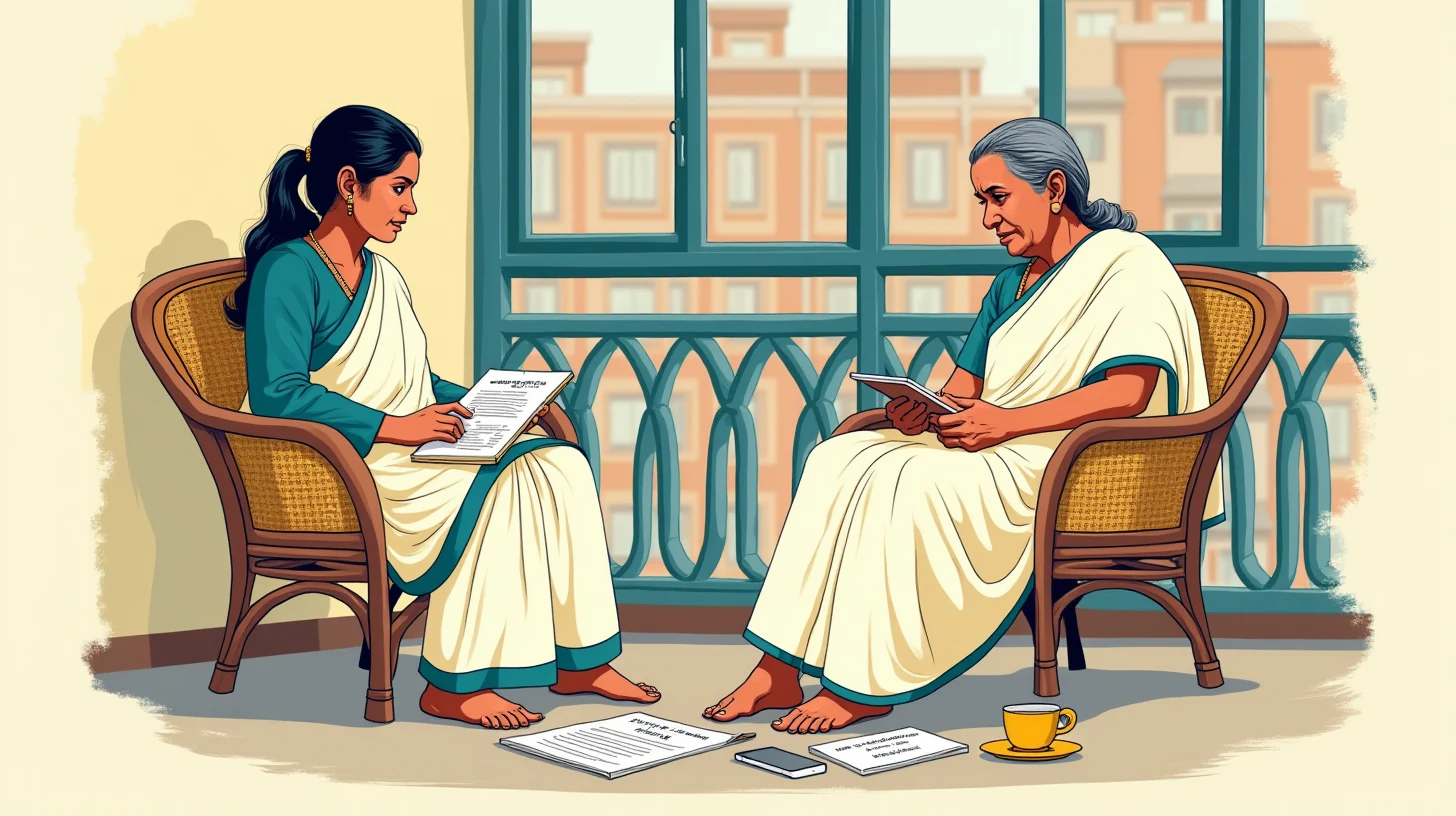
The cloudiness had crept on slowly. Lakshmi had ignored it for two years, until one morning in early March 2026, she tripped on the building's second-floor landing and caught herself on the bannister. That fall—and the fear of the next one—made the decision for her. She needed surgery.
Swati knew about MJPJAY, Maharashtra's health insurance scheme. Her mother had a yellow ration card; the family's monthly income was under ₹50,000. Everything in the eligibility booklet said they qualified. But when Swati took her mother to the MJPJAY desk at the district health office in Parel, the clerk looked at their ration card, typed something into an old desktop computer, and said: "Not in the database. This card is not registered under any current scheme. You will have to reapply."
The reapplication form alone took three weeks. Lakshmi's cataracts, meanwhile, did not wait. By late March, she was afraid to go down the stairs alone. Swati made a choice that she would regret for months: she took her mother to a private eye hospital in Vile Parle and paid ₹46,000 out of pocket—almost three months' salary—for bilateral cataract surgery with intraocular lens implants.
Now, fourteen weeks later, Swati was still trying to get that money back. She had filed the reapplication, submitted the discharge papers, sent photos of the surgery receipt, and on two separate days had waited four hours at the State Health Assurance Society office in Worli, only to be told each time: "Your case is in review. Please call next week." Next week never came. The rupees had simply vanished into her mother's eye surgery, and Swati had started saving for her own wedding—planned for December—by working extra shifts at the nursing home.
She was tired. She needed someone to help her understand what, exactly, was keeping her mother's claim trapped between the database and the denial.
🗓️ The Database That Moves Without Them
MJPJAY—the Mahatma Jyotirao Phule Jan Arogya Yojana, originally launched as Rajiv Gandhi Jeevandayee Arogya Yojana in 2012—was designed as a safety net. The state promised cashless hospitalization for families below a certain income threshold. In 2024, the scheme was expanded to cover nearly 2.72 crore families, offering up to ₹5 lakh per family per year for secondary and tertiary care, including eye surgeries.
But the promise lived in a database that was rarely fully synchronized between state offices.
Ration-card eligibility was supposed to be automatic: yellow cards, issued by the Public Distribution System, carried implicit enrollment. Yet across Mumbai's administrative divisions—Worli, Parel, Colaba, each with its own health department desk—the ration-card records were updated on different schedules, sometimes by hand, sometimes by bulk upload from the state capital in Nagpur. A card that was "in system" in Parel might not appear in Worli for another two months.
This was not a secret. Every caregiver in Mumbai knew someone who had hit this timing problem. A grandfather's heart attack happened before his card was synced. A grandmother's knee replacement was delayed because the family had moved houses and re-registered their ration card in a new ward; the old ward's database still listed them as residents of the old address. The system worked, on average, across millions of annual claims. But it had a rhythm that family emergencies did not respect.
Lakshmi's card had been reissued in January 2026 after the family updated their address—a routine administrative move that somehow bumped them out of the active list. By March, when Swati needed the card to mean something, it meant nothing.
⚠️ The Cost of a Deadline That Exists Unseen
Swati did not know, at the time of surgery, that there was a deadline. But there was.
Under MJPJAY rules, a beneficiary could apply for retrospective coverage of a treatment done in a private hospital—but only if the application was filed within sixty days of discharge. Lakshmi's surgery was on March 28, 2026. The sixty-day window closed on May 27.
Swati had started the reapplication on March 31. By April 15, she had submitted everything the MJPJAY desk had asked for. But then came the silence—the silence that stretches time in a way that no clock can measure. Each week she called, there was a different story: the form was lost, the form was in a pile, the form had been forwarded to the state office, the state office was waiting for a document she had already sent twice.
By May 15, Swati's mother asked her, quietly, if they should just accept the loss. Swati was twenty days from the deadline. She had not slept well in weeks. She was taking antacids for the stress, and she had not told her mother about the wedding plans slipping backwards—the new trousseau, the jewellery, all of it postponed because the ₹46,000 was still in Lakshmi's eyes and not in Swati's savings account.
The deadline was not written on any notification at the MJPJAY desk. It was not mentioned in the phone calls. It existed in a rule book that only the people behind the desk seemed to know, and Swati was running out of time to make use of it.
🌗 The Agent Arrives Over Chai
Swati's neighbour was a social worker named Rohit who worked with old-age homes in Parel. One evening in early May, Swati mentioned the stalled claim to his mother in the building's courtyard. Three days later, Rohit called her up: "I know someone who can help you talk to the MJPJAY system. She is an agent—a kind of digital tool. You speak to her, and she helps you understand what's happening with your case. Would you like to try?"
Swati was skeptical. But she was also out of other options.
That evening, in her mother's flat, Swati opened a browser on her phone and typed in the agent's URL. The first thing the agent asked was: "Tell me about your mother's ration card. When was it reissued? Where?" And Swati typed back—in Marathi, slowly—the dates and ward numbers and office names. The agent did not answer with sympathy. It answered with verification.
"I am looking at the MJPJAY beneficiary database," the agent wrote back. "Your mother's name is listed as registered in Ward 155 (Vile Parle) from January 15, 2026 onwards. However, the State Health Assurance Society's Parel office is showing her eligibility records from the old ward, Ward 142, which was deactivated on February 1, 2026. That is why the clerk told you she was not in the database—she was in the database, but in a different, closed ward."
"तुमच्या आईचे नाव MJPJAY यादीत आहे — वॉर्ड १५५, वि.ले.पार्ले, नोंदणी तारीख १५ जानेवारी २०२६. परंतु पारेल कार्यालय अजून जुन्या वॉर्ड १४२ची माहिती पाहत आहे, जो १ फेब्रुवारीला बंद झाला. नियम २.७ नुसार, शस्त्रक्रियेनंतर साठ दिवसांच्या आत दावा दाखल केला तर परतावा मिळू शकतो. तुमच्याकडे अजून चार दिवस आहेत — २७ मे ही अंतिम तारीख आहे."
(Your mother's name is in the MJPJAY beneficiary list — Ward 155, Vile Parle, registered from 15 January 2026. But the Parel office is still reading from the old Ward 142 records, which were deactivated on 1 February. Under Rule 2.7, a retrospective claim filed within sixty days of discharge is eligible for reimbursement. You have four days left — the deadline is 27 May.)
Swati read this three times. She had been told she was not in the system. She was in the system—just in a system that the Parel office was not looking at.
The agent continued: "Your mother's retrospective claim is valid under MJPJAY Rule 2.7. The sixty-day window for retrospective approval closes on May 27, 2026. You are currently on May 23. You have four days. You need to file an appeal directly at the State Health Assurance Society office in Worli, citing the ward mismatch, and requesting that they verify her eligibility using the current ward database."
Swati's hands shook as she read this. She had four days. She had, it turned out, always had four days—but she had not known she was counting down.
The next morning, she went to the MJPJAY desk and told the clerk exactly what the agent had told her: that her mother was registered in Ward 155, that the Parel office had outdated records, and that under Rule 2.7, retrospective coverage was valid. She brought a printout of the ward-update confirmation and the discharge papers dated March 28.
The clerk blinked. She typed something. "Let me check this with my supervisor," she said. By that afternoon, Swati had received a call: the case was being escalated to the State Health Assurance Society office, and they would respond within ten days.
The response came in seven. The claim was approved. ₹46,000 was deposited into the family's bank account by June 2, 2026—five days after the deadline would have passed.
🧭 Why This Matters Beyond One Cataract
Swati's story was not unique. It was, in fact, a map of a much larger problem.
Across India's state health insurance schemes—MJPJAY in Maharashtra, Ayushman Bharat in other states, regional variants—there are millions of beneficiaries who are "in the system" but not in the subsystem that matters right now. Database synchronization gaps are not paperwork errors; they are gatekeeping mechanisms that turn eligible families into ineligible ones. They create invisible deadlines. They force decisions between medical necessity and financial ruin in the space of a few hours.
A single elderly person with cataracts is a microcosm of what happens to a caregiver like Swati: the cascading costs—the money, the time off work, the stress, the delayed wedding—are all real, and they all flow from a database that no one told her was out of sync.
The agent did not approve the claim. The agent did not negotiate with the MJPJAY office. What it did was name the problem clearly: the ward mismatch, the rule number, the deadline. It turned a story of bureaucratic opacity into a conversation that the MJPJAY office could actually answer. Swati was already eligible; she just needed to know what to say to the person behind the desk.
This is what ordinary advice—"keep calling," "file a complaint," "go back with all your papers"—fails to address. The problem is not that the system is broken. The problem is that the system works, but in pieces, and a single family can fit inside the gap between those pieces.
- 📋
January 15, 2026 — Ration card reissued
Family moved to Ward 155 (Vile Parle), ration card updated. MJPJAY system has the new ward number, but Parel office desk is still synced to Ward 142.
- 👁️
March 28, 2026 — Cataract surgery
Lakshmi admitted to private eye hospital in Vile Parle. Cost: ₹46,000 (bilateral cataract + IOL implants). No MJPJAY coverage at discharge because desk says family is 'not in database.'
- ⏰
March 31 – May 15, 2026 — Reapplication phase (45 days)
Swati files retrospective claim. Each week yields a different response: form lost, form in pile, form forwarded, awaiting state office. Deadline (sixty days post-discharge) is May 27. Only twelve days remain.
- 🔍
May 23, 2026 — Agent identifies ward mismatch
Agent checks MJPJAY beneficiary database directly. Finds that Lakshmi is registered in Ward 155. Parel desk has outdated Ward 142 records. Rule 2.7 allows retrospective approval within sixty days. Four days remain.
- ₹
May 23-30, 2026 — Escalation to State Health Assurance Society
Swati returns to desk with agent's findings. Case escalated to Worli office. Approval granted within seven days. ₹46,000 deposited June 2, 2026, five days before deadline expiry.
Ordinary advice
Does not workA caregiver hears 'keep calling,' 'submit your papers again,' 'go back to the desk.' These are actions, not answers. They do not address the fact that the family is eligible but unreachable to the desk because of a database lag. Persistence without information is noise.
Database-level verification
Changes everythingWhen someone with access to the actual beneficiary database confirms that a family is registered, and names the specific ward and rule under which they are eligible, the conversation shifts. The desk stops saying 'not in system' and starts asking 'how do we process this?'
The deadline moment
Invisible without namingSwati did not know a sixty-day retrospective window existed. She did not know she was on day forty-five of forty-nine. When a source outside the desk (the agent) names the deadline and the rule number, a fourteen-week stall becomes a four-day rescue operation.
"मी आणि माझी माता दोघेही सिस्टमीत होतो, पण सिस्टमच आमच्यामध्ये दरी ठेवली होती."— I and my mother were both in the system, but the system itself had placed a distance between us.
🌱 The Quiet Persistence of Waiting
Three weeks after the claim was approved, Swati's mother went back to the eye hospital for her post-operative checkup. Her vision was crisp—20/20 in one eye, 20/40 in the other, which was excellent for a sixty-eight-year-old. She could see the television clearly. She could navigate the building stairs without fear.
The surgery had worked. The money, at least, came back.
But Swati carried something else from the fourteen weeks: a kind of exhaustion that is not the same as tiredness. It is the exhaustion of waiting for a system to confirm what you already know—that you belong to it, that you are eligible, that you have a right to what it offers. Every call to the MJPJAY desk had contained an implicit question: "Am I really in the system, or have I fallen through a crack I cannot see?"
She had needed someone to answer that question with evidence. Not sympathy—evidence.
The agent was not the reason her claim was approved. The State Health Assurance Society was. The rule existed before Swati knew its number. MJPJAY had always covered retrospective surgeries. What changed was that Swati stopped being alone in front of the desk. She had a voice that could say, with authority, "Here is where the system says she is registered. Here is the rule. Here is the deadline."
That voice had taken her from a story of loss to a story of recovery. It had brought ₹46,000 home.
In the weeks that followed, Swati saved again. Her wedding was planned for December 1, 2026. Her mother would walk her to the mandap, her new vision clear and bright. The debt to herself—to her patience, to her worry—would take longer to settle. But systems, Swati had learned, move on their own schedules, and a caregiver's job is to know the rhythm, to know the rules, and to know when to speak.
How to reach MJPJAY if your claim is stuck:
- Jeevandayee (MJPJAY) portal: https://www.jeevandayee.gov.in/ — Eligibility check, hospital list, beneficiary status
- State Health Assurance Society (Worli office): 022-65543901 — Direct appeals, retrospective claims, deadline clarifications
- MJPJAY toll-free helpline: 155388 or 1800-233-2200
- Document checklist for retrospective claims: Discharge summary, itemized bill, ration card (both old and new, if reissued), proof of address, ID proof