
The Patna daughter and the Jeevan Pramaan certificate her father's fingerprints could no longer produce
Lata had spent exactly thirty years watching her father's hands. Not out of affection—though there was plenty of that—but from habit. After Rajendra, her father, retired from the Bihar State Electricity Board in 1998, she had become the keeper of his paperwork, his bank statements, his pension slips, the small bureaucratic stream that kept him alive at eighty-one. His hands, once thick with callus from forty years of coiling live cables and reading the tiny silver needles of domestic meters, had softened but never lost their shape. What they had lost was something invisible: the ridges that made them his.
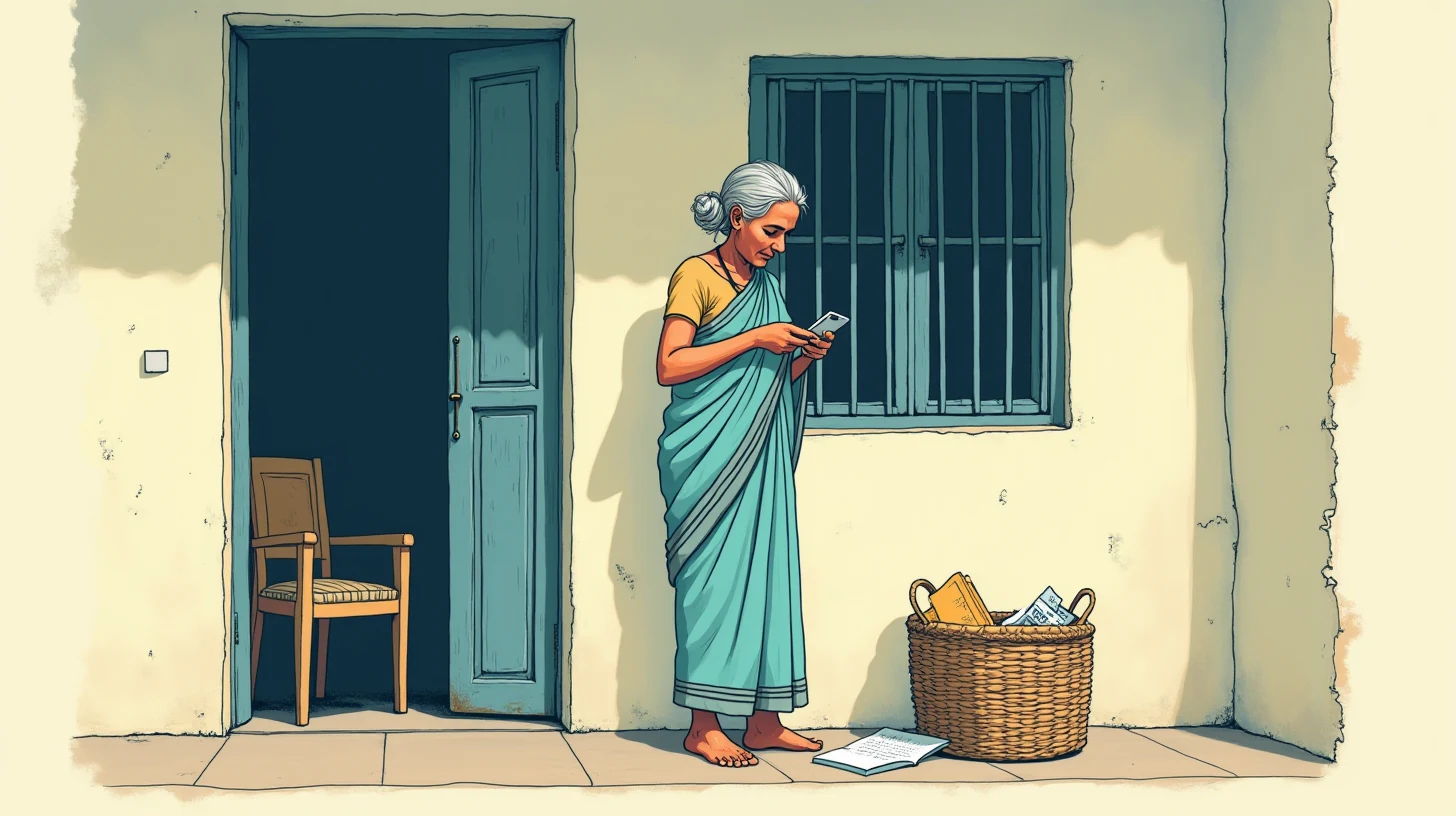
It began with a letter in September. Not a registered letter—Rajendra never received those anymore—but the kind of pale blue envelope that arrived in a stack of bills, easy to miss. The Jeevan Pramaan portal required him to complete his annual Digital Life Certificate by November 15th. He had been submitting it for five years without incident. He was alive. The government needed to know it, fingerprints first.
Lata's world had contracted to a small radius: her home in Kankarbagh ward, the Ramakrishna Mission hospital three streets over, the CSC office, and the district pension office where she had begun to know the clerks by their tea preferences. She had never worked outside her home. She had instead raised two children—both now in Delhi, both calling weekly—while nursing her mother through a stroke in 2013, and now managing her father's health and his entanglement with the systems that paid for his medicine.
When Rajendra's fingers failed to register on the Jeevan Pramaan scanner at the CSC, the operator, a young man named Vikram with a neat shirt and tired eyes, did not apologize. He simply said: "Sir, the system is not reading. Please come back with a better copy of your Aadhaar." Lata, standing beside her father in the cramped office, asked if the optical scanner could be cleaned. Vikram made a small gesture with his hand. "Sometimes it helps. Come tomorrow."
Tomorrow never came. It arrived again and again, each time with a different obstruction. The scanner was temperamental that week. Rajendra's fingers were too dry. The system was updating. Come on Tuesday. The November deadline began to narrow.
What Rajendra did not tell Lata, and what Lata did not know until her youngest daughter called from Delhi, was that his pension payment had already been suspended in October. The system had flagged his account: no Digital Life Certificate submitted. The bank had sent a letter. Lata found it wedged behind a calendar in the kitchen—three weeks old.
🗓️ The annual proof of life
The Digital Life Certificate is not a new practice. For decades, pension officers had visited pensioners in person, armed with a ledger and a camera, to verify that the state's money was reaching living people. It was inefficient, manual, limited by roads and weather and the patience of government staff. In 2015, the government launched Jeevan Pramaan as a digital replacement—a portal where pensioners could submit their biometric fingerprints and a photograph, and the system would return a certificate valid for one year.
The logic was sound. Automation. Reduced fraud. No travel. A pensioner in Patna need not wait for an officer from Darbhanga. They could go to the nearest CSC, scan their fingerprints, and the proof of life would be generated instantly.
Rajendra had used Jeevan Pramaan without confusion from 2019 to 2025. He was not computer-literate—he could not open his own email—but the CSC operator was a trained intermediary. Scan, photograph, wait thirty seconds, receive the certificate. The system had been designed for people like him.
In 2025, forty-one million Indian pensioners depended on Jeevan Pramaan or its equivalent UMANG (Unified Mobile Application for New-age Governance) portal to certify their annual existence. Rajendra was one of them. The EPFO alone oversaw twelve million pensioners; the Department of Pension and Pensioners' Welfare (DoPT) administered more than ten million. Every November, a bottleneck formed. Every November, pensioners stood in CSCs and district offices with documents that proved who they were, begging the system to believe them.
But the system had a requirement that Rajendra's body could no longer meet.
- 📨
September 2025 — Portal notice issued
The Jeevan Pramaan system sends an alert to the pensioner's registered address: your Digital Life Certificate expires in 60 days. No fine yet. No penalty. A courtesy.
- ⚠️
October–November — Certification window (60 days)
The pensioner has two months to appear at a CSC, submit fingerprints and a photograph. By November 15th, the deadline is non-negotiable. Payment does not resume without a valid certificate.
- 🛑
November 15th — Deadline closure
The portal closes certification submissions for that cycle. Any pensioner without a certificate is flagged in the pension disbursement system. Their bank account does not receive the November payment.
- ₹
November onwards — Payment suspension
The bank returns the December payment as well. The pensioner must visit the district pension office with fresh Jeevan Pramaan proof to unlock the frozen account. Backpay is not automatic.
The system assumed healthy fingerprints. It did not account for Rajendra.
⚠️ The ridge-map no longer there
Lata learned the term "ridge pattern" from the CSC operator on her seventh visit. The Jeevan Pramaan scanner was an optical device that read the tiny peaks and valleys on the surface of a fingertip—the ridge pattern—and matched them against a template stored in the Aadhaar database. If the ridges were worn too flat, or calloused too thick, or scarred, the match failed. The system would not advance. No certificate.
Rajendra's ridges were a labour history. Forty years of handling live electrical conductors had worn them smooth. The callus had hardened and flattened until his fingertips felt like leather. The meter work had been done without gloves—that was not how it was done then, the linemen stood on wooden poles with their hands on live copper and their feet on worn wood, and the ridge maps in their fingertips disappeared into the work itself.
"There is no workaround in the Jeevan Pramaan system," Vikram said. Not unkindly. He was repeating what his supervisor had told him. "If the fingerprints cannot be read, you will need to use face recognition."
Jeevan Pramaan did offer an alternative: facial recognition via a mobile app. Rajendra had a phone—a basic Android that Lata's daughter had bought him. But face recognition on Jeevan Pramaan required a specific app version, steady hands to hold the camera, good lighting, and a clear view of his face. Rajendra had tremors from age and mild Parkinson's. Lata tried seven times in their home, with natural light, with artificial light, with the camera held at different angles. The app said: "Face not clearly visible. Please try again."
Meanwhile, the bank sent a second letter. The November payment had not arrived. A fourth of their monthly budget had evaporated.
The CSC could not help. The district pension office said the matter was between Rajendra and the Jeevan Pramaan portal. The pension office could not override the system. The Jeevan Pramaan helpline, when Lata finally reached it on a landline from a neighbour's house, told her to visit the nearest CSC. It was a loop.
🌗 The table in the corner
In the second week of November, Lata stood in a crowd at the Kankarbagh district pension office, holding a folder of documents—pension slips, Aadhaar, bank statements—that proved Rajendra was alive. The line moved slowly. The clerk at the front desk was new, had seen her twice before, and still asked her to produce the same papers.
An older woman, maybe sixty, was sitting at a small table in the corner of the office. She was not a clerk. She was not part of the visible machinery. But several people in the line kept walking over to her, sitting for a moment, pointing at their phones, and then returning to stand in line again with a different expression—less frantic, more focused.
Lata did not know who she was. But she noticed.
After waiting two hours, Lata walked to the table. The woman looked up. She had kind eyes, the kind that come from having solved small problems for strangers a thousand times before.
"My father," Lata said, "cannot use Jeevan Pramaan. His fingers are worn. The app for face recognition does not work either."
The woman asked to see Rajendra's Aadhaar and the Jeevan Pramaan rejection notice. Lata had not brought a rejection notice—there was no formal rejection, only a failed scan. The woman pulled out a tablet and asked Lata to help her connect to the pension office Wi-Fi.
"I am going to show you something," the woman said. "It will take a few minutes."
On the tablet, she navigated to the Jeevan Pramaan portal. Lata had never seen the portal itself—only the CSC scanner interface. The woman clicked through Rajendra's account, pulling up the stored photograph, the dates of previous certificates, the biometric rejection flag. Then she navigated to an entirely different section: a form for pensioners with biometric registration failures.
"This exists," the woman said. "It is not the first screen. It is not the option they tell you about at the CSC. But it exists. Here." She pointed to a field on the tablet. "You can appeal your rejection. You provide a photograph from this year, recent proof of life, and you explain in writing why the biometric failed. The appeal goes to the pension office. A human reviews it."
The woman, who would not give her name, was a volunteer trained by the Jeevan Pramaan helpdesk to help pensioners in person. She was not a government employee. She had spent six months learning the portal's hidden features—the appeals process, the workarounds, the forms buried three clicks deep that no CSC operator ever mentioned because their job was simply to scan and move the line forward.
She helped Lata draft the appeal. "Your father worked with electricity," she said. "The government knows this causes wear. Write it down. Date it. Include a recent photograph."
Lata took a photograph of Rajendra on her phone that afternoon—him sitting on the verandah in afternoon light, his hands visible, his face clear, the date visible on the screen. She wrote a short letter in Hindi, explaining that his fingers could no longer be read by machines because of his labour, but he was alive, and she could prove it.
The volunteer woman had given her a printed form to submit to the pension office, attention: Pension Certification Cell. She had also shown her the email address where the appeal could be sent.
🧭 Why the system sees what it wants to see
The Jeevan Pramaan system was built on an assumption: that a pensioner's body would remain stable enough for biometric matching. Fingerprints do not change. But the assumption did not account for labour.
Forty million pensioners in India are not abstract policy units. They are electricians, construction workers, agricultural labourers, weavers, spinners, people whose hands have been reshaped by their work. A mason's fingertips are callused and flattened from decades of trowel work. A spinner's fingers are scarred and pale from handling raw cotton. An electrician's hands carry the history of every live wire they have survived.
For these people, the biometric system fails not because their Aadhaar is fake, not because they are committing fraud, but because the government's proof of life has become literally impossible to give.
The Jeevan Pramaan system was designed well for a pensioner in a city, working in an office for forty years. It was not designed for Rajendra. It was not designed for the twelve million EPFO pensioners who worked with their hands.
The face recognition alternative existed, but it demanded conditions that many elderly pensioners could not meet: a steady hand, a smartphone with the right app version, lighting that the camera could interpret. For a pensioner with arthritis, tremors, or vision loss, face recognition was another barrier dressed up as an option.
The system had also fragmented itself. The CSC operators, trained only to scan, did not know the appeal process existed. The pension office clerks said the system was "automatic," leaving pensioners to believe there was no way in. The Jeevan Pramaan helpline, when it could be reached, gave script answers that looped back to the CSC.
What it does
- 🔍Identify the specific biometric failure (fingerprints worn, face recognition unsuitable) and surface the appeal process that exists but is not advertised.
- 🗂️Help locate the appeal form, draft the written explanation, and gather supporting documents (recent photograph, labour history proof) without entering any credential.
- 📞Clarify which pension office address to submit the appeal to and verify the current email contact for the Pension Certification Cell.
What it does not do
- 🔒Never enter Rajendra's Aadhaar number, password, or any credential into the Jeevan Pramaan portal on his behalf.
- 💳Never submit the appeal form directly to the government office—Rajendra or Lata must deliver it in person or by certified post, retaining proof of submission.
- ✅Never guarantee that the appeal will be approved; the Pension Certification Cell may require additional proof or may ask for an in-person meeting at the district pension office.
The volunteers like the woman at the corner table existed in the margins of the system, learning its details through persistence and compassion, redistributing knowledge to people who had exhausted all visible channels. They were not part of the design. They were its conscience.
🌱 The quiet work
Rajendra's appeal was approved in December.
The Pension Certification Cell, after reviewing Lata's letter and the photograph, accepted a formal biometric exception. They issued a manual Digital Life Certificate valid for one year. The pension office sent word by post, three weeks after submission. Lata brought the certificate to the bank. The November payment was restored, and December came through. January followed. The rhythm of the months returned.
Rajendra did not need to understand how it happened. But Lata had learned something about the distance between the system as it was written and the system as it was lived. The same government that had designed Jeevan Pramaan so thoroughly had left small doors open—appeals processes, exceptions, the human review that kicked in when the machine said no. The doors were not advertised. They were found only by walking every corridor and asking every worker if something more existed.
She had also learned that the work of keeping a parent alive was not just nursing and paperwork. It was also navigation—learning the hidden syntax of government systems, finding the person at the corner table, translating the language of appeals for bureaucrats who read thousands of them. It was care that fell outside every definition of care that the world had ever given her.
"मैं अपने बाप को दवा दे सकती हूं, खाना बना सकती हूं, पर सरकार को बताना कि वह जीवित है, यह मेरा काम नहीं होना चाहिए था।"— I can give my father his medicine, cook his food, but proving to the government that he is alive should not have been my job.
In November 2026, when the next Jeevan Pramaan cycle began, Rajendra did not have to use fingerprints. The Pension Certification Cell had noted his exception in the system. He would submit a fresh photograph each year, and a human would verify it. The portal had learned his name, not just his biometrics.
But four million other pensioners still stood in CSCs each November with hands the government's scanners could not read. They waited for someone to tell them that an alternative existed. They waited for a woman with kind eyes to sit down beside them and say: there is a door.
"आपकी अपील स्वीकृत हुई है। लेकिन याद रखिए, यह हर साल करना होगा। सरकार को साल-दर-साल सबूत चाहिए कि आप जीवित हो।"
(Your appeal has been approved. But remember, you will need to do this every year. The government needs proof again and again that you are alive.)
For Lata, the lesson was not about winning against the system. It was about learning that the system, for all its automation and its efficiency targets, still needed the person who cared enough to keep walking through corridors until they found the corner table. It still needed her.