
The Port Blair daughter and the medical evacuation form her father's gallbladder forced
Anita Sharma is thirty-four and teaches English literature at Government Girls Secondary School in Port Blair's central ward, a position she has held for nine years. She lives with her father, Rajesh Sharma, sixty-eight, retired from the Port Authority, in a ground-floor flat in the Jangpura residential complex.
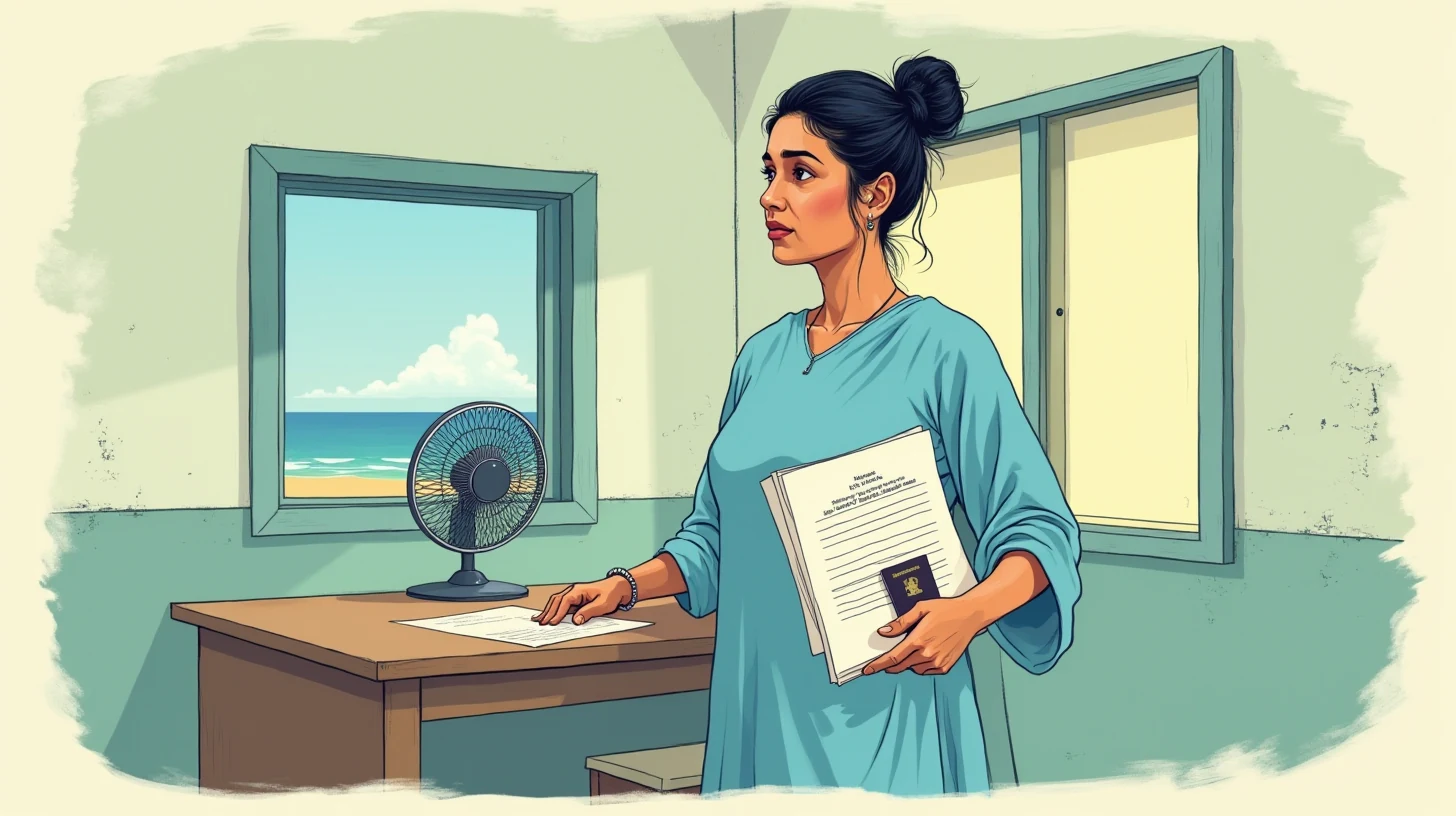
On Sunday, the eighteenth of February, at six-thirty in the morning, her father woke her with a groan of pure pain. He was in the bathroom, doubled over. By the time the ambulance from GB Pant Hospital arrived in nineteen minutes, Anita knew something had changed.
Dr. Kundal conducted an ultrasound within the hour. Acute cholecystitis: her father's gallbladder was inflamed and swollen. Two large stones lodged at the duct outlet. The treatment was laparoscopic cholecystectomy, emergency surgery to remove the gallbladder. GB Pant could do it. But Dr. Kundal said the complication risk was higher than he was comfortable with. Her father's age, the degree of inflammation, the imaging limitations — all pointed elsewhere.
"The surgery is safe here," he said. "But safer is in Vellore. CMC Vellore is the best for this."
He said they had three days. After three days, if the infection worsened, they would have to operate locally.
This is a story about what it took to move that choice from Port Blair to CMC Vellore, and about the form that made the move possible.
🗓️ The annual ritual of being an island
The Andaman and Nicobar Islands are, from the perspective of Indian healthcare administration, an outlier. The territory has around three hundred and eighty thousand people spread across the Bay of Bengal. The nearest mainland tertiary hospital by air is in Chennai, nine hundred and seventy kilometres away. For emergency medical cases that cannot be treated on the island — acute coronary syndromes, severe trauma, complicated surgery, organ failure — there is a formal evacuation system that arranges transport to the mainland and pre-authorizes costs.
The system exists because it must. But the form that triggers it — the medical evacuation request form, issued jointly by the Andaman & Nicobar Directorate of Health Services and endorsed by the Office of the Lieutenant-Governor — is a single document that carries three distinct bureaucratic weights: it is a clinical recommendation from the island hospital, an administrative approval from the DHS director, and a financial commitment from the territorial government to cover the costs of transport and treatment at a mainland hospital. For those three weights to align requires three separate counter-signatures and an endorsement that, in practice, operates as the final permission to leave.
The form has existed since the nineteen-eighties. It requires proof of identity, clinical recommendation, hospital financial estimate, insurance details, and endorsement from the DHS director and lieutenant-governor's office. The process is supposed to take two working days. It often takes four.
⚠️ The clock running down: thirty-six hours to treatment
Dr. Kundal gave Anita a form on Sunday morning. The form required patient name, age, clinical diagnosis, recommended treatment facility, and three signatures: treating physician, hospital director, and the DHS chief.
Anita began filling it out in the hospital corridor. She had her father's Aadhaar card, PMJAY ABHA number, ECHS card. She did not have the letter from CMC confirming admission.
Dr. Kundal called CMC at seven-forty-five. By eight-fifteen, he had email confirmation from Dr. Ashok Raman, chief of general surgery, that CMC had a bed and could admit by Monday evening. Anita printed it.
Dr. Kundal signed by eight-thirty. Dr. Sharma, the hospital director, signed by nine. But the DHS chief's signature required the form to be delivered to the Secretariat Building.
She called the DHS switchboard at nine-thirty on Sunday. The office was closed and would reopen at nine on Monday. She explained her father needed evacuation by Monday evening. The voice said: "Bring the form at nine on Monday. The director will sign it then."
Nine on Monday was fourteen hours away. The evacuation flight was scheduled for three on Monday afternoon. The window was tight.
🌗 The neighbour's cousin and the WhatsApp group
Anita's father, lying in the hospital bed on Sunday afternoon, said: "Go home. Rest. I will be here. Go."
But Anita opened her phone. She had been a member of a WhatsApp group called "Port Blair Women Teachers" since the pandemic — secondary-school teachers scattered across Port Blair's ward. She had never posted except for birthday wishes. She typed: "My father needs urgent evacuation to Vellore tomorrow. DHS form needs director signature. Does anyone know someone at the Secretariat?"
The responses came in thirty minutes. Asha, who taught Hindi, replied: "My cousin is friends with the DHS director's assistant. I will send you the WhatsApp number. Tell them Asha sent you."
Anita messaged the number. The assistant, Rajita, replied within ten minutes via voice note in Hindi:
"अनीता, मुझे चिंता मत करो। फॉर्म भेज दो। सोमवार सुबह नौ बजे से पहले हम ऑफिस में तुम्हारे बाप का फॉर्म साइन कर देंगे। लेकिन अब तुम्हें लेफ्टिनेंट गवर्नर ऑफिस में जाना होगा।"
(Anita, don't worry. Send the form. Before nine on Monday we will sign your father's form in the office. But now you have to go to the Lieutenant-Governor's office.)
Anita did not sleep on Sunday night. She printed the form, made copies, gathered identity cards, insurance cards, pension documents. At four in the morning, she texted Rajita: "What documents do they ask for at the LG office?" Rajita replied: "Everything. Bring copies of everything."
She arrived at the Secretariat at seven-thirty on Monday, carrying two folders. Rajita met her at nine, a woman perhaps thirty in a simple cotton dupatta. She took the folder and walked Anita to the director's office. Dr. Srinivasan, in his early fifties, read the form and signed it.
"Good," he said. "Your father's best chance is CMC. I am endorsing the evacuation."
The flight was at three. Anita walked next door to the Office of the Lieutenant-Governor and gave her name. A man in khaki uniform came down.
"Come back at one," he said.
At one o'clock, the man called her back. The form now had a stamp and signature from the Deputy Lieutenant-Governor, endorsing the evacuation and pre-authorizing all mainland hospital costs.
The flight left at three. Anita rode in the ambulance with her father from GB Pant to Port Blair's civil airfield. The turboprop Beechcraft took forty-five minutes to Chennai. From there, an ambulance transferred him to CMC Vellore, where he arrived at seven in the evening on Monday. Surgery was scheduled for Tuesday at seven.
🧭 Why this matters, and why the form is the only way
The medical evacuation form is, on its face, a bureaucratic redundancy. The doctor has already recommended the mainland hospital, the family has agreed, and the mainland hospital has confirmed a bed. Why does the island government need to sign anything?
The answer is financial. The Andaman & Nicobar Islands are a Union Territory. The territorial government is responsible for all public healthcare, including emergency transport and the costs of treating island residents on the mainland. The form exists because the government needs to commit significant resources — the air ambulance, aircraft fuel, hospital charges, transport home — knowingly and with authorization from the territorial medical authority.
But there is a second reason: the form is also a protection for the family. A family cannot simply decide to go to the mainland and hope the costs will be covered. The form ensures that if they evacuate, they will not arrive at the mainland hospital with a bill of three or four lakh rupees that the government then refuses to pay. The form is the guarantee of coverage.
- 🏥
Sunday 6:30 AM — Acute cholecystitis diagnosed
Emergency ultrasound at GB Pant confirms gallbladder inflammation. Dr. Kundal recommends CMC Vellore for safer surgery.
- 📋
Sunday 8:00 AM — Evacuation form initiated
GB Pant director signs clinical recommendation. CMC confirms bed availability.
- 🔍
Sunday evening — DHS outreach
Anita contacts DHS director's assistant Rajita via WhatsApp. Rajita confirms Monday morning signature.
- ⚖️
Monday 9:07 AM — DHS director signature
Dr. Srinivasan signs the form, approving evacuation and pre-authorizing hospital costs.
- 🛑
Monday 1:00 PM — Lieutenant-Governor endorsement
Deputy Lieutenant-Governor endorses the form. Evacuation is authorized and fully funded.
- 🚑
Monday 3:00 PM — Flight departs
Turboprop with medical staff departs Port Blair for Chennai, 45 minutes flight time.
- 🏥
Monday 7:00 PM — CMC Vellore admission
Transfer from Chennai airport. Surgery scheduled for Tuesday 7:00 AM.
What very nearly derailed this sequence was the timing. The form that Dr. Kundal handed her carried no instructions. It was simply a form. The assumption was that anyone filling it out would know: the DHS office is open Monday through Friday, nine to five. If your evacuation is on Sunday, you go to the office first thing Monday or you miss the window.
But Anita, because she knew someone through a WhatsApp group, did not have to guess. She knew, by Sunday evening, that the signature was guaranteed. This is the unspoken infrastructure of the form: it is the relationship between the patient's family and someone who knows how the Secretariat actually works.
🌱 The quiet aftermath
The surgery took ninety minutes. Dr. Ashok Raman removed the gallbladder laparoscopically — four small incisions, no complications. The pathology report came back the next day: acute cholecystitis, no malignancy. Anita's father was discharged six days later, with discharge papers and instructions to avoid heavy lifting for four weeks.
CMC's bill was ₹2,43,000 — covered by his PMJAY ABHA card. But the evacuation form had been necessary. CMC would not have admitted him without the territorial authorization. The mainland hospital network is built on the assumption that island residents arriving by air ambulance carry that approval in a folder.
The ward matron gave Anita the discharge summary, pathology report, and a form asking for a follow-up at CMC by telephone in four weeks.
Anita, sitting in the hospital lobby on Sunday afternoon, photographed the discharge summary. She opened a Kannada-Hindi-Tamil agent a colleague had suggested and showed it the photograph, asking whether there was anything she needed to do.
The agent read it and replied, in Hindi: "आपके पिता का सर्जरी सफल रहा। चार हफ्ते में आपको सीएमसी वेल्लोर को फोन करना है।" (Your father's surgery was successful. In four weeks you need to call CMC Vellore.)
It was the first time Anita had used the agent for something medical. In the previous week, every question she had asked a human — the security guard, the woman at the tea shop, Rajita at the DHS office. Now, in a hospital lobby three hundred kilometers from home, she could ask the app. The app answered, in her language, with the specific next step.
She had been running on adrenaline and favour for seven days. The form had moved. The signature had come through. Her father was recovering. What we build for caregivers on islands is simple: the ability to read the official letter, understand it without being bilingual, and know what step comes next. The form should not require knowing the right person at the Secretariat. It should require knowing what the form means.
Anita's father returns to CMC for his four-week follow-up next month. The appointment is scheduled. The form that evacuated him is archived in her email, with the DHS director's signature and the Lieutenant-Governor's endorsement.
What it does
- 🔍Reads discharge summaries and hospital documents by photograph, and translates them into the primary language spoken at home.
- 📞Identifies follow-up deadlines and next-step appointments.
- 🗂️Keeps a list of what documents are needed and what remains pending.
What it does not do
- 🔒Never submits forms — the family member still completes and signs all official paperwork.
- 💳Never accesses financial information, insurance numbers, or credentials without explicit instruction.
- ✅Never makes medical decisions — the physician and family decide.
"मुझे तो बस यह जानना चाहिए था कि फॉर्म कहाँ जाता है और किसे साइन करना है। बाकी सब मेरे काम का है — बाकी सब मेरी जिम्मेदारी है।"— I just needed to know where the form goes and who signs it. The rest is my job — everything else is my responsibility.
"अनीता, आपके बाप का सर्जरी बहुत सफल रहा। सीएमसी के डॉक्टर को पता है कि वह क्या कर रहे हैं। अब आप घर जाओ, आराम करो।"
(Anita, your father's surgery was very successful. The CMC doctors know what they are doing. Now you go home and rest.)