
The Raipur son and the MVSSY paperwork his father's transplant could not stop demanding
Anand's father, Rajesh, had a new kidney in his belly and a prescription he could not afford to keep. The transplant, in April 2023 at NICR Raipur, had worked. The surgeon's hands had been steady. The organ had taken, as the hospital staff said it with quiet relief. But the anti-rejection medications—tacrolimus in the morning, mycophenolate with lunch, and three more tablets in the evening—cost ₹38,000 a month. Rajesh was a retired engineer with a pension of ₹21,000. The mathematics were brutal and familiar to anyone in Raipur's care economy: the choice between eating and not dying.
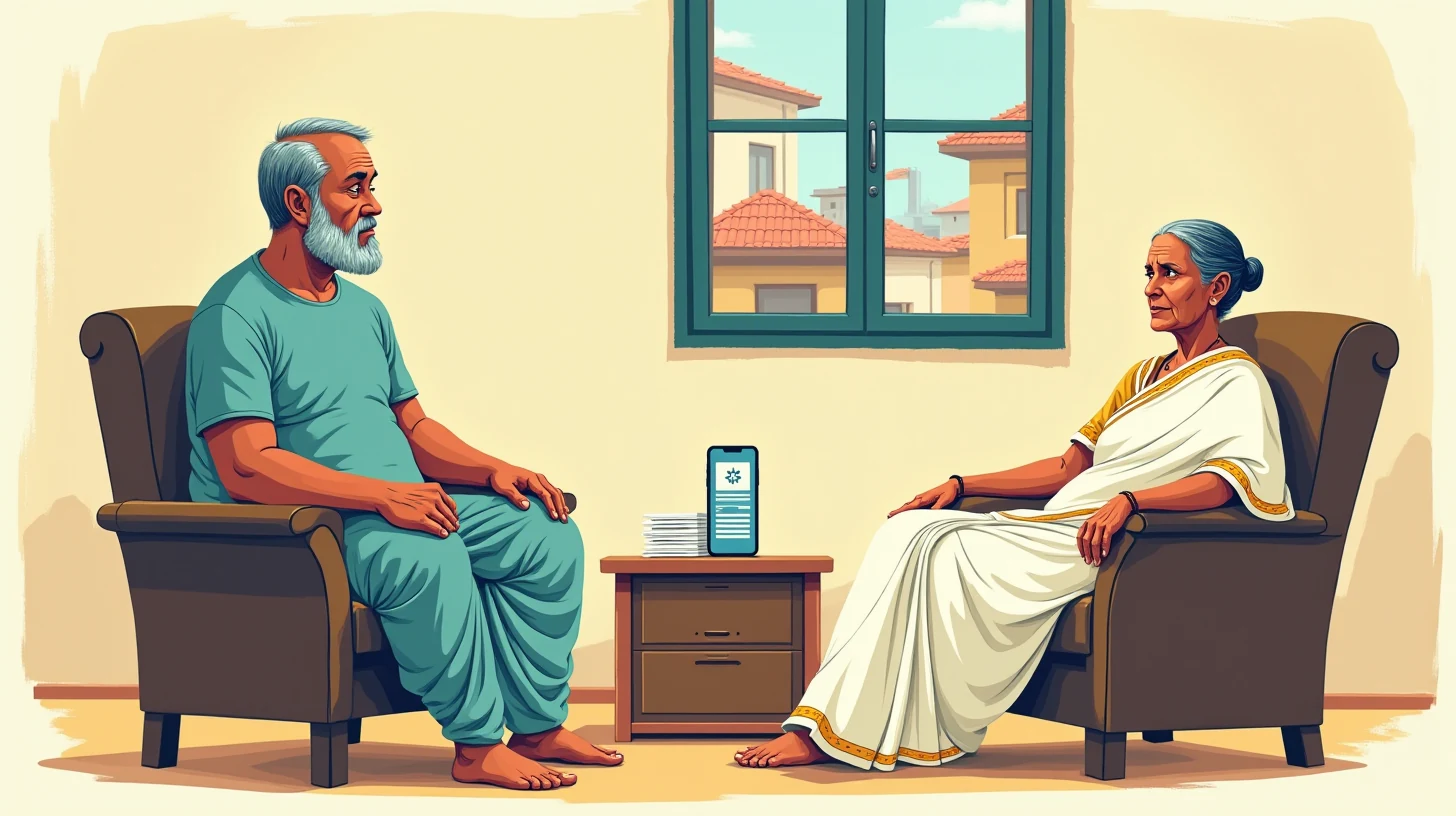
Anand was 42, a school administrator who had moved back into the house in Sector 6 to manage this arithmetic. His mother had died nine years earlier. His sister lived in Bangalore and called weekly but could not come home. So Anand had become the body in the house who kept track of prescriptions, who sat in hospital waiting rooms, who learned to read discharge summaries, and who, in August 2023, began making rounds to government offices with a folder full of forms that said his father might qualify for support—but no office could quite confirm what support meant.
The Mukhyamantri Vishesh Swasthya Sahayata Yojana, or MVSSY, was supposed to be the answer. It promised to cover chronic-disease medication costs for families below a certain income threshold. Rajesh's pension qualified. But the paperwork was distributed across three offices like a puzzle no one had assembled the box for: District Collectorate, where the initial means-test lived; the Mantralaya scheme cell at the state health directorate, where the chronic-care extension was approved; and the hospital's Third-Party Administrator (TPA), which actually dispensed the money. Each office sent him to the next. Each office had a form slightly different from the one he carried. Each office said the delay was not their fault.
By November 2023, four months after the transplant, Rajesh's anti-rejection medication had stopped for two weeks. He had not told Anand at first. When the fever came and Anand took him for an ultrasound, the doctor's face tightened: the kidney was swelling. Too much rejection was happening. They restarted the medication immediately, and it worked again, but the fear in Rajesh's eyes that week did not leave. He had already come back from the dead once. He did not want to do it twice.
This is where the story pivots—not on luck, but on a neighbour and a tablet.
🗓️ The annual ritual: Three offices, one medication
Chhattisgarh's health-support scheme ecosystem had evolved in layers. The Ayushman Bharat-PM-JAY program, the central government's flagship, covered the transplant surgery itself—the intensive care, the surgeon, the blood work. But once Rajesh came home with a new kidney and a prescription, PM-JAY's coverage ended. The ongoing medication, the blood draws, the check-ups: these were chronic care, and chronic care required the state scheme.
The MVSSY was designed precisely for this gap. Launched in 2004 and refined several times since, it offered ₹15,000 to ₹40,000 per family per year for chronic disease management. For transplant recipients, the scheme had a special section: "post-operative chronic-care extension." The extension was supposed to move faster, since it was documented—the surgery happened in a hospital, the diagnosis was clear, the medication list was printed on the discharge papers.
But the paperwork did not move fast. It moved, but through offices that did not speak to each other.
The first stop was the District Collectorate, Social Welfare branch, in Raipur's administrative complex. Here, a social worker verified the income. Rajesh's pension was documented. His house was in his name. He had a ration card—the yellow one, for families above the poverty line but below the creamy layer. The social worker filled out a form: "Applicant seeks support for chronic medication post-kidney-transplant." It was signed, dated, and stamped. The social worker said it would go to the Mantralaya in Naya Raipur.
The Mantralaya is the state secretariat. It is modern, built in the 2010s, with air-conditioned corridors and security guards who check your bag. The scheme cell sits on the second floor. The officer there looked at the Collectorate form and said it was incomplete. The hospital needed to send a separate letter confirming the medication costs and the transplant date. Had Anand approached the hospital's social worker? Anand had not. He was sent back to NICR.
At the hospital, the social worker (a different woman, also kind, also overworked) said the letter would take time—the medical records office had a backlog. She gave Anand a printed sheet with the medications and costs, and said to take it back to the Mantralaya. But when Anand returned, the Mantralaya officer said that sheet was not the letter. The letter needed to come from the hospital on hospital letterhead, signed by a doctor, with the hospital's seal. It took another six weeks. The hospital sent it. The Mantralaya received it. Then—this part Anand learned much later—it went to the hospital's TPA, the Third-Party Administrator, which is the company that actually processes and pays claims on behalf of the scheme. The TPA said it was still missing a form from the district. Round and round.
- ⚖️
April 2023 — Kidney transplant at NICR Raipur
Surgery successful; anti-rejection medication list provided. Discharge papers document the need for ₹38,000/month in tacrolimus and mycophenolate.
- 📋
May 2023 — Anand files at District Collectorate
Social worker confirms income eligibility. Form stamped and sent to Mantralaya scheme cell. Anand told to wait for approval letter.
- 🛑
August 2023 — Hospital letter requested by Mantralaya
Told the Collectorate form is incomplete. Must obtain hospital's medical certification on letterhead, signed by a doctor. Medical records backlog delays this by six weeks.
- 💸
November 2023 — First medication payment (four-month delay)
After TPA verification, MVSSY finally approves ₹38,000 for October and November. Rajesh has already gone two weeks without medication; kidney rejects, fever spikes, ultrasound shows swelling.
This is the annual ritual. Not just for Rajesh. For hundreds of transplant recipients and chronic-disease patients in Chhattisgarh: the paperwork lives in three offices that do not synchronize. A patient can be eligible and still be waiting. A form can be correct and still be called incomplete. The system is not broken—it functions exactly as designed. But the design assumes that the person seeking help can afford to pause their treatment while the offices shuffle papers.
⚠️ The near-miss: Two weeks without immunity
In the second week of November 2023, Rajesh stopped taking his medication. Not because he decided to. Because the bottle ran out, and the pharmacy said the approval from MVSSY had not arrived yet, and he could not afford to buy the full month's supply without it. Anand had ₹5,000 left in an emergency savings account. The medication cost ₹38,000. Anand asked Rajesh to be patient. One more week, he said. The approval letter is coming.
It was not coming. It was moving, but not arriving.
Rajesh became quiet that week. He sat on the verandah looking at the street, eating less. Anand thought his father was depressed and did not at first understand this was a symptom—the kidneys speak to the body before the mind. Without the anti-rejection drugs, Rajesh's immune system began attacking the transplanted organ, mistaking it for a foreign invader. His temperature climbed to 38.4 degrees on a Tuesday morning.
Anand took him to the nearest government clinic first—it was free, and Anand was thinking about money. The clinic doctor took one look and said this was beyond his scope; go to NICR. At the hospital, the ultrasound showed what Anand's fear already knew: the kidney was swollen. The blood work showed rejection markers rising. The nephrologist, Dr. Sinha, was not angry—she had seen this before—but she was firm. "If he does not take the medication today, the organ is at risk. You understand?"
Anand understood. He called his sister in Bangalore. His sister sent ₹40,000 by wire transfer that evening. Rajesh restarted the medication on Wednesday morning. The swelling began to recede by Friday. The fever cleared. The rejection markers dropped. But the near-death was real. Rajesh's face had the look of a man who had been handed back something he thought he had already lost.
The MVSSY approval, when it finally came, was dated November 4th. It arrived on November 15th. By then, Anand had already used his sister's money. The scheme paid ₹38,000 for October and November—but by then, the cost had already been borne somewhere else.
🌗 The pivot: The agent surfaces the hidden pathway
In January 2024, two months after Rajesh's fever, Anand's neighbour, Mrs. Sharma, mentioned in passing that she had used a tablet to help her own father navigate the pension-application process. It was not a person, she said. It was an artificial tablet—a program that knew the government portals.
Anand's first thought was that this sounded like nonsense. But Rajesh needed his medication refilled for 2024, and the MVSSY approval was good only for the previous calendar year. Anand would have to file again. The Collectorate, the Mantralaya, the hospital, the TPA: all again.
He asked Mrs. Sharma for the details. She texted him a link. He downloaded the app on a Wednesday afternoon.
On Thursday morning, Anand sat with the tablet and typed, in Hindi: "मेरे पिता को किडनी ट्रांसप्लांट हुआ है और उन्हें हर महीने दवाइयों के लिए ₹38,000 की जरूरत है। मैं मुख्यमंत्री विशेष स्वास्थ्य सहायता योजना के लिए आवेदन करना चाहता हूँ।" (My father had a kidney transplant and needs ₹38,000 per month for medications. I want to apply for the MVSSY.)
The tablet processed this and returned a sequence of steps:
- File the income-verification form at District Collectorate, Social Welfare branch (address and phone given).
- Once signed, bring it yourself to the Mantralaya Health Scheme cell, or mail it via registered post if mobility is an issue.
- Simultaneously, contact the hospital's TPA directly with the discharge summary and medication list (phone number provided).
- The TPA will request the hospital's certification letter; call the hospital's social work office and cite the TPA reference number so it is expedited.
The tablet also provided the portal URLs, the officer names (publicly listed), and a checklist: what each office needed, in what order. It did not decide anything. It did not fill any forms for Anand. But it showed him the hidden pathway—the one that existed in plain text across three different government websites and phone directories, but which no single office was obligated to explain.
The critical difference was the order. The tablet's sequence told Anand to contact the TPA before, not after, the hospital's letter arrived. This meant the TPA could flag the request in the system and pressure the hospital's medical records office. The hospital did not want the TPA chasing them; the TPA was the entity that paid the hospital. The form moved faster.
It still took six weeks. But this time, the approval came in February 2024, and the first month's payment—₹38,000 for January—was processed by mid-February. Rajesh did not run out of medication. The kidney stayed stable.
Office-by-office answer
4 monthsAnand walked to each office sequentially, filing documents in the order the offices received them. The Collectorate sent him to the Mantralaya; the Mantralaya sent him to the hospital; the hospital sent him to the TPA. Each office processed forms in the order they arrived.
Agent-guided pathway
6 weeksThe agent showed Anand the correct sequence: file at Collectorate, file at Mantralaya, and contact TPA before the hospital's letter arrived. The TPA's involvement moved the hospital records faster because the TPA had leverage—it was the payer.
Cost of the delay
₹40,000 personalFirst cycle: Anand borrowed from his sister during the medication gap. Second cycle: medication arrived on schedule; no gap; no crisis. The difference was not the offices—it was the sequence.
🧭 Why the pathway is hidden, and why ordinary advice fails
A social worker at the District Collectorate would tell any applicant: "It will take time. Bring all documents. Be patient." This is honest, but it is not true guidance. True guidance is the sequence, the pressure points, the leverage that the applicant does not have but the system itself possesses.
Rajesh's problem was not that MVSSY did not exist. It existed. His son was eligible. The medication qualified. But the eligibility lived in three offices, and none of them had any reason to rush. There was no deadline. There was no penalty for Collectorate if the Mantralaya was slow. There was no consequence for the hospital if the TPA was waiting for paperwork. The system was not malicious. It was just parallel.
This is the condition for millions of chronic-disease patients in India: the support exists, but the pathway is fragmented. A well-meaning government officer can explain the scheme, but they cannot mandate that the next office prioritize the file. A caregiver can make the rounds, but they cannot make the rounds in the order that actually moves the system. They have to discover the order by trial and error. By then, a month has passed. By then, a kidney might be swelling.
Most caregivers do not have a tablet to consult. Most do not have a neighbour like Mrs. Sharma who knows that such things exist. Most are like Anand was in April 2023: filing forms in the sequence that the offices tell them, which is not the sequence that moves the offices.
The agent does not make the system faster, in a structural sense. The Mantralaya still takes six weeks to process. The TPA still has a backlog. But the agent compresses the wasted motion—the false starts, the return trips, the visits to offices that do not need the form yet, the waiting in queues for officers who will say "not today." It surfaces the leverage: in this case, the fact that the TPA's involvement could move the hospital's records. It shows the protagonist the hidden sequence that was always there, always legal, always available, but never written down in a single place where a tired son could find it on a Thursday morning.
🌱 The quiet weight
By March 2024, the medication was arriving each month, and the bills were being paid by MVSSY. Rajesh's kidney was stable. His creatinine levels, which had spiked during the fever, came back down. He had gained back some weight. He slept better at night.
Anand still had to renew the approval form every year. The sequence was familiar now. But the first time, without the tablet, he would have fumbled it. His sister would have had to send more money. The kidney might have rejected again. The system was fragile in the way that all systems are fragile when the person navigating them has no map.
The agent did not heal his father. The surgeon did that. The agent did not write the policy or move the government. It simply showed Anand where the cracks were and how to step between them. It showed him that he was not lost; the pathway just needed to be read in a different order.
This is the work of caregiving in a fragmented system: to find the leverage, to move in the right sequence, to know that the office that said "wait" could be made to move if the next office was already waiting. To understand that time is not abstract—it is a kidney swelling, a fever spiking, a sister's emergency transfer, a new mercy squeezed in between bureaucratic delays.
Rajesh has now had his new kidney for three years. Most days, he sits on the verandah with a cup of tea and watches the street. The medication costs ₹38,000 a month, and the MVSSY covers it. He does not think about the paperwork anymore. Only Anand does—once a year, in January, when the renewal form comes due.
"सरकार की मदद तो है, लेकिन पहले आपको खोजना पड़ता है कि मदद कहाँ छिपी है।"— The government's help exists, but you have to find where it is hiding.
"MVSSY के लिए आवेदन करते समय, जिला कलेक्टर के दफ़्तर में पहले फॉर्म दाखिल करें, फिर मंत्रालय में भेजें, पर साथ ही तीसरे पक्ष के एजेंट को भी सूचित करें। यह क्रम महत्वपूर्ण है।"
(When applying for MVSSY, file the form first at the District Collectorate office, then send it to the Mantralaya, but also notify the Third-Party Administrator at the same time. The order matters.)