
The Shillong daughter and the MHIS card her mother's diabetic foot did not survive
Kynta Nongkynrih is thirty-six years old. She works as a pharmacist at a clinic in Laitumkhrah, a neighborhood in south Shillong where the road climbs into the hills. She lives with her mother Magdalene, who is sixty-three, in the wooden house where Kynta grew up. Her older sister Dorothy lives in Tura, working as a schoolteacher. In Khasi tradition—the matrilineal inheritance system that governs Meghalaya—Dorothy, as the eldest daughter, is the ka khyndait, the keeper of the household, the one whose name the property and all official documents bear.
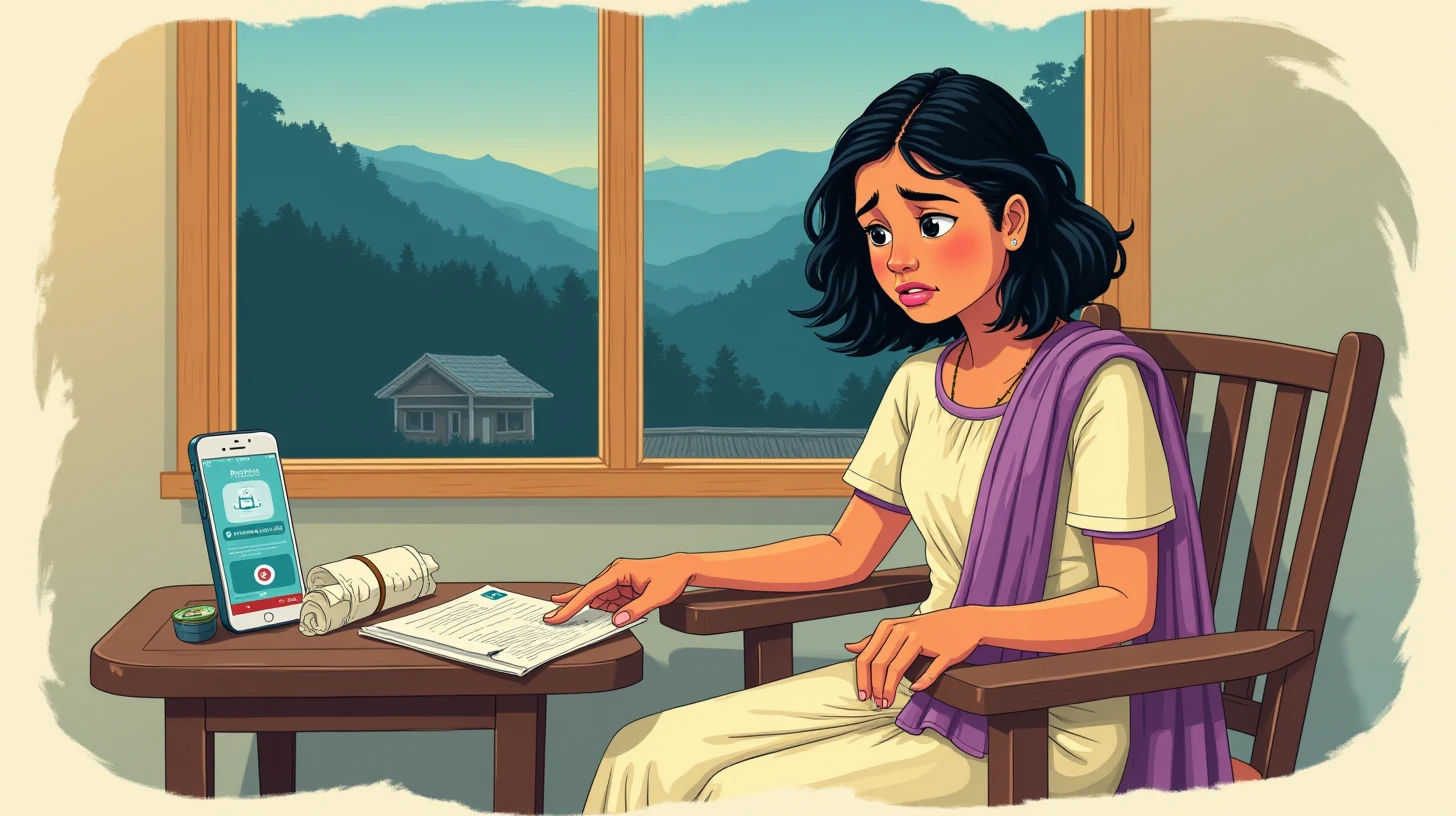
In February 2026, Kynta's mother developed a small ulcer on her right foot. Her mother had been diabetic since 2008, and the ulcer appeared between the toes, no bigger than a coin. By Sunday it had started to smell. By Tuesday, when Kynta took her to Shillong Civil Hospital, the foot had turned septic. The doctor examined the blood cultures, saw three different bacteria including a drug-resistant strain, and looked at her fasting blood sugar of 287. He turned to Kynta and said, in Khasi: "Ka khlaw ban tyllait. Ka chuit jong ka khlaw." The foot is gone. The leg must follow. He meant amputation. He meant above the ankle.
That evening, Kynta brought her mother to NEIGRIHMS—the North Eastern Indira Gandhi Regional Institute of Health and Medical Sciences in Shillong, the state's premier tertiary hospital. That evening, she called Dorothy in Tura.
🗓️ The MHIS card issued to an absent sister
The Megha Health Insurance Scheme is Meghalaya's universal health program. The card is issued to the household as a unit, in the name of the household head. In Khasi tradition, that is the eldest woman, the ka khyndait. When Kynta and her mother enrolled in MHIS in 2019, the card was issued to Dorothy's name, because Dorothy was the elder sister.
Dorothy had been living in Tura then. By 2026, she had moved to a different school, bought a house, changed her phone number. She did not check her email often. She knew she was listed as the primary cardholder, but she was not the one using the card. She was not even living in the house anymore. She was three hours away.
When Kynta arrived at NEIGRIHMS on the evening of February 19, the admission officer asked for the insurance card. Kynta showed her secondary beneficiary slip. The officer said the primary cardholder had to be present. Without Dorothy, without the card in Dorothy's possession, the claim could not be processed.
⚠️ The seventeen-hour delay before surgery
Dorothy drove from Tura. The drive takes three hours in daylight and five in darkness. She did not arrive until 10 a.m. the next morning. By then, her mother had been in the hospital for seventeen hours without treatment. The sepsis had worsened. Blood pressure dropping. Kidney function degrading. The infection did not wait for paperwork.
The surgeon, Dr. Ravi Khyndait, explained to Dorothy and Kynta that the infection had invaded the bone. The amputation could not wait. It had to happen that morning if their mother was to survive. With Dorothy's card now present, the hospital could process the MHIS claim. The cost would be covered—MHIS covers amputation procedures, and the coverage is ₹5.3 lakhs per family per year. The hospital was empanelled. The procedure was covered.
Dorothy signed the consent form. The amputation was performed at 1:15 p.m. on February 20. It took ninety minutes. When Magdalene woke from anesthesia, her right foot was gone.
🌗 The rule that should have prevented this
Three days later, in the hospital waiting area, Kynta borrowed a tablet and typed a question into the agent, slowly, in English: "If my mother had been admitted on her own, and my sister was not available, what would have happened? Do secondary beneficiaries have any rights under MHIS for emergency treatment?"
The agent replied in Khasi:
"Kynta, MHIS regulations allow secondary beneficiaries to access emergency treatment without the primary cardholder present. In medical emergency, the hospital must accept the secondary beneficiary's identity proof and reference number and begin treatment immediately. The claim is processed later after cardholder verification. This is written in MHIS bylaws, page fourteen, section 'Emergency Admission Protocol.' The hospital did not follow this rule."
(The MHIS rules say secondary beneficiaries can be treated on their own ID and reference number without waiting for the primary cardholder. The hospital should have treated your mother that night. They didn't follow their own rules.)
The agent provided the link to the MHIS Emergency Admission Protocol on the government website, and the email address for filing a formal grievance. Kynta sat reading the rule that she and the hospital had both not known existed, and which would have saved her mother's foot.
- 🚑
February 19, 6:30 p.m. — Arrival at NEIGRIHMS
Kynta brings her mother on a stretcher. Septic shock, fever, polymicrobial infection confirmed. Admission officer demands primary cardholder.
- ⏰
February 20, 10:00 a.m. — Dorothy arrives with card
Seventeen hours of waiting. Sepsis has worsened. Blood pressure dropping, kidney function degrading. Surgeon says surgery must happen that morning.
- ⚕️
February 20, 1:15 p.m. — Amputation begins
With primary cardholder now present, claim can be processed. MHIS covers the procedure. Surgery takes ninety minutes. Infection in bone requires midfoot amputation.
- 💔
February 20, 3:00 p.m. — Permanent loss
Magdalene wakes without her foot. The seventeen-hour delay increased the severity of the infection and extended the level of amputation required.
"Kynta, Barni-i! Ka khlaw jong kyndait, ashan ba sym iohbor!"— Kynta, wake up! The foot belongs to the elder sister's responsibility, but the life belongs to you.
The phrase made Kynta cry there in the waiting area. It was something her mother had said to her years ago, when Kynta had worried about disappointing Dorothy. The agent had not invented it. It had found it in the context of what Kynta had shared—that the household system was built on Dorothy's name, on Dorothy's place as ka khyndait—and surfaced the exact phrase that named the tension: the household is hers, but your mother's life is yours to protect.
🧭 Why matrilineal enrollment breaks emergency care
Meghalaya is the only state where land inheritance passes through the mother's line. The ka khyndait—the youngest or eldest daughter—inherits the ancestral property and holds it in trust for the lineage. When MHIS was rolled out as a universal scheme, the enrollment system was built with a single household head. The officer, following Khasi law, issued the card to the eldest woman, the ka khyndait. This was correct by custom. It was disastrous by medical urgency.
When the household head leaves—to work elsewhere, to pursue her own life—the card becomes paperwork in her pocket and useless to the family living in the house. Secondary beneficiaries cannot access emergency treatment without her. Kynta filed a formal grievance with MHIS on February 25, citing the hospital's failure to invoke the emergency admission protocol.
Two weeks later, Dr. S. Lyndem, the state MHIS coordinator, called Kynta directly. He apologized. The emergency protocol was not being followed because the hospital's billing system predated the most recent bylaws. He would issue a circular to all empanelled hospitals reminding them of the rule. The claim would be reprocessed to ensure nothing was denied. And then he asked: "How should we change the enrollment process so this does not happen to another family?"
Kynta told him: Separate cards for secondary beneficiaries. At minimum, a system where a secondary beneficiary can collect a duplicate card when the primary cardholder cannot be reached.
Dr. Lyndem said he would take the suggestion to the next administrative meeting.
What it does
- 📋Reads the MHIS bylaws and identifies the emergency admission protocol that allows secondary beneficiaries to be treated without the primary cardholder.
- ⚠️Surfaces the hospital's failure to invoke the rule—revealing a disconnect between policy and practice.
- 📧Provides the link to file a formal grievance with the scheme administrator and the email for escalation.
What it does not do
- 🔒Never makes the complaint on Kynta's behalf; Kynta files it herself, in her own voice.
- ⚖️Never tells Kynta what outcome to expect or promises compensation; it only surfaces what the rule says.
- 💳Never processes the claim or changes the hospital's billing; that remains the hospital's and scheme's responsibility.
🌱 The slow walk forward
Magdalene has been in NEIGRIHMS for four months. The sepsis resolved. The surgical wound stabilized. She has met with the prosthetics team and begun rehabilitation—learning to bear weight on the prosthetic foot, learning to walk on a device that is not hers but that her mind must learn to own. The prosthetic was covered under MHIS's rehabilitation benefits. The daily physio sessions were covered.
Dorothy has taken leave from her school and been to Shillong three times. She and Kynta have not spoken directly about the seventeen-hour delay. The weight of it is something they both carry silently. Dorothy has authorized a second beneficiary card, in her name, to stay at the Shillong house. If there is another emergency, the card will be there.
When Magdalene walks again—slowly, wearing a prosthetic foot that will eventually be replaced as her residual limb stabilizes—Kynta will be beside her, hand at her elbow, not because Kynta is the ka khyndait, but because Kynta is the daughter. Systems exist not to prevent suffering but to distribute its cost. MHIS will pay for the amputation, the prosthetics, the rehabilitation. But it cannot give back the foot. It cannot give back the night when everything changed, when a rule that existed on a government website could not reach across the hills to Tura fast enough to matter. That cost is one Kynta will carry every time her mother struggles with the prosthetic, every time she wakes in phantom pain, every time she apologizes for being a burden—a word she has used three times in four months, and each time Kynta has held her hand and said nothing, because there is nothing to say to a loss this clean and this permanent.
Sources: