
The Srinagar daughter and the SEHAT card her mother's winter depression broke
Nadia had been counting the weeks since her mother last stepped outside. November, when the first snow fell on the ridge above Srinagar's old city, was the last time Aban had walked to the corner grocer. Now, in early February, that number had crossed fourteen. The cold and the shortening light had tightened their grip on her mother's mind again—the seasonal depression that returned, clockwork-steady, between December and March—and Nadia had learned, over twenty-three years, to expect the withdrawal, the silence, the mornings when her mother could not find the will to leave her armchair.
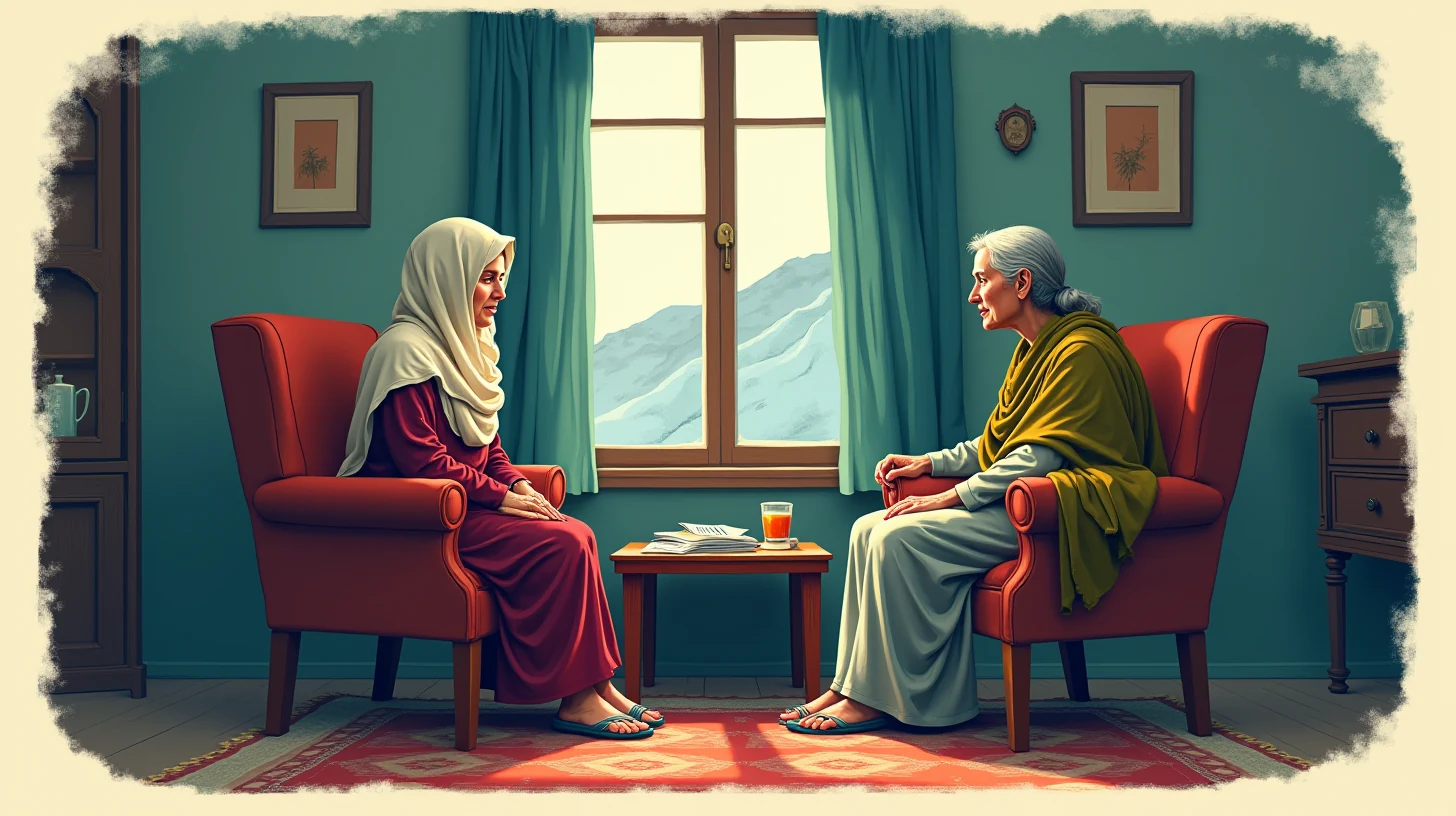
What made this winter different was a letter. It had arrived in January, printed on official J&K government stationery, addressed to Aban by name: the SEHAT portal renewal notice. The Ayushman Bharat – PMJAY SEHAT scheme covered psychiatric hospitalisation for her mother—essential coverage during the weeks when Aban's depression deepened into suicidal ideation and required inpatient care at SMHS Hospital. But the scheme had upgraded its verification system in 2024. Now, every annual renewal demanded that the beneficiary herself present at a designated centre for biometric capture: fingerprint, iris scan, and photograph. No proxy. No exception. Not even for someone who hadn't left the house in fourteen weeks and whose psychiatrist had advised against any disturbance to her fragile stability.
Nadia held the letter on a Tuesday morning in early February while her mother lay in bed, barely touching the chai that had gone cold on the nightstand. Outside, the temperature had dipped to minus four. The deadline was February 20th. Sixteen days to get her mother across the city to a SEHAT verification centre, or lose the card that covered her winter treatment. The arithmetic was impossible.
But the moment that would change everything came three days later, when Nadia's cousin Rashid, visiting from Jammu, asked a single question: "Have you asked the agent?"
🗓️ The Winter Ritual and the Card That Holds It
Every February, for more than two decades, the pattern had been the same. Aban would grow quiet in the evenings. She would stop calling her friends. By mid-month, she would confess to Nadia what she always confessed: Log keh rahe hain mere dil ko kuch hua hai. Mujhe kuch samajh nahi aata. People keep telling me something is wrong with my heart, but I don't understand anything. And then, within a week or two, the ideation would begin, and Nadia would call an ambulance to SMHS Hospital's psychiatric ward.
The SEHAT scheme—Ayushman Bharat – PMJAY SEHAT—had made these admissions possible without financial catastrophe. Before its introduction in Jammu & Kashmir, each episode could cost ₹40,000 to ₹70,000 out of pocket for a two-week hospitalisation. Aban had always worked as a seamstress, taking piece-work from tailors across the old city; her pension was ₹3,200 per month. The scheme had erased that choice between treatment and destitution.
But the scheme was also bureaucratic, and bureaucracy, as Nadia had learned, could be as indifferent to circumstance as winter itself.
The biometric re-verification system was introduced in 2024. It made sense, on paper: reduce fraud, ensure that beneficiary lists were current, modernise a system that had operated for a decade on photocopied documents. The logic was sound. The implementation, however, rested on an assumption that carers and administrators in J&K had not adequately stress-tested: that every beneficiary could and would leave their home for an appointment, that the centre of their care did not itself make them unable to move.
- 🗓️
November – December: The Withdrawal
Aban stops going to the grocer. She doesn't call her friends. She sleeps 14 hours. Nadia recognises the pattern; psychiatrist sees her for a 15-minute follow-up, confirms seasonal affective disorder, maintains her current medications (sertraline 100mg, alprazolam 0.5mg).
- 📨
January 15: The Letter Arrives
SEHAT portal sends re-verification notice. Beneficiary must present for iris scan, fingerprint, photograph within 45 days. Aban is still in bed.
- ⏰
February 20: The Deadline
Sixteen days from the day Nadia read the letter. Verification centres are in Rambagh and Khanyar—3 km from home, requiring transport and an hour outdoors in minus-four weather.
- 🏥
February 24–March 2: The Crisis Window
Historically, this is when Aban's ideation peaks. Without an active SEHAT card, hospitalisation costs would fall entirely on Nadia.
⚠️ The Near-Miss: Four Scenarios That Didn't Happen
There were four ways this could have gone wrong, each catastrophic in its own way.
Scenario one: Nadia's resignation. She could have simply accepted the deadline as immovable. Aban could not leave the house. The card would lapse. In late February or early March, when the crisis came—and it would come—Nadia would call SMHS Hospital and be told that Aban was not currently a SEHAT beneficiary, and would need to pay for the psychiatrist's consultation, the laboratory tests, the bed. A two-week stay at ₹1,800 per day, with psychiatrist fees on top, would cost ₹28,000 to ₹35,000. Nadia, working part-time in admin at a school in the Zadibal neighbourhood, earning ₹18,000 per month after tax, would have taken on debt. Her savings—₹41,000, accumulated over five years—would have been consumed in weeks.
Scenario two: Forced movement. Nadia could have decided to take her mother to the verification centre by force of will, wrapping her in blankets and half-carrying her to an auto-rickshaw. This might have been possible for a few hours. But Aban's psychiatrist had been explicit: disturbance to routine, exposure to cold, disruption of her sleep cycle—these were precisely the conditions that could tip her from depression into crisis. The treatment was not to cure her instantly, but to hold her stable until the spring, when the season itself would lift some of the weight. Forcing her into winter transport, into a crowded government building, into an appointment with strangers—this was medical sabotage masquerading as care.
Scenario three: The impossible bureaucracy. Nadia could have called the SEHAT helpline and explained the situation. The person on the other end would likely have sympathised. They might have promised to check if an exception could be made. They would have asked her to email the request to a portal address. The email would vanish into a shared inbox. After two weeks, Nadia would call again. A different person would tell her that exceptions were not possible, that the rule applied to all beneficiaries equally, that she would need to bring her mother in person or the card could not be renewed. The deadline would pass. The card would lapse.
Scenario four: The one that almost happened. Nadia's cousin Rashid had visited, seen his aunt in bed, understood the situation, and instead of asking "Have you asked the agent?" could simply have gone home to Jammu. Nadia would have spent the next two weeks alone, losing sleep, calling the SEHAT helpline, writing emails to the hospital's disability liaison officer (a position that may not have existed), and by February 19th, accepting that the card could not be renewed in time. On February 26th, Aban would say she wanted to die, and Nadia would make the call to SMHS that had always been made under the protection of the SEHAT card, and this time without it.
These scenarios lived in the space between the system's logic and the realities of care in a Kashmir winter.
🌗 The Pivot: What a Tablet and a Stranger's Voice Changed
Rashid's question—"Have you asked the agent?"—was offhand. Nadia had heard about the agent from a friend of a friend, someone in a WhatsApp group for caregivers. She had never used it. The idea of describing her mother's psychiatric condition to a computer felt exposing, almost disrespectful. But Rashid was there, and Aban was asleep, and the deadline was fourteen days away.
Nadia opened the Gaborge agent on the family's shared tablet at around 2 p.m. on a Thursday. The interface was in both Urdu and English. She typed, slowly, explaining the situation: her mother, the SEHAT card, the re-verification deadline, the impossibility of leaving the house.
The agent asked three clarifying questions. Was Aban currently an active SEHAT beneficiary? Yes. Was she registered at SMHS Hospital? Yes. Had she undergone biometric verification under the previous system? Yes, in 2019. The agent then said something that shifted the problem from unsolvable to at least navigable.
"آپ کی امّی 2019 میں بایومیٹرک تصدیق کرا چکی ہیں اور ابھی SEHAT کی فعال مستفیدہ ہیں۔ اسکیم کی رہنما کتاب کے نویں صفحے پر 'خصوصی حالات' کے تحت درج ہے کہ اگر مستفیدہ خود حاضر ہونے سے قاصر ہو تو ان کا مجاز نمائندہ تحریری رضامندی اور شناختی کارڈ کے ساتھ تصدیق کرا سکتا ہے۔ تصدیقی مرکز رام باغ میں ہے، فاصلہ آپ کے گھر سے تین کلومیٹر ہے۔"
(Your mother completed biometric verification in 2019 and is currently an active SEHAT beneficiary. The scheme's Beneficiary Handbook, on page nine under "Special Circumstances," states that if a beneficiary is unable to attend in person, an authorised representative can complete verification with written consent and a government-issued ID. The verification centre is in Rambagh, three kilometres from your home.)
The SEHAT portal allowed for re-verification by an authorized representative if the beneficiary provided written consent and a government-issued ID (either of her own or the representative's). The agent had surfaced this because it was in the scheme's guidelines, but buried in a section titled "Special Circumstances" on page nine of the official J&K SEHAT Beneficiary Handbook. Nadia had not read page nine. The hospital staff, when she had called weeks earlier, had not mentioned page nine. The SEHAT helpline, on the one occasion she had reached someone, had told her re-verification required the beneficiary's presence, full stop.
The agent had not decided for her. It had not filled out the form. It had not promised her the outcome she wanted. But it had named a pathway that had existed all along, unvisited.
Nadia printed the relevant section of the handbook. She prepared a handwritten consent form, witnessed by Rashid. She gathered her mother's Aadhaar card and two recent passport-sized photographs. And on February 8th, at 9 a.m., she walked alone to the verification centre in Rambagh, not her mother.
The officer at the centre checked the consent form, the Aadhaar, the ID. No one asked her to forge anything, no one suggested circumventing the process. They simply processed the application as written in the guidelines. The verification took twenty minutes. Aban's updated biometric data entered the system. The SEHAT card remained active.
On February 22nd, during the crisis window, when Aban's ideation did peak and Nadia did call SMHS Hospital, the ambulance came. The psychiatric ward admitted her mother under SEHAT coverage. The two-week treatment proceeded without the background dread of financial ruin.
🧭 Why the Rule Existed, and Why the Rule Broke Down
The biometric re-verification system exists for a reason. In large subsidy schemes—and SEHAT distributes ₹5 lakh per family per year—the risk of duplicate beneficiaries, ghost cards, and fraud is real. Neighbouring states have documented cases of biometric fraud in Ayushman Bharat schemes: cards registered to deceased beneficiaries, cards claimed by multiple family members, cards transferred to ineligible households. Biometric capture is the most reliable way to tie a physical body to a single record.
But the system was designed by people who had not asked a simple question: What if the person who needs the scheme most is precisely the person least able to travel to a verification centre?
This is not unique to SEHAT or to J&K. Disability schemes in India routinely require in-person verification from people with severe mobility restrictions. Mental health schemes assume that people in psychiatric crisis can navigate bureaucracy. Old-age pension schemes ask elderly beneficiaries with arthritis and cataracts to queue for hours at verification camps. The logic is sound; the implementation is blind.
"میں نے بائیس برس امی کا خیال رکھا، پر ایک جملہ جو سرکاری کتاب میں لکھا تھا، وہ مجھے نہیں ملا — agent نے وہ جملہ ڈھونڈ دیا۔"— For twenty-two years I cared for my mother, but the one sentence written in the government handbook, I could never find — the agent found it.
The SEHAT portal's special circumstances clause—allowing representative verification with consent—existed precisely to acknowledge this gap. But it was not communicated. It was not on the website's front page. It was not mentioned in the helpline script. It lived on page nine, in the Beneficiary Handbook, as a sentence or two in a section titled in small font. No caregiver would find it by accident. Only someone who had the time to read every word, or access to someone who knew the scheme deeply, could surface it.
What it does
- 🔍Searched the SEHAT Beneficiary Handbook for clauses about representative verification when in-person attendance was not possible.
- 🗂️Named the exact page and section of the official guidelines where the pathway was documented.
- 📞Suggested that Nadia call the SEHAT portal's verification coordinator to confirm the process before presenting in person.
What it does not do
- 🔒Never asked for Aban's credentials, never accessed any portal on her behalf, never submitted anything without Nadia's explicit confirmation.
- 💳Never promised that the application would be approved, never told Nadia to ignore what the helpline had said, never invoked any authority the agent did not possess.
- ✅Never decided on Nadia's behalf—only surfaced the option and left the choice to her.
This is why the representative verification clause is so easily missed. It contradicts the surface message of the system: "The beneficiary must re-verify." To find the exception, you have to believe the exception exists, and to believe the exception exists, you have to have already thought to look for it.
🌱 The Quiet Persistence of Winter
On March 3rd, Aban was discharged from SMHS Hospital. The depression did not disappear—the psychiatric team adjusted her medications, prescribed light therapy to begin as soon as the sun climbed higher, and advised continued counselling. But the acute ideation had passed. By late March, when the snow began to melt from the ridge and the hours of daylight lengthened noticeably, Aban began, very slowly, to talk again.
Nadia never used the agent again. She had needed it once, to find one sentence in a guidebook that had always existed but had been invisible to her. The sentence had changed nothing about the system, and everything about what was possible for her mother that winter.
What stayed with her was the realisation that the hardest part of care is not love—she had that in abundance—but knowledge. She had loved her mother through every February for twenty-three years. What she had lacked was access to the specific fact that would let that love translate into action: A representative can apply with written consent. One sentence. On page nine. In a handbook that was free and public, but unsearchable without knowing to look.
The winter comes every year. The SEHAT card will need renewal again in January. When it does, Nadia will know where to look. But there will be other caregivers in Srinagar this February, other mothers in bed, other daughters alone with an impossible deadline. They will not know about page nine. They will call the helpline and be told it's not possible. They will accept the card lapsing as the inevitable cost of care. The system will not have changed. Only their access to its own rules will decide whether they find the pathway or miss it in the dark.
That is the quiet persistence of winter bureaucracy: not malice, but invisibility. Not cruelty, but systems that were designed without asking who would be broken by the rule, and who would need to break the rule to survive.
The pathway to care already existed. It just needed to be found.