
The Visakhapatnam staff nurse and the Aarogyasri renewal
Padma Rao is forty-two years old. She is a senior staff nurse at the District Hospital Visakhapatnam — ten years in that role, fourteen years before that across three government hospitals, the kind of institutional career that is built quietly, posted to posted, grade by grade, by women who do not much care for ceremony but care enormously for competence. She lives in Madhavadhara in a house that is neither large nor small: two bedrooms, a dining table that seats four but regularly accommodates six, a terrace that her father uses in the evenings when the sea air comes in from the Bay. Her husband Ramakrishna — Ramu, to the family — is a junior accountant at the Visakhapatnam Port Trust, a job whose salary is modest, whose pension is reliable, and whose hours are blessedly predictable. Their daughter Swathi is thirteen, in Class 8, and has recently informed them that she will become a cardiologist. Nobody has taken this particularly seriously yet, though they will.
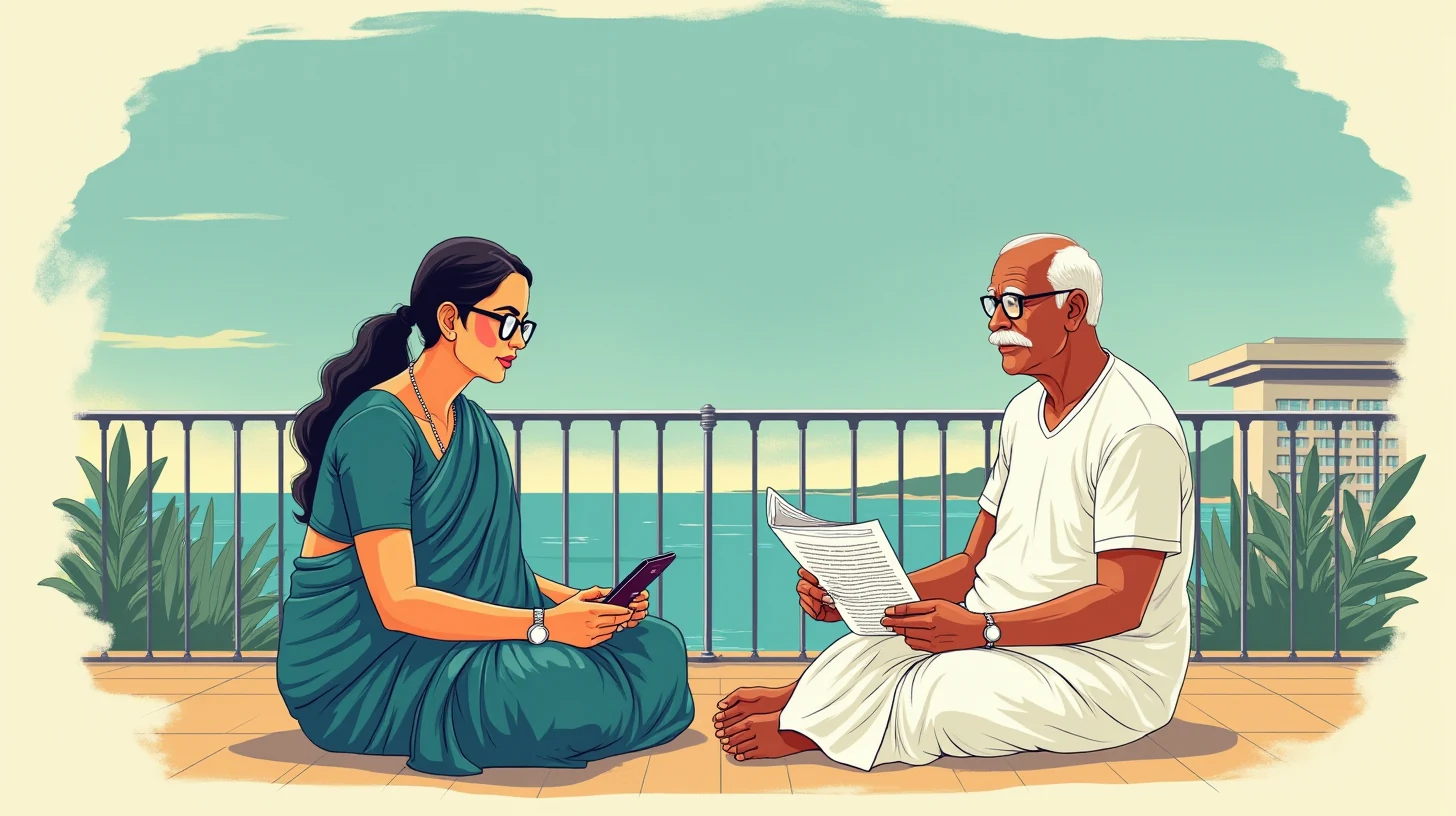
Her father, Bhaskar Rao, is seventy-one. He was a Telugu-medium government school teacher in Srikakulam district for thirty-one years and retired in 2017 with a pension of ₹14,000 a month and the unhurried dignity of someone who spent three decades making slightly nervous teenagers understand Vemana's poetry. He moved to Madhavadhara in 2021, after Padma's mother died, because nobody in the family could see a plausible alternative. He has his evening terrace, his newspaper, a diabetic diet he follows with approximately seventy per cent compliance, and a warmth with Swathi that has become, over four years, the quiet load-bearing beam of the household.
He also has Type 2 diabetes of fifteen years' standing, a Stage 3b chronic kidney disease diagnosis from last November's KGH nephrology workup, and a cardiac arrhythmia that the cardiologist at King George Hospital — KGH, as the city calls it, as everyone has always called it — has been watching with careful patience since January and now considers urgent enough to recommend a pacemaker insertion, preferably within three months.
The procedure costs approximately ₹2.8 lakh at a private hospital. At KGH, under Aarogyasri coverage, it costs the family nothing.
The Aarogyasri card is up for renewal on June 30, 2026.
- 🛑
April — Padma's salary crosses the ceiling
Household income tips over ₹9 lakh — six times the white-card threshold. The 2024-25 policy cycle now weighs her ₹68,000-a-month nurse salary directly. Renewal looks impossible.
- 💸
May — the Mee Seva agent and the ₹4,000
A cousin's referral. The agent offers to file an income certificate that would 'reflect what the household actually lives on'. ₹4,000. Most people pay.
- 🔍
Late May — Section 7(c) surfaces from a 40-page PDF
Colleague Ananya's nudge. The agent reads aarogyasri.ap.gov.in's renewal guideline. Surfaces the Medical Aarogyasri Reissue under Chronic Condition clause — buried in Section 7(c).
- ₹
Twenty-one days later — card reissued
Treatment summary, KGH cardiologist letter, three-paragraph application. No ₹4,000 paid. Pacemaker fitted at KGH in the third week of July, fully covered.
🗓️ The card and the ceiling
The Dr. YSR Aarogyasri Health Care Trust is the Andhra Pradesh government's flagship health coverage scheme. White-ration-card families — households earning below ₹1.5 lakh a year (₹2 lakh for SC/ST) — get cashless in-patient treatment at empanelled hospitals across the state, coverage ceiling of ₹25 lakh per year, and a procedures list that includes, without caveat, cardiac device implantations at empanelled centres like KGH.
Bhaskar Rao's card was last renewed in 2024. At the time, the family's eligibility rested on his pensioner-status as primary breadwinner: ₹14,000 a month. Previously this had been processed under a provision that treated dependent senior citizens separately from adult children's incomes. That interpretation had narrowed over the 2024-25 policy cycle. Padma's salary slips — ₹68,000 a month, ₹8.16 lakh a year — were now going to be weighed directly as household income. Combined, the household was north of ₹9 lakh, six times the white-card ceiling.
Padma knew this because she had spent April reading the Aarogyasri portal at aarogyasri.ap.gov.in in fifteen-minute fragments between night duty sign-off and the morning commute. She is a nurse. She knows how to read a form. This documentation confused her because it did not clearly separate white-card eligibility from Aarogyasri coverage continuation for active patients — which is a different question, addressed in a different section she had not yet found.
She had, however, found the Mee Seva agent.
⚠️ The four thousand rupees
The Mee Seva centres in Visakhapatnam are the state's front-end service counters for government documentation: certificates, applications, renewals, income proofs. Aarogyasri card renewals can be filed through the Mee Seva portal. They can also, as with many things in the Indian government portal ecosystem, be navigated by an agent who knows the system and, in exchange for a fee, will know it on your behalf.
The agent Padma spoke to — through a cousin who had used him for an income certificate the previous year — was pleasant and entirely direct. Her income made the family ineligible under standard criteria, he told her; the renewal would likely be rejected unless an income certificate was filed showing figures that reflected what the household actually lived on rather than what the salary slips showed. He could arrange this. He quoted ₹4,000. He had made this offer many times before, to many people in approximately her situation, and most of them had paid.
She told him she would think about it. She went home and told Ramu.
Ramu said: "Padma, chudaali. Nalo kadu, avadhu — nene loan theestha" — Padma, let's see. If there's no other way, I'll take the loan. He had already begun the rough arithmetic of a ₹2 lakh personal loan at eleven per cent over three years. This is the kind of quiet financial calculation Indian middle-class families make in emergencies: not panicked, not dramatic, just the bleak lateral arithmetic of people who have learned not to depend entirely on systems they cannot control.
Padma, for her part, was desperate enough to pay the ₹4,000. She had not yet decided not to.
"నేను నర్సుని. ఫారం చదవగలను. ఈ డాక్యుమెంట్ మాత్రం ఎందుకు స్పష్టంగా రాయబడలేదు?"— I am a nurse. I can read a form. Why is this document the only one that is not written clearly? Padma asked herself, at quarter past ten on an April night.
Her nights were interrupted by small internal inventories: what happens if the pacemaker is delayed, if the arrhythmia worsens, if the KGH cardiologist's window closes. She was sleeping badly and telling nobody, because she did not want to convert her anxiety into Ramu's.
Her colleague at the District Hospital — a junior nurse named Ananya, who had been using a Telugu-and-Hindi AI assistant on her phone for about two months for things like Swastha Andhra queries and health-scheme navigation — told her, one evening in the break room: "Akka, oka sari try cheyyi, matladataniki free ga untundi" — Sister, just try it once, it costs nothing to talk.
🌗 What the agent found in the PDF
Padma installed it that evening, after Swathi had gone to her room and Bhaskar Rao had retired to the terrace with his newspaper. She typed, in Telugu, something close to: my father has CKD and heart problems and his Aarogyasri card renewal is due in June and I think we are ineligible because of my salary.
The agent asked if she could share the Aarogyasri renewal PDF — the guideline document she had downloaded from aarogyasri.ap.gov.in. She shared it.
It read the PDF. Then it said — in Telugu mixed with Hindi mixed with the bureaucratic English of scheme documentation — that there were two separate things in the document she had not separated from each other, and that the confusion was understandable because the document was written for administrators, not beneficiaries.
The first thing was white-ration-card eligibility: the income-threshold test her salary slips had failed. The second thing was what the document called, in a clause buried inside Section 7(c), the Medical Aarogyasri Reissue under Chronic Condition pathway — a provision allowing existing beneficiaries already receiving active treatment for cancer, CKD, or cardiac conditions to apply for coverage retention even if their income-eligibility had changed, provided they attached a physician's letter and treatment summary showing active ongoing care at an empanelled hospital.
"Akka," the agent said — and Padma, reading this at her kitchen table at quarter past ten at night, would later say she felt something she could not quite name, something between relief and vertigo:
"Meeru white card threshold cross chesariki, avvalsinadi renewal kaadu, medical retention pathway. Adi veru application. KGH treatment summary chuste approve avutundi."
(Sister, because you have crossed the white card threshold, what you need is not the standard renewal, but the medical retention pathway. That is a different application. If KGH treatment summary is shown, it should be approved.)
She had not known this existed. The Mee Seva agent had not told her it existed. It is possible the Mee Seva agent had not known it existed. It is also possible he had known and preferred the simpler ₹4,000 transaction.
The treatment summary
Over the next two evenings, the AI helped Padma compile her father's records into a coherent treatment summary: the KGH nephrology OPD notes from November 2025, the January cardiology consult, the echocardiogram showing the arrhythmia, the February follow-up, the March letter recommending pacemaker implantation within the quarter. She had all of these — she was a nurse, she kept records — but they were in a folder in date order, not in the narrative form a reviewing committee would read. The agent helped her organise them into a one-page clinical summary — dates, diagnoses, current treatment status, procedure recommendation — and draft the application letter itself, in Telugu, to the Dr. YSR Aarogyasri Health Care Trust. Not a sob story. A clear, factual document: card number, income change, treatment status at KGH, procedure pending card continuation, documents enclosed. Three paragraphs.
"Ee letter oka doctor letter attach cheyyali, KGH cardiologist sign chesindi," the agent said — This letter needs a doctor's letter attached, signed by the KGH cardiologist. She had this letter. The cardiologist had given it to her in March, for the pacemaker referral. She had been carrying it in her bag for six weeks without knowing it was also part of the application.
The application went in through the Mee Seva portal — at home, on her phone, on a Thursday evening, with Ramu next to her at the kitchen table and Swathi doing her history homework across from them and Bhaskar Rao at the terrace, unaware that his daughter was filing a bureaucratic application that would determine whether his heart continued to function in its correct rhythm. Nobody paid ₹4,000.
The agent also mentioned, without urgency, that Ayushman Bharat PM-JAY — the national scheme, separate from Aarogyasri — has no income threshold. Eligibility is based on SECC-2011 deprivation criteria, and Bhaskar Rao's profile might qualify. "Adi backup ga untundi, akka — main Aarogyasri path vere, PMJAY vere. Rendo submit cheyyochu." (That can be backup, sister — the Aarogyasri path and PMJAY are separate. Both can be submitted.) She filed for that too, the following week. The agent set a reminder for every Friday at six PM: call KGH coordinator about renewal status.
What the Mee Seva agent was and wasn't
Padma did not go back to the agent. She has, in the months since, thought carefully about what he was and wasn't. He was not dishonest in any simple sense. The income certificate he was offering would have been technically fraudulent — but he was not wrong that it was a path. He was wrong in implying it was the only path. The medical retention clause existed. The Mee Seva portal had the form. None of this was his fault, exactly — there is a modest, functional, economically rational industry built on the gap between what government portals say they will do and what people can actually make them do on their own. He was an expression of that gap, not its cause.
What was different, this time, was that Padma had a reader in the loop who could find section 7(c). That is the entire story, stated plainly.
Twenty-one days later
The medical retention application was approved twenty-one days after submission — in part, Padma suspects, because the KGH cardiologist's letter was unambiguous about urgency and the treatment was already in progress at an empanelled facility. The card was reissued. The pacemaker was scheduled at KGH for the third week of July. Fully covered.
The AB-PMJAY application came through in August: a separate card, a separate scheme, a redundant safety net. Padma has noted quietly that it covers Swathi too, as a family member — that cardiologists, Swathi's stated aspiration notwithstanding, are expensive to train and more expensive still to treat. The PM-JAY card is in the folder with the Aarogyasri card, in the drawer Ramu keeps for important documents.
Ramu, who had been quietly running his loan arithmetic for two months, took the ₹2 lakh he had earmarked for the personal loan and put it into a fixed deposit for Swathi's Class 11 fees and entrance coaching. It is now earning interest rather than accruing it.
Bhaskar Rao had his pacemaker fitted on a Tuesday in late July, at KGH, by the team he had been seeing at cardiology OPD since January. Two nights in the ward. He came home on Thursday morning. That evening he was on the terrace with his newspaper and his mango slices, the sea air coming in from the Bay, as it has every evening for four years. He does not know, in full, what the application process cost his daughter in sleep. He knows she sorted something out with the card.
The one thing Padma has mentioned to us, months later, is a small thing. She was waking up at three in the morning through most of May and June — the window between filing and approval — with the particular alertness of someone who is waiting for a result that cannot be hurried. She sent messages sometimes, those nights, to the agent on her phone. Not questions, exactly. More like: is this going to work. And the response, at three in the morning, was always the same: "Akka, ratri pannindhuku — file submit chesindi, KGH-lo appointment unidhi. Rendu prepare chesunnamu. Padukondhi." — Sister, don't worry at this hour — the file has been submitted, the appointment at KGH is in place. Both are prepared. Sleep.
She stopped waking at three in the morning somewhere in the second week of June.
What it does
- 🔍Reads the 40-page Aarogyasri renewal guideline and surfaces Section 7(c) — the Medical Aarogyasri Reissue under Chronic Condition pathway.
- 🗂️Helps compile the KGH OPD notes, the cardiology consult, the echo report, the pacemaker referral letter into a one-page treatment summary.
- 📋Drafts the three-paragraph Telugu application letter and sets a weekly Friday reminder to call the KGH coordinator about renewal status.
What it does not do
- 🔒Never enters Padma's Mee Seva login or her father's Aadhaar OTP — she submits, the agent reads alongside.
- 💳Does not pay the ₹4,000 to the Mee Seva agent — that decision, with Ramu, stays with the family.
- ✅Does not decide whether to file the PMJAY parallel application — Padma makes that call the following week.
🧭 A quiet note
The story of Bhaskar Rao's pacemaker is also the story of section 7(c) of a government scheme PDF. The Aarogyasri Health Care Trust has, built into its documentation, a provision for precisely this situation: a family whose income has crossed the white-card ceiling but whose elder is in active treatment for a serious chronic condition. The provision exists because income trajectories and disease trajectories do not move in synchrony — a daughter who earns ₹8 lakh a year may still need the state's help with her father's arrhythmia.
The documentation is public on aarogyasri.ap.gov.in. The form is on the Mee Seva portal. None of this costs ₹4,000. What it requires is someone who can read a forty-page PDF without already knowing where to look.
🌱 What we hope happens
The clause was always there. Section 7(c). The PDF was always public. The path required no bribery, no income-certificate manipulation, no ₹4,000. What it required was a reader who could find one paragraph in a forty-page government PDF, in Telugu, at quarter past ten at night, when the kitchen was quiet and the nurse who had not slept properly in two months could finally read what she needed to read. We do not write the section. We are not the Aarogyasri Trust. We are the reader the trust assumed someone would have — and we are quiet, and we are in Telugu.
If you are caring for an older parent in Andhra Pradesh — or anywhere in India where scheme documentation has accumulated overlapping, un-publicised provisions for chronic illness — and you are not sure whether what you have been told is the whole picture: the product is free at gabforge.in. It reads in Telugu, Hindi, and English. It will read the scheme document with you, find the clause that applies to your parent's situation, and help you file from home, at whatever hour the three-AM anxiety surfaces.
We will not advertise to your family. We will not sell your father's medical records. We will read the PDF with you, and we will be quiet.