
The startup funding stalled. Then HAL called.
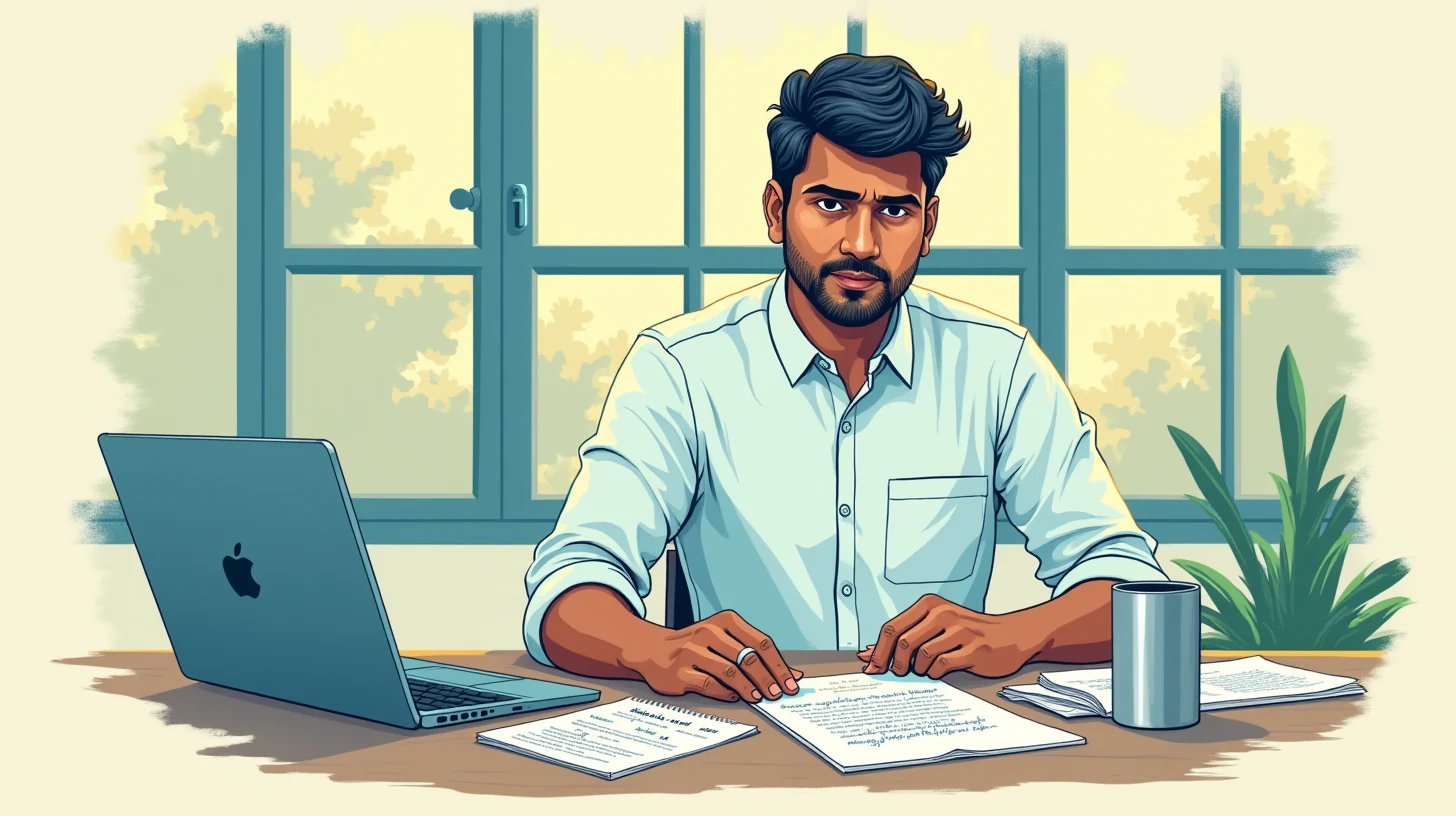
💻 Arjun Reddy, 34, was a software engineer at Google for four years, making ₹38 lakhs per year. In August 2024, his contract ended. He joined Mitra Payments, a Series B fintech startup, with the same salary and 1.2% equity. His home loan EMI is ₹60,000 a month. His daughter Avni is twelve. He had never seriously considered a government job until the Series C funding stalled.
🚨 The problem
In March 2026, Mitra Payments' Series C fundraising hit a wall. The investor narrative shifted from "formality" to "taking longer than expected." The team had nine to ten months of cash runway at current burn (₹70 lakhs per month) — maybe twelve months if they cut headcount by 20%. The 20% cut was coming. On the same week Ravi announced "unit economics clarity," Arjun received two notifications: ISRO was hiring, and HAL's Bangalore division posted a Systems Engineer role on the LCA Tejas program — ₹96 lakhs base salary, a defined-benefit pension of 50% of last drawn salary for life, and zero layoff risk.
🚀 How GabFORGE helped
Arjun's wife Priya opened the agent and asked a question in Kannada: "If Mitra fails, how much does Arjun lose over 25 years versus taking HAL and walking a slow but guaranteed path?" The agent calculated three scenarios:
- 🔍 If Mitra succeeds: ₹30–36 lakh equity gain, total 25-year income ₹95–110 lakh. No pension.
- 💸 If Mitra fails: 18 months job-search, ₹9 lakh severance loss, next role 15–20% lower salary. Total 25-year loss: ₹50–60 lakh.
- 🏛️ If HAL: ₹288 lakh base salary over 25 years plus ₹144 lakh pension (50% last drawn, for life). No uncertainty. Total guaranteed: ₹432 lakh.
The agent flagged the timeline collision: HAL application deadline May 31, Series C closure uncertain, both decisions arrived the same month. Arjun rewrote his statement of purpose that night: "I am applying to HAL not for growth — I know the growth is limited — but for certainty. I have a daughter entering her teenage years, and a home loan that requires a calendar of income, not a timeline." He submitted it on May 3, 2026.
On May 12, HAL confirmed receipt. On May 14, Arjun received a call: he was shortlisted. Interview scheduled June 3, 2026. He called Priya from the Mitra parking lot. She asked: "What are you going to tell Ravi?" He did not answer. Both futures were now synchronous — a HAL interview and a Series C collapse arriving in the same month.
🇮🇳 Why this matters
Bangalore has 1.7 million software engineers. A cohort of 30–40% have experienced layoffs, have dependents and debt, and are watching startups oscillate between euphoria and collapse. Few know that HAL, ISRO, and government roles are open. Fewer have someone in their circle who successfully made that transition. The choice is real — not between free-fall and death-spiral, but between a compound with no floor and a floor with no ceiling.
The long version has the two-column chart Avni drew, the Figma whiteboard marked "ISRO pension calc," the moment Priya saw the numbers, and the four-minute call from HAL that made two futures synchronous.