
The Port Blair jetty engineer and the 2004-tsunami legacy
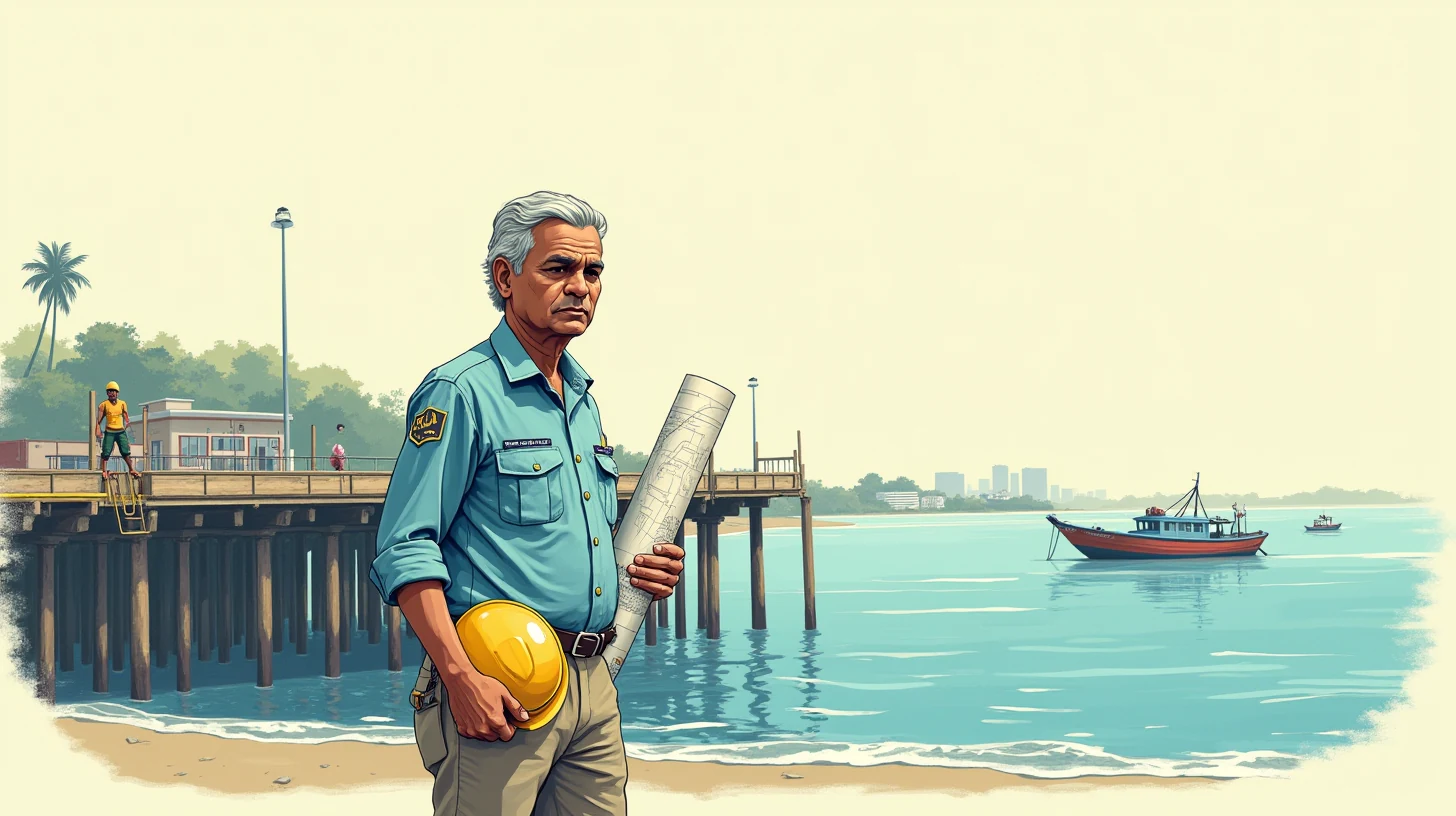
🏗️ Rajesh Pandey, 46, lives in Port Blair, CPWD quarters on Munda Pai Road. For 23 years he has built and rebuilt the jetties that connect Andaman's islands. His daughter Anika is at NIT Rourkee studying civil engineering. His son Arjun is sixteen. He was 23 years old when the 2004 tsunami happened. He watched the North Jetty collapse. He took notes in Odia: "Steel pilings bent at 1.3 metres above mean high-water line. No lateral bracing on timber cross-members." Twenty-three years later, he still carries a notebook and still designs jetties for water he does not fully trust.
🚨 The problem
In January 2025, the Sagarmala portal rejected his North Jetty Phase 2 calculations. The portal said his piling specifications exceeded "National Building Code tolerance for minor port structures" and quoted IS-456 (2000)—a general reinforced-concrete standard that does not specify tsunami-resilience margins. But Rajesh had designed for the National Coastal Mission standard since 2007: all Andaman structures must survive 1–2 meter tsunami waves and dissipate wave energy at 450 m/s through lateral bracing and shear walls. Which standard applied? The portal did not say. The Sagarmala document said "per established coastal protocols"—which could mean either.
🚀 How GabFORGE helped
His daughter Anika, home for spring break from NIT Rourkee, downloaded an agent and asked it: "Which standard actually applies to the North Jetty Phase 2 in Port Blair?" The agent searched the Sagarmala implementation guide, found the footnote on page 47, and clarified: all coastal-zone projects in tsunami-risk states (including A&N) shall additionally conform to the National Coastal Mission standard. Rajesh's 450 m/s wave-dissipation rate was correct. The portal specification was incomplete—but his original designs stood.
🔍 Traced the rule — found the coordinating footnote between IS-456 and National Coastal Mission standards. 💬 Translated the bureaucracy — explained why the portal specification was incomplete and what the complete picture was. 📞 Restored authority — connected Rajesh's 23 years of experience to the regulatory framework that supported it.
He rewrote the portal submission, adding a paragraph citing page 47 of the Sagarmala guide and clearly stating that the National Coastal Mission standard governs. The portal accepted it within 24 hours. The project moved to procurement. ✅
🇮🇳 Why this matters
When the official system contradicts your professional judgment, and you are not sure whether the system is smarter or simply distant, you can freeze. Rajesh knew the water better than any regulation. The regulation just needed to read the words aloud in the right order.
The long version contains [details from original article].