
The Aizawl homemaker and the Bana Kaih livelihood-loan KYC mismatch
Lalrinpuii was thirty-five and had been running her bamboo-craft and seasonal-produce shop in Chanmari, Aizawl, for nearly eight years. Every morning, she opened her narrow storefront at seven, arranged baskets of fresh ginger and turmeric on the front shelf, and checked her small Nokia 2100 for customer messages. By noon, she had usually sold enough to cover lunch and evening groceries. On good weeks, she made enough to set aside five hundred rupees toward her daughters'' school fees. The shop sat in a rented room on the ground floor of a colonial-era building, with living quarters behind and above. She lived there with her two daughters, her mother-in-law, and her husband Zakhumi, who worked irregular day labour at the city''s timber depot.
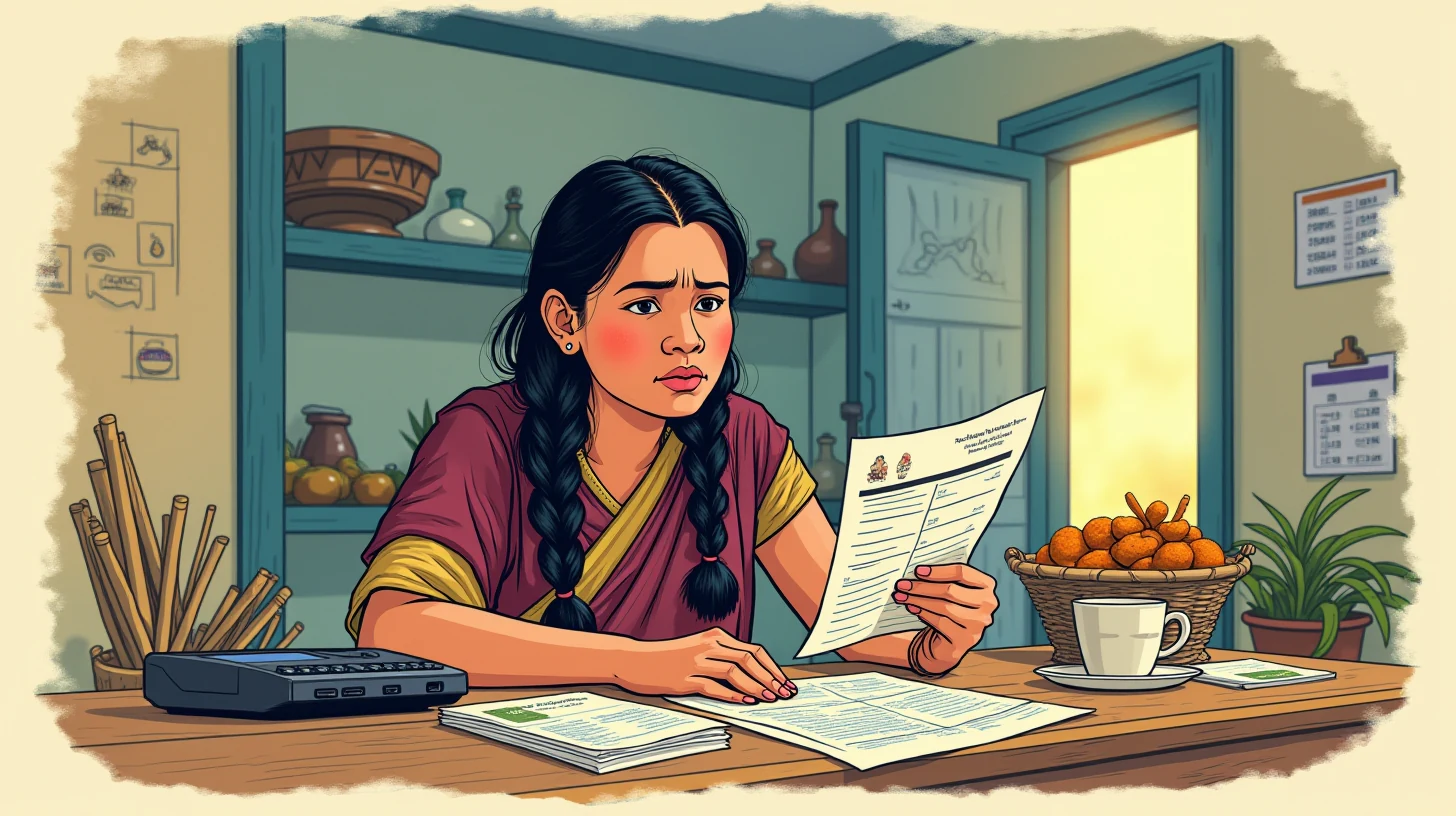
In February 2026, Zakhumi brought home a printed flyer about the Bana Kaih scheme — the Mizoram State Handholding Scheme that had just launched nationwide in September 2024. The leaflet, in Mizo and English, promised collateral-free loans of up to ₹50,000 for small business owners like Lalrinpuii, with the state government guaranteeing the loan if she defaulted. No security deposit. No gold or property to pledge. Lalrinpuii read it three times over chai that evening. For years, she had wanted to expand: to buy a small microwave oven for a corner bakery, to invest in better drying equipment for the bamboo strips, to hire a second pair of hands. But every bank in Aizawl wanted collateral. The Bana Kaih flyer felt like the first time someone had said "yes" to her in writing.
In early March, she walked to the district headquarters with her Aadhaar card and a photocopy of her PAN, which she had obtained three years ago after the tax office had issued a notice. The Bana Kaih registration desk was in a converted room on the first floor. The clerk, a young man named Ravi, scanned her papers, filled in a form, and told her to wait for a phone call. By mid-March, her loan was approved for ₹50,000 at 4% interest, with a five-year repayment term. The approval letter arrived by SMS and email. She was to receive the funds within two weeks, the bank told her. She began sketching plans for a small oven, mentally calculating how many loaves she could bake per week.
That was three months ago. The money had not come.
🗓️ The annual KYC re-verification cycle and the name-mismatch trap
The Bana Kaih scheme works through partner banks across Mizoram — SBI, IDBI, BOB, and others — that hold the credit guarantee backing from the state. When a loan is approved, the bank must then complete a full "Know Your Customer" (KYC) verification before the funds are released. KYC is the legal gateway: the bank must confirm that the borrower''s identity documents match across all government systems and that no tax or police red flags exist against the name.
Mizoram, like most Indian states, mandates annual re-verification of KYC for any new borrower or any borrower seeking a loan above ₹5 lakh. For Lalrinpuii''s ₹50,000 loan, the bank was required to cross-check her identity across three systems: her Aadhaar, her PAN, and her bank account registration. If all three matched, disbursal followed within ten working days.
But Lalrinpuii''s did not match.
Her PAN certificate, issued in 2023, read: "Lalrinpuii". Her Aadhaar, issued in 2010 and renewed in 2019, read: "Lalrinpuii Lianzuali". The discrepancy was her mother''s surname — a customary Mizo practice in which a daughter''s full name can include her mother''s surname at registration, but formal documents like PAN sometimes omit the second half. The bank flagged the mismatch as a KYC break and returned her file to the Bana Kaih approver with a note: "Cannot disburse pending name reconciliation."
Ravi, the registration clerk, had not mentioned the name check. The Bana Kaih approval letter did not warn her. And the bank''s helpline, when she called after two months of silence, said the issue was "with the portal" and that she should "correct her PAN with the Income Tax Department."
⚠️ The two-month silence and the near-expiry of the loan offer
By late May, Lalrinpuii had made three trips to the bank. Each time, she sat in a hard plastic chair for thirty minutes, was told the same thing — "the system is checking your documents" — and left with no written explanation. She had spent ₹180 on auto-rickshaw fares alone. Her mother-in-law, who had never trusted banks, began making remarks: "They took your name on a form and now they have disappeared. This is how they trap you."
The Bana Kaih approval letter, buried in a folder on Lalrinpuii''s shelf, came with a quiet clause: the loan offer was valid for six months from the approval date. If KYC was not cleared by September 15, 2026, the bank could cancel the disbursement without notice, and she would have to reapply from scratch, waiting another two to three months.
Zakhumi suggested she try the Bana Kaih office directly. She did not have the office address in Aizawl. The registration form had no contact number. The Bana Kaih website mentioned a helpline in English that redirected to a Bengaluru-based call centre with no Mizo staff. When she called on June 5, the agent asked her to "submit a written request to the nodal department" and gave her no address.
The fear began to crystallize: she might lose the loan without any clear way to retrieve it.
🌗 The agent arrives via an Anganwadi worker
On June 12, Lalrinpuii''s younger sister Remngaihi, who worked as an Anganwadi nutrition worker in the same district, stopped by the shop between home visits. Remngaihi had trained on a tablet-based scheme-tracking system the state had introduced for Anganwadi staff — a way to log POSHAN 2.0 and maternity-benefit data without paper. On that tablet was an offline tool: a simple agent interface that could read plain-text government documents, parse scheme rules, and suggest next steps without requiring internet.
Lalrinpuii showed her the bank letter and the Bana Kaih approval document. Remngaihi opened the agent on her tablet, read aloud the text of the KYC rules under the Bana Kaih scheme policy, and discovered something the bank had not volunteered: a clause that allowed the borrower to file a "Name Clarification Affidavit" with the bank if the discrepancy was due to state-issued documents (Aadhaar vs. PAN) rather than fraud.
The agent then cross-referenced the same clause in the Income Tax Department''s PAN-Aadhaar linkage guidelines, which confirmed that a mismatch caused by " regional naming conventions" could be resolved by either:
- Filing a Form 49A (PAN Correction) with the Income Tax Department if the PAN name was incorrect, or
- Filing a statutory affidavit with the bank''s KYC officer if the Aadhaar name was the primary identity and the PAN was a secondary derivative.
The agent suggested a third option specific to Mizoram State schemes: the Bana Kaih nodal office (under the Planning & Programme Implementation Department) had authority to override a bank''s KYC hold if the borrower provided notarized proof that both names were hers and that the discrepancy was cultural, not fraudulent.
Remngaihi made a note of the affidavit route and the Bana Kaih nodal office address (which the agent had extracted from the Mizoram State website), and she drove Lalrinpuii to the district notary the next morning. The affidavit, which cost ₹280, took twenty minutes to prepare and notarize. It stated: "I, Lalrinpuii Lianzuali, also known as Lalrinpuii, do hereby declare that I am one and the same person, and that the discrepancy between my Aadhaar name (Lalrinpuii Lianzuali) and my PAN name (Lalrinpuii) arises from the Mizo custom of surname variation and does not indicate fraud or dual identity. I request the bank to proceed with KYC clearance based on this sworn statement."
🧭 Why the system fails homemakers and small borrowers like Lalrinpuii
The Bana Kaih scheme is, on paper, a revolutionary leap. It is the first collateral-free lending scheme in India to explicitly include small traders, farmers, and household entrepreneurs. The state promotes it with billboards and SMS alerts. But its execution collides with a bureaucratic absurdity: the KYC system that the scheme relies on was designed for wage workers and salaried staff, not for people whose official names vary across documents for cultural, linguistic, or administrative reasons.
In Mizoram alone, name-variation issues affect thousands of women like Lalrinpuii. Mizo culture uses matrilineal surnames; a woman''s Aadhaar might include her mother''s name, while her PAN might use only her given name (if issued by a tax office in a city far from her home village). A similar issue affects many states: Bengali women often use their husband''s surname in one document and their maiden name in another; Tamil Nadu has caste-naming conventions that show up inconsistently across documents; Assamese and Arunachal Pradesh have similar village-register variations.
But the RBI guidelines for KYC, updated as recently as 2021, treat any mismatch as a security flag. Banks, fearing penalties from the Reserve Bank for "loose KYC", err on the side of rejection. The Bana Kaih scheme''s approval process assumes that KYC is a rubber stamp — a fact check that takes a week. In reality, it is often a bottleneck where borrowers disappear because they lack the literacy, time, or resources to navigate the corrective paperwork alone.
Lalrinpuii''s case also reveals a gap between scheme design and scheme communication. The Bana Kaih approval letter should have warned her: "Your loan is approved, but KYC clearance by [date] is required for disbursal. If your name appears differently across your Aadhaar, PAN, and bank account, you may need to provide an affidavit or file a correction with the Income Tax Department."
Neither the Bana Kaih registration desk nor the bank helpline volunteered this information. Neither provided a checklist of documents required for KYC, or a timeline, or a contact person if the process stalled. The burden of discovery — of finding out what was wrong and why — fell entirely on Lalrinpuii.
This is how homemakers and small traders get stuck. They are not merchants with accountants or employees with HR departments. They have no one to call. A two-month silence at a bank feels like a rejection, even if the scheme''s rules are technically in their favour.
- ⚖️
March 2026 — Loan Approved
Lalrinpuii registers for Bana Kaih; loan approved for ₹50,000 at 4% interest, valid until September 15, 2026.
- 📋
Mid-March — Bank Initiates KYC
Partner bank flags a mismatch: PAN name is ''Lalrinpuii'', Aadhaar name is ''Lalrinpuii Lianzuali''. Disbursal stalled pending name reconciliation.
- 🛑
March–May — Silent Hold
For 70 days, Lalrinpuii receives no explanation. Bank helpline says ''contact the portal''. Approval letter does not mention KYC timeline. Near-expiry date (September 15) begins to loom.
- 🌗
June 12 — Agent Intervention via Anganwadi Worker
Remngaihi discovers the affidavit clause in the Bana Kaih policy document via the agent. Three paths forward: PAN correction, statutory affidavit with bank, or nodal-office override.
- 📨
June 13 — Notarized Affidavit Filed
Lalrinpuii obtains a notarized statement clarifying that both names are hers. Affidavit cost: ₹280. Filed with bank''s KYC officer and forwarded to Bana Kaih nodal office.
- ₹
Late June — Disbursal Approved
Bank clears KYC based on affidavit. Funds disbursed: ₹50,000 into her account on June 28, 2026.
Form 49A — PAN Correction
2–4 weeksFile with the Income Tax Department to amend your PAN to match your Aadhaar. Free. But requires proof of address, birth certificate, or Aadhaar original. Slowest option if PAN is wrong.
Statutory Affidavit with Bank
3–5 daysSwear before a notary that both names refer to the same person. Cost: ₹200–₹400. File with the bank''s KYC officer and the Bana Kaih focal point. Fastest if both documents are yours.
Bana Kaih Nodal-Office Override
5–10 daysWrite to the Planning & Programme Implementation Department (nodal agency) with your affidavit and request override authority. Nodal office can instruct bank to clear KYC. Requires persistence, but is the scheme''s own safety valve.
"Tlang tlai a chang, tlan hian bank phei dawn lo. Kum khat chu ka thlen a, nula chu ka la zawn ta angah. Hei chuan ka lawm a, Ka ran chu a mangtha."— "The wait is hard when you''re small. A year ago I had nothing, but now my daughters need school books. This money is my small freedom. I finally have it."
"Aizawl-a Bana Kaih office-a phone a awm e. 0389-2340982. Oriseadhaar-aadhaar link mismatch te chu statutory affidavit-in siam vel a awm. Kan nodal office chu Planning Department-a awm a, Lalrinpuii te chu an direct suitea nawt chin thute, affidavit chauh le."
(There is a Bana Kaih office in Aizawl. Call 0389-2340982. PAN-Aadhaar mismatches can be resolved with a statutory affidavit. Our nodal office is under the Planning Department; for people like Lalrinpuii, an affidavit is often enough to unblock the bank, and you don''t need to wait for corrections elsewhere.)
🌱 The quiet geometry of small courage
By late June, Lalrinpuii had her ₹50,000. She bought the microwave oven for ₹22,000. She spent ₹8,000 on bamboo strips and tooling. She paid ₹12,000 of the loan back over her first three months of operation — faster than the five-year repayment term demanded. Her daily income, which had hovered around ₹400–₹500, rose to ₹700–₹800 on days when she had both fresh baked goods and craft items to sell.
More than the money, what stuck with her was the moment when Remngaihi had opened the agent and showed her that the rules were actually on her side. The Bana Kaih policy, the Income Tax guidelines, the bank''s own KYC manual — all of them contained a path forward. She had not needed to fight the system. She had needed to read it correctly.
It is a small truth, but it matters in a country where most homemakers and small traders have never learned that the bureaucracy speaks in layers. The first layer — the bank helpline, the registration desk — is often dismissive or ignorant. The second layer — the written policy, the nodal-office address, the statutory provisions — is almost never read by the people who need it most. The third layer — a person who can navigate between the first two, without condescension, and with a device that runs offline and asks no permission — is so rare that when it arrives, it feels like grace.
Lalrinpuii does not think of it as technology. She thinks of it as Remngaihi knowing where to look. And she is right. The tool was only a mirror. The knowledge was always there, waiting in the fine print of rules written for everyone and understood by almost no one.