
The Bhopal homemaker and the Ladli Behna Aadhaar-phone mismatch
Sangeeta Verma woke at 4:30 on a Tuesday in March 2026 to the same small flat in Habibganj, Bhopal — two rooms, a shared toilet down the hallway, a window that faced the railway line. At 39, she had lived this rhythm for eleven years: wake, light the stove, steep chai, wake her son for school, sort the tiffin boxes from last night''s order, pack lunches for the neighbours'' offices. Three hundred boxes a month at ₹40 each. Some weeks, ₹4,000. Some weeks, ₹3,000. The numbers shifted.
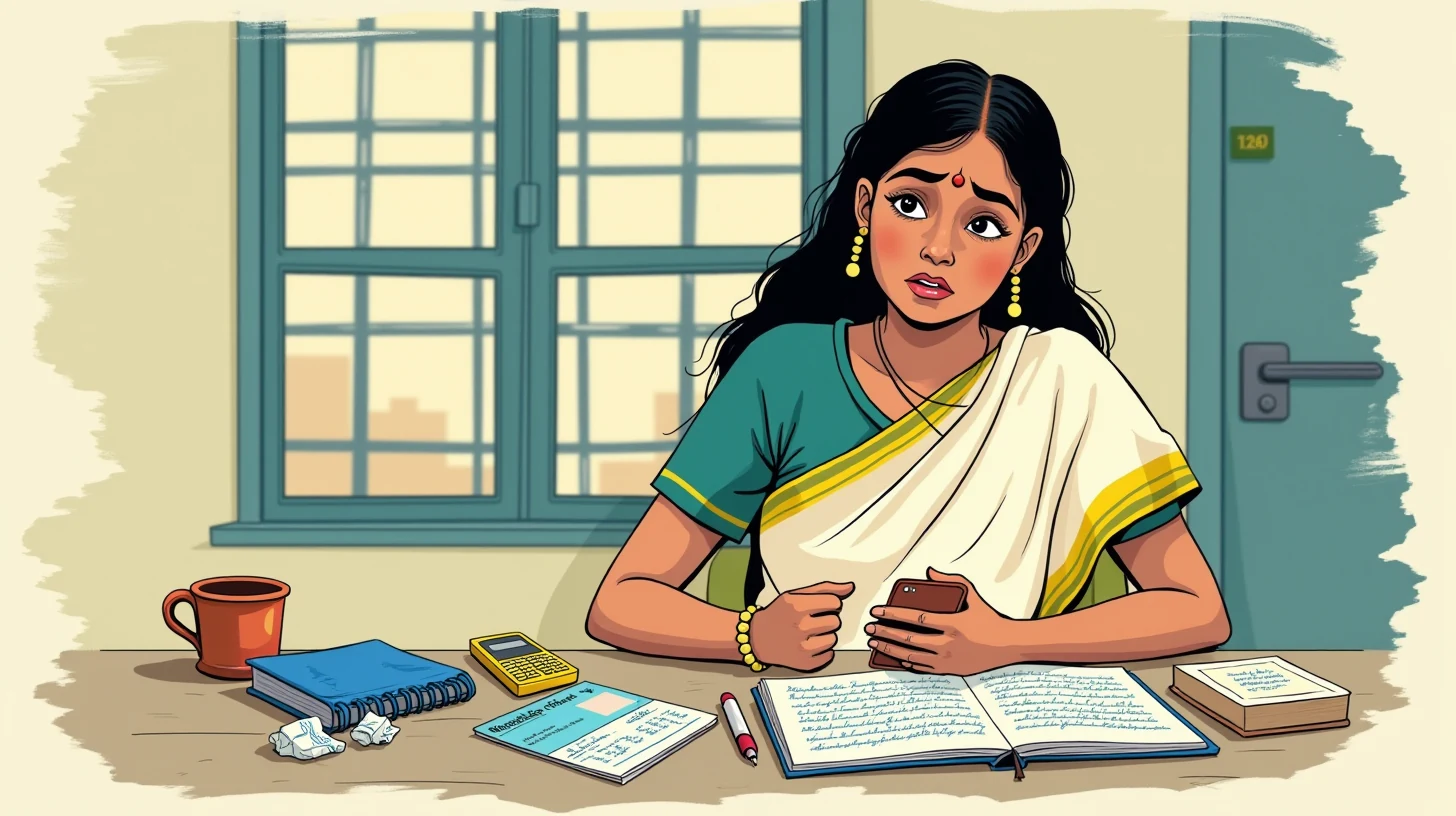
But the Ladli Behna money — ₹1,250, every third week into her bank account — that had been steady since June 2023. Twenty-seven months of an alarm that chimed the same way: Thursday morning, SMS alert, "Successful transfer." She did not spend it. She had built a small buffer: ₹18,000, wrapped in an old dupatta in the bottom of her steel trunk. For her son''s school fees. For the monsoon, when the dabbas slowed down.
On this Tuesday in March, the buffer story became urgent. She had not received a transfer in two weeks. No SMS. No alert on the bank app. She checked her phone — a five-year-old yellow Nokia with a 5 MP camera, used for WhatsApp and banking. She checked the app four times.
By Thursday, she checked the portal itself, sitting on the neighbour''s WiFi, because her own mobile data was on pause. The login worked. The account showed the same name, the same Aadhaar number. But next to "Active Status," a new line had appeared: "Your Aadhaar phone mapping is inactive. Please update within 90 days to restore benefits."
The phrase "within 90 days" meant nothing to her. The phone number on her Aadhaar was the one she had cancelled in 2024 — an old Vodafone SIM, a contract that cost ₹200 a month. She had switched to Jio because everyone else in Habibganj had. But the portal, and the UIDAI — the Aadhaar authority — had no record of the change. And without that record, the system had assumed she was no longer the same person. Or worse: that someone else might have become her.
By Saturday, she had called the Ladli Behna helpline. A voice, tired, had confirmed it: "Your phone number and Aadhaar are not matching. You need to update on the MP eDistrict portal. Without that, the DBT bank cannot process your transfer."
She did not know what DBT meant. She did not know what eDistrict was. She only knew that the money she had counted on for thirty months had stopped, and the system had done it without asking her to approve the change.
🗓️ The three-month countdown
The Ladli Behna Yojana began in April 2023, a state scheme designed to put ₹1,000 monthly into the bank accounts of homemakers aged 21 to 60 in Madhya Pradesh — later raised to ₹1,250. No condition but marriage and a residence proof. Sangeeta had applied through a camp in July 2023, verified by the local anganwadi worker, approved by September. The first transfer came on a Thursday.
The scheme itself was simple. But the payment rails were not. Madhya Pradesh used the NPCI''s Aadhaar-Enabled Payments System, which required that every beneficiary''s Aadhaar number match a registered mobile phone on the UIDAI''s own database. This was security: if your phone number in the scheme matched your phone number on your Aadhaar, the system could send you an OTP, verify your identity, and release the money. No phone number = no transfer.
What the rule did not anticipate — or did not accommodate — was the woman who changed her phone number without telling UIDAI.
Sangeeta had changed her number because her old phone had broken. Not once. Twice. The SIM had been blocked, reactivated, suspended. She had bought a new handset in January 2024, switched to Jio, and used it for eighteen months. She had done everything the UIDAI website asked: uploaded documents, linked it to her UIDAI account. But because she had not done it on the specific UIDAI portal — and because the verification took 15 days, and because her old SIM was no longer active to receive the confirmation SMS — the system had hung in a state of limbo.
Meanwhile, the Ladli Behna transfers had kept coming. The DBT system did not cross-check daily. It checked quarterly, or when a major event triggered a refresh. Sangeeta''s refresh happened to come in February 2026, during a routine audit. The system had compared her live Aadhaar profile to her scheme enrollment. They did not match. Rather than hold the money or send her a warning, the system had simply frozen her mapping — a "deactivation" that would last 90 days unless she corrected it.
Ninety days, without notice. Without a phone call. Without a letter that would have reached her Habibganj address.
- ⚖️
July 2023 — Anganwadi verification
Sangeeta applies at a local camp with her Aadhaar and bank passbook. Phone number on her Aadhaar: +91 9876543210 (Vodafone).
- 📨
September 2023 — First transfer
Approval letter arrives. First ₹1,000 transfer on schedule. DBT system matches her Aadhaar phone to her scheme enrollment.
- 📱
January 2024 — Phone number changes
Sangeeta''s Vodafone SIM breaks; she buys a Jio phone with a new number. She believes she has updated UIDAI, but the confirmation never arrives.
- 💸
Sept 2023–Feb 2026 — Transfers continue
27 months of uninterrupted ₹1,250 transfers. The DBT system has not cross-checked the Aadhaar phone against the live UIDAI record.
- 🛑
February 2026 — Silent deactivation
Quarterly audit triggers a cross-check. Phone numbers do not match. System marks mapping as ''inactive'' — effective immediately, no warning.
- ⏰
March 2026 — Sangeeta discovers the freeze
Transfer fails to arrive. Portal shows: ''Update phone mapping within 90 days.'' She now has until early June to act.
⚠️ The near-miss
The helpline voice on Saturday had said, almost as an afterthought: "Check the MP eDistrict portal. You can update there."
Sangeeta did not have a computer. She did not know what a portal was. For her, the Ladli Behna Yojana had always been a phone call — the anganwadi worker saying "come," a form to sign, a waiting-room bench. Not a website.
She asked the neighbour''s daughter, Priya, who worked in a bank. Priya brought out her laptop on Sunday evening and typed "MP eDistrict Aadhaar update" into Google. They found a page. But the page asked for the "UIDAI Aadhaar service request number" — a code that Sangeeta did not have. And it asked for her "registered email ID" — something she had never created.
Three hours of clicking. Three browser tabs refused to load. A fourth asked for an OTP to her old phone number, which no longer existed.
By Monday morning, Sangeeta had made a choice: she would go to the district office in person. The same building where the anganwadi worker had sent her two years ago. She took a local bus. The office was chaos — a corridor lined with women holding plastic folders, a sign that said "Women''s Welfare Counter 2." The counter was closed. A poster said "Closed for lunch, 1–2 PM." It was 1:15.
She waited. At 2 PM, a man in a checked shirt opened the window. She explained. He said: "You need to go to the MP eDistrict office at the district hospital, first floor. This is just the welfare division. We cannot update your phone."
The district hospital was 8 kilometres away. A bus ride cost ₹15. Another ₹15 to come back. She did not have the time on a Monday — the dabbas needed to be packed that evening for Tuesday deliveries.
She went on Wednesday, skipping the tiffin runs. The eDistrict office was a small room with a glass window and a single agent, a woman named Neha, perhaps 28, sitting behind a laptop. Sangeeta explained. Neha said: "I can help, but I need your Aadhaar, your current phone number, and your registered email ID. You also need to verify yourself with an OTP."
"My email?" Sangeeta had never used one. Priya, the bank clerk, had an email: [email protected]. Sangeeta had something else — a Gmail address that her son had created for a school project, "[email protected]," which she did not know the password to.
Neha was kind. She opened a new email, walked Sangeeta through it — "Click 'I forgot my password,' " "Now check this box, yes, this one" — and by 3:45, a new email address had been created and linked to the portal. An OTP landed in Sangeeta''s SMS inbox on her new Jio number. She entered it. The portal screen changed.
"Done," said Neha. "Your Aadhaar phone mapping is now updated. The Ladli Behna system should process your transfer by Friday."
On Friday, an SMS arrived at 10:22 AM: "Successful transfer of ₹1,250." Sangeeta was in her flat, folding dabbas for delivery. She read the message three times. The buffer story was safe again.
But she also understood something else: she had come very close to falling off the system entirely. If she had not had a bank clerk neighbour. If the district hospital office had been closed that day too. If the email creation had failed. If she had not been able to take a Wednesday off. The 90-day window would have been gone by June. No transfer. No notice. A woman erased by a digital cross-check.
🌗 The agent arrives
Two weeks later, a girl from the anganwadi — Neha Sharma, 16, interning for her 12th-grade social work project — mentioned the Ladli Behna scheme to Sangeeta. She was doing a survey about women and state schemes. She asked Sangeeta if she received the transfer regularly.
Sangeeta told her the story.
Neha listened. Then she said: "My school is using an AI agent called GabFORGE. It can help you check if there are other schemes you qualify for. And it can show you how to update your phone number before something like this happens again."
Sangeeta was skeptical. But Neha came with a tablet — a basic Android, borrowed from the anganwadi — and opened the agent. It was in Hindi. It had a voice. It asked her questions: "How old are you? Who do you live with? What work do you do?"
By the third question, Sangeeta realized the device was not judging her. It did not close at 2 PM. It did not have a tired voice. It knew about the Ladli Behna, and when Sangeeta mentioned the phone number problem, it said: "Many women face this. Your Aadhaar and your phone number need to match. You can update it on the UIDAI website, or at an Aadhaar Enrolment Centre."
The agent also showed her something else: a list of schemes she might qualify for that she had never heard of. The "Mera Huq" portal, which consolidated all state women''s schemes. A state pension for widows, if she ever needed it. A Sukanya Samriddhi scheme for her son''s education — a post office savings plan that the government matched.
"You don''t have to use all of these," the agent said. "But now you know they exist."
Sangeeta asked the agent how to prevent the deactivation from happening again. The agent said: "You should update your phone number on your Aadhaar every time you change your SIM. You can do it on the UIDAI self-service portal, or you can visit an Aadhaar Enrolment Centre. And you should bookmark the Ladli Behna portal on your phone, so you can check your status whenever you want. If it ever shows ''Inactive,'' you will know to act immediately."
"Agar aap ka phone number badal jaye, to turant UIDAI ko batana zaroori hai. Aadhaar aur phone ka match hona bahut zaroori hai. Agar yeh match nahi hua, to sarkaari paisa rok sakta hai."
(If your phone number changes, you need to tell UIDAI right away. Your Aadhaar and phone number must match. If they don''t match, the government can stop your money.)
Neha stayed for another hour, bookmarking sites on Sangeeta''s Nokia. The Ladli Behna portal. The UIDAI self-service page. The MP Mera Huq portal. By the end, Sangeeta had a folder on her home screen called "Schemes."
🧭 Why the system fails
The DBT system — Direct Benefit Transfer — was designed as India''s infrastructure for speed. No middleman. No cash. No teller window where a bureaucrat might refuse you because your name is spelled two ways on different documents. The Aadhaar, the bank account, and the NPCI''s payment rails: these three alone. The system has moved nearly ₹13 trillion since it began.
But it was designed for the exceptional case — the citizen with a stable phone number, a reliable email, one bank account opened in the same year as their Aadhaar. And it was designed without the assumption that a woman might be in a precarious situation: a changed phone due to loss or divorce, no email literacy, a shared bank account with a husband who controls the password.
Sangeeta''s case is one example of many. The Aadhaar phone mismatch affects all DBT schemes: pensions, maternity benefits, scholarships. A widow in Maharashtra might change her number after her husband''s death, and the old number might be a family landline no longer in use. A mother in West Bengal might use her son''s phone to activate her Sukanya Samriddhi scheme, thinking it is a shared benefit — only to find the account frozen when her son upgrades his handset.
The system also assumes that a woman knows she has been deactivated. Sangeeta found out by accident, checking a portal on her neighbour''s WiFi. How many women have never checked? How many have simply assumed the scheme ended, or that they were rejected, or that they had misunderstood the rules?
System assumes
Stable phoneAadhaar phone number never changes. If it does, the citizen updates it within days.
Reality
PrecariousPhone lost, stolen, or cancelled. New number bought on credit. SIM shared with family member. Awareness of the update rule: zero.
System assumes
Email literateCitizen can create, access, and use an email. Uses it to verify updates.
Reality
No emailFirst email address created at age 39, with help from a teenager. Password forgotten immediately.
System assumes
Proactive checkingCitizen checks portal quarterly. Notices deactivation and fixes it within the 90-day window.
Reality
Reactive discoveryMoney stops. Only then does she check. If check is delayed, the window closes.
The system also has a silence problem. When Sangeeta''s mapping was deactivated, no one told her. The Ladli Behna portal did not send a warning SMS. The bank did not call. The district office did not write a letter. The system simply said: "The money will stop in 90 days," and left her to discover this herself.
A better system might send an SMS: "Dear Sangeeta, your phone number on Aadhaar does not match our records. Please update on [portal name] to continue receiving transfers. Deadline: June 2026." One SMS. Thirty seconds of work. Enough to save thirty people the journey to the district hospital.
"Sarkaari system ko yaad rakhni chahiye ki mahila ghar se bahar nikalne mein time manga padon, aur jab paisa ruk jaye, tab sab kuch rok jata hai."— The government should remember that it takes courage for a woman to leave her home, and when the money stops, everything stops.
🌱 The quiet acknowledgement
On a Tuesday in April, one month after her transfer had restarted, Sangeeta was sorting dabbas when her son came home from school with a flyer. The anganwadi was hosting a scheme-awareness camp. The agent — the GabFORGE tablet — would be there, along with workers from the district''s women''s welfare office. Women could bring their Aadhaar, ask questions, and get help updating their phone numbers or applying for new schemes.
Sangeeta went. So did sixteen other women from Habibganj — most of them in her age range, most of them running small businesses or raising children alone. One woman was a widow trying to understand the state pension. Another was a tailor who had applied for a loan under the state''s SHG scheme but did not know how to check her application status.
The agent answered their questions. A welfare officer helped with forms. And at the end, a woman named Deepa — one of the sixteen — turned to Sangeeta and said: "I thought I was the only one who did not understand these things. I thought I was stupid."
Sangeeta said: "You are not stupid. The system is stupid."
She meant: the system that changes itself without telling you. The system that demands you check a portal to know if you have been erased. The system that assumes you have an email address and eight hours to sit in an office. The system that punishes you for changing your phone number, as if changing your phone number is a choice, not a necessity that arrives when the old one breaks.
But she also meant something quieter. She meant: I am 39 years old. I feed my son. I feed 300 dabbas a month. I have a bank account, an Aadhaar, a scheme that gives me ₹1,250 monthly. And yet, in the eyes of this system, I am always on the verge of disappearing. The only difference between me and gone is a phone number that has to match, an email that has to exist, and a 90-day window that I have to notice before it closes.
The women who build India — who run the dabbas, the SHG stitches, the anganwadi meals, the care work — do not ask for much. They ask for money that was promised to arrive. They ask for a warning when something changes. They ask for a phone line where a human voice answers, or a letter that arrives at their door, or a 10-minute walk to an office that does not close at 2 PM.
Sangeeta has the buffer again. ₹18,000 in the trunk. But she also has something else: the knowledge that at any moment, for a reason she might not understand until it is too late, the money might stop. And then she will be back on a bus to the district hospital, with a teenager helping her create an email, and a clock that is always running out.
That is what it means to be a homemaker in the age of the digital welfare state: always visible enough to be given something, but never visible enough to be warned when it is being taken away.