
The Chandigarh homemaker and the BBBP scholarship her Anganwadi worker was on leave for
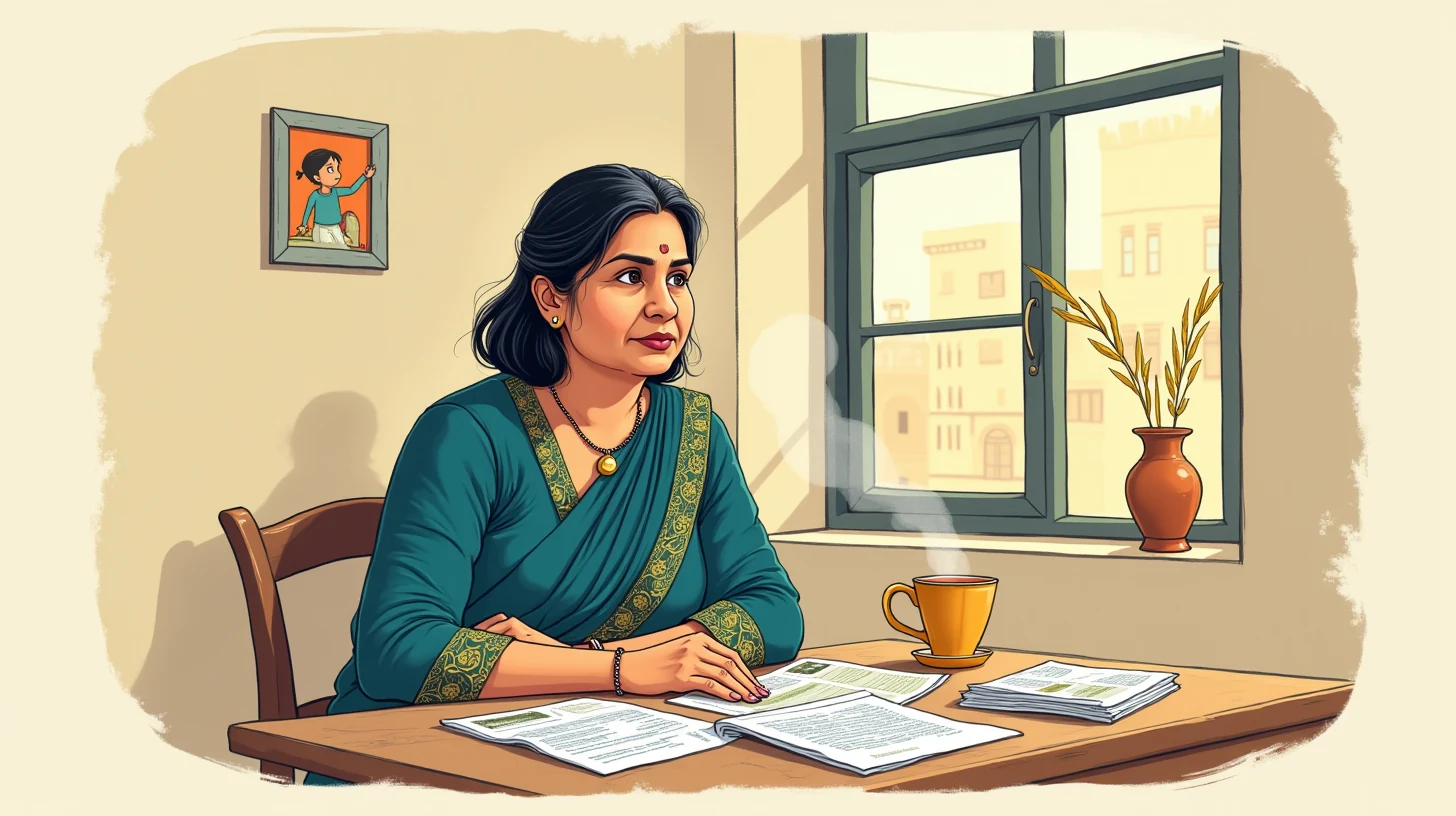
Inderjit Kaur was forty-three days away from the scholarship deadline, and she had already lost a month to silence. Every morning, she walked her fourteen-year-old daughter Avneet to the bus stop near Sector 35-D, Chandigarh, then returned to the small two-room flat she kept while running a tiffin service — sixty dabbas a day, packed between 5 a.m. and 8 a.m., delivered across the city''s grid by afternoon. The work paid ₹8,000 a month, enough for rent and Avneet''s school fees, but not enough for the college that Avneet, who ranked third in her class, deserved. Avneet''s father had died six years earlier, leaving Inderjit as the sole provider. The Beti Bachao Beti Padhao scholarship — ₹35,000 for one year, renewable for three — would change that. It would mean textbooks, a laptop, a coaching class for her entrance exams. All Inderjit needed was the Anganwadi worker''s signature on a single verification form. The Anganwadi worker had been on maternity leave for four months. No one else would sign.
🗓️ The rhythm of the scheme and the silent wait
The Beti Bachao Beti Padhao (BBBP) scheme, launched in 2015, flows through India''s state welfare systems as a convergence: the Ministry of Women and Child Development issues guidelines, the district Social Welfare Department administers the applications through the Sub-Divisional Magistrate''s (SDM) office, and the Anganwadi worker — the neighbourhood-level grass-roots frontline — verifies the household. The scheme opens its application window twice a year. For Chandigarh, the winter cycle deadline falls in mid-June. Inderjit had learned this from a neighbour whose daughter had received the scholarship two years earlier.
The application required six documents: the girl''s birth certificate and school enrollment proof; the school''s UDISE+ code (an eleven-digit national identifier); the family''s annual-income affidavit, signed by a notary; Aadhaar cards for both mother and daughter; and a signed verification form from the Anganwadi worker confirming that the household income matched the affidavit and that the girl was enrolled in school. The Anganwadi worker served as the household''s first checkpoint — a signal to the SDM that the claim had been locally verified.
Inderjit had done her homework. She obtained Avneet''s birth certificate and school certificate easily, visiting the school office in late April. She booked an appointment with a notary in Sector 22-C and spent ₹300 on the income affidavit. She retrieved her and Avneet''s Aadhaar cards from the drawer. But when she walked to the Anganwadi center in Sector 36, three blocks from her flat, she found a paper notice on the door. The worker, Priya, was on maternity leave. There was no date for her return. There was no deputy. There was no alternate contact. Inderjit asked the cook, the cleaning staff — no one had a signature stamp or authority to verify anything.
- 📨
January 10 — Anganwadi worker takes maternity leave
Priya, the Anganwadi worker for Sector 35-D, begins her leave. No substitute is assigned.
- 📋
April 20 — Inderjit begins collecting documents
She gathers school certificate, Aadhaar cards, and schedules notary appointment for income affidavit.
- ⏰
May 10 — Application window opens
BBBP cycle opens. Inderjit visits the Anganwadi center and discovers no one is available to sign.
- 🛑
June 15 — Submission deadline
BBBP application window closes. Avneet''s scholarship hangs in suspension.
⚠️ The refusal at the SDM office
Inderjit took the bus to the SDM Chandigarh office in Sector 17, where the BBBP applications were received. She carried all five of her collected documents in a cloth bag — the verified birth certificate, the affidavit, the Aadhaar cards, the school certificate, and a printout of Avneet''s UDISE+ code from the government portal. She arrived at 10 a.m., when the office opened. The clerk at the window was polite but firm: without the Anganwadi worker''s signed verification form, the application could not proceed. It was a mandatory field. Could she return with the signature? Inderjit explained the situation — the worker was on leave, no one knew when she would return, no deputy had been appointed.
The clerk shrugged. He suggested she contact the District Social Welfare Officer or the local Sector 35 office — they might have a record of the leave and could authorize a temporary verification. He gave her a phone number on a small slip of paper. When Inderjit called, the line rang fourteen times before someone picked up. It was not the officer but an assistant who said the officer was in a meeting. She left a message. Three days passed. No callback. She called again. Same situation. The third time, she was told to come to the office in person.
The Sector 35 office was a small annexe, staffed by two people who shuffled her between them. One said the matter was not their jurisdiction — it was the Anganwadi system, not theirs. The other said the Anganwadi worker would need to authorize a substitute in writing. But Priya had filed no such letter. No one had her contact details. The backup was to wait until Priya returned from leave, which could be six weeks or six months — maternity leave had no fixed term.
Inderjit, who had never missed a tiffin delivery in nine years, sat in the Sector 35 office for two hours, feeling the deadline pass in silence.
"Mera baita meri sab kuch hai, par system mera hai bol ke nahin sunta — yeh sab kaagaz ghar mein rakhe hue hain, aur koi samakshta nahin karke deta."— My daughter is my whole world, but the system doesn''t listen to me. All these papers sit in my house, and no one will come and verify.
🌗 The pivot through a tablet
Inderjit''s neighbour, Nikita, was home on study leave from her office — she worked in IT support for a small firm. She had seen Inderjit sitting on the flat''s threshold late one evening, papers spread across her lap. When Inderjit told her the story, Nikita remembered using an AI agent on her phone to navigate a GST return for her side income — a small digital service that walked through the forms. She suggested Inderjert try something similar, and lent her an old tablet. The two of them sat together in Nikita''s living room, and Inderjit used the tablet — a simple Android with WiFi, unfamiliar in her hands — to search for the Beti Bachao Beti Padhao scheme, the Chandigarh Social Welfare Department portal, and the Anganwadi network.
The agent she accessed helped her surface three immediate options: First, contact the Chandigarh Women and Child Development Department directly, citing Section 14 of the BBBP Scheme guidelines, which allow for "exceptional verification procedures when the primary certifier is unavailable." Second, request a written confirmation from the Anganwadi center''s supervisor — not a substitute, but a senior official — stating that Priya was on authorized leave and that no deputy had been appointed, and that this written confirmation could be attached to the application as a compliance note. Third, reach out to the SDM office with a formal letter, drafted by a legal aid organization, framing the delay as administrative denial due to understaffing.
The agent did not submit anything; it did not decide for Inderjert. It only surfaced the pathways and the relevant documents to reference. What it did do was give her language. Inderjit copied down the exact text of Section 14 from the guidelines. She read the portal information again, this time more carefully — and noticed a footnote: "Alternative verification may be sought from the District Social Welfare Officer in cases of personnel unavailability."
Armed with that sentence, Inderjeit drafted a one-page letter to the District Social Welfare Officer, explaining her situation, referencing Section 14, and requesting that the DSO either authorize a temporary verification or provide written confirmation that no deputy was available. She printed it at a cyber cafe for ₹10, signed it, and hand-delivered it to the Sector 35 office.
"BBBP yojana mein alternate verification ke liye Section 14 dekha. Iska matlab hai agar Anganwadi kaamkaz ghar par hai, to Social Welfare Officer kar sakte hain. Meri ladki ko yeh scholarship se chance milega padhai karne ka."
(I looked up Section 14 in the BBBP guidelines, which talks about alternative verification when the primary worker is unavailable. That means the Social Welfare Officer can verify instead. This scholarship will give my daughter a chance to study.)
🧭 Why the system fails and who else pays the price
Anganwadi centers are supposed to have a staff of three: a primary worker, a mini-worker, and a helper. In Sector 35-D, there was one primary worker — Priya — and occasional help from a helper who came three days a week. The mini-worker position was vacant. When Priya took maternity leave (to which she was entitled, protected under the Maternity Benefit Act), no one was assigned to cover her duties. The district had a list of substitute workers, but assigning them required a sanctioned post, which took time. The Anganwadi system, nationwide, is understaffed by an estimated 30–40 percent — a chronic shortage that leaves single-worker centers floating in limbo when that one worker becomes unavailable.
The second failure was architectural. The BBBP scheme, as administered in Chandigarh, built the Anganwadi worker verification into the submission pipeline as a hard requirement — a checkbox that prevented the form from being accepted at the SDM office. This made administrative sense: it was a local touchpoint, a way to ensure that applications were not fraudulent. But it also meant that any single-point failure in the Anganwadi system became a gatekeeper. A worker''s illness, leave, resignation, or death could stall an entire household''s application. There was no bypass, no temporary authority, no fallback — not in the portal, not in the written procedure.
The third failure was visibility. The SDM office staff knew that the Anganwadi worker was on leave, but they did not proactively offer alternatives. The Sector 35 office staff knew about the vacancy, but they treated it as the mother''s problem to solve. No one owned the gap. Inderjit was not the only mother waiting. In Chandigarh alone, an estimated 2,000 households a year apply for BBBP. A conservative estimate suggests that 5–10 percent are delayed or withdrawn due to Anganwadi unavailability.
The impact ripples beyond the scholarship. If Avneet''s BBBP application succeeded this year, she could renew it for three years. But a one-year delay meant she would move into college, become ineligible under secondary-school-only criteria, and lose the chance. For a family living on ₹96,000 a year (₹8,000 monthly tiffin income), that was not just a missed opportunity — it was a redirected life.
What it does
- 🔍Proactively check Anganwadi worker status during SDM intake
- 🗂️Offer written confirmation if the worker is unavailable, citing scheme guidelines
- 📞Contact the District Social Welfare Officer to authorize temporary verification
What it does not do
- 🛑Refuse the application without explaining alternatives or appealing procedures
- ⏰Allow the deadline to close without flagging the delay to supervisors
- ✅Leave the mother without a clear next step or point of contact
🌱 The quiet completion
Two weeks after Inderjit submitted her letter, the District Social Welfare Officer issued a written memorandum. It stated that Priya was authorized to be on maternity leave until September 15, that no deputy had been assigned due to sanctioned post delays, and that alternative verification could be conducted by the DSO''s office on the mother''s request. Inderjit took the memorandum, along with all her documents, back to the SDM office. This time, the clerk accepted the application. He stamped it, gave her a receipt, and said the decision would come within four weeks.
The decision came in three weeks. Avneet was approved for ₹35,000 in her first year of the Beti Bachao Beti Padhao scholarship. The money was transferred to Inderjit''s bank account — the same account where she deposited her tiffin service income — and Avneet''s school fees for the year were covered. Inderjit still ran the dabbas — sixty a day, from 5 a.m. to 8 a.m., delivered across Chandigarh''s grid. But now, Avneet could attend the coaching class Inderjit had always promised. Now, when the time came, there would be money for entrance exam fees and travel for university visits.
The system did not change. The Anganwadi worker was still on leave. The deputy position was still vacant. But Inderjit had learned the shape of the exception, the line in the guidelines that said when the usual path fails, there is another way. She did not feel victorious — she felt the weight of having navigated around a gap that should not have existed. She felt the quiet relief of a mother who had carried her daughter''s future through a bureaucratic winter and emerged on the other side.
Later, she would tell other mothers in her colony about the memorandum, about Section 14, about the DSO''s authority. They would nod, and some would ask for her help drafting their own letters. And Inderjit, who had never been to high school herself, would sit with them and read from the printed guidelines on Nikita''s tablet, pointing to the sentences that said your child deserves to study.