
The Chennai homemaker and the Magalir Urimai Thogai electricity-bill mismatch
Vanaja Subramaniam''s day begins at 4:45 a.m. in K.K. Nagar, Chennai, a neighbourhood of narrow lanes, shared courtyards, and houses built wall-to-wall with only a single window facing the street. She lights the kerosene stove—the gas cylinder ran out four days ago, and the refill has a two-week wait—and begins boiling water for the family''s morning tea. Her husband Anand works as a junior accountant at a printing press in Kilpauk, earning ₹18,000 a month. Their two children are in school, ages 9 and 12. Her mother-in-law, now 73, moved in five years ago after her husband—Vanaja''s father-in-law—died of a heart attack in 2018. Vanaja has never worked outside the house. She manages the household, cooks twice daily, pays the bills from her husband''s account, and tracks the small government schemes the family is entitled to: the children''s school scholarships, the widow''s pension that arrives (irregularly) for her mother-in-law, and, since September 2023, the ₹1,000 monthly transfer from the Tamil Nadu government''s Magalir Urimai Thogai scheme. That transfer stopped in November 2025. The government portal now tells her that her case is "under review — TANGEDCO mismatch," and no one has explained what that means or how long it will take to fix.
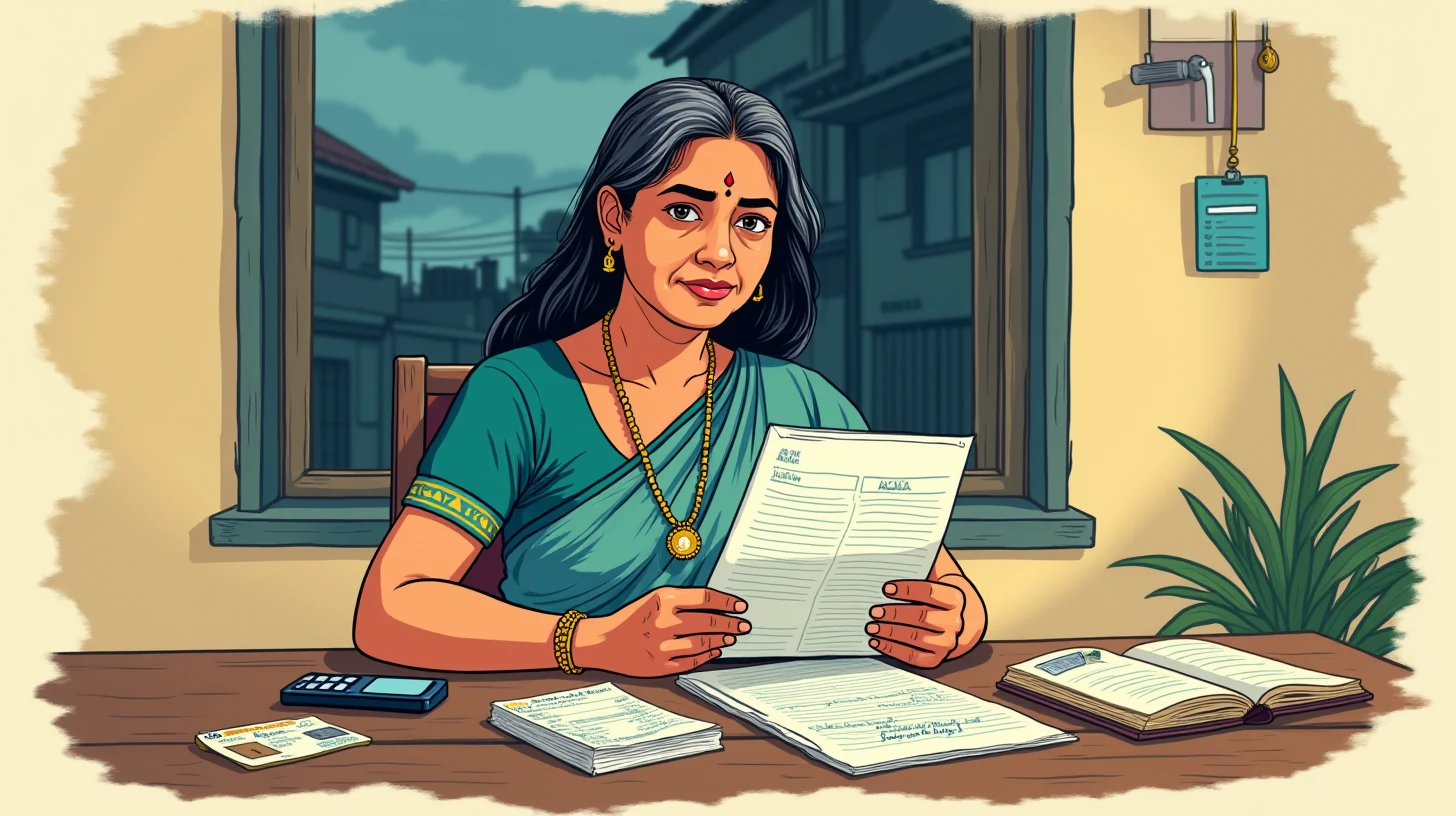
The Magalir Urimai Thogai scheme launched on September 15, 2023—the birth anniversary of former Tamil Nadu Chief Minister C.N. Annadurai. It promised ₹1,000 every month, every month, no exceptions, to every woman aged 21 and above in a family with an annual income below ₹2.5 lakh and electricity consumption below 3,600 units per year. Vanaja learned about it from a neighbour, Mrs. Rani, who brought her a printout of the application form from an e-Sevai kiosk at the local municipality office. The scheme felt like recognition—not charity, but acknowledgment that women''s unpaid work in the home has value. When Vanaja''s ₹1,000 transfer arrived in her bank account that first month, it was not life-changing—the family still had to budget, still had to choose between the school fees and the electricity bill—but it was hers. She didn''t have to ask her husband. She could buy the children new uniforms without guilt. She could set aside ₹200 each month for her mother-in-law''s medication.
For 26 months, the transfers came without fail. Then, in November 2025, the deposit stopped. Vanaja waited. November became December. December became January. No phone call, no message, no letter. In late January, she logged into the e-Sevai portal using the Nokia smartphone that her daughter helped her navigate, and the status bar said only: "under review — TANGEDCO mismatch." She had no idea what it meant. She asked Mrs. Rani, who suggested she visit the municipality office. The supervisor there, a young man named Rajesh, photocopied her form and told her to wait, that the government was busy, that sometimes verification took time. He did not explain the mismatch.
🗓️ The rule of the name
The Magalir Urimai Thogai scheme has a straightforward eligibility rule: electricity consumption below 3,600 units per year. But the verification is not simple. When Vanaja applied in August 2023, she submitted her electricity bill as proof. It was issued in the name of her late father-in-law, P. Subramaniam, who had held the connection since 1998. He died in 2018. The bill continued to arrive in his name because no one in the family had filed a name-change application with TANGEDCO—the process involves a form, a visit to the office, proof of death, a new agreement, and a fee. In K.K. Nagar, in households like Vanaja''s, the electricity bill sits in a corner of the kitchen, a piece of paper that gets paid and forgotten. It was in her father-in-law''s name, yes, but Vanaja paid it from her household account every month, and the government had already approved her application.
By November 2025, TANGEDCO''s records had been cross-checked against the Magalir Urimai Thogai beneficiary database, and the mismatch surfaced: the application was in the name of Vanaja Subramaniam, but the electricity consumer was P. Subramaniam (deceased, 2018). The rule, as the government portal eventually explained in a terse paragraph that Vanaja read with her daughter''s help, is that "the family''s electricity-bill holder must be a household member." Dead men are not household members.
- 💔
2018 — Father-in-law dies
P. Subramaniam passes away. His electricity bill, held in his name since 1998, remains unchanged. No one files for a name transfer with TANGEDCO.
- 📋
September 15, 2023 — Scheme launches
Tamil Nadu announces Magalir Urimai Thogai. ₹1,000 monthly to eligible women. Vanaja learns of it from a neighbour.
- ✍️
August 2023 — Vanaja applies
She submits her form with the electricity bill in her father-in-law''s name. The application is approved. First transfer arrives September 2023.
- 💸
September 2023–October 2025 — Transfers arrive
For 26 months, ₹1,000 arrives in Vanaja''s account every month. She relies on it for school fees, medication, household needs.
- 🛑
November 2025 — Transfers stop
No deposit. Vanaja checks the e-Sevai portal. Status: ''under review — TANGEDCO mismatch.''
- ⚠️
January–April 2026 — Waiting
No resolution. No guidance on how to fix the mismatch. Vanaja is six months without the transfer. Bills accumulate.
⚠️ The closing window
By February 2026, Vanaja had missed two months of school fees. The private English-medium school where her daughter studied cost ₹2,400 a month. Without the ₹1,000 from the scheme, she had to ask her husband for extra, and every extra rupee meant a conversation, a negotiation, a sense of depending again. Her son''s tuition fees were due. Her mother-in-law''s doctor had prescribed a new blood-pressure medication that cost ₹340 per month—more than before. Vanaja knew that she could not wait forever. She visited the municipality office again, this time with her daughter, who spoke better English than her mother.
Rajesh, the supervisor, seemed sympathetic but helpless. "The system has flagged your case," he told her. "The electricity bill is not in the right name. You need to go to TANGEDCO and change the bill to your name or your husband''s name. Then we can re-verify. Then it should clear." He spoke as though this was simple—a visit to TANGEDCO, a signature, done. But Vanaja did not know where TANGEDCO''s office was. She did not have her father-in-law''s death certificate (it was in a wooden box at her mother-in-law''s natal house, two hours away by bus). She did not know if she was even allowed to request a name transfer—was the bill in a deceased person''s name a legal problem? Could she lose the connection? The questions stacked up faster than her confidence.
Weeks passed. She did not visit TANGEDCO. Instead, she made small adjustments: she pulled her son out of tuition and taught him herself from books. She bought cheaper vegetables from the early-morning market. She cut back on the coconut oil she bought each month. She borrowed ₹800 from Mrs. Rani to pay the electricity bill on time—missing it was not worth the interest charges that TANGEDCO would add. In March, she checked the e-Sevai portal again. The status was still "under review." There was a helpline number listed: 044-25619208. She called it one morning at 9 a.m., hoping to reach someone before the phone credit on her Nokia ran out. A recording told her the office was open 9 a.m. to 5 p.m., but when she called back in the afternoon, a voice answered but then transferred her to a queue that never connected. She tried again two days later. Same result. By late March, she had stopped trying.
🌗 The navigator
In late April, Vanaja met with the agent. The family had a basic Android phone that her daughter had received as a school prize, and Mrs. Rani suggested she try the GabFORGE app—"it helps with government things," Mrs. Rani said vaguely. Vanaja was skeptical of such promises, but she opened the app on a Sunday afternoon when the house was quiet and her son was studying for his exams. She described her situation: the transfers had stopped, the portal said there was a TANGEDCO mismatch, she didn''t know how to fix it. The agent asked her several questions. What was the original applicant name on her Magalir Urimai Thogai form? (Vanaja Subramaniam.) What was the electricity consumer name? (P. Subramaniam.) When had he passed away? (2018.) Did the family still live at the same address? (Yes.) The agent then explained, in clear Tamil, what had happened.
"Ungal saadhana appadi irukkuthamma, TANGEDCO-il EB bill appozhum valanavai aandaan peyaril irundhukkum. Avarai marandhudu, bill nee thuravu irundhaalum, system-la avandai peyar irundhukum. Magalir Urimai Thogai scheme-il, palam kodu-nnu computer-ye check pannum appadi, EB consumer oru current household member-ai irukka vendiyum. Dead person-ai irundhal reject panrum."
(Your situation is this: the electricity bill has been registered in your father-in-law''s name in TANGEDCO''s system. He passed away, but the bill''s holder''s name hasn''t changed. Even though you pay the bill, the system still shows his name. The Magalir Urimai Thogai scheme checks through the computer—it needs the electricity consumer to be a current household member. If the holder is deceased, it rejects the claim.)
The agent continued: "The fix is a name transfer with TANGEDCO. You need to visit their office with your father-in-law''s death certificate, your Aadhaar, your marriage certificate or your husband''s permission letter, and a form called the ''Change of Consumer Name'' form. TANGEDCO will issue this form. There''s a fee—usually ₹200 to ₹400. Once the name is changed to yours or your husband''s, the scheme will re-verify automatically within 2–3 weeks. Your transfers should resume."
For the first time in five months, Vanaja understood the problem and the path forward. It was not insurmountable. It required effort—finding documents, visiting an office, paying a fee—but it was not a bureaucratic dead-end. She asked the agent: "Will they ask why the name wasn''t changed earlier? Will they blame me?" The agent replied that TANGEDCO was used to name transfers, that death and name-change delays were routine, and that there was no blame to assign. The system was simply checking names and marking mismatches. The solution was administrative, not moral.
🧭 The systemic argument
Vanaja''s case is not unique. According to anecdotal reports from municipalities and e-Sevai kiosks across Tamil Nadu, hundreds of women have seen their Magalir Urimai Thogai transfers halted due to electricity-bill mismatches. The mismatch occurs in households where:
- A widowed daughter-in-law is the homemaker but the bill is still in a deceased father-in-law''s name.
- A woman''s name is added to a ration card as head of household, but she has never updated the electricity bill from her husband''s name.
- A woman rents a flat and pays the bill, but the landlord''s name is on TANGEDCO''s register.
- A second wife in a joint-family home is the household manager, but the bill is in the first wife''s name.
The scheme''s rule—that the electricity consumer must be a household member—is sensible as a fraud check. It prevents someone from claiming a scheme benefit using a dead relative''s bill or a neighbour''s address. But the implementation is blunt. The government does not proactively warn applicants that if the bill''s holder is deceased, they need to fix it before applying. When mismatches are discovered months or years later, there is no gentle notification, no explanation, no pathway to resolution visible on the portal. The woman is simply left with a frozen transfer and a cryptic reason.
Moreover, the assumption embedded in the rule is that women own or control the electricity bill. In much of India, a woman in a joint family does not. Her father-in-law owns the bill, or her husband does, or she pays it but it remains in someone else''s legal name. To make her eligible for the scheme, she must change the bill—but that requires her to know the process, to gather documents that may be scattered across relatives'' homes, to travel to the office, and often to have a man''s permission or signature. In effect, the scheme''s eligibility rule outsources bureaucratic work to the women it is meant to help, and it does so without warning.
What the scheme assumes
Ideal caseWoman''s name on the electricity bill. All documents in one place. Quick eligibility match. Transfers flow without pause.
What Vanaja''s house looks like
Common caseBill in deceased father-in-law''s name. Death certificate at mother-in-law''s village house. Husband''s permission needed for a name transfer. Five months of missing transfers.
What the system checks
AutomatedTANGEDCO register vs. Magalir Urimai Thogai database. Name match required. No allowance for death, remarriage, or household transitions.
The government has provided no public guidance on how many beneficiaries face this mismatch, what timeline they can expect for resolution, or what the appeal process is. The e-Sevai portal shows the status as "under review" indefinitely. There is no escalation. There is no email confirming receipt of a grievance. A woman can call the helpline, but the helpline does not always answer. She can visit the municipality office, but the supervisor may not know what to do. She waits.
"Naan saadhaarana pen. Government scheme-a kaekap poraan, aana enachu paisa-ana problem irundhal, naan yaar-le ketavendraala verum nenappu."— I am an ordinary woman. I wanted to trust the government scheme, but if there is money at stake and no one is telling me what to do, I can only be worried.
🌱 The quiet close
Vanaja had the death certificate retrieved from her mother-in-law''s house. Her husband took a half-day off work and accompanied her to the TANGEDCO office in Kilpauk. They waited in a queue for forty minutes, filled out the Change of Consumer Name form, and paid ₹350. The official assured them the change would take effect in 3–5 business days. Two weeks later, Vanaja''s November transfer arrived—a back-payment of ₹2,000. By the third week of May 2026, her status on the e-Sevai portal showed "Approved," and the June transfer was deposited on time.
The money had returned, but the five-month gap had cost her. The school had sent a notice asking about unpaid fees. Her son was now in government school instead of tuition. Her mother-in-law''s medication had become intermittent—she took it four days a week instead of seven because the ₹340 monthly was still a stretch. The fear of the frozen transfer, of the unexplained hold, of the portal that offered no answers—that had settled into a caution in Vanaja''s mind. She now keeps a folder beside her bed, in it her Aadhaar, marriage certificate, ration card, electricity bill (with her name on it), and her bank statements. If the transfers stop again, she will not wait five months. She will have her documents ready.