
The Daman homemaker and the Vahli Dikri savings bond stranded in the UT merger
Rekha Tandel sits cross-legged on the tiled floor of her Moti Daman kitchen, a folder of papers balanced on her lap, while her four-month-old daughter Riya sleeps in a woven cradle in the next room. It is Tuesday afternoon, and the monsoon clouds have begun their slow roll across the Daman strait. Rekha is 34, works part-time at a private school in the town centre—four hours a day, three days a week, forty kilometres by auto-rickshaw each way—and spends the rest of her week managing the household, preparing meals, and, for the past month and a half, trying to understand why the government will not acknowledge her daughter''s birth grant.
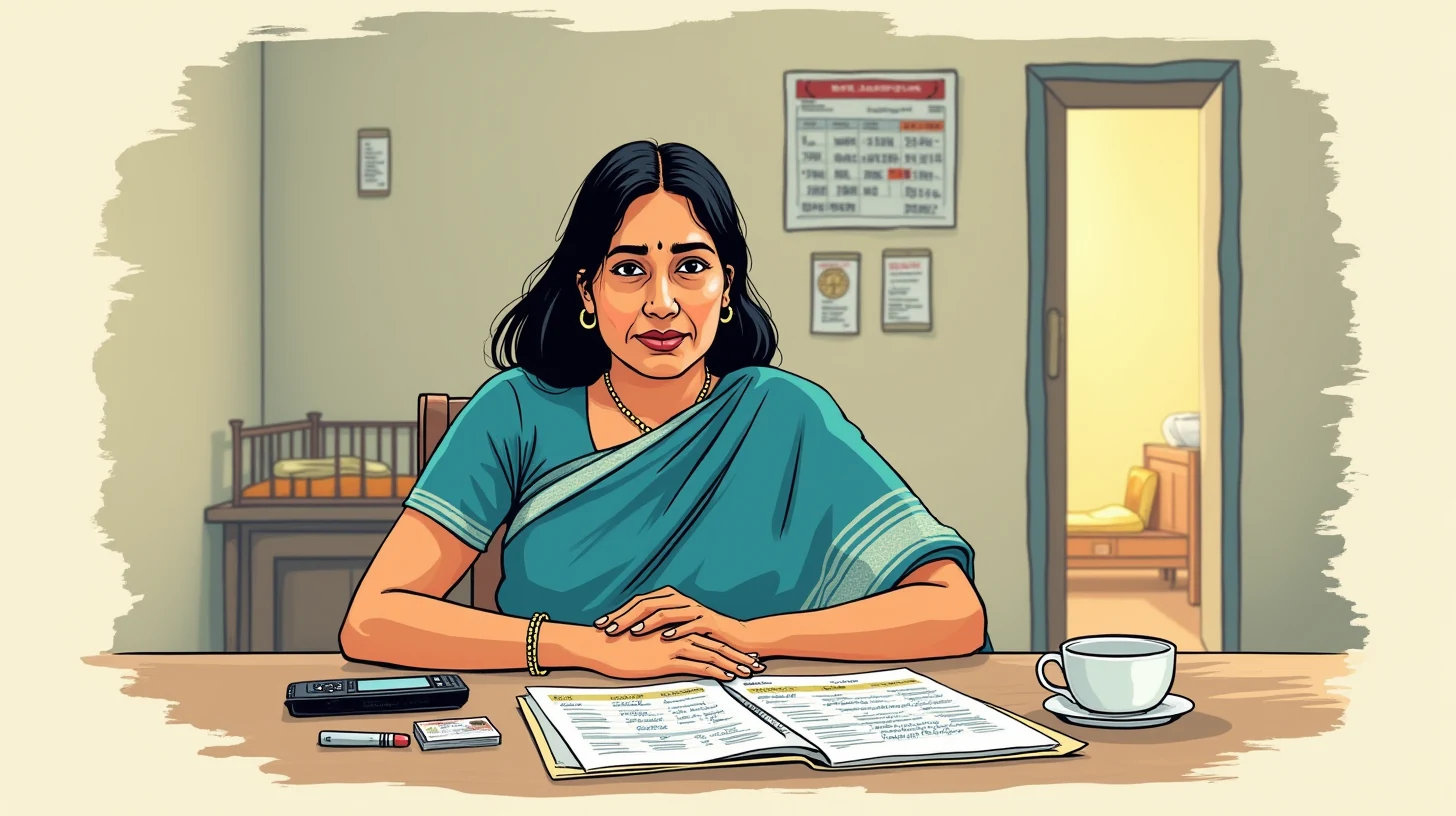
The scheme is called Vahli Dikri Yojana. It means "Dear Daughter" in Gujarati, and it promises ₹4,000 when a girl enrolls in Class 1, another ₹6,000 when she enters Class 9, and ₹1,00,000 when she turns 18 and completes her schooling. The money is a form of financial security—not wealth, but enough to buy a year of vocational training, or help with a wedding if Riya chooses one, or seed a small business. For Rekha, who earns 8,500 rupees a month, the scheme meant something simple: I will not have to choose between her education and my rent.
She filled out the application form on 15 March 2026, three weeks after Riya was born. The form was in Gujarati, printed on the pale yellow paper that all government forms in Daman still used before the 2020 merger that unified the small union territories of Dadra & Nagar Haveli and Daman & Diu into a single UT. She took it to the Mamlatdar office—the district administrative office—on the first floor of the old Secretariat in Moti Daman, along with copies of her Aadhaar, her household register, her bank passbook, and Riya''s birth certificate from the municipal corporation. The clerk took the folder without looking at her, stamped it, and told her to return on 10 April for the decision.
On 10 April, she returned. The Mamlatdar''s assistant said the application was still being "verified." On 24 April, she called the office. "Verifying with Silvassa," the same voice told her—Silvassa being the administrative capital of the newly merged UT, roughly 200 kilometres north. On 8 May, she went in person again. This time, a younger clerk, slightly more sympathetic, admitted that the form itself was no longer compatible with the new unified e-District portal that Daman and Diu had adopted after the merger. The old Gujarati-format PDFs would not validate in the system. The department was "waiting for guidance" from the central DNH-DD office on whether to accept the forms manually, ask families to resubmit in the new portal format, or honour the original applications with a parallel paper-based process.
Meanwhile, six weeks have passed, and Riya is growing. The deadline for Class 1 enrollment is still more than five years away, but Rekha knows that deadlines in Indian bureaucracy do not wait patiently for systems to align.
🗓️ The rhythm of the post-merger UT
Before 2020, Daman & Diu was a separate union territory, with its own administrative structure, its own district offices, and its own versions of welfare schemes adapted from Gujarat state. When the central government merged Daman & Diu with Dadra & Nagar Haveli, it also merged their digital infrastructure. The new UT administration, headquartered in Silvassa, began the long work of consolidating two separate e-governance systems into a single unified portal.
Vahli Dikri Yojana itself originated in Gujarat state in 2019. When Daman & Diu adopted it—leveraging proximity to Gujarat and a Gujarati-speaking population—the scheme arrived with its own application templates, its own Gujarati documentation, and its own rhythm: applications accepted year-round, decisions issued within 60 days, deposits made directly into the daughter''s bank account or into an Aadhaar-linked savings bond.
The DNH-DD Department of Social Welfare and Women & Child Development inherited this scheme when the merger took place, but they did not inherit the old portal infrastructure intact. Instead, they had to thread a needle: keep the scheme open, keep accepting applications, but do so through a brand-new e-District portal that Silvassa was still building. The old Gujarati-format forms—the ones families like Rekha''s had relied on for a year—became what bureaucrats call "legacy documentation." They were no longer machine-readable, no longer automatically validating, no longer automatically routing to the right department inbox.
For families who filed before the merger was administratively complete, the gap was invisible until they tried to track their application. For families filing after, the new portal was still not user-friendly: the instructions were in English and Hindi, with Gujarati translations still pending. The field labels did not align perfectly. The required documents list was slightly different.
Rekha''s application arrived on the cusp of this transition. Not old enough to be fully legacy. Not new enough to be fully digital.
⚠️ The moment the portal stopped accepting legacy forms
The Mamlatdar''s office began rejecting legacy Gujarati-format PDFs on 1 May 2026—a decision that came via an email from Silvassa marked "for immediate implementation." The email did not say what would happen to applications already filed; it only said that as of 1 May, all new applications would need to be submitted through the new e-District portal, which would open for Vahli Dikri registrations on 15 May.
Rekha''s application had been filed on 15 March, more than a month before the cut-off. But because it had not yet been decided, it was not yet "closed." It sat in a folder in the Mamlatdar''s office, waiting for departmental clearance that was never issued, because the system that was supposed to issue it was still under construction.
When the clerk explained this to her on 8 May, Rekha felt a small panic rise in her throat. "Do I have to resubmit?" she asked. "Do I start from the beginning?"
The clerk was honest. "We do not know yet," she said. "We are waiting for the central office to clarify whether a legacy application counts as filed, or whether it needs to go through the new portal. You might need to resubmit. But if you resubmit, and then the central office rules that legacy applications are still valid, you may have two applications in the system."
This is the moment that many families in the UT were experiencing. Applications frozen. Timelines extended. Decisions held in suspense. For a woman earning 8,500 rupees a month, this was not merely an inconvenience. It was the slow dissolution of a plan.
🌗 The moment a neighbour''s daughter showed Rekha the new portal
On 14 May, the day before the new e-District portal opened, Rekha''s neighbour—Meera, a younger woman whose daughter was born six months after Riya—came to her door with a tablet borrowed from a nearby cyber café. The cyber café owner, it turned out, had received advance instructions from the Tahsil office on how to help families navigate the new portal. Meera had brought the tablet to show Rekha the new application form for Vahli Dikri.
On the tablet screen, Rekha saw a sleek, modern form. The labels were bilingual—Gujarati on one side, Hindi on the other. The required documents list was almost identical to the one she had submitted on 15 March. The online form had a dropdown menu for "UT of residence"—a new field, designed to route applications to the correct district office within the merged UT.
But there was a problem. The online form had a field for "date of original application." If a family had filed before 1 May, they could list that date, and theoretically the system would flag the application as a potential duplicate, and theoretically the department would check the legacy file before processing the new one. But the system had no way to verify this. There was no acknowledgement number from the old Gujarati-format form. There was no receipt. There was no way for the system to know that Rekha had already applied.
Meera''s voice on the phone that evening was practical: "You could list the date, Rekha. You could put '15 March 2026' in that field. The department will see it. They will know you filed early."
But Rekha hesitated. She did not want to make a mistake. She did not want to be accused of double-submitting, or gaming the system, or trying to claim benefits twice. She had grown up navigating government offices, and she knew the unspoken rule: if you make a clerk''s job harder, the clerk can make your life harder. A question mark in the system was a risk.
That night, she made a phone call to the Mamlatdar''s office. A woman answered—not the usual clerk, but someone new. "If I resubmit through the online portal," Rekha asked carefully, "and I list my original application date of 15 March, what should I do about the physical copy I submitted that day?"
The woman on the phone said something that Rekha found both helpful and infuriating. "Bring the physical copy to the office. We will verify it against the online submission. If they match, we will mark the legacy application as closed and process the new one. If they do not match—if you have somehow changed the details—we will investigate."
This was, in a way, the system working. A person in the office was trying to help. But it was also the system as it existed: suspicious, duplicative, designed to route families through multiple verification steps rather than to move quickly. Rekha would now need to submit twice, provide the same documents twice, wait twice as long, and hope that the "verification" process did not flag some small discrepancy—a different spelling of her address, a different formatting of her bank account number—that would cause both applications to be rejected.
🧭 Why the merger left ordinary homemakers holding folders of papers
The 2020 merger of Daman & Diu with Dadra & Nagar Haveli was, at the government level, a rational administrative reorganization. It reduced overhead. It consolidated duplicate infrastructure. It aligned the union territory with the larger goal of administrative streamlining that had begun with earlier mergers of smaller UTs into larger ones.
But at the ground level, for families like Rekha''s, the merger did not feel rational. It felt like a rule change in the middle of a game. Families who had filed applications under the old system suddenly found themselves in a new system, where their documentation was no longer readable, their application numbers no longer valid, their timelines no longer clear.
The core problem is that mergers of this kind almost always happen from the top down. The central government decides. The state government implements. By the time the decision reaches a district office—a Mamlatdar''s office or a department of social welfare—it arrives as a directive, not a choice. And at that level, no one has the resources to anticipate the bottlenecks that families will face.
For homemakers—women managing households on modest incomes, often without access to consistent internet or mobile phones, relying on their own intuition and sometimes on help from neighbors or cyber café operators—the invisibility of such a change is total. Rekha did not know that a merger had happened until her application stopped progressing. She did not know that the form she had submitted was now considered "legacy." She did not understand that the new portal would open on 15 May, or that she would need to resubmit.
The bigger problem is that this same situation is occurring across other schemes as well. State welfare schemes like Sukanya Samriddhi Yojana, PMSMA (Pradhan Mantri Surakshit Matritva Abhiyaan), and various DBT initiatives all require families to navigate online portals. When portals change, when systems migrate, when UTs merge, applications get caught in the friction between old and new systems. A woman''s application does not move not because she made a mistake, but because the system itself is in transition.
Rekha is one woman in one district. But across the entire merged UT, there are hundreds of applications—for daughter welfare schemes, for maternity benefits, for widow pensions, for women''s SHGs—all stuck in the same gap between the old and the new.
🌱 The folder, and what Rekha knows now
On 16 May 2026, Rekha took her folder to the cyber café near the market and filled out the new Vahli Dikri application on the e-District portal. She listed her original application date: 15 March 2026. She uploaded the same documents. She submitted it.
Then she took the physical folder—the original application, the stamped receipt from 15 March, the photocopies of her Aadhaar and Riya''s birth certificate—to the Mamlatdar''s office and handed it to a clerk, explaining that she had resubmitted online and that the physical copy was a reference.
The clerk nodded and took the folder without comment. "Decision in 60 days," she said, which meant late July at the earliest.
Rekha walked home in the May heat, past the market and down the narrow street toward her flat, where Riya was asleep in her cradle. She thought about the 1,10,000 rupees that would eventually arrive in a bank account, whenever the system decided to process it. She thought about the five years until Class 1. She thought about how much could change—how a child could grow, how circumstances could shift, how a rule could change again.
She also thought about what this experience had taught her: that systems designed in offices in distant capitals can arrive at your door as bureaucratic friction, that mergers invisible to ordinary citizens become very visible when deadlines come due, that patience with government processes is not merely a virtue but a necessity.
The folder sits on her shelf now, in a dark plastic file box where she keeps important papers. The ₹4,000 for Class 1 enrollment remains unbilled, unreceived, unconfirmed. But Rekha has filed her claim. She has doubled her effort. She has done what the system asked, even when the system contradicted itself.
In this small, ordinary act of resubmitting what she had already submitted, of waiting longer than she should have had to wait, of adapting to a rule change she had not chosen, she is doing what millions of Indian homemakers do every day: she is turning bureaucratic friction into personal responsibility, and calling it patience.
- 📨
15 March 2026 — Original submission
Rekha submits application for Vahli Dikri Yojana to Mamlatdar''s office in Moti Daman, using legacy Gujarati-format paper form. Receipt stamped. Told to return 10 April.
- ⏰
10 April – 8 May — Verification loop
Application marked as ''under verification.'' Rekha visits twice, calls once. Each time: still verifying. No acknowledgement number. No tracking ID. On 8 May, clerk admits form is no longer compatible with new merged UT system.
- 🛑
1 May 2026 — Legacy portal cut-off
DNH-DD directive: legacy Gujarati-format applications no longer accepted after today. New e-District portal opening 15 May. Rekha''s application—filed before cut-off, but still pending—falls into limbo.
- 💸
16 May 2026 — Resubmission via new portal
Rekha submits identical application through new e-District portal, listing original date of 15 March. Provides physical folder to Mamlatdar as backup. New 60-day clock begins. Expected decision: late July 2026.
Legacy Gujarati Form
Pre-1 May 2026Paper form in Gujarati. Submitted in person to Mamlatdar office. Stamped receipt, no tracking number. No way to verify submission online. 60-day decision timer unclear if ever started.
New e-District Portal
From 15 May 2026Online form, bilingual (Gujarati/Hindi). Submitted via internet. Automatic acknowledgement email with application ID. Can check status online. Clear 60-day timer from submission date.
The Gap
15 March – 15 MayApplications filed in the gap are neither fully legacy nor fully digital. Families must resubmit to get a trackable application ID, or risk their application being rejected as incompatible.
"મને કહેવામાં આવ્યું કે મારો ફોર્મ લીગેસી છે, પણ તે લીગેસી નથી જ્યાં સુધી મેં તેને નવા ફોર્મમાં ફરીથી જમા કર્યો નથી। તો તે પ્રથમ આવતો છે? તે લીગેસી ગણાય છે?"— I was told my form is legacy, but it is not legacy unless I resubmit it in the new format. So which comes first? Is it legacy or is it new?
"તમારું મૂળ અરજી ચિહ્નિત કરો તેમ જ નવી પોર્ટલ પર પણ જમા કરો. દોનેમાં મેળ હોય તો આપણે લીગેસી બંધ કરીશું અને નવી પર કામ કરીશું. તમે નોટ કરેલી તારીખ—15 માર્ચ—તે મુજબ અમે તપાસ કર્યા પછી જ આગળ વધીશું."
(Note the date of your first application on the new portal when you submit. We will close the legacy one and process the new one once we have verified that the details match. We will verify against the date you have listed—15 March—and only then proceed.)