
The Dehradun homemaker and the Nanda Gaura affidavit stamp-paper denomination
Pushpa Bisht sat at the kitchen table in her two-room flat in Race Course, Dehradun, holding a folder of photocopied documents — her daughter Aanchal''s birth certificate, her own BPL card, her Aadhaar, the family ration card. It was March 2026, and Aanchal had just turned five. Pushpa''s neighbour, who worked at the Anganwadi centre, had told her about the Nanda Gaura Yojana: a Uttarakhand state scheme that would deposit ₹11,000 now and another ₹51,000 into a fixed-deposit account when Aanchal turned eighteen. That money could mean the difference between Aanchal''s education ending after tenth or stretching into college. Pushpa earned ₹8,000 a month as a tailor, working from home for a small ready-made garment shop in Paltan Bazaar. Her husband drove auto-rickshaws, often pulling in less than ₹7,000 on a bad month. They lived on seventeen thousand rupees most months, so every long-term safety net mattered.
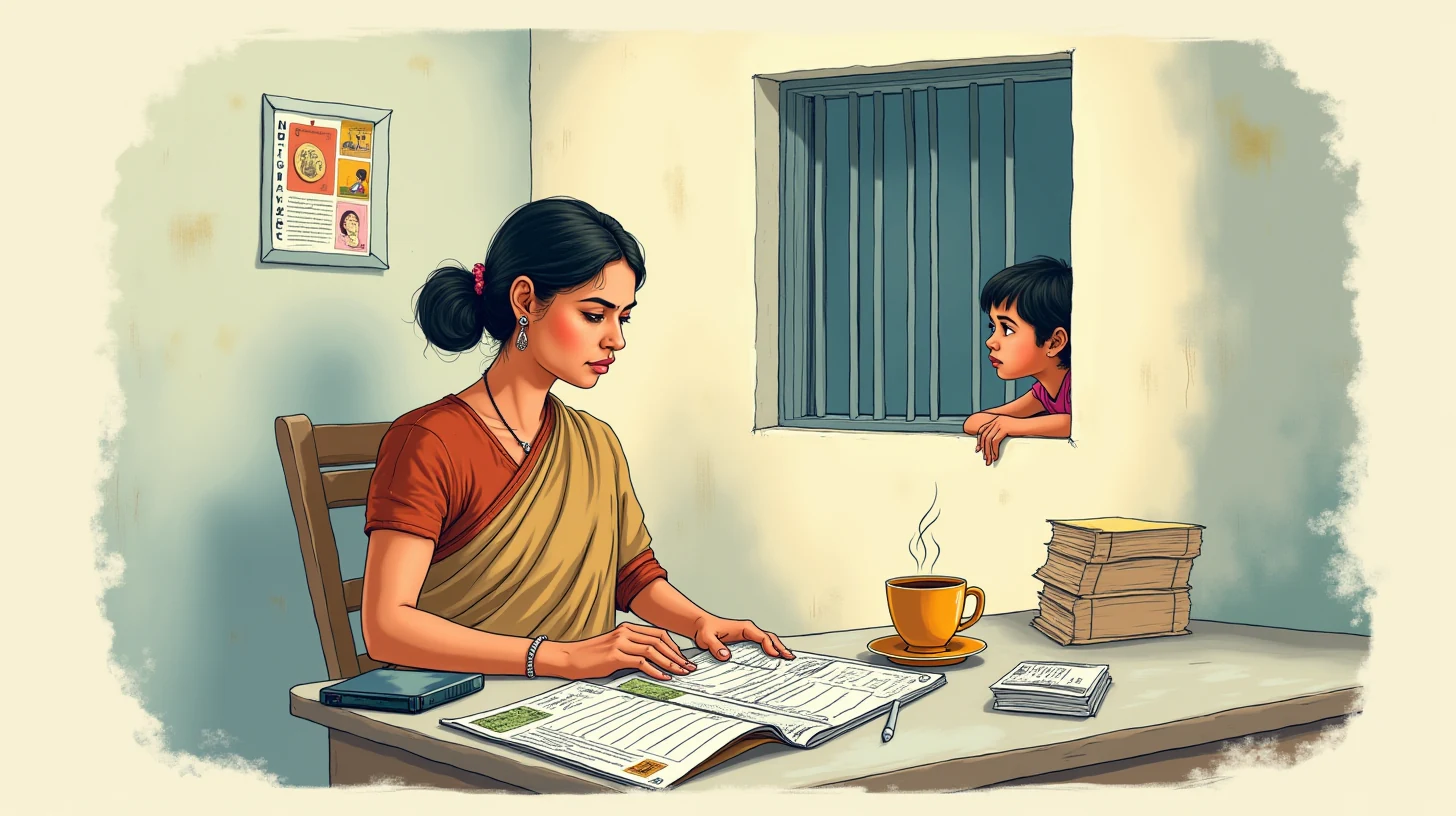
The Nanda Gaura application was online — mercifully, because it meant no Tehsildar queues during her peak sewing hours. She clicked through the portal at nandagaurauk.in, filled in Aanchal''s details, uploaded her birth certificate, her own ration card as income proof. Then came the part that made her pause: "An affidavit confirming that Aanchal is the first or second daughter, and that all information provided is true." The portal told her to print the affidavit form, have it signed by a notary or gazetted officer, and submit it with the birth certificate.
That was fine. Pushpa walked to the Dehradun Stamp Office near the Old Secretariat and asked the clerk what she needed. He handed her a stack of non-judicial stamp papers. On the counter sat papers in denominations of ₹10, ₹20, ₹50, and ₹100. "What size for an affidavit?" she asked. The clerk shrugged. "Go to the Tehsildar''s office. They''ll tell you."
🗓️ The rhythm of scheme seasons
The Nanda Gaura Yojana divides girls into two phases. Phase 1 opens at birth: parents (or guardians) file the affidavit and supporting documents within six months of the child''s birth. The state deposits ₹11,000 into a linked bank account — not as cash, but as a fixed deposit maturing in 18 years. Phase 2 opens after the girl completes Class 12th: a second affidavit unlocks the larger ₹51,000 deposit, maturing at age 18. The scheme is first-come, first-served, subject to annual budget allocation. In Uttarakhand, the deadline for Phase 1 applications is usually pushed back to January each year, and Phase 2 applications close by November.
Pushpa was ahead of schedule. Aanchal had turned five in January; it was only early March. But she had learned from earlier schemes (Sukanya Samriddhi, the PMMVY) that early submission meant less rejection risk. Schemes closed before you finished photocopying. Documents changed. Forms got redesigned and suddenly your submission didn''t match the new template. So Pushpa was moving fast.
The Nanda Gaura rules were clear on the main documents: birth certificate, ration card, Aadhaar, income proof, bank account proof, utility bill, and an affidavit from an anganwadi worker or health worker confirming the child''s birth and the mother''s identity. Nowhere in the rules did it say which stamp paper denomination to use for the affidavit. That was the first clue that trouble was coming.
⚠️ The near-miss
Pushpa walked into the Dehradun Tehsildar''s office on a Wednesday morning in mid-March, clutching her folder of documents. The office was in the old Secretariat building, a mustard-coloured colonial structure that smelled of old paper and floor wax. She stood in the affidavit counter, number 7, behind four other women. One was there for a legal heir affidavit; another for a change-of-name deed. Pushpa held the printed Nanda Gaura affidavit form — a one-page document confirming that Aanchal was her first daughter and that all information was truthful.
"I need a notary to sign this," she said to the clerk, showing the form. He glanced at it, then at the form itself. "Stamp paper?"
"I have it," Pushpa said. She had brought one ₹10 stamp paper and one ₹20, unsure which the scheme required. In her experience, schemes that asked for "an affidavit" without specifying denomination usually meant ₹10 — the lowest denomination used for simple declarations and undertakings across Indian government offices.
The clerk''s expression hardened. "No. This is a government scheme affidavit. You need ₹100 stamp paper. Go buy ₹100 and come back."
Pushpa felt her stomach drop. ₹100 for the stamp paper, plus the notary fees (usually ₹200–300), plus the photocopy costs. That was ₹400 total, almost five per cent of her monthly income. And there was no guarantee the Tehsildar''s office was right.
She walked back out to the street and stood there, phone in hand, trying to decide whether to trust the clerk or check the scheme rules again. The Nanda Gaura portal at nandagaurauk.in had no specific mention of stamp paper denomination. The WCD Department circulars she could find online (mostly through Telegram groups of Uttarakhand mothers) didn't specify either. But the Uttarakhand Stamp & Registration Department website was clear: "Affidavits require a stamp duty of ₹10 only." That was posted on their FAQ page under non-judicial stamp paper usage.
Pushpa had ₹300 in her household emergency fund. If she spent ₹400 now on what might be an incorrect stamp-paper denomination, she would have no buffer if the clinic visit for Aanchal''s vaccination came up, or if the gas cylinder price spiked. She walked back inside and asked to speak to the Tehsildar himself. The clerk told her to come back the next day with an appointment request.
🌗 The moment the agent arrives
That evening, Pushpa sat at her kitchen table with her phone — a three-year-old Samsung that had cost ₹6,500 — and opened the chatbot interface that her neighbour Harini had shown her. Harini''s daughter worked in a startup and had given Harini access to a tablet and a chat-based AI agent that could read Uttarakhand government documents and circulars. It was called "the agent," and Harini said it was free to use for Anganwadi mothers and scheme queries in Uttarakhand.
Pushpa typed in her question: "Nanda Gaura Yojana affidavit stamp paper — ₹10 or ₹100?" The agent took a few seconds, then came back with a response in simple Hindi.
"Nanda Gaura Yojana affidavit ke liye Uttarakhand mein ₹10 stamp paper zaroori hai. Tehsildar office galat kah rahe hain. Stamp & Registration Department ke FAQ mein likha hai: 'affidavit mein ₹10 stamp duty lagti hai.' ₹100 wala stamp paper Nanda Gaura ke liye zaroorat nahi hai — yeh sirf zyada mahangee padd jayega."
(The Nanda Gaura affidavit in Uttarakhand requires ₹10 stamp paper. The Tehsildar''s office is wrong. The Stamp & Registration Department FAQ says: "affidavits require ₹10 stamp duty." ₹100 stamp paper is not necessary for Nanda Gaura — it will only become needlessly expensive.)
The agent also gave her the link to the official Stamp & Registration Department portal and the Nanda Gaura FAQ page that confirmed this. Pushpa read the Hindi carefully, cross-referencing the links on her phone''s small screen. Yes — the department FAQ clearly stated that non-judicial stamp paper for affidavits, declarations, and undertakings required only ₹10. The Tehsildar''s office was conflating two separate rules: the ₹100 maximum denomination available in Uttarakhand (which just meant you couldn''t buy higher), and the actual minimum stamp duty required for different document types (which was ₹10 for affidavits).
The agent then offered to surface the specific government circular that she could take to the Tehsildar''s office. It was from the Uttarakhand Stamp & Registration Department, dated 2024, clarifying the stamp duties for various affidavit types. Pushpa had the agent create a simple one-page printout showing the relevant section, highlighted and translated to Hindi.
- 📱
Early March: Online application submitted
Pushpa fills in Aanchal''s details on nandagaurauk.in, uploads birth certificate and supporting docs. Affidavit form is ready to be notarized.
- 🛑
Mid-March: First Tehsildar office visit
Clerk insists on ₹100 stamp paper for the affidavit. Pushpa, confused, walks out. ₹100 would cost ₹400 total (stamp + notary fees), over 5% of her monthly income.
- ⚠️
Evening: Pushpa checks the scheme rules online
Nanda Gaura portal doesn''t specify denomination. Uttarakhand Stamp & Registration FAQ says ₹10 is correct for affidavits. The office appears to be wrong.
- 🧭
Same evening: Agent consultation via tablet
Pushpa accesses the agent through Harini''s tablet, asks about stamp-paper denomination. Agent confirms ₹10 and provides the official Stamp & Registration circular.
- 📋
Next day: Return to Tehsildar with evidence
Pushpa presents the printed circular from the Stamp & Registration Department. The clerk acknowledges the rule but suggests checking with the sub-registrar. She buys ₹10 stamp paper (₹12 cost) and has it notarized (₹250).
- ✅
One week later: Aanchal''s affidavit is accepted
The notarized ₹10 affidavit is submitted alongside Aanchal''s birth certificate. No further objections. The Phase 1 deposit of ₹11,000 is processed; Pushpa receives confirmation via SMS.
Pushpa printed the one-page circular that the agent generated, and the next morning (after dropping off Aanchal at the Anganwadi), she returned to the Tehsildar''s office. She walked up to the same clerk, placed the circular on the counter, and said quietly, "The rule says ₹10. The Stamp & Registration Department says so." The clerk read it, frowned, and said, "Let me ask the sub-registrar." Twenty minutes later, the sub-registrar came out and confirmed it: ₹10 was correct. The clerk nodded and told Pushpa to come back with the ₹10 stamp paper, notarized.
She did. The notary charged her ₹250 to sign and stamp the affidavit. The ₹10 stamp paper itself cost ₹12 (a small premium over the base stamp duty). Total: ₹262. A third of what the Tehsildar''s office had initially insisted. She submitted it along with Aanchal''s birth certificate, the BPL card, the ration card, and a utility bill. One week later, her phone buzzed with an SMS: "Congratulations. Aanchal has been enrolled in Nanda Gaura Yojana Phase 1. Fixed Deposit of ₹11,000 initiated."
🌗 Why the system fails ordinary homemakers
Pushpa''s story is not unique in Uttarakhand, or anywhere else in India''s welfare-scheme landscape. The Nanda Gaura Yojana is a well-designed scheme — transparent, with a clear online portal, digital submission, and clear eligibility rules. But the bureaucratic machinery at the last-mile (the Tehsildar''s office) is where the rules become ambiguous. The clerk''s error was not malice; it was indifference born of handling dozens of affidavits a day for different purposes (property deeds, legal heir confirmations, caste certificates, change-of-name applications) — each with slightly different stamp-paper requirements. Rather than look up the specific rule for Nanda Gaura affidavits, the clerk defaulted to the highest denomination he could think of. In his experience, ₹100 was "safer."
This happens because:
Schemes don''t always clarify stamp-paper requirements in their main portal or rules. The Nanda Gaura website assumes applicants will know the standard non-judicial stamp-paper denomination for affidavits. It should not. Many homemakers in Uttarakhand file their first affidavit ever for a government scheme. They will guess.
District office clerks are generalists, not specialists. A single Tehsildar''s office issues affidavits for 50+ different purposes across 10+ schemes. The clerk has no incentive to remember the specific stamp-duty rule for Nanda Gaura. He will pick the safest option from his memory, which is often the most expensive.
The cost barrier is real. For a woman earning ₹8,000 a month, ₹400 is not trivial. It''s a choice between the scheme and a doctor''s visit for the child, or a month''s surplus. Pushpa''s hesitation was not paranoia; it was accurate risk assessment. She had no guarantee that the Tehsildar was right.
The rule exists but is not communicated downward. The Uttarakhand Stamp & Registration Department publishes the correct denomination rule on its FAQ page, but the Tehsildar''s office does not cross-reference it when processing Nanda Gaura affidavits. There is no integration, no single source of truth for the district office staff.
The same pattern repeats with other state-level schemes: Mahtari Vandana in Chhattisgarh (affidavit not always specified in the rules), Ladli Behna in Madhya Pradesh (stamp-paper denomination left blank in district office checklists), Subhadra in Odisha (notary fees vary wildly by district). A homemaker applying for her daughter''s Sukanya Samriddhi account faces the same ambiguity — does the affidavit need ₹10 or ₹100 stamp paper? Is it mandatory? Who decides?
The burden falls on the woman. She must navigate the silence, absorb the cost of the mistake, and absorb the time lost to back-and-forth visits.
Official Rule (Stamp & Registration Dept FAQ)
CorrectAffidavits require ₹10 non-judicial stamp paper. This covers all routine affidavits: declarations, undertakings, confirmations. No exception made for government schemes.
Tehsildar Office (First Visit)
WrongClerk insists on ₹100 stamp paper for Nanda Gaura affidavits. No rule cited. Logic is unclear — possibly a defensive overshoot based on other high-denomination documents processed that day.
What Pushpa Actually Needed
Applied₹10 stamp paper (cost: ₹12), notary signature (cost: ₹250), plus 10 minutes of the clerk''s time. Total: ₹262 instead of ₹412. Affidavit accepted without question.
🧭 The systemic argument
The Nanda Gaura Yojana is meant to reduce inequality. A girl from a BPL household — Aanchal — receives ₹51,000 by age 18, money her parents could never save. But the pathway to that money is not equally accessible. It assumes the mother can navigate an ambiguity that the scheme itself creates by not specifying stamp-paper denominations. It assumes she has the time to visit an office, be turned away, research the rule, and return. It assumes she has access to someone (a neighbour, an Anganwadi worker, an AI agent) who can tell her the truth.
For Pushpa, the cost was manageable because she had a neighbour with a tablet and a link to an agent that could read government documents. For a mother in a more isolated village — without internet access, without an Anganwadi worker who cares to help — the cost becomes prohibitive. She pays ₹400, or she doesn''t enrol. Her daughter misses ₹51,000 by age 18. The scheme fails not because it was badly designed, but because the last-mile implementation created friction.
This is the defining pattern of welfare-scheme access for Indian homemakers:
- The scheme is well-meaning. Nanda Gaura is a genuine transfer, a fixed deposit, not means-tested disbursement or subjective grants. It will reach Aanchal.
- The rule exists. The ₹10 stamp-duty rule is published, clear, and applies uniformly.
- But the rule is not local. The Tehsildar''s office does not read the Stamp & Registration Department circular. There is no training, no checklist, no integration.
- So the homemaker absorbs the cost of clarity. She must be the one to resolve the ambiguity, to travel back, to insist, to produce evidence. And she must do this while managing a household, a young child, and a livelihood that cannot pause.
🌱 The quiet close
By May, Aanchal''s ₹11,000 fixed deposit had matured into a locked account at the Uttarakhand Gramin Bank, waiting thirteen years for her to turn eighteen. Pushpa received updates every quarter: the deposit was earning interest, compounding, slowly growing into the ₹51,000 horizon. She had done what the system asked of her, at a cost both financial and temporal.
But something had shifted in Pushpa''s relationship to the state. She no longer assumed that the first answer from a government office was the correct one. She now knew to check the rules, to question, to produce evidence. This is not a failure of her trust — it is a realistic assessment of how bureaucracies work. The clerk is not the rule. The portal is not the rule. The rule is the published guideline, and the homemaker must be the one to enforce it on her own behalf.
Aanchal, now five and a half, played with toys on the kitchen floor while Pushpa sewed, her hands moving in the rhythm she knew. The ₹11,000 was gone from her bank account, but it was safe now — government-guaranteed, untouched, growing for a girl who would turn eighteen in the year 2039. By then, the cost of Pushpa''s inquiry (the ₹262, the three office visits, the evening spent on the tablet) would be invisible. What would remain would be the deposit itself, and the difference it made.
That was all a mother could ask.
"फॉर्म तो ठीक है, पर साथ मे हिदायते नहीं देते कि कौन सा स्टाम्प पेपर लगेगा। अगर कोई दूसरी माता को पूछो तो वो कुछ और कहती है, अगर क्लर्क को पूछो तो वो कुछ और। जब तक अपने आप गवर्नमेंट की वेबसाइट पर नहीं खोजा था, मुझे पता ही नहीं चला कि क्या सही है।"— The form is fine, but it doesn''t tell you which stamp paper to use. If you ask another mother, she says one thing; if you ask the clerk, he says another. I didn''t know what was right until I searched the government website myself.
Sources: