
The Gurgaon homemaker and the Lado Lakshmi enrolment that her Anganwadi worker couldn''t finish
Sunita Yadav sat on the small kitchen-table bench in her DLF Phase 3 flat, a one-inch stack of government papers folded in front of her. It was a Tuesday in early May 2026. Her daughter Khushi, 11 months old, sat on her hip, grabbing at the borrowed Android phone—a cousin''s older model, screen cracked at one corner—where Sunita had been trying to open the "Lado Lakshmi portal" for the past hour.
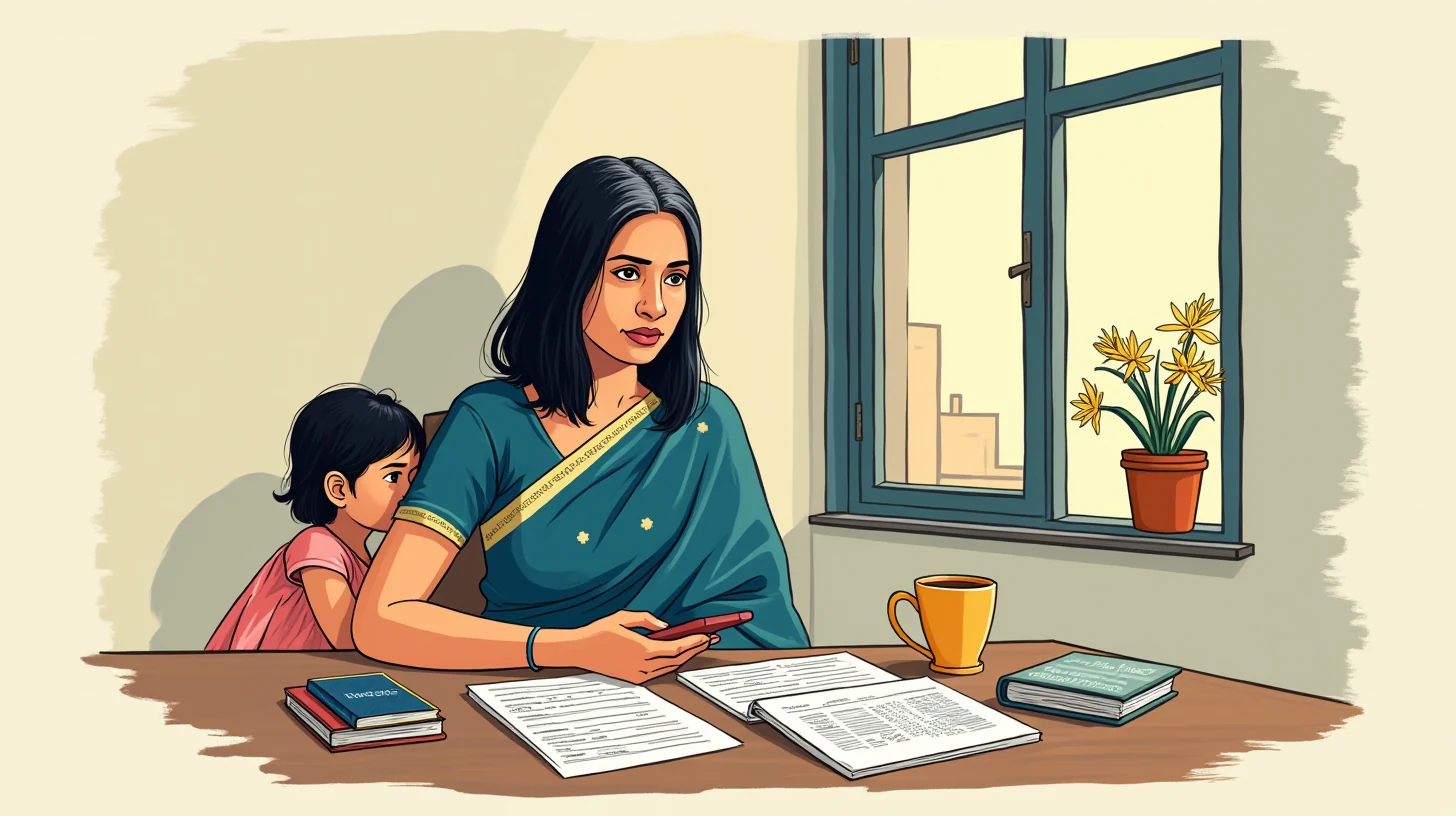
"Your daughter is eligible," the Anganwadi worker, Rekha, had said two weeks earlier during a routine home visit. "The government announced it in February. ₹2,100 every month. It is online only." Rekha had written down a website on a scrap of paper. Sunita had thanked her, tucked the paper into the folder where she kept Khushi''s vaccination cards, and planned to apply after the morning rush—after Khushi''s 10 a.m. feed, after sweeping, after her husband left for his accounting job in Sector 43.
Sunita was 38. She had married at 19, moved to Gurgaon from her family home in Hisar—Haryana state, but a different district, a different cycle of forms and harvest permits and panchayat offices. She had never worked formally. Her father-in-law''s pension, her husband''s salary, and the irregular money from the tiffin service she ran for a small group of office workers in her building (60 dabbas a week, cash in hand) made up the household. They lived carefully. Two rooms, shared bathroom with the family upstairs, a small kitchen where she prepped dal and rice and rotli at 4 a.m. before Khushi woke.
When Khushi was born, Sunita had received the standard calls and visits: the ASHA worker checking vitals, the health centre nurse asking about iron tablets, a pamphlet in Hindi about Janani Suraksha Yojana maternity cash. But Lado Lakshmi was new. The Haryana government had announced it on 25 February 2026—the birth anniversary of Pandit Deendayal Upadhyay, the pamphlet had said, as if the date mattered to Sunita. What mattered was the number: ₹2,100 a month. Once the application was approved, ₹1,100 would go into her bank account every month. The other ₹1,000 would go into a government savings account that would mature after five years. For a family like hers, that was not nothing. That was her daughter''s first set of proper school clothes. That was wheat flour bought in bulk. That was a small buffer against the month her husband''s boss delayed the salary or her tiffin business went quiet in June.
Sunita opened the browser. The Anganwadi worker''s note had said "mahila evam bal vikas haryana dot gov dot in". She typed it in. The page loaded: Haryana Mahila evam Bal Vikas. Department of Women and Child Development. A banner image of women in salwars and sarees, smiling, with a child on a woman''s lap. The layout was clean. There was a section for Lado Lakshmi with a blue button: "Apply Now".
She tapped it.
The page redirected to a form with several fields: name, age, Aadhaar, bank account details. And then, partway down, a field that made her pause: "PMJAY Chirayu Enrolment Status". A dropdown. "Select...". She tapped the dropdown. The options read: "Enrolled", "Not Enrolled", "Unsure".
Sunita was not enrolled in PMJAY-Chirayu. She had never heard of it until that moment.
She tried "Not Enrolled" and tapped continue. An error message appeared: "PMJAY linkage required. Please enrol in Chirayu Haryana first before proceeding with Lado Lakshmi application."
She closed the browser. She opened it again. Same error.
On Wednesday, she called the Anganwadi centre and asked for Rekha. Rekha was surprised. "Linkage? No, no, I have filled many applications. You just enter your Aadhaar. It should work." Rekha offered to visit and help. On Friday morning, Rekha sat across from Sunita at the same table, phone in hand, and tried the form herself. Same error. Rekha took a photo of the error message with her own phone. "I will tell the supervisor. This is not right. The form should not block like this."
But the form did block. And that blockage—a single checkbox, a requirement neither Sunita nor Rekha had anticipated—began to unwind the small, careful logistics of Sunita''s week.
🗓️ The scheme rhythm and the PMJAY precondition
Lado Lakshmi was not a new idea. The Haryana government had long offered maternity benefits through the Pradhan Mantri Matritva Vandana Yojana (PMMVY), a central scheme that gave ₹5,000 in three instalments to pregnant women and new mothers. Lado Lakshmi was meant to go deeper—to give direct monthly cash to mothers of daughters, a gender-targeted supplement. The amount was modest but regular. ₹1,100 a month, every month, deposited into her bank account by direct benefit transfer (DBT).
The eligibility was straightforward, or so it seemed: a woman aged 23 to 60, a resident of Haryana for at least 15 years, family annual income up to ₹1 lakh (a category that included Sunita—her husband earned ₹28,000 a month, her tiffin business was cash-in-hand and unmeasured, her father-in-law''s pension was ₹7,000). She needed an Aadhaar number, a bank account, and proof of residency.
But the Haryana Mahila evam Bal Vikas portal that processed Lado Lakshmi applications was not a standalone form. It was a gateway to the state''s broader health and welfare infrastructure, which had begun, in 2023, to merge all beneficiary records into a single spine: the Parivar Pehchan Patra, or PPP—the Family Register. The PPP was meant to be the single source of truth: income, caste, ration eligibility, land ownership, health insurance enrolment.
And in Haryana, starting in late 2025, health insurance for many schemes had been routed through Chirayu Ayushman Haryana—an extension of the central Ayushman Bharat PMJAY scheme. Chirayu offered ₹5 lakh in annual hospital coverage to families whose PPP data showed income between ₹1 lakh and ₹3 lakh. For Sunita, who had never had to think about health insurance—she went to the government primary health centre, paid a small fee at private clinics—this was a new layer.
The bottleneck was this: the Lado Lakshmi portal checked the PPP database to see if the applicant''s family was linked to PMJAY-Chirayu. If yes, the application proceeded. If no, it stopped.
No one had told Sunita that Lado Lakshmi depended on PMJAY. Rekha had not known either. The pamphlet the health centre had handed out made no mention of it. The rule existed in the system, between departments, in a logic that assumed all families in Haryana''s welfare apparatus were on the same page. They were not.
⚠️ The near-miss and the deadline
By mid-May, Sunita had been trying for three weeks. She had called the Anganwadi centre, the health centre, the district child development office in Gurgaon, and the helpline number printed on an old PMMVY pamphlet. The responses were consistent and useless: "Try again." "It should work." "Clear your browser cache." "Your Aadhaar might not be linked correctly."
No one mentioned PMJAY until she asked directly.
On the phone, a woman at the district office said, "Madam, you need to be on PMJAY-Chirayu first. That is the new rule. Contact the health department."
Sunita did. The Chirayu helpline told her that enrolment was automatic if her family was in the PPP database with income up to ₹3 lakh. But to check, she would need to log in to the Saksham Haryana portal or call a designated ASHA worker in her zone.
There was no ASHA worker in her building. The nearest one, a colleague mentioned, was in a different ward. Sunita did not know which ward she lived in. DLF Phase 3, Gurgaon, was not a village with a clear panchayat boundary; it was a urban colony—numbered flats, a gated entrance, a security guard who noted comings and goings.
A week passed. Sunita had downloaded and printed her Aadhaar and her husband''s (he had PPP too, as the primary earning member of the household). She had her bank passbook. She had Khushi''s birth certificate. But she could not find the ASHA worker, and she could not log in to Saksham Haryana without a state government username. She tried the PPP portal website directly: www.parivarsamrid.haryana.gov.in. The login asked for a "state portal user ID". She did not have one. She did not know how to obtain one.
The Anganwadi centre called again. Rekha said the supervisor had filed a complaint with the district office. "They say your family should be on PMJAY automatically. Can you go to the primary health centre and ask them to check your PPP record?"
On a Thursday afternoon, Sunita took Khushi to the Sector 37 primary health centre, a ten-minute walk from her flat. She waited two hours in the antenatal clinic queue—Khushi fussing, Sunita sweating through her saree—to speak to a nurse who typed her Aadhaar into a dusty desktop computer and said, "Your record is here. But PPP linkage is saying PMJAY status unknown. You need to update it."
"How?" Sunita asked.
"At the district office or through your Panchayat. Or call Saksham Haryana."
Saksham Haryana''s helpline was answered after 40 minutes of hold music (a recording of a government jingle, looped). The operator asked Sunita a series of questions: name, Aadhaar, husband''s name, annual income. Sunita gave them. The operator was silent for a moment, then said, "Madam, your record shows income as ₹4 lakh."
Sunita''s heart dropped. "No. No, we are not 4 lakh. My husband earns 28,000 only."
"The record says 4. If I change it now, there will be a delay. You will need to submit a new income certificate from your employer and the taluka office. Then it will take 10 to 15 days to update."
Sunita sat on the bench outside the health centre, Khushi on her lap, and called her husband. "Your PPP record is wrong. It says 4 lakh instead of 28,000. That is why PMJAY is not linking."
Her husband was quiet. Then: "How did it become 4 lakh?"
"I do not know. The woman said we need a new income certificate from your company and the taluka office."
An income certificate from the taluka office—the tehsil, the block revenue office—required a separate trip, a form, a fee, a visit to a government office in a part of Gurgaon Sunita did not know. She had not left the DLF area in two months except for the health centre and the market. The idea of navigating a taluka office, of sitting in a queue with a baby, of explaining to some official that her PPP record was wrong, was overwhelming.
She did not make the trip that week. Or the next week. By late May, the Lado Lakshmi application remained blank on the Haryana Mahila evam Bal Vikas portal, and Khushi was still not enrolled.
🌗 The pivot and the agent
It was Khushi''s 11-month checkup. The health centre had sent an SMS reminder. Sunita went, and while the child health worker was weighing Khushi, Sunita mentioned, in passing, the Lado Lakshmi trouble.
"Oh," the worker said. "I know someone. There is an AI tool that helps with these things. It is called an agent. It is on a website. Gabforge. A friend of my sister''s used it."
Sunita had no reason to trust this suggestion. She had heard of "AI" only as something that came up in news articles about jobs disappearing, about robots. But she was stuck, and this was a concrete suggestion. That evening, she borrowed her husband''s laptop—he used it for personal spreadsheets and Whatsapp—and opened the website her colleague had written down in capital letters on a piece of paper: gabforge.ai
The site was simple. She navigated to a section called "Agents" and found one listed as "Bureaucracy Guide". There was a button that said "Start a conversation". She did. She typed a description of her problem in Hindi: "Mera PPP record galat hai. 4 lakh likha hai par hum 1 lakh se kam earn karte hain. Lado Lakshmi ke liye PMJAY link karna padega par Saksham Haryana ne income fix nahi kiya."
(My PPP record is wrong. It says 4 lakh but we earn less than 1 lakh. I need to link PMJAY for Lado Lakshmi but Saksham Haryana hasn''t fixed the income.)
She submitted. A few seconds later, the agent replied. It began by confirming what she had said: that yes, the PPP record error was blocking PMJAY enrolment, which in turn was blocking the Lado Lakshmi application. Then it did something unexpected. It broke down the steps:
- Obtain an income certificate from her husband''s employer confirming his salary.
- File an application at the taluka office (revenue block) in Gurgaon with the corrected income certificate.
- The taluka office would update the PPP record within 5 working days.
- Once updated, log back into Saksham Haryana and trigger a PMJAY linkage refresh.
- Return to the Lado Lakshmi portal and complete the application.
The agent also provided the address and phone number of the Gurgaon taluka office, the list of documents she would need, and a sample format for the income certificate request she could give to her husband''s company HR department.
What struck Sunita most was not the information—she could have gathered some of this herself if she had the time or the determination—but the structure. The agent had taken her half-formed complaint and returned it as a sequence. It had taken the chaos and given it a shape.
She printed the agent''s reply. She gave it to her husband. "This is what I need to do," she said. "It says here: ask HR for this form. Then we go to the taluka office."
Her husband read it. His expression shifted from skepticism to something like relief. He knew what forms looked like. He knew how to ask HR for something. He knew where the taluka office was. He took a copy to work the next day.
🧭 Why the system fails ordinary homemakers
Lado Lakshmi was, in its design, a direct-cash scheme. It bypassed most of the discretion that plague older welfare programs. No recommendation letter from a sarpanch. No proof of ownership of land. No character certificate. Just: are you a woman aged 23–60, a 15-year resident of Haryana, with family income under ₹1 lakh? If yes, money into your bank account.
Except that this simplicity lived only in the scheme''s official description. The actual implementation depended on a chain of prior conditions that most women like Sunita did not know existed. To be eligible for Lado Lakshmi, you now had to be in the PPP database—the state family register. To access the PPP, you had to have your record verified, and that verification depended on the accuracy of a dozen details that had been entered by a clerk, months ago, in a block office. If even one detail was wrong—income, caste, address—the digital chain broke.
And once broken, the chain did not repair quickly. Updating a PPP record required visiting an office, submitting a form, waiting 5–15 days, checking back, and hoping the update had actually propagated to all the systems that fed from it. This loop was invisible to the scheme itself. The Lado Lakshmi portal did not explain it. The Anganwadi worker did not know it. The helpline operator did not volunteer it. A woman had to discover it through trial and error, or through luck—a health worker who happened to know about an AI agent, or a relative who had navigated the same tangle before.
Sunita was not alone. Across Haryana, thousands of women were eligible for Lado Lakshmi but could not complete the application because their PPP record showed the wrong income, or no income, or an income linked to a now-deceased relative (in one common case, widows whose PPP records still showed their husband as the earning member, even though he had passed years ago). Some had never created a Saksham Haryana username. Some did not know the difference between the PPP portal, the Saksham Haryana portal, and the Lado Lakshmi portal—there were three separate login screens, and if you got the name wrong, you landed in the void.
This was not a failure of the scheme. It was a failure of the ecosystem that held it. The Haryana government had woven all its welfare schemes into a single database, expecting that this would simplify access. But simplification at scale required that every woman be visible in the database, and be visible correctly. It required that updating a record be as easy as calling a helpline, or that Anganwadi workers be trained to help women update their own records, or that the Lado Lakshmi portal itself offer a direct path to fix PPP errors before blocking the application.
None of these existed. The result was that the women most likely to benefit from Lado Lakshmi—those with irregular income, those who had never registered for a government scheme before, those whose household records had drifted out of sync with their reality—were the ones most likely to be stuck outside it.
An Anganwadi worker in a neighbouring district, speaking anonymously to a journalist in April 2026, had put it simply: "The scheme is good. But the system does not trust new people. If you have never filled a government form before, every box is a trap."
🌱 The quiet close
By early June, Sunita''s husband had obtained the income certificate from his company. It stated clearly: annual salary ₹3,36,000. A clerk at the Gurgaon taluka office had reviewed the documents, stamped them, and told him to come back in a week. Sunita had waited, then logged back into Saksham Haryana. The operator who helped her seemed to have better access; she found the updated income certificate, confirmed it, and said, "Now I am linking you to Chirayu. It will take 24 hours to show in the system."
Twenty-four hours later, Sunita tried the Lado Lakshmi application again. The PMJAY dropdown now showed "Enrolled". She filled in the rest of the form. She submitted.
A message appeared: "Application received. You will receive confirmation via SMS within 3 business days."
The confirmation came on a Friday. Khushi was now 12 months old. In the SMS, it said the application was approved. The monthly payment would begin in July, after a final verification. The amount was ₹2,100—₹1,100 monthly, ₹1,000 into a government savings account.
Sunita did not celebrate. She had learned enough not to. She screenshotted the SMS. She saved it to a folder on her phone titled "Lado Lakshmi". She told Rekha, the Anganwadi worker, who said, "Good. I will make a note in my records that Khushi is enrolled."
On a hot afternoon in mid-June, Sunita sat in her small kitchen and did the math. ₹1,100 a month. That was fifteen kilos of ghee. That was four school uniforms, with some left over. That was a buffer. In five years, when the ₹1,000 monthly deposits matured into a recurring deposit, there would be ₹60,000. She would not touch it. It would be for Khushi''s intermediate school, maybe a laptop to study with, maybe a boarding hostel if she chose to study in Delhi or Mumbai.
The system that had held this money back had not done so out of malice. It had held it back because the state had built its welfare apparatus as a series of checkpoints—each designed to prevent fraud, to verify that money went only to those truly eligible—and had not bothered to explain the checkpoints to the people they affected. A woman who had lived in Gurgaon for 22 years (Sunita had moved there at 16 when she married), who had borne and birthed her children there, who paid her electricity bills there and stood in queues at the government clinic, could still be invisible in the PPP database until a clerk was paid to update her record.
This was the ordinary life of an Indian homemaker in 2026: not without schemes or support, but living at a constant distance from them—close enough to see the money, too far to reach it without help. Close enough that the failure felt personal, even though it was clearly systemic.
- 📨
May 1–3: Anganwadi worker mentions Lado Lakshmi
Rekha hands Sunita a scrap of paper with the portal URL. No mention of PMJAY requirement.
- 🛑
May 5–10: First attempt blocked
Sunita fills the Lado Lakshmi form. At the PMJAY dropdown, an error appears: ''PMJAY linkage required.''
- 📞
May 12–20: Helpline loop
Calls to Anganwadi centre, health centre, district office, Saksham Haryana. Each refers her elsewhere. No clear path to fix PPP.
- ⚖️
May 22: PPP record audit
Health centre nurse discovers PPP shows ₹4 lakh income (wrong). Correct income needs new certificate from taluka office. 10-15 day wait.
- 🌐
May 28: Pivot to agent
Health worker mentions Gabforge AI agent. Sunita uses it, receives a step-by-step breakdown of what to do.
- 📋
June 3: Income certificate obtained
Husband gets certificate from HR, files at taluka office.
- ✅
June 10: PPP updated, PMJAY linked
Sunita tries Saksham Haryana again. Record shows ₹3,36,000. Operator links to Chirayu.
- 💸
June 12: Lado Lakshmi application approved
Sunita resubmits form. Application accepted. ₹1,100 monthly payment to begin in July.
The Scheme
What you hearLado Lakshmi: ₹2,100/month for mothers of daughters, aged 23–60, income under ₹1 lakh, 15+ years in Haryana. Online application. Direct deposit.
The PPP Database
What must be true firstYou must be registered in Haryana''s Parivar Pehchan Patra with correct income, caste, address. Any mismatch blocks the scheme.
The PMJAY Linkage
The hidden preconditionThe Lado Lakshmi portal requires PMJAY-Chirayu health insurance linkage, which is automatic only if your PPP record is correct and current.
"Mujhe lag gaya tha ki ₹2,100 likha hai portal par, par wo paise mere account mein aa nahi raha kyunki mere naam ke aage likha tha 4 lakh ki income. Har jagah phone kiya—samaj hi nahi aaya kisi ko ki ye linkage wagairah kya hota hai."— I thought the ₹2,100 was written on the portal, but the money wasn''t coming to my account because they had written ₹4 lakh next to my name. I called everywhere—nobody could explain what this linkage business was.
"Aapka PPP record update hona padega pehle. Taluka office jao, nayi income certificate de do. Phir Saksham portal mein PMJAY ko trigger karo. Phir Lado Lakshmi form dobara bharo. Ye teeno separate portals hain, lekin ek dusre se linked hain."
(Your PPP record has to be updated first. Go to the taluka office, submit a new income certificate. Then trigger PMJAY in the Saksham portal. Then refill the Lado Lakshmi form. These are three separate portals, but they''re linked to each other.)