
The Guwahati homemaker and the Orunodoi DBT that paused
Pranita Boro had been expecting the SMS for seven years. Every month since 2019, the text would arrive by 10 a.m.: your Orunodoi credit of ₹1,250 has been processed. She would tell her husband, Prabhat, in the kitchen while warming the morning tea. By afternoon, the money would land in the joint account she maintained at Assam Gramin Vikash Bank on Zoo Road. It was never enough to be careless with, but it was enough. A bag of rice from the holesale market in Bhangagarh. Cooking oil. The electricity bill that arrived on the 15th. Medicine for her mother-in-law's blood pressure, which Pranita refilled every six weeks.
In February 2026, the SMS stopped coming.
Pranita, 41, lives in a second-floor flat in Beltola, a quiet neighbourhood northwest of central Guwahati where retirees and school teachers and small-business families keep apartments the size of her grandmother's entire house. She had been running a tiffin service for fifteen years—dabas, methi parathas, luchis, egg curries—a one-woman operation that fed office-workers and college students from a shared kitchen in a nearby residential compound. The service brought in 800 to 1,200 rupees a week, cash, enough to pay her sister-in-law (who helped with packing) and keep the diesel stove running. But Orunodoi had been the certainty. The breathing room. The month her knees went bad and she couldn't kneel to grind spices, Orunodoi kept the utilities on.
On 27 February, she logged into the Sewa Setu portal—Assam's e-District gateway—to check the status of her monthly transfer. The portal, which had always shown a green "Approved" tag beside her name, now displayed a yellow notice: Household income threshold exceeded. Eligibility suspended pending review. Below it, a case reference number beginning with OD-2026-, and a note: "Please contact the Orunodoi Cell at Janasanyog Bhawan, Guwahati, for details."
Prabhat, her husband, had taken on a freelance data-entry contract in early January through a neighbour who worked at a private logistics company. The project lasted six weeks. He was paid a lump sum of ₹40,000 on 1 February. To file his taxes—he had never filed before—Pranita had helped him register as a sole proprietor and file a GSTR-1 form, listing the January-February revenue as ₹40,000. Within two weeks, the Orunodoi system had flagged the household and suspended her benefit. The algorithm had read the ₹40,000 as monthly recurring income, calculating an annual household total of ₹4,80,000, well above the ₹2-lakh threshold.
The irony was not lost on her: she had done the bureaucratic work correctly—reported the income, filed the forms—and been penalized for it.
🗓️ The Scheme, the Threshold, the Silence
Orunodoi means "that which brings light" in Assamese. The scheme began in October 2020, during the first pandemic lockdown, as a direct cash transfer of ₹1,000 per month to economically weaker households headed by women. By 2024, it had expanded to "Orunodoi 2.0," increasing the transfer to ₹1,250 and the eligible household base to 17 lakh women. In October 2025, the Assam government launched Orunodoi 3.0, expanding the beneficiary pool to 37 lakh women—nearly 40 per cent of the state's adult female population.
The eligibility rule is simple, in print: annual household income not exceeding ₹2 lakhs. A woman aged 18 or above. Permanent residence in Assam. Enrollment under the National Food Security Act (NFSA), which qualifies households for rations. That is the rule.
In practice, the rule lives inside a government portal. Pranita's household income was determined not by a caseworker visiting her Beltola flat, not by a careful examination of her account books from the tiffin service, not by a conversation with her or Prabhat. It was determined by data entry in the Sewa Setu system. Once entered, the threshold operated like a guillotine: above the line, suspended; below the line, approved. There was no appeals queue for families like hers. There was a waiting list.
The Orunodoi Cell, the local implementation office, was located on the third floor of Janasanyog Bhawan, a five-storey colonial brick building on Mahatma Gandhi Road, in the heart of the city. When Pranita called the main line on 1 March, a woman with a tired voice said: "You can submit a correction form at the office. The queue is six weeks right now. Come on a Thursday morning." Thursday was when the Cell processed appeals. The next available Thursday, after accounting for public holidays, was mid-April.
- ⚖️
1 January – Prabhat takes freelance data-entry contract
Six-week project through a private logistics firm, payment on completion.
- 💸
1 February – Lump-sum payment of ₹40,000
Full project fee paid as a single transfer, not monthly installments.
- 📋
10 February – GSTR-1 GST filing
Pranita and Prabhat register his data-entry work as a business, declare ₹40,000 revenue for Jan–Feb.
- 🛑
27 February – Orunodoi portal flags household
System reads ₹40,000 GSTR entry as monthly recurring, calculates ₹4,80,000 annual income, suspends Pranita''s benefit.
- ⏰
1 March – Waiting list opens
Janasanyog Bhawan Orunodoi Cell records Pranita''s case. Six-week queue until mid-April appeal hearing.
Pranita had filed correctly. She had done what the tax form asked. The algorithm, though, did not know the difference between a freelance one-time contract and a sustained monthly business. It did not know about diesel stoves and dabba orders and knees that went bad. It knew only: income on portal, threshold exceeded, flag household. And once flagged, it took six weeks of waiting to be unflagged.
⚠️ The Near-Miss: ₹3,750 in February, March, April
The arithmetic of a paused benefit moves fast when a woman is living month-to-month.
February was the month Pranita's mother-in-law needed a CT scan. Not an emergency—her blood pressure had been high for years, and a local clinic had recommended imaging to rule out kidney issues. The scan cost ₹2,800. Pranita paid it from her tiffin savings, dipping into the small cloth bag she kept in the Godrej steel almirah. She had planned to use the Orunodoi transfer to replenish it. The transfer did not come.
March was worse. The landlord of the shared kitchen compound sent a message: the diesel stove would be shut down for two weeks (15–29 March) for annual maintenance on the shared plumbing. Pranita would lose the income those weeks. She had planned, tentatively, to ask Prabhat for extra money to cover the shortfall. But Prabhat's freelance contract had ended. He was back to doing occasional data-entry work at home—a few hundred rupees a week if he was lucky. And in mid-March, he developed a severe cough that kept him bedridden for ten days.
By 20 March, Pranita had used ₹1,850 from her backup fund (which should have been untouched) to cover medicine (₹450), part of the April rent (₹800), and a top-up for her sister-in-law, who helped with the tiffin packing (₹600). She was waiting for the Janasanyog Bhawan appointment. She was waiting for Prabhat's cough to clear. She was waiting for the diesel stove to come back online. And she was watching the math: Orunodoi should have been ₹3,750 by now (three months). Her backup fund was down to ₹600.
She did not call the Cell again. She did not file a formal complaint. She simply waited, and conserved.
Expected: Orunodoi 3-month total
Baseline plan₹1,250 × 3 months = ₹3,750. To be spent: mother-in-law scan (₹2,800), utilities/oil (₹950).
Actual: Income crisis
February–AprilTiffin service: ₹800–1,200/week. Prabhat''s income: ₹0 (contract ended Jan). Stove shutdown: ₹0 (March 15–29).
Result: Backup fund depleted
Risk threshold₹1,850 withdrawn to cover scan, rent, wages. Balance: ₹600. One serious illness or rent delay = debt.
🌗 The Pivot: A Neighbour, a Tablet, and the Verification Game
On 8 April, two days before her appointment at Janasanyog Bhawan, Pranita's neighbour Deepika mentioned, casually over the balcony railing, that an "AI aunt" on a tablet could help with government forms. Deepika's daughter had used it to track her own maternity benefit. Pranita had heard the term used loosely—some people called anything computer-based "AI"—but she was curious. Deepika gave her a phone number.
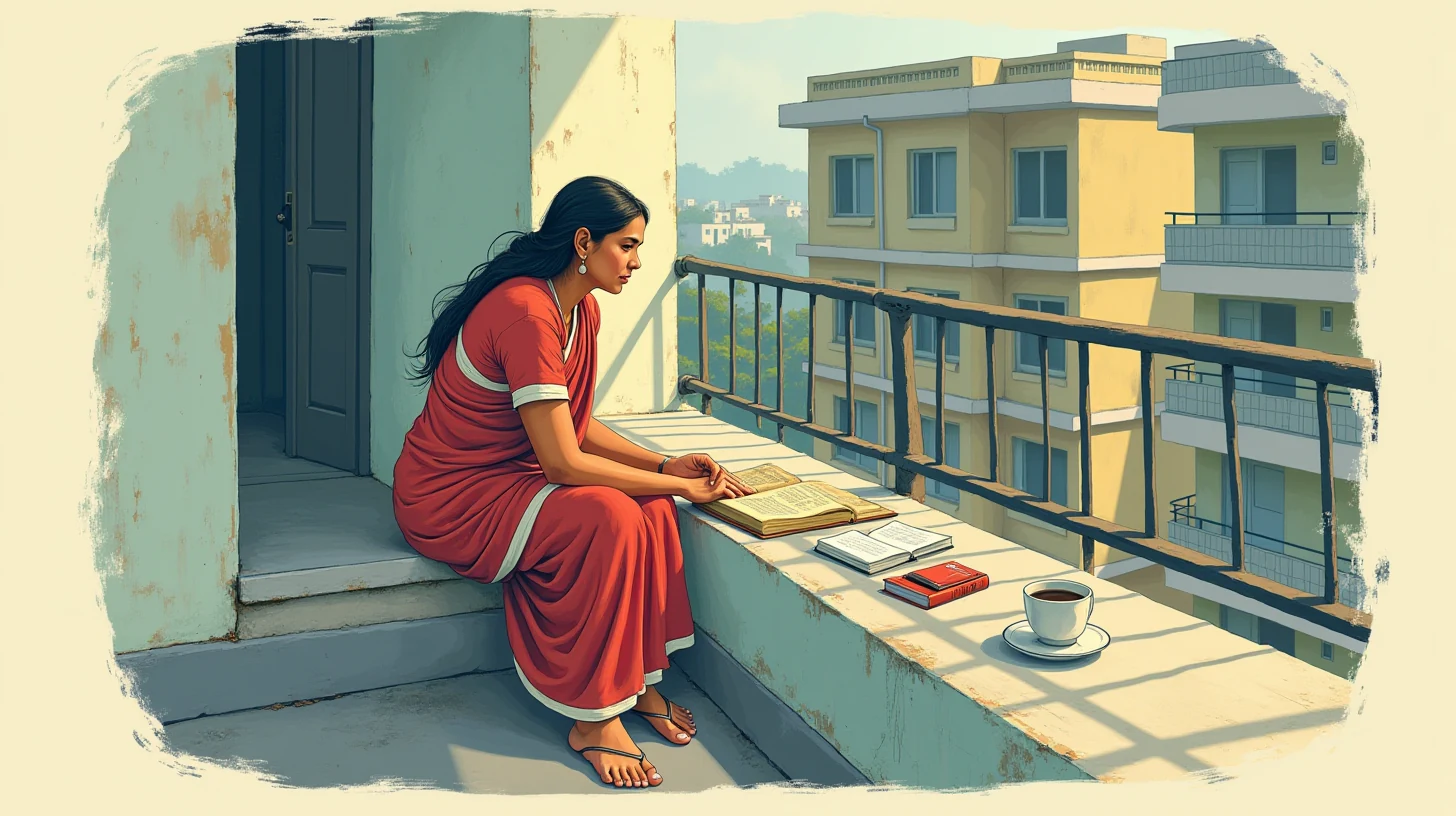
The agent arrived on a small Android tablet, accessed through a public Telegram link. Pranita, sitting on her balcony with a cup of tea, described the situation: the lump-sum payment, the GSTR filing, the portal flag, the waiting list. She pulled out her Aadhaar, her bank passbook, and the GSTR-1 form printout.
The agent asked for the exact date of the ₹40,000 transfer, the exact date of the GSTR filing, and whether the GSTR had a field for "period" or "financial year." Pranita scrolled through the GSTR-1 form while the agent watched and noted. Yes: it listed "January–February 2026" as the period, and "₹40,000" as the turnover for that period.
The agent then displayed a critical piece of information: the Sewa Setu system had flagged the household based on an "annualized monthly average" calculation. That calculation was: ₹40,000 ÷ 2 months = ₹20,000/month, × 12 months = ₹2,40,000 annual. The system had done the math correctly given the data. But the data was incomplete. The GSTR-1 form, when filed, should have been accompanied by a note clarifying that ₹40,000 was a one-time project fee, not monthly revenue. Without that note, the system had no way to distinguish.
"গাহরী ডকুমেন্টত, প্রজেক্ট ফি দেই আলোদা লাইন লিখলে, পোর্টাল অটোমেটিক মাসিক আয় হিসাব কৰা নাইবা। প্রজেক্ট ফি লিখিবলা হয় সিঙ্গেল ট্রানজাকশন। আপোনার GSTR-ত ই লিখা আছে 'জানুয়ারি–ফেব্রুয়ারি সিক্স উইক' কিন্তু সিস্টেম পইড়া মাসিক সবে ভাগ কৰিছে।"
(If you had written on the GSTR that the fee was for a specific six-week project—a single transaction—the portal would not auto-calculate monthly income. The system would have read it as non-recurring. Your GSTR says "January–February, six weeks," but the system divided it by months.)
Pranita's eyes widened. "So the problem is... I need to prove it wasn't monthly?"
"হা। আপোনাক একখান সাপ্লিমেন্টারি লেটার দিবলা লাগিব—তাৰ মেইল হ'ল, প্রজেক্ট ফি, একক পেমেন্ট, ছয় সপ্তাহ মেয়াদ। আৰু Janasanyog Bhawan-লৈ নিয়া যাওক। আগামী বৃহস্পতিবাৰ।"
(Yes. You need a supplementary letter stating it was a project fee, a one-time payment, covering a six-week period. And bring it to Janasanyog Bhawan on Thursday.)
The agent showed Pranita a template for such a letter—a simple, one-paragraph statement that Prabhat could write or have typed, signed by both of them, dated. The agent even noted the specific clause in the GSTR rules (Section 11 of the GSTR-1 instructions) that allows for clarifications about non-recurring income. Pranita had not known this clause existed. She had thought the GSTR form was final, unchangeable.
By the morning of Thursday, 17 April, she and Prabhat had the letter typed by a small-shop cybercafé near her tiffin kitchen, signed and stamped with the family register as proof of signature. She brought it to Janasanyog Bhawan.
🧭 Why the System Fails, and Who Else Waits
The Orunodoi scheme, in its design, assumes a certain kind of household income: a steady salaried job, a small farm, a regular small business, a pension. Income that is consistent and predictable. For such households, the annual threshold of ₹2 lakhs is a reasonable proxy.
But India is a country of freelancers, project workers, seasonal labourers, gig workers, and cash-based small businesses. A woman like Pranita, whose husband has just moved from full-time work to contract-based work, finds herself in a blind spot. The system does not have a category for "one-time large payment." The system knows "monthly income" and "annual income." A six-week contract does not fit neatly. And when the portal cannot classify something, it defaults to the most conservative interpretation: treat a lump sum as if it were monthly recurring, and flag it.
This is not malice. It is automation without nuance.
Across Assam, there are an estimated 4.2 million women eligible for Orunodoi 3.0. Many of them live in households where income is irregular—domestic work, stitching, temporary labour, vendor work, government contract positions. A woman whose husband gets work as a mason three days a week, paid in cash, has no way to prove what his "annual income" is. A woman whose eldest son works in a garment factory during the busy season and returns home in the off-season has no way to average the income. And the system, presented with irregular or seasonal income, tends toward the harsh interpretation.
The Janasanyog Bhawan office has no record of how many households have been flagged for income misclassification. When Pranita asked a staff member (after submitting her supplementary letter), the woman said: "Many. You're not the only one." She did not offer a number.
What is known: between February and April 2026, Orunodoi received over 18,000 eligibility-correction requests across the state. Guwahati district accounted for 3,200 of them. The Orunodoi Cell has a staff of four full-time reviewers. At the current pace, a household flagged in late February would not see a final decision until early June—four months of suspended benefits.
For a woman running a tiffin service, living month-to-month, four months is the difference between keeping the lights on and taking a loan.
🌱 The Quiet Knowledge
By mid-May, Pranita had still not received formal confirmation that her benefit had been restored. She called Janasanyog Bhawan on a Tuesday afternoon. The staff member she reached—the same woman who had taken her supplementary letter in April—said: "The letter was reviewed. Your case is now showing as 'pending re-approval.' Next payment should process on the 1st of June." There was no formal reinstatement letter. There was no apology, no explanation of what went wrong. Just a voice on a phone saying "next payment" as if the three-month pause had been a small clerical hiccup, not a rupture in a family's budget.
Pranita had learned something during those four months. She had learned that a government system could appear absolute—a green checkmark or a yellow warning—but still be wrong. She had learned that the wrongness could often be fixed, but only if you knew it was wrong, and only if you had the vocabulary to argue about it (supplementary letter, non-recurring income, GSTR clarification). She had learned that the people who help you do this work—the neighbour with the tablet, the cybercafé typist, the woman at Janasanyog Bhawan who actually read the supplementary letter—are not paid to be patient, and so patience itself becomes a privilege you have to generate yourself.
"মই ঠিককৈ কৰিছিলো — ট্যাক্স ফর্ম ভৰাইছিলো, কাগজ দিছিলো। কিন্তু চিস্টেমে বুজা নাই। এতিয়া মই জানো যে বুজোৱাটো মোৰ কাম।"— I had done everything correctly — filed the tax form, submitted the papers. But the system did not understand. Now I know that explaining it is also my job.
She had not learned these things in school. She had learned them by living through a pause, and by refusing to disappear into it.
On the first of June, the SMS arrived at 10:07 a.m.: your Orunodoi credit of ₹1,250 has been processed. Pranita showed the message to Prabhat in the kitchen, the same way she had for seven years. By afternoon, she would see the deposit in her bank account. She would replenish the cloth bag in the Godrej almirah. The tiffin service would continue. The bills would be paid. And somewhere in Guwahati, at Janasanyog Bhawan, another woman's supplementary letter would be waiting in a stack of files, filed under a six-week wait.
Schemes Mentioned:
Orunodoi 3.0 Scheme (Finance Department, Government of Assam): Monthly direct cash transfer of ₹1,250 to eligible women aged 18+ in economically weaker households. Eligibility threshold: household income not exceeding ₹2 lakhs per annum. Check status and apply via Sewa Setu portal or contact the Orunodoi Cell at Janasanyog Bhawan, Guwahati.
Sewa Setu — Assam e-District Portal (General Administration Department, Government of Assam): Single-window digital access to 300+ government services across Assam. Use to check scheme eligibility, submit documents, and track application status. Helpline: 1800-345-3574 (8 a.m.–8 p.m.).