
The Hyderabad widow and the Aasara pension community-certificate gap
Padmaja Reddy was fifty-one when her husband died. Not from illness—at least not one the doctors had a name for. Ramesh had been an autorickshaw driver in Hyderabad, the kind of man who left before dawn and came back as the sun dropped, who talked to his regulars about their kids'' schools and the price of petrol, who sent half his daily earnings straight to the groceries and the rent. He had been doing that for twenty-eight years. On an evening in early October, after a run to the airport, he pulled over in Khairatabad to rest. He never woke up.
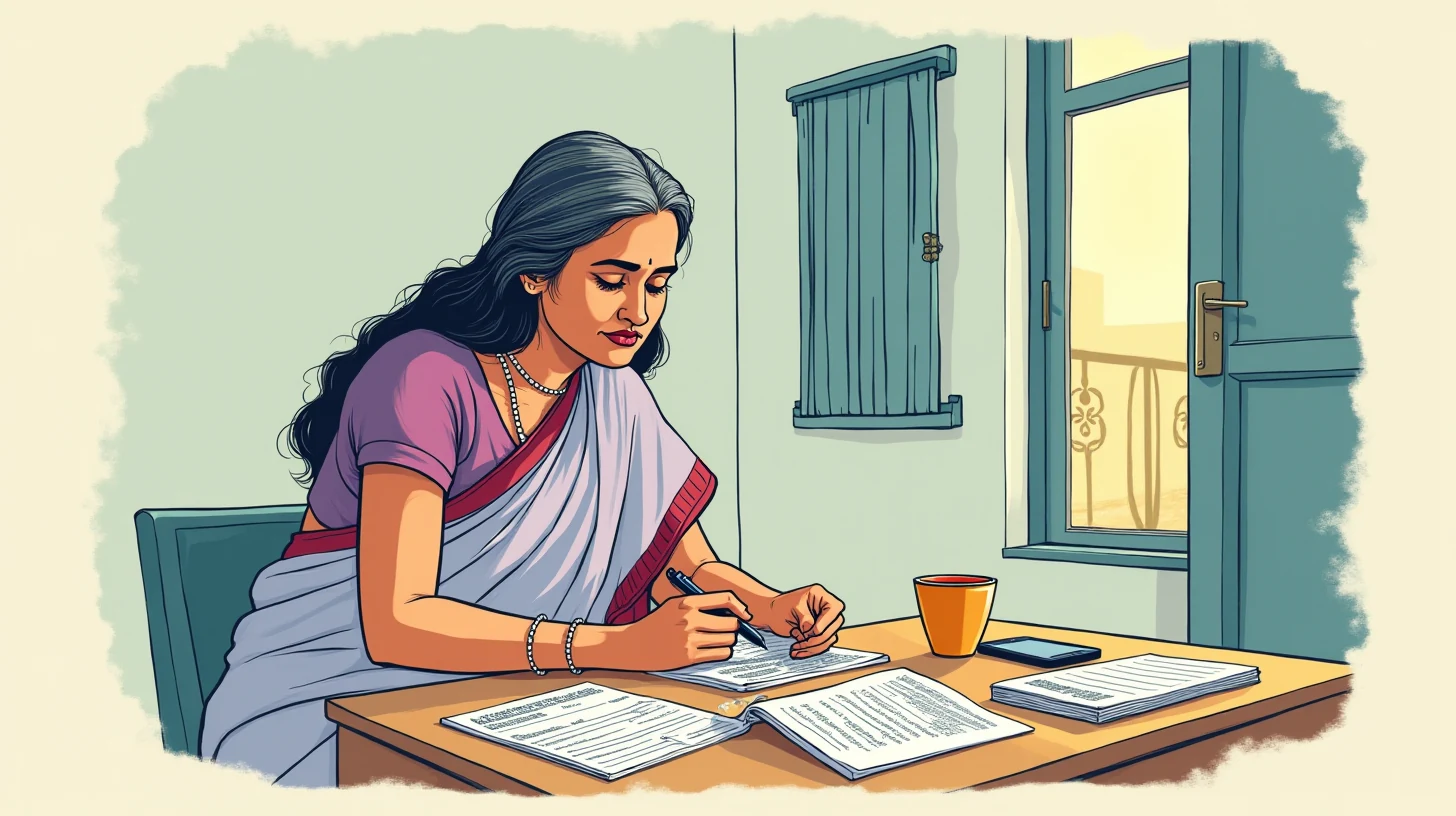
The death certificate came two weeks later. The hospital discharged him into the bureaucracy.
Padmaja had no savings. The autorickshaw was rented from a man she had never met. The flat—two rooms, a kitchen the size of a cupboard, a balcony where she now hangs washing—cost ₹4,500 a month. Without Ramesh, that ₹4,500 came from nowhere. She had raised two daughters in that flat; both were married now, living in Bangalore and Pune, calling home on Sundays. They sent money when they could, but they had their own children, their own rents. The older daughter was pregnant. Padmaja was a grandmother and, for the first time in her marriage, afraid of the ordinary morning—the tea, the electricity bill, the thought of next month.
Three weeks after Ramesh''s death, a neighbour, Mrs. Vijayadevi, came to her door with a MeeSeva brochure. ''The government gives money to widows now,'' she said, as if saying it simply made it true. ''Not much, but enough. It comes every month.'' The amount was ₹2,016. Padmaja did the math in her head. It would not cover the rent, but it would cover the groceries. And groceries were what mattered on days when her daughters could not reach.
🗓️ The waiting room
The Aasara pension scheme is a Telangana state programme that sends monthly stipends to vulnerable populations—widows, the elderly, people with disabilities, those too sick or too poor to work. The widow pension amount, ₹2,016 per month, has been stable for three years. It is not generous, but it is reliable, and in a home like Padmaja''s, reliability is a luxury. The state processes applications through two channels: the district administration (where the Tahsildar''s office manages verification) and the MeeSeva portal, where residents file documents online.
The annual calendar is simple. Applications open year-round. Processing takes up to 60 days under normal circumstances—a term that means roughly nothing when you live in a mandate designed in the 1950s and run on systems updated three times in two decades. Once approved, the pension is transferred by electronic fund transfer directly to a bank account. No visits to the office every month. No collecting a cheque. The money arrives on the 7th, predictable as the dawn.
But there is a condition. Before the Tahsildar approves the widow pension, Padmaja must prove she is domiciled in the area where she is claiming the pension. She must have a ration card (she did), a residence proof (she had the rent agreement), a death certificate (certified copies, she had three), and—here the logic twists—a community certificate issued in her current mandal confirming her caste and residence.
Padmaja had lived in Khairatabad for twelve years. But the community certificate—the white card that Mrs. Vijayadevi pointed to—was issued in her maiden district, Nalgonda, where her family originally lived. Somewhere in that gap between then and now, the mandal boundaries had redrawn. Her original certificate was valid, the Tahsildar''s office said, but it needed to be "cross-verified" with the Nalgonda Tahsildar. And that process, they said, would take "some time."
⚠️ The five-month wait
The application was filed on November 12th. By November 30th, Padmaja had received a text message saying her application was "under review." The text came from the automated MeeSeva system; it was not a promise, only a receipt. December passed. She called the MeeSeva help desk on her old Android phone—the numbers were small, and the young man on the other end spoke very fast. He told her the application was "with the cross-verification officer" and she would "hear soon." The word ''soon'' can mean anything. Soon came and went.
January. February. The rent was due again. She borrowed ₹5,000 from her older daughter, promising to pay it back when the pension came through. The daughter did not ask when that would be. By mid-February, Padmaja called the Nalgonda Tahsildar''s office directly. A woman with a heavy accent told her that the file had arrived but that the officer responsible for "inter-district verification" was on leave. She would be back on March 8th. Padmaja wrote the date on a calendar she kept by the phone.
March 8th came. She called again. No answer. She tried on March 9th, March 10th. On March 12th, a man who sounded like he was speaking from inside a busy room said the file was "moving through the system" and she should "not call repeatedly." She did not call after that. Instead, she started checking the MeeSeva portal twice a day, refreshing the page the way people refresh news feeds, as if the frequency of looking might speed up the verdict.
By late March, she had spent ₹2,000 from savings that had already been counted twice. She was buying the cheaper rice now, the kind that broke when you cooked it. She was in the peculiar waiting room of the poor—not yet in crisis, but close enough to see it.
- 📨
November 12 — Application Filed
Padmaja submits the widow pension application through MeeSeva with death certificate, ration card, and Nalgonda-issued community certificate.
- ⏰
November 30 — ''Under Review'' Message
Automated SMS confirms receipt. Processing window begins. Normal processing time: 60 days. Padmaja starts counting weeks.
- 🛑
January — Cross-Verification Stalls
Tahsildar''s office tells her the community certificate must be verified with the original-issuing mandal in Nalgonda. File is in transit but encounters delays.
- 📞
February-March — Repeated Follow-ups
Padmaja calls the Nalgonda office. Officer on leave. File ''moving through the system.'' She is asked not to call repeatedly. Uncertainty hardens into frustration.
- ⏳
April 15 — Five Months Elapsed
Still no approval. The pension remains un-transferred. Padmaja has borrowed ₹5,000 from her daughter to cover rent shortfalls. The application is stuck in inter-district limbo.
🌗 The agent arrives
On April 16th, a young woman from the Anganwadi centre in Khairatabad—a nurse named Sunita who came around twice a month to check on elderly women in the neighborhood—visited Padmaja to ask about her grandchildren. While she was there, Padmaja mentioned the pension. Sunita listened for a minute, then took out her phone. She opened a browser and typed slowly, one letter at a time, searching for "Telangana Aasara widow pension status." The results were in English, and Sunita''s English was careful but functional. She clicked on a link that said "Check Beneficiary Status," and there, on the screen, was Padmaja''s name and application number—and a red flag labeled ''Pending Verification.''
Sunita took Padmaja''s phone number and said she would call someone. That someone was a tablet-based agent that a NGO in Secunderabad had deployed, trained to walk people through the Aasara application workflow and surface blockers like the cross-verification delay. When Sunita called the agent, the agent asked for Padmaja''s name, the application number, and the date she filed. Then it paused—a pause that Padmaja heard as silence, but which was actually the agent cross-referencing the MeeSeva database and the Tahsildar''s records.
"ఆపను దీపకను ఎంచుకుని పాలకుడిని సంధర్శించండి, ఎందుకంటే నలగొండ నుండి ప్రధాన ఆధారం ఇంకా అందుకోలేదు. మీరు ప్రత్యక్షంగా నలగొండ టిహసిల్దారు వద్దకు ఒక తీగపత్రం పంపించవచ్చు."
(The agent said: Go to the Khairatabad MeeSeva center with your application number and ask specifically for the status of the cross-verification sent to Nalgonda. You can also send a physical letter directly to the Nalgonda Tahsildar''s office requesting confirmation that the file was received and asking for an expected completion date.)
The agent then gave Sunita a website: the official Telangana government portal where cross-verification requests could be logged online. It took five minutes. The agent did not fill it out—Padmaja would do that, with Sunita''s help. The agent only identified the step, named the portal, and clarified what to ask for.
The next morning, Padmaja and Sunita went to the MeeSeva center in Khairatabad. They took a printout of the application and the agent''s instructions. The MeeSeva operator—a young man named Arun, who had been helpful before—looked at the application number and sighed. He said the same thing he had told every other person with a similar situation: the file was "with the mother Tahsildar,'' meaning the Nalgonda office, and he had no way to speed it up. But then Sunita asked a specific question. ''Can we send a letter to the Nalgonda Tahsildar asking for a timeline?'' Arun nodded slowly. It was not in his job description, but it was not against it either. He said they could write a formal letter on behalf of the MeeSeva center, attaching a copy of Padmaja''s application, and send it registered post to the Nalgonda Tahsildar''s office.
Padmaja wrote the letter by hand. It took her an hour, and her fingers hurt. She had not written much since school. The letter was four paragraphs: her name, her application number, the date she filed, the fact that she had not heard in five months, and a request for either approval or a clear timeline. Sunita helped her spell a few words. Arun photocopied it, stamped it with the MeeSeva center''s seal, and they went to the post office. Registered post, with acknowledgment due. Padmaja kept the receipt.
The letter arrived at the Nalgonda Tahsildar''s office on April 21st.
🧭 Why the system breaks for widows like Padmaja
The Aasara scheme itself is not flawed. The application process is not, technically, broken. The MeeSeva portal works. The Tahsildar''s office has the authority to approve pensions. The problem is that all of these—the portal, the two Tahsildar''s offices (Khairatabad and Nalgonda), the verification rules, the community-certificate mandate—were designed in isolation, without a shared understanding of what happens when a person lives in one jurisdiction but has historical roots in another.
This is not rare. In Hyderabad, where migration from rural and semi-rural areas has accelerated for two decades, thousands of widows, daughters, and elderly people have left their original mandals for jobs, marriage, or caregiving. They have ration cards in their new homes. They have death certificates issued in their new homes. But their community certificates—the document that often feels like proof of belonging—are still issuing from their old addresses. The Tahsildar''s offices treat this as suspicious, a potential sign of fraud. They demand cross-verification to ensure the woman is genuinely widowed and genuinely the registered beneficiary. The cross-verification rule is reasonable. The implementation is not.
There is no formal time limit for cross-verification. There is no tracking system to tell Padmaja where her file is in the Nalgonda office. There is no automatic escalation if the verification stalls. The assumption seems to be that a widow can afford to wait. Or that waiting is not a harm, just an inconvenience.
Padmaja is one of 1.3 million widow-pensioners in Telangana. The scheme transfers roughly ₹2.6 billion annually. But for women caught in the cross-verification gap—especially those who moved between mandals—the pension might as well not exist. They have the eligibility. They have the documents. They have the need. They do not have the patience of bureaucracy on their side.
The same bottleneck appears in other Telangana widow schemes, in pension portals across Karnataka, Odisha, and Uttarakhand, and in the state-level DBT (Direct Benefit Transfer) schemes that require proof of residence. The moment a person''s document-home and actual-home diverge, the system pauses.
What it does
- 🔍Verify her application status in the live MeeSeva system
- 🗂️Identify which document is missing or triggering delays
- 📞Surface the correct portal or office to contact next
- 📨Help her draft a formal letter to the Tahsildar
- ⏰Track the timeline and flag when escalation might be warranted
What it does not do
- 🔒Never impersonate her or submit documents on her behalf
- 💳Never access her bank account or move money
- ✅Never decide that she should give up or skip the process
🌱 Waiting as a kind of knowledge
On May 4th, Padmaja received a letter from Nalgonda. The handwriting was formal, the paper official. The Tahsildar''s office confirmed that they had received her file, that the cross-verification was "complete," and that the approval would be transmitted to the Khairatabad Tahsildar within three working days.
Three days later, the money arrived. ₹2,016. Not a fortune. Not enough to undo the five months. But enough. The rent was paid in full. She bought the good rice again, the kind that stayed whole. She called both daughters. She did not tell them she had been afraid.
What Padmaja learned was not about schemes or portals. It was about the particular kind of power that emerges when someone sits with you and says: ''This is where your file is stuck. This is why. This is what you can do about it.'' Not fixing it for her. Not deciding. But making the invisible visible. Making the waiting legible.
"ఐదు నెలలు నేను పోర్టల్ని నమ్మాను — ఆ పోర్టల్ నన్ను నమ్మలేదు. కానీ ఆ ఏజెంట్ చెప్పింది: నువ్వు చేసిన పని సరే, ఇక్కడ చిక్కుకుంది అని."— For five months I trusted the portal — the portal did not trust me. But the agent said: what you did was right, it is stuck here.
The agent came through a neighbour and a tablet. In other homes in Hyderabad, it comes through a daughter with a smartphone, or a volunteer, or sheer luck. The needful never changes. But the arrival of someone who understands the shape of the wait—that is everything.
Sources: