
The Imphal homemaker and the CMHT verification camp that kept moving
Sanahanbi Devi is thirty-six years old. She lives in Singjamei, a neighbourhood in central Imphal where the houses are narrow concrete buildings squeezed close enough that you can hear the neighbor's cooking sounds and the smell of mustard oil drifts across the lane when the wind shifts from the east. She has lived in this same three-room house for fourteen years, since she married Oinam Ibudhou, who works as a daily-wage mason on construction contracts in the Imphal urban district. They have two children — Sanahanbi's older son, Oinam Ashish, who is nineteen and works as a delivery assistant for a local grocery distribution firm, and a daughter, Oinam Wangkhei, who is sixteen and in Class X at the local school. Ashish's salary is ₹7,000 a month plus a 200-rupee per-delivery bonus on weekends. Sanahanbi herself manages the household — cooking, the vegetable shopping at Kwality market, the payments to the water vendor, the ration card renewals, the medical appointments. She manages this on a household income that, when Ibudhou has regular work, comes to somewhere around ₹12,000 to ₹15,000 a month, with gaps in the monsoon and the winter when construction sites close.
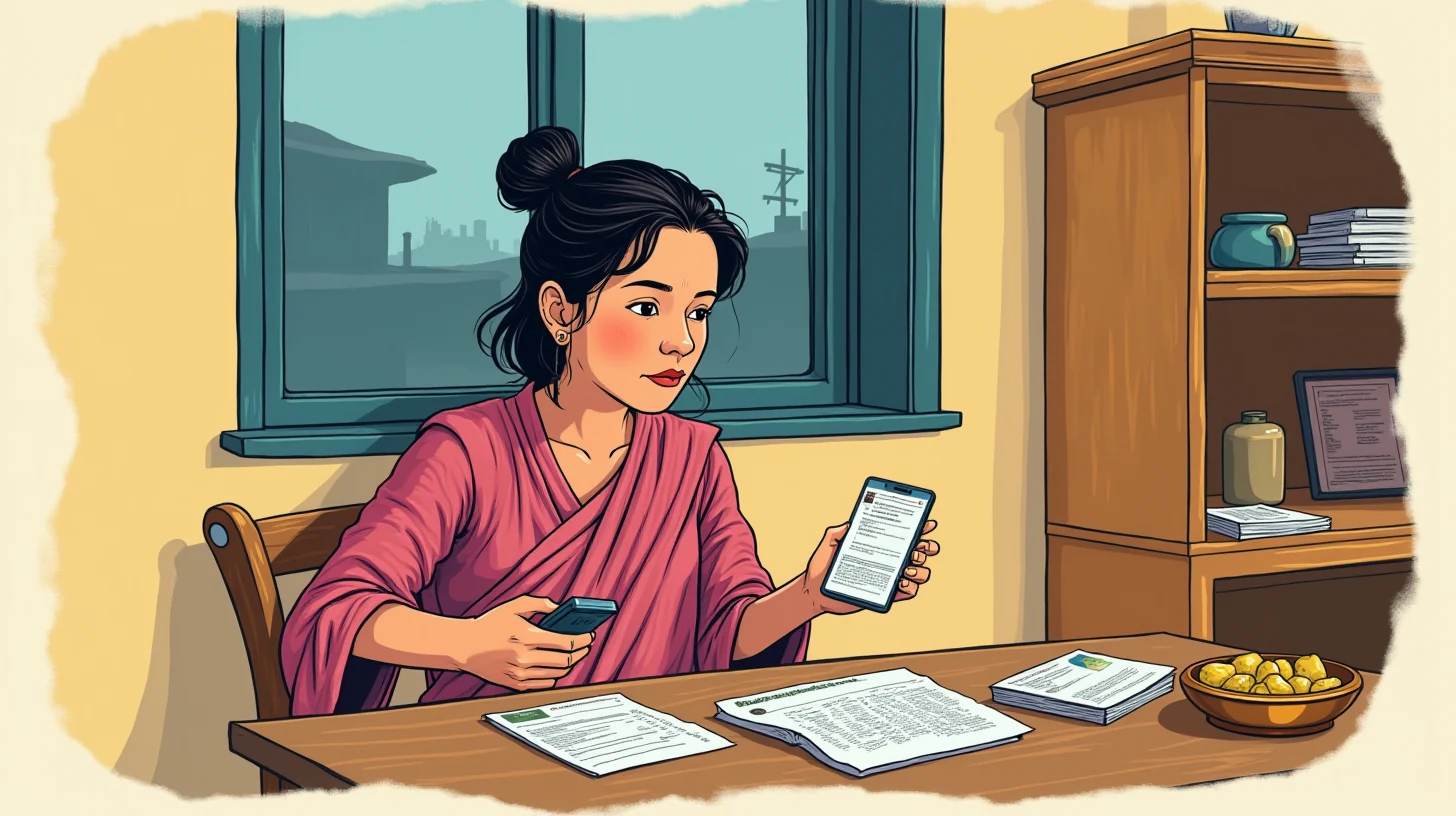
Three months ago, in February 2024, Ashish fell ill for two weeks — a fever that lasted eight days, then a respiratory complaint that lingered. It was the kind of minor, ordinary illness that happens in every household, but it required a visit to Imphal District Hospital, where the doctor told Sanahanbi that they could admit Ashish if the fever worsened, and that having an updated CMHT health card would be necessary if he needed to be admitted. Sanahanbi has maintained a CMHT card for the family since 2019 — she is registered as the primary cardholder, as a widow or lower-income household within the state welfare database — but the card requires annual biometric verification. Ashish's name is on the card as a dependant family member, and his biometric data needs to be updated every year. The last update was in March 2023. The verification camp should have happened in March 2024, but the curfew, which had begun intermittently in late February and intensified in early March, had cancelled all government services camps for the month. The District Office where the camp was scheduled simply closed the notice on the compound wall: "Camp extended. Date to be announced."
Ashish recovered without needing admission. But Sanahanbi now has a household member whose health card is, technically, not current. And in Manipur, where curfews are not rare and verification camps are run only when they are safe to run, this is the story of waiting.
🗓️ The rhythm of verification
The Chief Minister-gi Hakshelgi Tengbang scheme — CMHT in conversation, or "the Chief Minister''s health card" in common speech — is a state government health assurance program that provides cashless hospitalisation cover up to ₹5 lakh annually for registered families. To receive this coverage, the family must have a valid card, and the card must be re-verified every year. This is not a complex requirement by any standard bureaucracy — most government health cards across India have an annual renewal cycle, and Manipur''s CMHT scheme is no exception. The verification is biometric: each family member must appear in person at an official District Office verification camp, have their fingerprints or iris scan recorded in the system, and receive a stamped confirmation that their card is now valid for the coming year.
In Imphal District, the camps are scheduled in the post-winter season — traditionally March and April, when the weather is warm and predictable, before the monsoon rains make the office courtyard impassable. The District Office posts notices two weeks in advance on its compound wall and on the district website, sometimes at the local anganwadi centre as well. The camps themselves run for a week at a time, typically from 9 a.m. to 4 p.m., with a lunch break at 1 p.m. They are free. They are required.
The problem is not the scheme itself. The problem is time and geography.
Imphal District has a population of roughly 280,000 families eligible for CMHT coverage. The verification camps can process, at a realistic capacity, about 50 to 80 families a day — a two-person team with one biometric scanner and one forms clerk. A single week-long camp can verify perhaps 400 families. If every family showed up only once a year, this would be adequate. But families miss camps because of illness, because of work shifts, because the notice on the compound wall was posted when they were not looking. The backlog grows. By the time March 2024 came, there was already a waiting list from the 2023 camps.
The curfew made this worse.
⚠️ The camp that didn't happen
On 25 February 2024, the state government imposed a curfew in Imphal District following violence in the surrounding areas. The curfew was declared intermittently at first — lifted in the mornings, reimposed in the evenings — and then, as the violence widened, declared continuous from 5 p.m. onwards, then extended to full days, then extended to the District Office area itself. Government offices in Imphal reduced operations to essential services only. The CMHT verification camp scheduled for the first week of March was cancelled by written order. The District Office pasted a notice on the compound wall on 28 February: "Camp postponed due to law-and-order situation. New dates will be announced when situation normalises. Please do not come to the office."
Sanahanbi saw this notice on 3 March, when her sister-in-law came back from the market with news. She did not need to come to the office. She was not waiting. But Ashish was now, unexpectedly, a person whose health card was going to expire in twelve months without renewal.
The curfew continued into April. The office remained closed. No new camps were announced. Sanahanbi did what most households did: she asked neighbours, she asked at the anganwadi centre, she asked at the local CSC (Common Service Centre) if there was any way to renew the card remotely or via post. The CSC operator told her that CMHT renewals had to be done in person with the biometric scanner. The office was still closed. There was nothing to do but wait.
🌗 The WhatsApp network
By late April, when the curfew had been lifted to evening-only, the District Office began preparing for a new camp. The notice was not pasted on the compound wall first. Sanahanbi heard about it on a WhatsApp group called "Singjamei-Nursing-Mothers" — a group of about forty women from the neighbourhood, many of whom had children in school, who shared information about school closures, power cuts, and government schemes.
One member, a woman named Irenbi who worked at the district hospital, had forwarded a message from a friend in the District Office: "Camp from May 2 to May 6. Morning 9 to 12, afternoon 1 to 4. Imphal District Office, first floor, east wing. Bring Aadhaar and old card."
Sanahanbi showed this message to her husband. He said, bring Ashish on a Saturday if there is a Saturday slot, otherwise she should take him during his work break. She replied in the WhatsApp group to confirm the dates.
The next day, Irenbi sent another message: "Correction. Camp is May 3 to May 7, not May 2 to 6. Same times. I heard this from the office attendant directly."
Three women asked follow-up questions. Two said they had already asked their employers for time off on May 2. One said she had arranged child care for May 2 and could not rearrange. Irenbi did not know whether the old dates or the new dates were final. She said she would ask again.
For the next week, Sanahanbi kept her phone close. The WhatsApp group became a waiting room. Every few days, someone had heard something new. One message said the camp had been moved to May 8 to 12. Another said the government had scheduled two camps — one for families whose names started with A to M, one for N to Z. Another said the camp was still happening May 3 to 7, but only until 2 p.m. because the office was closing early due to some other government event.
Sanahanbi had no way to verify any of this. The District Office website had not been updated. The anganwadi centre had no information. When she called the CMHT helpline number printed on her old card, she reached a call centre in another state, where the operator had access to the same website Sanahanbi could access herself and could only repeat: "Camp dates are posted on the official Manipur government website. Please check there."
The official website, last updated on 10 April, still said: "New camp dates will be announced shortly."
She had started using a small AI assistant her younger brother — a government schoolteacher in Thoubal — had set up on her phone the previous month. She showed it the WhatsApp screenshot of the latest camp notice and asked whether the dates were confirmed anywhere official.
"ꯁꯅꯥꯍꯟꯕꯤ, CMHT District Office ꯒꯤ official website ꯗꯥ ꯃꯦ ꯸ꯇꯩ ꯐꯥꯎꯕꯥ ꯃꯇꯃꯗꯥ camp ꯒꯤ date ꯄꯣꯁ꯭ꯇ ꯇꯧꯗꯦ — May 10 ꯇꯨ May 14, 9 AM ꯇꯨ 4 PM. ꯑꯦꯗꯤꯟꯒꯤ, cmhtmanipur.gov.in ꯗꯥ last updated ꯑꯣꯏꯔꯤꯕꯁꯤ 8 May ꯗꯥ. WhatsApp ꯒꯤ message ꯑꯃꯗꯤ correct ꯑꯣꯏ, ꯑꯗꯨꯒꯥ ꯑꯃꯨꯛ ꯑꯥꯗꯥꯔ ꯑꯃꯒ CMHT card original ꯂꯩꯍꯛꯄꯤꯢꯣꯠ."
(Sanahanbi, the CMHT District Office official website posted a camp notice on May 8 — May 10 to May 14, 9 AM to 4 PM. The site was last updated on 8 May. The WhatsApp message is correct. Bring Aadhaar and the original CMHT card.)
🧭 Why the system breaks for families
The problem Sanahanbi faced is not unique to Manipur, and it is not unique to the CMHT scheme. It is the structure of how government services work when the ground-level infrastructure — the notice boards, the office staff, the official communication channels — is less reliable than the informal networks that ordinary people maintain.
The CMHT scheme itself is sound. The verification requirement is reasonable. The camps exist. The staff exist. The problem is that in a state where order-and-security can disrupt government routines for weeks at a time, the system has no contingency for informing people when camps restart. There is no SMS sent to registered cardholders saying "your verification camp has been rescheduled to X date." There is no email option, no call centre that knows the actual dates. The scheme relies entirely on notices posted on a physical office wall and information updated on a government website — both channels that work well in ordinary times, and both channels that fail when the office is closed or when the website is not being updated daily.
For a single person, this is an inconvenience. For a household like Sanahanbi''s, it is something larger. Ashish''s work schedule is 6 days a week, 8 a.m. to 6 p.m., with Sunday off. His boss will allow him a leave day for medical emergencies or family crises, but not for administrative renewals. If Ashish misses the verification camp, his card stays invalid. If his card stays invalid and he becomes acutely ill — if he has a serious fever again, or a traffic accident injury, or something that needs hospitalisation — the family cannot use the CMHT card for his treatment at the District Hospital. They will have to pay cash. For a family where the household income is ₹12,000 to ₹15,000 a month, a week-long hospitalisation that costs ₹40,000 or ₹50,000 is not an expense they can absorb. This is not a small problem.
Moreover, Manipur''s verification camps are not just disrupted by curfews. They are also disrupted by the routine cycle of what happens in the state — the monsoon makes the office courtyard unusable, the winter brings administrative transfers, election seasons bring official focus to polling, the annual water shortage closes offices mid-afternoon. The system is built as though these disruptions do not happen. And yet they happen every year.
- ⚖️
March 2024 — Camp cancelled
The CMHT verification camp scheduled for 1–7 March is cancelled by state order due to curfew. District Office posts notice on compound wall.
- 📞
April 2024 — Waiting with no information
The curfew continues through April. Sanahanbi inquires at the CSC, the anganwadi centre, the helpline. All direct her to the office. No new dates are announced officially.
- 📨
May 2024 — WhatsApp rumours
Word spreads via WhatsApp group from an office worker''s relative that camps will restart May 3–7. Dates shift twice: then to May 8–12. Sanahanbi cannot confirm.
- 🛑
June 2024 — Ashish''s card expires unseen
The actual camp happens 10–14 June. Sanahanbi brings Ashish. Card is re-verified. Ashish''s coverage is now valid until June 2025. But he has been uncovered for three months.
Families in WhatsApp groups
ConnectedHear about camps from neighbours, anganwadi workers, or hospital staff. Get dates early (sometimes wrongly), can plan work schedules around camps, show up prepared. Sanahanbi''s pathway.
Families at the office wall
OfficialRely on notices pasted at District Office or anganwadi centre. See notices two weeks before camps. Have to show up during posted times or not at all.
Families outside Imphal city
Rural and isolatedMay hear camp dates only if someone from household visits the city, or if anganwadi worker is proactive. Many miss camps entirely and renew only when illness forces a hospital visit.
Across Manipur''s three-district system, CMHT renewal rates have been declining. The official reason cited in government reports is "beneficiary mobility" — families moving between districts, people losing contact with the scheme. The actual reason is simpler: when the verification camp dates are not communicated reliably, many people simply stop coming. They keep their old cards, stop visiting the District Office, and only remember the card exists when someone in the family becomes seriously ill and needs to be admitted.
This is not a failure of individual families. It is a failure of a system that has no backup plan for its own information channels.
🌱 The quiet cost of waiting
On 12 June 2024 — more than three months after the original scheduled camp — Sanahanbi and Ashish walked to the District Office early in the morning. The new camp was confirmed on the WhatsApp group, and this time, the notice had also appeared on the office compound wall. The queue was long: about forty families waiting, with registration numbers written on slips of paper. They waited for an hour. When their turn came, a clerk photocopied their old card, Ashish put his right index finger on the biometric scanner twice, and then a different clerk stamped a renewal certificate on the back of the card, dated 12 June 2024, valid until 12 June 2025.
Sanahanbi asked the clerk: would there be more camps before next June, in case they needed to update again? The clerk said, yes, normally in March and April. She said thank you and left.
She did not ask why there was no SMS sent to beneficiaries when camps restarted. She did not ask why the helpline operator did not know the actual dates. She did not ask why the website said "to be announced" when the dates were being circulated via WhatsApp. These are reasonable complaints, but they are complaints that assume a system designed to answer complaints. Sanahanbi knows, as most households know, that government systems do not always answer. You show up when you can, you bring the papers you are told to bring, and if the timing works out, you walk away with a stamp.
"ꯑꯣꯐꯤꯁꯤꯌꯦꯜ website ꯑꯃꯥ update ꯇꯧꯗ꯭ꯔꯦ — ꯃꯇꯃ ꯑꯃꯒ꯭ꯗꯥ ꯅꯪ WhatsApp ꯗꯥ ꯑꯦꯟꯒꯦ ꯂꯧꯔꯕꯥ camp date ꯑꯃꯔꯝ ꯁꯤꯖꯤꯟꯅꯕꯥ ꯇ꯭ꯔꯥꯏ ꯇꯧꯒꯗꯕꯅꯤ꯫"— When the official website goes silent, you have to trust the camp date someone heard in a WhatsApp group and hope it holds.
What Sanahanbi Devi learned, across three months, is that in a state where curfews come and go and camps shift dates, the health coverage your family is entitled to is only as reliable as the informal networks that pass information between neighbours and anganwadi workers and hospital staff. The CMHT card itself is not the problem. The problem is that a household''s security — the difference between paying for a hospitalisation out of pocket and paying nothing — now depends on whether someone you know happens to hear about a camp, and whether you can coordinate your family member''s work schedule around a date that was posted on WhatsApp the day before.
This is not a question of money or policy. This is a question of information, and information, in Imphal, flows through WhatsApp groups because the official channels have gone silent.
Sources: