
The Jaipur homemaker and the Laadli Yojana labyrinth
Meera Rathore is thirty-seven years old. She lives in a second-floor flat in Vaishali Nagar, Jaipur, in the kind of neighbourhood that sits between the ambitions of a planned colony and the reality of a city growing faster than its planning — wide enough roads for the first four streets, narrowing to something more improvised by the tenth, a park in the middle where men play badminton in the evenings and women sit on the boundary wall watching children who are allowed to fall off things in the way that children should be. Her husband, Vikram, works in a private trading firm in the Pink City area. He is not present in this story in the way that men are absent from most stories about government paperwork: not through negligence, but because the paperwork concerns their daughters, and the daughters are Meera's domain, and yeh sab tum sambhaal lo, main kaam pe late ho raha hoon — handle all this, I'm getting late for work — is not a failure but a division of labour that both of them have accepted without naming it.
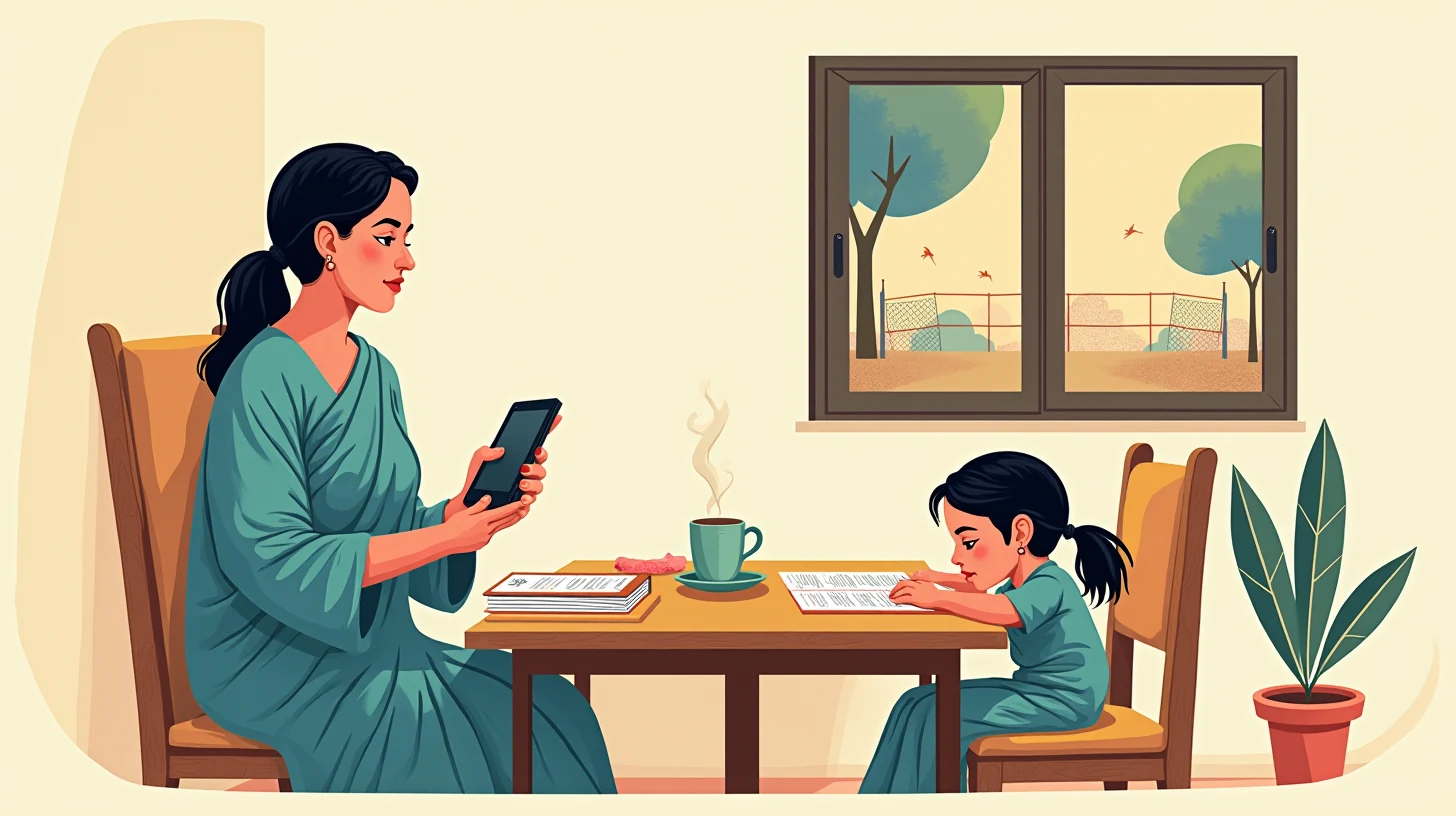
Their daughters are Kiran, who is nine and attends a private English-medium school in Vaishali Nagar, and Riya, who is five and is in nursery at the same school. Both were born in Rajasthan. Both are registered on the family's ration card. The family is not BPL; they are somewhere in the respectable middle — a rented flat, a two-wheeler, a colour television, private school for the girls because the government school three lanes over has sixty children per class and a crumbling wall on the east side that has been crumbling since 2017.
This is a story about the schemes that the Rajasthan government has made available for families like Meera's — specifically for daughters like Kiran and Riya — and about the gap between a scheme existing and a mother in Vaishali Nagar being able to access it, and what changed when her friend's cousin, who works in a bank in Mansarovar, told her to try the Hindi AI on her phone.
- 📨
September 2024 — the SMS that did not survive Navratri
Chiranjeevi renewal SMS arrives in dense Hindi-English. Meera reads it. School re-opening, parent-teacher meeting and Riya''s nursery paperwork override the mental note.
- 🛑
January 2025 — the card has lapsed
Kiran develops otitis media. The Saket clinic confirms the Chiranjeevi card expired in November. ₹800 consultation plus ₹340 antibiotics paid out of pocket.
- 🔍
February — Pooja''s cousin from Mansarovar
At a kitty group, Pooja mentions an agent on her phone that explains Hindi government circulars. Meera installs it that night.
- ₹
March–April — Chiranjeevi current, MSBP opened, RTE reminder set
Re-registration at the D-block e-Mitra: 8 minutes, ₹20 fee. ₹80,000 deposited at the Vaishali Nagar post office at 7.5%. RTE January-2026 reminder armed.
🗓️ What Rajasthan has, in theory
Rajasthan is not a state that has been indifferent to the welfare of girls and women. Over the past fifteen years, through three different governments and four Chief Ministers, it has assembled a set of schemes — some of national origin, some state-specific — that, on paper, address several of the real financial pressures on a family raising daughters.
There is the Mukhya Mantri Chiranjeevi Swasthya Bima Yojana, which provides health insurance of up to ₹25 lakh per family per year, covering hospitalisation at empanelled government and private hospitals, and which requires annual renewal. The scheme covers Meera's family in principle, but the renewal is not automatic — it requires re-registration on the Chiranjeevi portal, which generates a new card, and which, if missed, lapses the coverage.
There is the Rajasthan Laadli Yojana — distinct from the central government's Sukanya Samriddhi and from the older Rajasthan Laadli Laxmi — a scheme under which families with a girl child who meet certain income and residency criteria receive a one-time financial transfer at specific milestones: school admission, Class 6 transition, Class 10 board results. The details have changed across budget cycles, and the current iteration is administered through the Rajasthan Jan Soochna Portal.
There is the Right to Education 25% quota — the constitutional provision under which twenty-five percent of seats in private unaided schools are reserved for children from economically weaker sections and disadvantaged groups, with the school reimbursed by the government — which applies to Kiran and Riya's school, and for which Riya, entering primary school next year, is eligible to apply. The application window opens annually in January and the deadline, in the current year, was February 28.
There is the Mahila Samman Bachat Patra, a small-savings certificate scheme for women launched by the central government in 2023, offering 7.5% interest on deposits up to ₹2 lakh over a two-year tenure, available at post offices and participating banks — more favourable than a standard fixed deposit, and accessible to a homemaker in her own name without requiring a salary slip.
Meera knew, in the abstract, that schemes existed for her daughters. She did not know the names of most of them. She did not know the difference between the Chiranjeevi scheme and the PM-JAY scheme that her husband's company's HR had mentioned once. She did not know the RTE 25% quota applied to schools other than the cheapest ones. She had, in 2023, asked the schoolteacher at Kiran's school about any government benefits she might be missing and the teacher had said "yojana ke baare mein school authority se poochho" — ask the school administration about schemes — and the school administration had said there was nothing they were aware of.
"योजना के बारे में कुछ ना कुछ है — बस मुझे नहीं पता कौनसी, कहाँ, और कितनी।"— There is something out there about schemes — I just don't know which one, where, and how much. Meera said it once, to the kitchen wall, in early February.
⚠️ The Chiranjeevi renewal she nearly missed
In September 2024, Meera received an SMS from the Rajasthan government portal — a number she did not recognise, in a combination of Hindi and English that is the characteristic language of Indian government SMS, dense with abbreviations and portal names: "Aapki Mukhya Mantri Chiranjeevi Yojana registration ki validity 31 Oct 2024 ko samapt ho rahi hai. Naye saal ke liye re-registration hetu https://chiranjeevi.rajasthan.gov.in par visit karein." She read it. She understood the gist: something was expiring. But the portal URL, the word re-registration, and the deadline were not things she had bandwidth for in September, which was the month of school re-opening, a parent-teacher meeting at Kiran's school, Riya's nursery admission paperwork, and Navratri preparations in the building. She had set a mental note. Mental notes, in September, do not survive to October.
The card lapsed in November. She did not know it had lapsed until January 2025, when Kiran developed an ear infection that worsened to otitis media and required ENT consultation and antibiotics. At the private clinic, she asked whether the Chiranjeevi card would cover the consultation. The clinic receptionist looked it up and said: "Card expired hai, ma'am. Renewal agar karwao toh next time cover hoga." The card has expired. If you renew it, it will be covered next time.
The consultation cost ₹800 out-of-pocket. The antibiotics cost ₹340. These are not sums that broke the family budget. But they are sums that the scheme existed specifically to prevent, and they represent a pattern — the small, preventable health expenses that compound over a year into something non-trivial — that the expired card would continue to enable if nothing changed.
It was the friend's cousin from Mansarovar — a woman named Pooja who had been using the AI at her bank branch for customer queries and had started using it at home — who told Meera about it. Pooja came for a ladies' kitty group gathering in Vaishali Nagar in February, heard about the Chiranjeevi lapse, and said: "Arrey, mere paas ek cheez hai — Hindi mein baat karo, sab samjha deta hai." There's this thing I have — talk to it in Hindi, it explains everything.
🌗 What the agent found in an evening
Meera installed the agent on her Android phone and, over the course of a single Tuesday evening — after Kiran's homework was done and Riya was asleep — worked through four questions she had been carrying for months without knowing where to take them.
The first: the Chiranjeevi renewal. The agent walked her through the process in Hindi, step by step, in the Rajasthani-inflected register she used herself. The Jan Aadhaar card — the Rajasthan state family identity card that serves as the anchor for most state schemes — was already on her phone as a photo. The agent told her to go to the nearest e-Mitra kiosk (there was one, it told her, at the market near the Vaishali Nagar D-block crossing) and ask the operator for Chiranjeevi re-registration using Jan Aadhaar. No additional documents needed. The operator at the e-Mitra would handle the portal navigation. Cost: ₹20 at most for the service fee.
She went to the e-Mitra the following Thursday. The re-registration took eight minutes. The new Chiranjeevi card was valid from March 2025 to February 2026.
The second question: the RTE 25% quota for Riya. The deadline, the agent told her, had already passed for the current academic year — it had closed on February 28, and she was consulting it in mid-March. But the agent told her something more important: the quota applied to Class 1 admissions, and Riya, currently in nursery, would be eligible for Class 1 in the 2026-27 academic year. The application window for that cycle would open in January 2026. The agent set a reminder for January 10, 2026. It also explained the income ceiling for the EWS category — ₹1 lakh per annum — and the disadvantaged group (DG) category, for which girls from certain communities were eligible regardless of income. It asked Meera her husband's annual income. She said approximately ₹4.5 lakh. The agent told her, gently:
"EWS category ke liye income limit se thoda zyada hai. Lekin DG category mein Riya's caste certificate check karein — agar OBC certificate hai toh DG mein apply ho sakta hai."
(The income is slightly above the EWS ceiling. But check the DG category with the caste certificate — if there is an OBC certificate, Riya may be eligible under DG.)
Vikram's family had an OBC certificate from his father's name, issued for Rajasthan. They had never used it for anything. The agent told her it was valid for RTE purposes if it was issued in Rajasthan, and gave her the document checklist for the application.
What it does
- 🔍Reads the September Chiranjeevi SMS, the RTE Rajasthan eligibility tree, the MSBP scheme terms, and the Jan Soochna live-status list — in Hindi.
- 🗂️Surfaces the e-Mitra fee, the OBC-certificate route under DG, the head-post-office MSBP procedure, the January-2026 RTE date.
- 📞Finds the nearest e-Mitra (Vaishali Nagar D-block) and the Vaishali Nagar head post office address.
What it does not do
- 🔒Never enters Meera''s Jan Aadhaar OTP. The e-Mitra operator runs the portal; Meera signs.
- 💳Does not pay the ₹20 e-Mitra fee or transfer the ₹80,000 — Meera deposits at the counter herself.
- ✅Does not pretend to know the Laadli current status. It names the uncertainty, links Jan Soochna, and tells her what to ask.
The third question: the Mahila Samman Bachat Patra. Meera had ₹80,000 in a savings account that she had been accumulating from the household savings she managed — the small margins from the monthly grocery budget, a ₹5,000 gift from her mother-in-law at Diwali, the balance from Kiran's school uniform money that year. She had been meaning to do something with it but had not known what. The agent told her about the MSBP scheme — 7.5% for two years, available at the head post office in Vaishali Nagar or at participating banks, in her name alone, with no salary slip required. She asked if her husband could also benefit. The agent told her the scheme was specifically for women and that she could open an account in her own name, and also an account in Kiran's name (as minor, with her as guardian) and Riya's name, each up to ₹2 lakh. She had ₹80,000. That was one account for herself, and perhaps a smaller one in Kiran's name from the next few months' savings.
She opened the MSBP account in April — ₹80,000, in her own name, at the Vaishali Nagar post office. The paperwork took forty minutes. The interest rate was better than her savings account by approximately 3.3 percentage points. Over two years, on ₹80,000, that is approximately ₹5,300 extra. Not life-changing. Not nothing either.
The fourth question she asked, almost as an afterthought, was about the Laadli Yojana — what it was, whether her daughters were eligible, and what she needed to do. The agent's answer was honest in a way that government portals are not: "Laadli Yojana ka naam kai schemes ke liye use hota hai — alag alag rajyon mein alag hota hai. Rajasthan mein current scheme ka naam 'Rajasthan Laadli Laxmi Yojana' tha lekin 2023 ke baad iska status portal pe update nahi mila. Jan Soochna portal pe check karna hoga — main link de raha hoon, aap e-Mitra se bhi confirm kar sakti hain." The name Laadli Yojana is used for many schemes across states. In Rajasthan, the current scheme's portal status has not been updated since 2023. You will need to check on Jan Soochna portal — I'm giving you the link, and you can also confirm at e-Mitra.
This is not a triumphant answer. The scheme may exist in a form Riya and Kiran can benefit from, or it may have been absorbed into another programme, or it may be pending revival under a new budget. The agent did not pretend to know what it did not know. It named the uncertainty precisely, gave her the place to check, and told her what to ask.
🧭 What the agent is not
It did not get Riya into a school on the RTE quota. The window had closed for that year. It did not unlock the Laadli Yojana — that answer was genuinely uncertain. It did not undo eight months of lapsed Chiranjeevi coverage between November and March. These are the limits of a tool that reads circulars and explains them; it cannot travel back in time and hand Meera the September SMS at a moment when she had bandwidth to act on it.
What it did was give her a Tuesday evening in which four months of vague administrative anxiety — the sense that she was missing things she didn't know about, that schemes existed that her daughters weren't benefiting from, that the government paperwork was somewhere behind a door she didn't know how to open — had become, if not resolved, then at least mapped. She knew what was fixed (Chiranjeevi), what was pending (MSBP account), what had a date attached (RTE January 2026), and what was genuinely uncertain and might never be certain (Laadli current status). Mapped is not the same as done. But it is better than unmapped.
Her mother-in-law, a seventy-year-old woman from a village near Sikar who visits for a week every two months and has opinions about everything including the AI on Meera's phone, asked what the thing was for. Meera said: "Sarkari kagaj samjhaata hai, Hindi mein." It explains government papers, in Hindi. Her mother-in-law said: "Matlab naata hi nahi tha, ab naata aa gaya?" — You mean there was no connection, and now there is? Meera said: "Haan, kuch aisa hi samjho." Yes, something like that.
The Chiranjeevi card is current. The MSBP is earning 7.5%. The RTE reminder is set for January 10, 2026. The Jan Soochna portal has, twice, shown Laadli Yojana as active for girls born after 2019, which includes Riya by one year, which Meera has noted and which the agent has flagged as worth verifying in person at the next e-Mitra visit.
Kaam chal raha hai. The work is in progress.
🌱 The mapping, before the doing
Mapped is not the same as done. The Chiranjeevi card will lapse again next October. The Jan Soochna portal will keep moving the Laadli status under one or another budget cycle. The MSBP rate will be re-set at the next quarter. None of this gets handed to Meera, finally and forever. What got handed to her, one Tuesday evening in February, was the shape of the room: where the doors were, which were stuck, which opened, and which had been ajar all along. The kitchen wall does not need to listen to her again.
If you have daughters in Rajasthan, or a mother trying to navigate the schemes that exist for them, the product is free at gabforge.in.