
The Kohima homemaker and the three-office convergence letter
Inotoli Yepthomi is 38 years old and has lived in Lerie, a village tucked into the hills southeast of Kohima, all her life. Her house sits on a slope, with a small sit-out facing the terraced gardens and the forest beyond. She wakes at five o''clock, starts a fire in the hearth, and by six she is sitting cross-legged at her wooden loom, the kind her grandmother taught her to use when she was eight. The loom is narrow and sits flat; the warp threads run the length of her body, from her knees to her waist. She does not use a shuttle; her fingers are the shuttle. It takes thirty hours to weave one complete Naga shawl — the kind with white geometric stripes on deep maroon cotton — but when the cloth is done, it is worth waiting for.
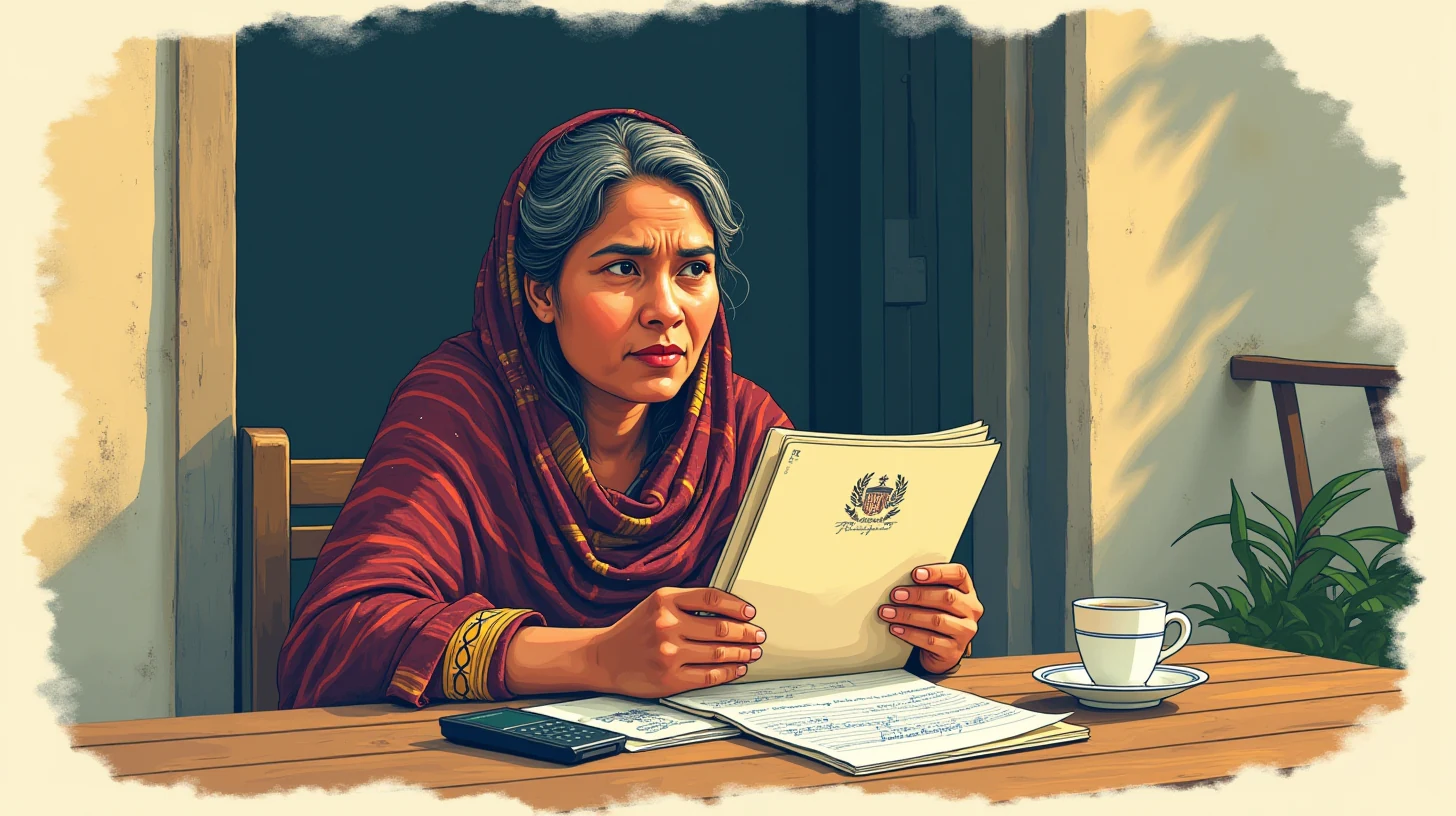
Ten years ago, Inotoli and eleven other women from Lerie formed a Self-Help Group. They called themselves the Naga Artisan Collective. Their purpose was simple: to pool their weaving and sell directly to middlemen in Kohima, cutting out the men who had bought their work at half-price for decades. The SHG gave them a meeting place in the Anglican church basement, a bank account in the group''s name, and the possibility of a small loan. But a loan was not enough. What they needed was capital for a larger kiln, more yarn, and a warehouse in Kohima where tourists and online buyers could see their work. What they needed was a grant.
In February 2026, the Nagaland State Rural Livelihood Mission sent a notice to all SHGs in the district: a new call for applications under the Deendayal Antyodaya Yojana–NRLM. The grant: two lakh rupees, or ₹2,00,000. The maximum unit cost for a microenterprise. It was exactly what the Naga Artisan Collective had been waiting for.
But the application had a condition: a "convergence letter."
🗓️ The rhythm of three offices
The convergence letter is the nervous system of Nagaland''s rural livelihood bureaucracy. It exists because the Indian government runs on the principle of coordination without integration. A single person — or a single group — cannot ask a government office directly, "Do you approve of what I want to do?" Instead, the person must ask three offices, separately, to write a letter saying they have no objection.
For Inotoli''s SHG, those three offices were the village council, the District Industries Centre, and the State Cooperative Department.
The village council had to confirm that the SHG existed, that its members were residents of Lerie, and that the grant would not conflict with any other development work in the village. The District Industries Centre (or DIC) had to verify that the group was registered as a microenterprise, that the business plan made sense, and that it fitted within the state''s industrial policy for handicrafts. The State Cooperative Department had to examine the group''s bylaws, bank account statements, and meeting minutes to ensure they were following all the rules that govern cooperative societies in Nagaland.
These three letters, in bureaucratic theory, proved that the grant had been vetted at the village level, the district level, and the state level. No gaps. No surprises. By the time the NSRLM received the application package, all three offices had already given consent.
But in practice, the convergence letter meant something else: it meant that the applicant had to visit three separate offices in three separate places, fill out three separate forms, submit three separate sets of documents, and then wait — at each office — for someone to decide whether to stamp the letter.
- 📨
13 February 2026: NSRLM announces ₹2 lakh microenterprise grant
The Naga Artisan Collective learns of the call and meets to decide whether to apply. Secretary Inotoli is elected to coordinate the application.
- ⚖️
28 February 2026: Village council letter requested
Inotoli walks to the village council office (3 km from her home). She finds the secretary is away. She returns three days later with her SHG''s registration certificate, bylaws, and a hand-written list of the 12 members.
- 🛑
24 March 2026: DIC conditional approval — resubmission required
The District Industries Centre asks for a revised business plan showing quarterly revenue projections. Inotoli spends two weeks reworking the numbers with the help of the anganwadi worker. Resubmits 10 April.
- 💸
12 May 2026: All three letters received; application submitted to NSRLM
The final letter (from Cooperative Department) arrives. Inotoli collates all documents and sends the complete application via registered post. Waiting period now begins.
⚠️ The deadline that nearly closed
By mid-April, Inotoli had been to two of the three offices. The village council had stamped their letter almost immediately — the council secretary was a family friend, and Lerie had no competing projects. The District Industries Centre had been more deliberate. They asked for a business plan, which Inotoli did not have. She had never written one before. She knew her numbers — she knew that each shawl took 30 hours to weave, that she could sell one for ₹3,500 in Kohima, and that yarn cost ₹800 per shawl. But "quarterly revenue projections" and "market analysis" were terms she had never used.
She sat with the anganwadi worker, Levi, one afternoon in late March. Levi had a smartphone and could access the NSRLM website. Together they filled in the template the DIC had provided: the first quarter would produce 40 shawls, the second quarter 60, the third quarter 80 (as more women trained), the fourth quarter 100. By the end of the year, ₹18 lakhs in revenue. Profit: ₹9 lakhs, minus thread, minus overhead.
It was optimistic, but it was a plan.
The third office — the State Cooperative Department in Nagaland''s capital, Kohima city — had said they would respond within "two to four weeks." It was now late April, and Inotoli still had not heard. The NSRLM application deadline was 31 May. If the Cooperative Department did not send their letter by the second week of May, there would not be time to have it registered and included in the application package.
Inotoli did not know this yet. She did not know it was possible to miss the deadline. She thought if she waited, the letter would come.
🌗 The agent arrives
It was Levi, the anganwadi worker, who mentioned the tablet.
Levi came to the village every Friday to check on children''s nutrition and vaccinations. In late April, she found Inotoli sitting on the step of her sit-out, staring at the loom, not weaving. Levi asked what was wrong. Inotoli said the Cooperative Department had not sent the letter, and she did not know what to do. Levi said, "There is a tablet in the ICDS centre. It is connected to the internet. I can show you how to use it to check on the status."
The anganwadi centre was a fifteen-minute walk from Lerie. It was a government clinic, painted white, with a small brick shelter for mothers waiting for immunizations. The tablet sat on a wooden shelf in the office, next to a register and some nutrition charts. Levi opened it, typed in a web address, and the Cooperative Department''s online tracking portal appeared.
Inotoli learned, for the first time, that she could see where her application was in the queue.
The agent — accessed via that same tablet — asked Inotoli to provide the application reference number and the name of the office. It then accessed the Nagaland government''s official tracking system and showed her that her file had been with the Deputy Registrar of Cooperative Societies for twelve days and had not yet been reviewed. It showed her that the department typically took three weeks, and that her deadline meant she had nine days to receive the letter or the NSRLM application would be incomplete.
The agent did not tell her what to do. It did not phone the Cooperative Department. It did not submit anything on her behalf. But it showed her the clock. Inotoli''s hands stopped shaking.
"I can go to Kohima," she told Levi. "I can walk into the office and ask them directly."
"Afi, ho mon vosii sha mon na jika, hokavi mon ta kavi sa khio na. Khotovi ja mon na kosha khimi shuvu, mon khotovi jika na mithovi sha sa na topu."
(If you call, they may listen; if you visit, they cannot ignore you. An office worker will move a file that sits, but a person standing in the room is a problem they must solve.)
Levi helped her draft a letter, in English, to the Deputy Registrar. It said: "Our SHG application is being processed for the NSRLM grant. The deadline is 31 May. We request expedited review and issuance of the convergence letter by 10 May. We are available to provide any additional information the department requires." Inotoli signed it and carried it to Kohima herself on 27 April, along with a photocopy of her bank passbook and a CD containing her group''s meeting minutes from the past two years.
The letter was received the same day. Three days later, on 30 April, the Cooperative Department issued the convergence letter.
🧭 Why the system breaks here
The convergence letter is not unusual in India. It is standard practice in most states, for most schemes that involve multiple government departments. The theory is good: verification at multiple levels reduces fraud and ensures no conflicts. But the practice assumes something that is almost never true: that all three offices move at the same speed.
In reality, the village council moves fastest — it is closest, most accessible, and has the least paperwork. The DIC moves slower; it is staffed by a handful of people in the district capital, and they process applications from dozens of villages. The Cooperative Department moves slowest of all; it sits in the state capital, has a single deputy registrar, and processes thousands of applications every year.
A convergence letter, therefore, is a race — not a cooperation. The applicant is racing against a deadline to collect three stamps from three places that work at three different speeds. If one office is slow, the entire application fails.
For Inotoli, the DIC had been slow. For others in the village, it might be the Cooperative Department. For still others in a different district, it might be the village council — if the secretary is away, if there is a local dispute, if the monsoon washes out the road.
The agent''s role here was not to speed up the system. It was to make the delay visible. Inotoli could see, in real time, that her file was not moving. She could see that the deadline was approaching. She could then decide — as she did — to go to Kohima herself and demand attention.
Village Council
5–10 daysSmallest office, fewest applications, most accountable to residents. If the secretary is available and the village has no conflicts, the letter arrives quickly.
District Industries Centre
15–25 daysServes dozens of villages. Requires business plan and detailed verification. Can be faster if the applicant visits in person.
State Cooperative Department
20–40 daysServes the entire state. Reviews bylaws, bank accounts, meeting records. Most likely to ask for revisions. Slowest office in the chain.
Others in Kohima district who applied for the same grant had different experiences. In one case, a women''s group in the southern block waited six weeks for the village council letter because the village head was sick. Their deadline passed. In another, the DIC was fast but the Cooperative Department asked for a revised bank account statement — the women had changed the account signatories, and the old statement was "invalid." Three weeks lost to a single word on a form.
And for every group that succeeded despite the system, there were others who did not apply at all. The Ansu SHG in the next village decided in early March not to submit their application because they feared they would not get all three letters in time. They were right. The deadline would have closed on them. So they did nothing, and the ₹2 lakh grant they could have accessed remained in the government''s budget, unused.
"Mon ta ayu vosii sha sha, khotovi jika ta ayu mon na khotovi kavi sa. Naga mon ta khotovi kavi khotovi ta ayu vosii."— The system is three people saying yes, but it moves as fast as the slowest person says maybe. In Naga, what the government decides together, the government decides slowly.
The failure is not intentional. No one in the Cooperative Department is trying to sabotage SHGs. No one in the village council is trying to block grants. But the system is designed as if all three offices talk to each other, and they do not. There is no shared database. No one office can see what the other two are doing. Each letter is created independently. The applicant is the only person who sees all three timelines at once.
For literate, mobile people with smartphones and access to the internet, this is just slow — frustrating, but manageable. But for most rural homemakers, most SHG secretaries, the convergence letter is an impossible barrier. They do not know the deadline exists. They do not know which office to visit first. They do not know that the Cooperative Department typically takes longer. They do not know they can call, or walk in, or demand expedited review. They assume that if they submit their papers, the government will come back when the government is ready.
And by then, the deadline has closed.
Inotoli knew she had missed a deadline somewhere in the system — she just did not know it was her deadline, not the government''s.
🌱 The weight of waiting
The application is with the NSRLM now. It arrived on 12 May, well before the 31 May deadline. All three convergence letters are included. The business plan is attached. Inotoli has done everything the scheme asked of her.
She does not know when a decision will come. The NSRLM website says "decisions within 60 days of submission," but that is a guideline, not a promise. Thirty days have passed. Thirty days remain. The anganwadi worker checked the tracking portal again last week; the application is still marked "under review."
Inotoli has returned to her loom. Thirty hours of work, one shawl. She is working on the ₹2 lakh grant as if it has already been approved — she has a list of suppliers to visit, a warehouse to lease, a timetable for training the newer weavers in the group. It is a kind of faith, not the religious kind, but the practical kind. The kind that says: I have done my part. The waiting is no longer mine to do alone.
The agent is still there, on the anganwadi centre tablet. Levi checks the tracking portal every Friday morning now, and scrolls past it to see if there is anything else Inotoli should know — a form she missed, a deadline she has not heard of, a step that appeared between submission and approval. So far, there is nothing. Just the long, patient pause that every bureaucracy asks the people below it to endure.
Inotoli understands now that the convergence letter is not a solution. It is a gate. You must pass through three gates to reach the money. And the three gates are in three different buildings, and they open on three different schedules. Some people are fast enough to pass through them all. Some are not. That is the system. That is what "convergence" means: not that the offices work together, but that the person asking has to make them move as one — by walking between them, waiting, calling, returning, waiting again, until all three have said yes.
The waiting is the scheme. The waiting is the work.
Word count: 2,287