
The Mumbai tiffin-wallah who nearly missed her own pension
Sunita Kamble is forty-seven years old. She lives in a two-room tenement in Dadar East — one of those buildings off Gokhale Road where the staircases are narrow enough that you have to turn sideways with a tiffin stack, and where the cooking smells from every floor are so layered by eight in the morning that you cannot tell whose kitchen is producing which fragrance. She has been living there since she married Ramesh Kamble in 2001. Ramesh is a contract painter — he works on residential renovation jobs scattered across Parel, Sewri, and occasionally as far as Kurla, getting paid per flat, with no employer and no ESIC number and no anything that a government portal would recognise as formal employment. They have one son, Sachin, who is twenty-two and works at a garment export firm in Sion. They have a daughter, Priya, who is studying B.Com at a college in Wadala and who is, by universal agreement in the Kamble household, the most organised person in the family.
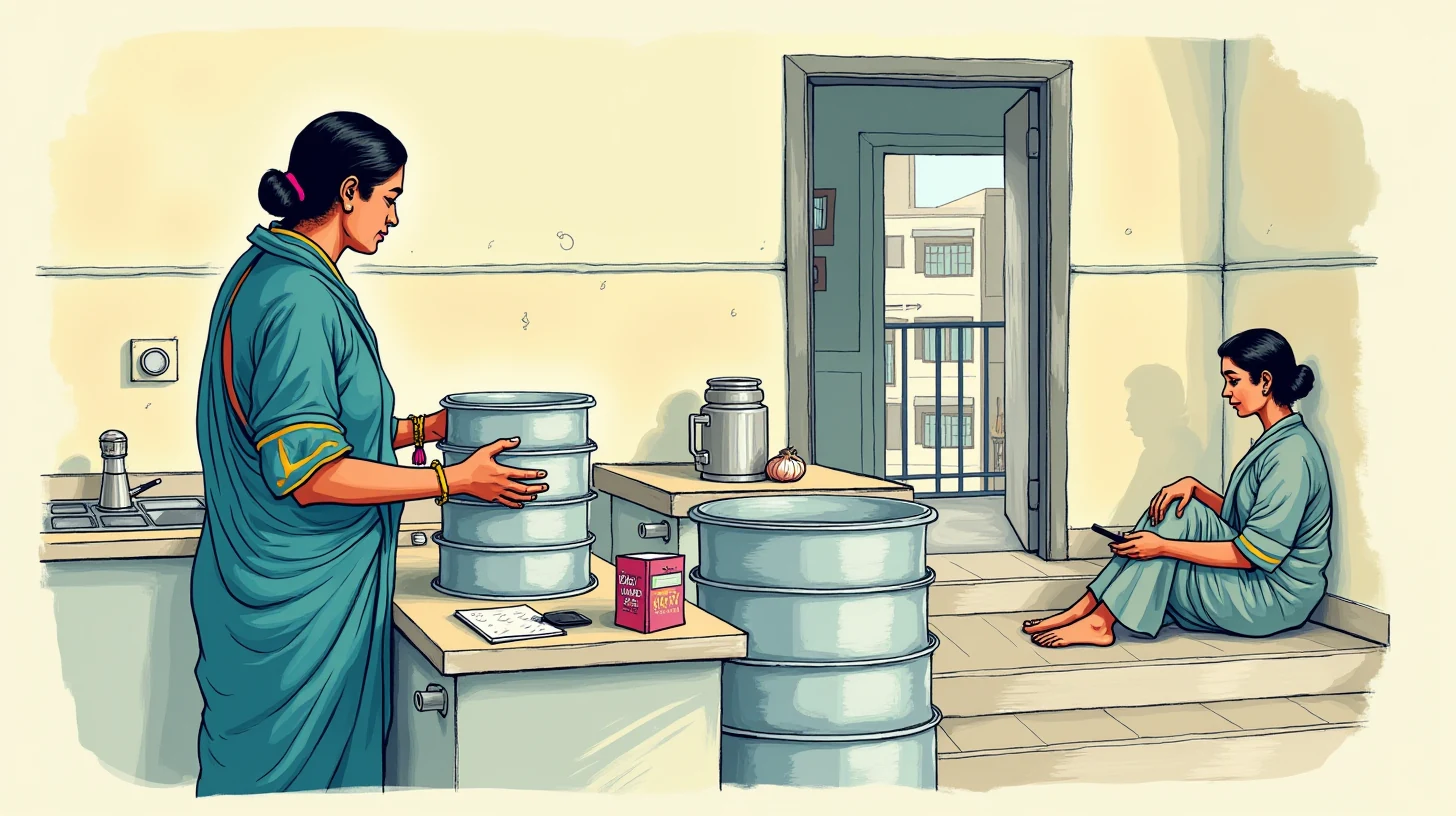
For the last eleven years, Sunita has been running a dabba service from that two-room kitchen. At peak, she delivers sixty tiffins a day — forty to a nearby office building on Senapati Bapat Marg and twenty to individual customers in the neighbourhood, a network she built one by one through word of mouth and through Priya's WhatsApp statuses. The economics of a Mumbai dabba operation run like this: she charges ₹2,200 per customer per month for two meals a day, five days a week. At sixty customers, that is ₹1.32 lakh a month in gross receipts, out of which she buys vegetables and dal and rice and cooking gas and the occasional spice order from the wholesale market in Matunga, pays two part-time helpers who come in from six to nine every morning, and brings home something in the range of ₹45,000-₹55,000 a month after expenses. By the standards of unorganised sector domestic work in Mumbai, this is a respectable income. By the standards of the Indian social security system, it is an income that does not exist.
Sunita Kamble has no UAN. She has no ESIC number. She has an Aadhaar card and a ration card and a Jan Dhan account at Bank of Baroda that she uses to receive UPI payments from her customers. She has, technically, a PAN card that Priya helped her get in 2019, though she has never filed an income tax return. She is, in the formal lexicon of the Indian welfare state, a parivar ki mahila — a household woman, and by inference, dependent.
This is the story of what happened when she tried, for two years, to access two government schemes that she was theoretically entitled to, and what changed when Priya installed something on her phone.
- 📨
2022 — first CSC visit, OTP arrives 38 minutes late
Vijay at the CSC tries to register Sunita on e-Shram. The OTP comes thirty-eight minutes later, after the session has expired. They retry. The OTP does not arrive.
- 🛑
2023 — second CSC visit, six-minute window
A Naigaon CSC operator gives her six minutes before moving on. The OTP does not come. Sunita goes home.
- 🔍
February 2025 — Priya finds the face-authentication fallback
Three evenings on the e-Shram FAQ. The fallback exists, buried three pages deep. The CSC on Gokhale Road has a biometric machine.
- ₹
Tuesday morning — 41 minutes from Aadhaar to UWID to PM-SYM
Face authentication, e-Shram card, UWID, PMSYM enrolment in progress, first ₹100 debited from Jan Dhan. Home before noon.
🗓️ The schemes she didn't know about
The first is called PM-SYM. The full name is Pradhan Mantri Shram Yogi Maan-Dhan, and it is a voluntary pension scheme for unorganised sector workers — exactly the category Sunita falls into. If you enrol before the age of forty and contribute a small monthly amount (between ₹55 and ₹200, depending on your age at enrolment), the government matches your contribution, and at sixty years you receive ₹3,000 a month as a guaranteed pension for life. This is not a large pension. It will not replace a working income. But for a woman in the unorganised sector with no EPFO account and no prospect of a formal employer's provident fund, it is the difference between having something and having nothing at sixty.
Sunita had heard of PM-SYM in passing — from a woman at the Matunga market who mentioned it, from a news item on the TV, from a pamphlet that had appeared at the local CSC (Common Service Centre) near the Dadar railway station sometime in 2022 and been removed by 2023. She had not enrolled. This was not laziness. It was a specific, bureaucratic, perfectly preventable failure.
To enrol in PM-SYM, you need to register on the e-Shram portal first. The e-Shram portal is a national database of unorganised workers, launched in 2021, and it is genuinely a good idea: a single place where domestic workers, construction labourers, fisherfolk, street vendors, and small home-business operators like Sunita can register, generate an e-Shram card, get a Unique Worker Identification Number, and thereby become visible to government welfare programs. Registering requires your Aadhaar, your mobile number linked to Aadhaar, a bank account number, and a nominee's name. It takes about fifteen minutes if the OTP arrives.
The OTP is the problem. Sunita's Aadhaar is linked to her old Nokia feature phone — a number she has had for twelve years, which is registered in Ramesh's name with Airtel, which sometimes receives OTPs and sometimes does not, and which has never once received an OTP on the first attempt when the portal was actually open and the session hadn't timed out. In 2022, she tried to register at the CSC with the help of the CSC operator, a young man named Vijay. The OTP came thirty-eight minutes later, after the session had expired. They tried again. The OTP didn't come for two hours. Vijay had other customers. Sunita went home. She tried once more in 2023, at a different CSC in Naigaon, where a slightly less patient operator gave her six minutes before moving on. She went home again.
The second scheme is the Maharashtra government's Ladki Bahin Yojana, which provides ₹1,500 per month to women between the ages of twenty-one and sixty in below-poverty-line and economically weaker section households. Sunita is not technically BPL, but the scheme has a broader EWS eligibility category, and at ₹55,000 take-home from a home business with no employer and two dependants in education, she is, by any reasonable definition, an economically weaker household. The scheme requires an application on the Aaple Sarkar portal. The Aaple Sarkar portal requires a login. The login requires — again — an OTP to the Aadhaar-linked mobile. The mobile that sometimes receives OTPs and sometimes does not.
She mentioned this to Priya in passing one evening in February, while Priya was helping with the dinner prep and Sunita was sorting the next morning's vegetables. She said it the way you say things you have decided to stop being upset about: "Yaa sarkari yojanaa aaheta pan mala milana naahi" — these government schemes exist but I can't get them.
"या सरकारी योजना आहेत पण मला मिळणार नाही."— These government schemes exist but I cannot get them. Sunita said it in February, the way you say things you have decided to stop being upset about.
Priya, who is twenty-two and studying B.Com and who has, by virtue of being twenty-two and studying B.Com, the particular competence that comes from having spent three years navigating academic portals, college administration, and bank forms, said: let me look into this.
⚠️ What the OTP problem actually is
Priya spent an evening with the e-Shram portal documentation, then another evening with the Aaple Sarkar FAQ, then a third evening in a frustration that she described as "like trying to do a puzzle where someone has hidden the instructions in a different room." What she found was this: the OTP problem is not an edge case. It is a structural feature of how Aadhaar-linked authentication works when the registered mobile number is a) old, b) on a network with variable OTP delivery, or c) not a smartphone. The e-Shram portal does have an alternative: you can authenticate via face recognition using the mAadhaar app. You can also complete the registration at a CSC with a biometric device. The problem is that neither of these alternatives is clearly explained anywhere on the portal — the primary UX flow is OTP, and if you fall off that flow, there is no prominent "or try this instead" button. Vijay at the CSC had not known about the face-recognition option either.
She also found the Shram Suvidha portal — a separate Labour Ministry portal that handles EPFO and ESIC registration for formal workers but also has a section for gig and unorganised workers. She found the NCS portal, which is primarily for job seekers but has a self-employment and skills registration pathway. She found, buried in an FAQ three pages deep on the PMSYM enrollment page, a note that you can enrol in PM-SYM directly at a CSC if you bring your Aadhaar card, bank passbook, and a CSC operator who knows about the face-recognition fallback. This is perfectly actionable information. It is also information that is nowhere near the top of any page.
This is the specific texture of the problem Priya was trying to solve: not that the schemes don't exist, not that Sunita is ineligible, not that the government hasn't built the infrastructure. The schemes exist. Sunita is eligible. The infrastructure is there. The problem is that the information about the infrastructure is distributed across five portals in a mix of English and bureaucratic Hindi, with no consistent navigation between them, with no Marathi option on two of the three that matter, and with a critical piece of practical knowledge — the face-recognition fallback, the right CSC operator, the correct order of operations — sitting three pages deep in a FAQ that a woman running sixty tiffins a day is never going to find.
🌗 What Priya did
Priya downloaded an AI assistant on her mother's phone — the slightly newer Android she'd bought Sunita last Diwali, the one Sunita used primarily for calling customers and receiving the occasional voice-message recipe from her sister in Nashik. The assistant spoke Marathi. Priya spent twenty minutes setting it up and explaining to her mother what it was.
Sunita's initial response was skeptical in the way that the most practical people are skeptical: "Hya pasun kahi fayda hoeel ka?" — will this actually be useful? Priya said, try asking it what you need to do to get the e-Shram card.
The agent had read, as part of its setup, the Aadhaar-linked OTP problem note that Priya had typed in, the bank account details, the age, the occupation. It responded in Marathi, in large text:
"Sunita-tai, tumhi e-Shram portal var OTP yeine problem aali hoti — tya saathi ek vegalich maarg aahe. Tumhya javalik Dadar station balik ek CSC ahe (Gokhale Road var). Tithe gela ki khenava: Aadhaar card (original), Bank of Baroda chi passbook, ani mobile. Tithe biometric machine aahe — OTP nahi laagnar. Operator la saanga 'face authentication karaayche aahe e-Shram registration sathi.' Tya nanttar PMSYM madhye enroll karaya, same CSC var same day hoe shakto. Tumhi keva jaau shakat?"
(Sunita-tai, you had a problem with OTPs on the e-Shram portal — there is a different path for that. Near Dadar station there is a CSC on Gokhale Road. Take: Aadhaar card original, Bank of Baroda passbook, mobile. They have a biometric machine — no OTP needed. Tell the operator "I need face authentication for e-Shram registration." After that, PMSYM enrollment can happen the same day at the same CSC. When can you go?)
Sunita read it twice. She said: "Asa simple aahe?" — is it that simple? The agent said, yes, the information exists, it just wasn't visible.
She went the following Tuesday, between the morning delivery and the lunch prep, which gave her a window of about ninety minutes. The CSC on Gokhale Road had a new operator — not Vijay — who had, in fact, done face-authentication enrollments before. It took forty-one minutes. She came out with an e-Shram card, a UWID number, and a PMSYM enrollment in progress, with the first month's contribution of ₹100 debited from her Jan Dhan account. She was home before noon.
The Ladki Bahin application took another two weeks — there was a separate income certificate she needed from the Ward Office, which required a different trip — but the agent walked her through that too, step by step, in Marathi, telling her exactly which counter at the Ward Office, exactly what document to ask for, and the correct form number to cite (Form 16 under the Maharashtra Resident Income Certificate rules). The application went in. The first transfer of ₹1,500 came into her Jan Dhan account thirty-two days later.
The tiffin arithmetic
None of this changes the fundamental economics of running a Mumbai dabba. The vegetables are still expensive. The gas cylinder still needs changing. The two morning helpers still need to be paid. Sachin's contribution to the household still covers rent. Priya's college fees still come out of the tiffin income.
What changed is more modest and, in a way, more meaningful. Sunita Kamble, who has been working since she was nineteen, who has run a sixty-tiffin operation for eleven years entirely on informal credit and social trust, who has been paying taxes indirectly through every GST-inclusive vegetable and gas purchase she has ever made — she now exists, formally, in one government database. She now has a pension she will receive at sixty, which she did not have last January. She now has ₹1,500 a month coming in, which she puts aside in a small savings envelope she keeps in the kitchen shelf behind the turmeric.
She did not need a revolution. She needed the OTP problem explained in Marathi and someone to tell her which CSC to go to.
What it does
- 🔍Reads the e-Shram FAQ, the PMSYM enrolment notes, and the Aaple Sarkar Ladki Bahin guidelines — in Marathi.
- 🗂️Surfaces the face-authentication fallback, the Gokhale Road CSC location, and Form 16 at the Ward Office.
- 📞Names the documents to bring: Aadhaar original, Bank of Baroda passbook, the mobile (even if its OTP is unreliable).
What it does not do
- 🔒Never enters Sunita''s Aadhaar biometric. The CSC operator runs the face-auth machine; Sunita stands in front of it.
- 💳Does not debit the ₹100 PMSYM contribution. Sunita signs the auto-debit mandate on the Jan Dhan account.
- ✅Does not file the Ladki Bahin application for her — she submits it; the agent only walks her through each Aaple Sarkar field.
🧭 Why we built it
The PM-SYM scheme has, as of the last government count, enrolled roughly forty-five million unorganised workers. The eligible population is estimated at four hundred million. The gap — three hundred and fifty-five million people with a pension they are entitled to and have not accessed — is not primarily a funding problem or a political problem. It is, in very large part, an information and navigation problem. The portals exist. The CSCs exist. The schemes are funded. The path from "eligible but not enrolled" to "enrolled" runs through a specific sequence of bureaucratic steps that is not documented anywhere accessible in a language that the eligible person actually uses.
A small agent that speaks Marathi — or Telugu, or Tamil, or Bhojpuri, or whatever language the woman running the tiffin service actually thinks in — that knows the OTP fallback exists, that knows the correct CSC location, that knows the form number for the Ward Office income certificate: this is not impressive technology. It is exactly as useful as having a younger cousin who has spent two evenings reading portal FAQs, which is a resource most unorganised sector workers do not have.
The information is not secret. It has just been placed in a room that most people cannot find.
🌱 The shelf behind the turmeric
Sunita keeps the Ladki Bahin envelope on the kitchen shelf behind the turmeric, beside a small jar of mustard seeds. ₹1,500 a month, in cash, set aside from a transfer she did not have last January. Her e-Shram card is in the same drawer as Priya''s college mark-sheet. Her PMSYM debit shows up in the Jan Dhan SMS list every month: ₹100, the same date, the same amount, until she is sixty. None of this changes the vegetables or the gas cylinder or the morning helpers. What it changes is the answer to a question she had stopped asking herself out loud — whether the state knew she existed. It does now, in one database, on the strength of a Tuesday morning at Gokhale Road.
If you are running a home business, a tiffin operation, a small tailoring unit, a domestic work practice — anything that keeps you outside the formal employment record — and you would like to find out what you are entitled to, the product is free at gabforge.in. We have Marathi, Hindi, Tamil, Telugu, Kannada, Malayalam, Bengali, Gujarati, Punjabi, Odia, and Assamese. We will not sell your income details to anyone. We will not push advertisements for bank loans or insurance products at you. We will read the portals with you, in your language, and tell you which CSC counter to go to.