
The Panaji homemaker and the Griha Aadhar income certificate that wouldn''t come through
Beatrice D'Souza's kitchen in Taleigao, Panaji sits exactly as it has for twenty years: turquoise cupboards along one wall, a narrow gas cooktop wedged into the corner, two refrigerators side by side (one for the family, one for the small catering orders), and a windowsill lined with jars of dried chillis and turmeric. At 44, Beatrice has never stopped moving through that kitchen—planning menus for her husband's holiday guests, setting dabbas for her daughter's office, managing the weeks when the season is slow and money is slower.
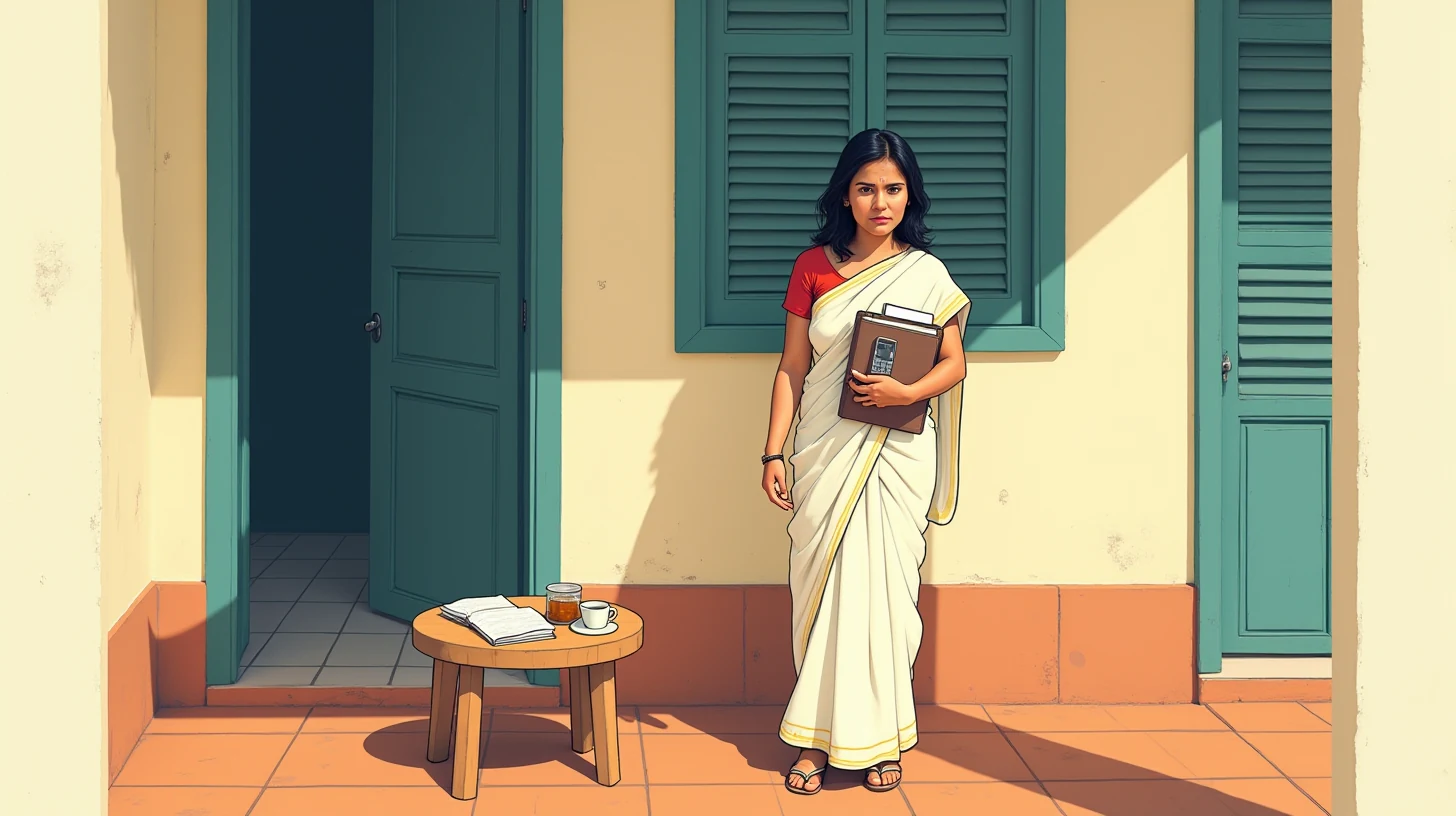
She has lived on ₹1,500 a month from the Griha Aadhar scheme for the past three years. The money sits in her bank account until the electricity bill comes, or a school fee, or a doctor. It is a slender lifeline for weeks when tourism drops or when her husband's tour-operating business turns quiet. The catch: every April, the scheme requires a fresh income certificate from the Mamlatdar's office. One form, one verification of last year's household income, one proof that the family still qualifies. Beatrice has filed her renewal four times. Each time, she waited a month, maybe six weeks, and it arrived.
This year, something broke in the machinery. On 3 March, she walked into the Mamlatdar's office in Tiswadi with her husband's business tax returns, their Aadhaar cards, the marriage certificate, and a bank statement. The officer at the desk handed her a numbered receipt. Three months later—thirteen weeks, to be exact—the income certificate has not arrived, and the Griha Aadhar renewal window closes in fourteen days.
🗓️ The calendar that governs women at the margins
The Griha Aadhar scheme is Goa's answer to a grandmother's arithmetic. For a woman who keeps house and minds the children and watches a husband's income swing with the monsoon, ₹1,500 is the difference between month-end credit and month-end choice. The scheme acknowledges a truth the tax code does not: that women's work—the meal-planning that stretches rations, the careful accounting of electricity and phone, the homework supervisions and health appointments—has a shadow value. It does not pay for that work. Instead, it pays a woman to be at home and married and below a certain income line.
The renewal is annual, locked to the financial year. Applications must be filed between 1 April and 30 April. Approval, the government promises, takes 30 days. Beatrice filed hers on 3 March, deliberately early—she had learned from other beneficiaries to leave a cushion. Thirty days passed. She called the Mamlatdar's office on 3 April. "Still under verification," the voice on the phone said.
The second week of April, she called again. Same answer. The third week, a clerk she reached by luck told her that her husband's business income for FY24-25 had been higher than the threshold, and the office was checking his FY25-26 returns—the year just ended. "Verification," the clerk said, "will take time."
By early May, Beatrice understood that "verification" meant that the Mamlatdar, somewhere in a file, was deciding whether her marriage, her income, her household, her right to ₹1,500, still made bureaucratic sense. She did not know how long that would take.
- ⏰
1 April – 30 April: Renewal window opens
Annual income-certificate renewal must be filed within this month to maintain benefits.
- 📨
3 March: Beatrice submits (4 weeks early)
She files at Tiswadi Mamlatdar''s office with tax returns, Aadhaar, and marriage certificate.
- ⚖️
3 April – 20 May: ''Under verification''
Eight weeks pass. Office is checking FY25-26 income; her husband''s tour-operating business had a strong season.
- 🛑
19 May: 14 days remain
Window closes 30 May. If approval does not arrive by then, Beatrice loses the stipend for June and July.
The promise is that a homemaker''s income from a spouse''s labour and the home itself—the two cannot be separated—will not exceed ₹3 lakh in a year. Beatrice''s husband is a tour operator; he books buses for visiting groups, arranges guides, negotiates hotels. On a good monsoon-end season, clients arrive to see the Western Ghats and the beaches. On a slow one, the phone sits silent. Last year was good. He invoiced ₹3.2 lakh—just above the threshold.
"But next year," Beatrice told the clerk, "he won''t have that much. The monsoon was just good that one time."
"The Mamlatdar will decide," the clerk said.
The scheme does not account for seasons or bad years to come. It verifies the year that passed. Goa''s tourism industry breathes with the calendar, but the bureaucracy reads only fixed numbers.
⚠️ The moment when the system tightens
On 15 May, Beatrice received a call. It was the Mamlatdar''s office. "Your husband''s income certificate has been rejected," a voice said. Not delayed. Rejected. The household income exceeded the threshold. The scheme does not allow wives of men who earn more than ₹3 lakh.
Beatrice sat down. The ₹1,500 she had budgeted for June was suddenly not coming. The electricity bill was due on the 25th. Her daughter had a course fee in early June—not large, but it had been absorbed into the monthly stipend.
"There must be a mistake," Beatrice said. "I have the returns. I can show that this year will be different."
"You can file an appeal," the voice said. "The form is on the Goa e-Sevaa portal."
She asked for the form name. The voice did not know. She asked where to submit the appeal. "The Mamlatdar''s office," she was told. "You can come in person or post it."
Beatrice hung up and sat in her kitchen. The appeal form did not exist on the portal—she searched that evening on her husband''s Nokia. There was an application form, there was a status-check page, there was a downloadable list of required documents. There was no appeal form.
The same evening, she called the Directorate of Women & Child Development helpline. After thirty minutes on hold, a voice said the form was available at the taluka office or could be requested from the Mamlatdar''s office directly. "How long does an appeal take?" Beatrice asked.
"If it is strong," the voice said, "it can be approved in one month."
One month would be June. The stipend is due May 31st.
What it does
- ⚖️Compares total household income (husband + wife) to the ₹3 lakh threshold for the past financial year.
- 📋Requests tax returns, business ledgers, and municipal property documents to verify claimed income.
- 📞Contacts the taxpayer''s registered address if the numbers raise questions.
What it does not do
- 🔍Account for business seasonality, monsoon variations, or future income likelihood.
- 💸Allow appeals based on hardship, changed circumstances, or a poor upcoming year.
- ⏰Provide an estimate of how long verification will take or communicate progress after receipt.
🌗 When a neighbour opens a door
On 16 May, Beatrice''s neighbour, Mrs. Prabha, was watering the garden when she saw Beatrice sitting inside, motionless, her phone on the windowsill. Prabha came in. Beatrice told her about the rejection, the appeal, the closed June, the missing form.
"My daughter," Prabha said, "uses an agent on her phone. For one of those government things. She calls it a tablet—not AI, she says. Just a thing that reads forms and tells you what you need. Let me ask her."
Prabha''s daughter, who works at a bank in Panaji, had discovered the agent through her office training. She came over with her own phone. Beatrice showed her the rejection letter, the portal, and the helpline receipt. The agent, accessed through a browser, took the rejection letter, the scheme name, and the question: "Is there a formal appeal process for Griha Aadhar income rejections, and what documents will strengthen an appeal?"
The agent''s response came back in five minutes. It identified two paths: (1) a written appeal to the Mamlatdar citing business seasonality and projecting next year''s income with new invoices; (2) a formal grievance to the Directorate of Women & Child Development if the Mamlatdar''s office refused to accept the appeal. It listed the specific documents to attach—GST returns for two years, a letter from her husband''s business partner or a client confirming next season''s bookings, and a revised household budget for the next year.
More than that: it pulled the contact details for the Mamlatdar''s office grievance portal and the Directorate''s appellate email from the government websites themselves.
"This is what you need," the agent said in its text reply. "But you must file it. You must submit it. The agent cannot submit for you. You decide."
That was the moment Beatrice decided.
"आपल्या कामाचा मूल्य असले पाहिजे, तर अगोदर लिहून दाखवावे लागते."— The value of our work must be proven in writing first, before anyone will believe it exists.
🧭 Why the system fails homemakers, and who else it leaves waiting
The Griha Aadhar renewal process breaks at three points, and each one erases a different kind of woman.
First, the income threshold itself is a single number, not a spectrum. A husband who earns ₹2.95 lakh qualifies; ₹3.05 lakh does not. There is no account for the nature of the work—a farmer whose monsoon was kind; a fisherman whose nets came up full one year; a guide who led more trekking groups that season. The scheme cannot distinguish between a permanent income surge and a windfall, so it treats them identically. In a state where 40% of the economy depends on tourism and agriculture, both cyclical and climate-dependent, a single-year verification is crude enough to break families at its edges.
Second, the timeline is inflexible. The renewal window—April 1 to 30—assumes that every household has finalised its previous year''s income by then. But a tour operator''s books may still be settling; a farmer may not know the final yield until late April. A self-employed woman, if she has her own business, may not have filed her GST returns. The government demands proof that has not yet materialised.
Third, the communication is broken. When the Mamlatdar''s office is "verifying," Beatrice has no way to know what that means: Are they checking a number? Waiting for a signature? Unclear about the documentation? Will it take ten days or ten weeks? There is no status page that shows progress, no automatic SMS alerting her to the next step, no deadline for the office itself. The verification can stretch indefinitely, and the applicant simply waits.
"हे अर्ज देवून पाहा, तर महात्तारांचे कार्यालयाला तुमचे नाव आणि कागदपत्र आहेत असे माहिती मिळेल. परंतु कसे चलते आहे, ते कधीच कळणार नाही."
(Submit the appeal, and the Mamlatdar''s office will know your name and papers exist. But whether it is moving forward, you will never know.)
This affects not just Beatrice. Across Goa, approximately 28,000 women are enrolled in the Griha Aadhar scheme. Each year, a fraction of them—those whose husbands'' income oscillated just above the line, or those whose verification documents were unclear, or those whose offices simply moved slowly—will miss the renewal deadline. They lose the stipend, not because they became ineligible, but because the calendar ran out.
The women who suffer most are those with no safety net: a widow running a tiffin service from her kitchen, whose husband''s pension was her legal income limit; a mother in her 50s whose son''s income was cited but whose own work as an anganwadi helper was uncounted; a separated woman trying to rebuild and whose former husband''s business income still appeared on old property papers.
These women are not a statistical error in the system. They are the women the system is built to serve.
🌱 On proving what you already know
Beatrice''s appeal, when she filed it on 17 May, included three pieces of paper that her husband''s business partner had written by hand. They stated that the monsoon-end surge was unusual, that the next season was expected to be slower, and that the average annual income over the past three years was ₹2.8 lakh. She attached her husband''s GST returns for two years, highlighted the variance, and wrote a two-paragraph letter explaining that the FY25-26 figure did not reflect normal operations.
She did not know if it would work. The appeal process had no timeline, no published criteria, no way to predict an outcome.
What she did know, sitting in her kitchen on the evening of 17 May, was that she had tried every piece of information the system itself had made available to her. The appeal form came from the government portal; the contact addresses came from the government website; the documents she attached were the same documents the government asked for. She had not guessed. She had not begged. She had read what was written and acted on what she found.
The ₹1,500 might not come in June. The electricity bill would come regardless. But for the first time in eight weeks, Beatrice was not waiting in dark. She was waiting with a file, with proof, with her own words written beside her husband''s numbers.
The Mamlatdar, somewhere in Tiswadi, was still reading.