
The Phulwarisharif mother and the Kanya Utthan ₹50,000
Sushila Devi is forty-four years old. She lives in Phulwarisharif, which sits about ten kilometres southwest of Patna city — close enough to be pulled by its gravity, far enough to feel the specific friction of its own world: unpaved alleys between pukka brick walls, an auto-rickshaw stand near the main road, government schools that are, by the standards of the neighbourhood, genuinely attended. Her husband Shyam Yadav drives an auto-rickshaw, working the Phulwarisharif-to-Patna route six days a week. Household income runs somewhere between nine and twelve thousand rupees a month, depending on the weather, the diesel price, and how many passengers decided to walk. They have a BPL ration card. They have three daughters: Pooja, nineteen; Khushi, sixteen, in Class 10; and Anushka, twelve, in Class 7.
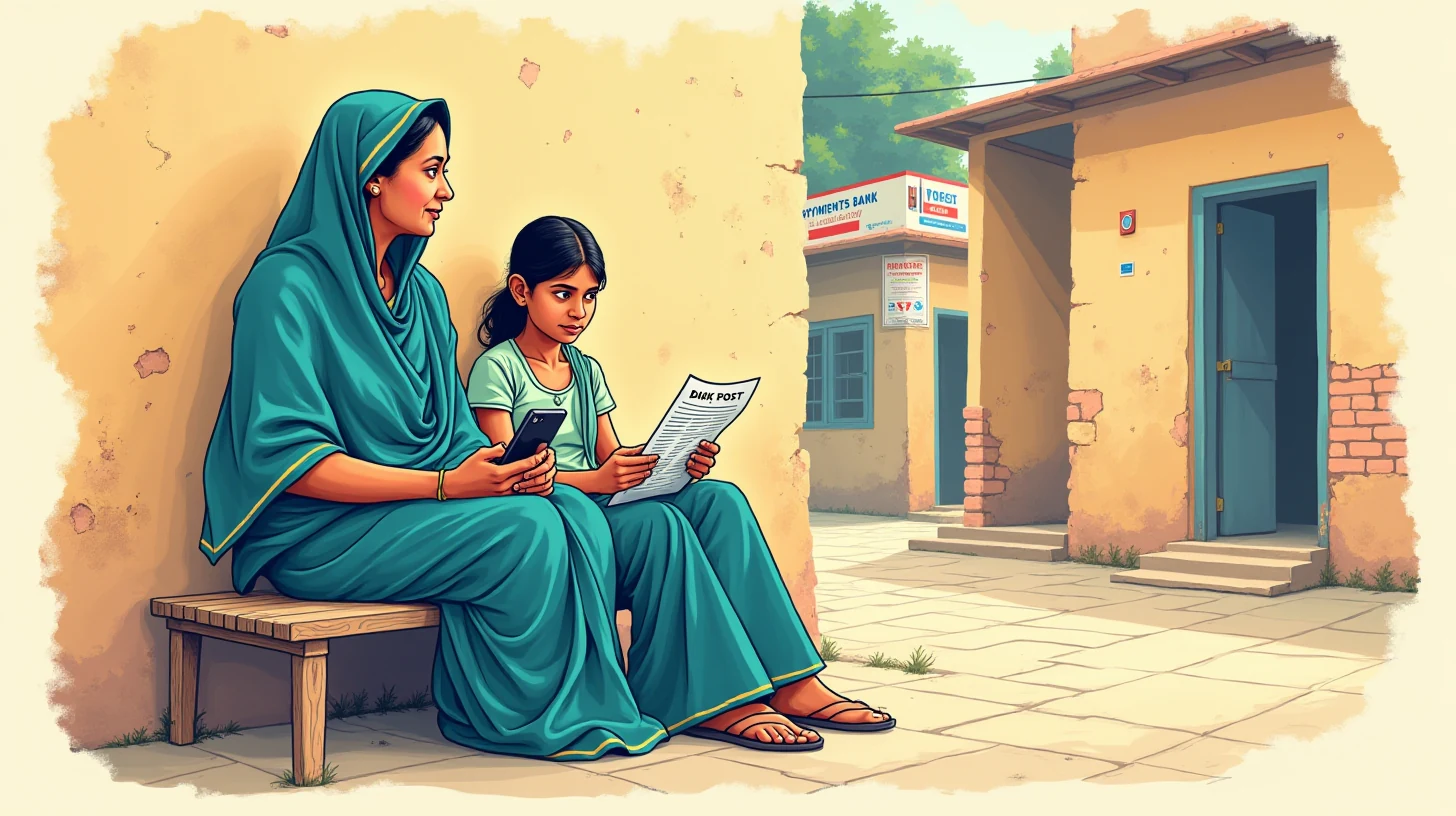
Sushila dropped out of school at Class 5 — not because anyone decided she should, but because the domestic arithmetic of the household simply required her to, the way it has required millions of women of her generation. She can read Hindi slowly and with effort. She has never operated a smartphone for anything beyond making or receiving a call — her elder daughter Pooja handles the WhatsApp, the Google searches, the occasional bank app navigation the family needs done. This is a perfectly ordinary division of labour in a perfectly ordinary Phulwarisharif household. Sushila does not experience it as limitation. It is simply the shape of the world she lives in.
What is unusual is that her eldest daughter turned out to be quite a bit more than ordinary.
- 📋
March 28 — Pooja''s BSEB Class 12 result, 71 percent
Arts stream. Sushila clasps her daughter''s face and cries. Shyam declares, to nobody in particular, that B.A. at Patna Women''s College is now decided.
- 🛑
Late March — Kanwariya Bhaiya quotes ₹2,500
The neighbourhood fixer offers to handle the e-Kalyan, Aadhaar seeding, and residence certificate as a bundle. Roughly a quarter of the family''s monthly income.
- 🔍
April 3 — Pooja installs the agent on the old Vivo
Four minutes. Free. Hindi. The first question: yes, the Intermediate component is real and Pooja qualifies. The second: India Post Aadhaar seeding is free in five minutes.
- ₹
May 8 → July 14 — submission, then ₹50,000 in the IPPB account
Application filed 27 days before the window closes. DBT credit lands on July 14 at 11:43 AM. ₹38,000 to Patna Women''s College admission; ₹12,000 to a refurbished Lenovo.
🗓️ The result that changed the arithmetic
Pooja's BSEB Class 12 result came out on March 28, 2026. Arts stream — Hindi, History, Geography, Economics, Political Science. She scored 71 percent. A certain kind of outside observer would call this modest. Sushila clasped Pooja's face and cried. Shyam, returning from his shift, sat with the marksheet for a long time and then said, to nobody in particular: "Iske baad B.A. hoga. Patna Women's College mein." As if it were decided. As if it had always been decided. Pooja, who had spent the previous three hours privately making peace with the probability that it would not be Patna Women's College — that it would be an early marriage in two or three years — said nothing. She put the marksheet in a plastic sleeve.
She had not told her parents about Patna Women's College. This is a thing that daughters in families like hers learn to do — hold ambitions quietly, like water in cupped hands, until the moment it becomes clear whether the ground beneath will accept them.
"पटना विमेन्स कॉलेज में बी.ए. — मैंने ये बात किसी से कही नहीं थी।"— B.A. at Patna Women's College — I had not said this to anyone. Pooja, holding the marksheet in its plastic sleeve, on March 28.
What she did not know, sitting with the marksheet in its plastic sleeve, was that the Bihar State Government had been making a very specific offer to girls exactly like her for the past several years.
The scheme she hadn't heard of correctly
The Mukhyamantri Kanya Utthan Yojana provides, among several components, a one-time benefit of ₹50,000 to unmarried girls who complete Intermediate — Class 12 — from BSEB, with results from April 1, 2018 onwards. Applications go through the Bihar Education Department's e-Kalyan portal at e-kalyan.bih.nic.in. The money comes via Direct Benefit Transfer, directly into the girl's Aadhaar-seeded bank account. For the March 2026 batch, the window opened April 5 and closes June 4 — sixty days.
Pooja had heard of Kanya Utthan — vaguely, a general awareness that there was some government money for girls somewhere. She had understood it to be a Class 10 scheme. The ₹10,000 Matric component she knew about dimly, because a classmate's sister had mentioned it. The ₹50,000 Intermediate component she did not know existed at all. She certainly did not know that she was, right now, with her 71-percent marksheet in its plastic sleeve, eligible for fifty thousand rupees that would more than cover the first-year admission fees at Patna Women's College.
Sushila knew less. "Maai, scheme ke baare mein kaun batayega humka?" Pooja asked her on the evening of March 29, after a neighbour's daughter had mentioned some scheme for Intermediate-pass girls. Sushila would ask at the mohalla. Ask Mrs. Sharma. Ask the schoolmaster's wife. The schoolmaster's wife thought it was the cycle scheme — the Mukhyamantri Balika Cycle Yojana, under which Khushi had received ₹3,000 in Class 9, which had nothing to do with the Intermediate benefit. That chain led, eventually, to the suggestion that there was a man in the neighbourhood who could handle these things.
⚠️ Kanwariya Bhaiya
His name, in the neighbourhood's accounting, was Kanwariya Bhaiya. He was twenty-six, owned a printing shop with a scanner, had some familiarity with the e-Kalyan portal, and occupied the specific social role that exists in most Indian urban-adjacent neighbourhoods — the person who knows how to do the paperwork that ordinary people don't. He was not a cheat. He was, in the moral landscape of his neighbourhood, a useful person. The charge for Pooja's case — the e-Kalyan application, Aadhaar seeding at the bank, and the residence certificate — he quoted at ₹2,500.
₹2,500 is roughly a quarter of the family's monthly income. It is the thing that stands between a ₹50,000 government benefit and the family's actual access to it. The government had designed the scheme correctly, in principle. The portal existed. The money was real. The Direct Benefit Transfer infrastructure was live. But between the scheme and the beneficiary there was a document gap — specifically, the Aadhaar-seeding gap — that a family without institutional knowledge could not cross without paying someone who had that knowledge. This is the quiet structural problem of well-designed government schemes in practice: they are built for a population that has information no one gave them.
Shyam's reaction was immediate: "Kanwariya bhaiya pe bharosa hai humka. Do hazaar paanch de do, kaam ho jaayega." Trust Kanwariya. Pay the money. He had spent his life learning that government portals do not work without human mediation, and that human mediation costs money, and that this is the cost. He was not wrong, exactly. He was operating on the best information available to him.
Pooja was not sure. She was nineteen. She had navigated the BSEB results portal herself, filed her college pre-admission form herself, done the digital part of the Mukhyamantri Balika Poshak Yojana application for Anushka herself. She did not know what Aadhaar seeding meant, or whether she could do the e-Kalyan application alone. But she did not immediately accept that she couldn't.
🌗 The phone in the almirah drawer
Her father's old Vivo phone had been sitting in the almirah drawer for eight months — replaced by the model he used for Ola. It still worked. Sushila's own phone was too slow for much beyond calls. On April 3, two days before the e-Kalyan window opened, Pooja installed gabforge.in on the Vivo. Four minutes. Free. It spoke Hindi. She opened it and typed the question she most needed answered: "Mukhyamantri Kanya Utthan Yojana kya hai? Kya mujhe ₹50,000 milenge Class 12 pass karne ke baad?"
The agent — Meera, as she is named in the gabforge.in interface — replied in plain Hindi, without jargon, without the bureaucratic register that government portals use and that is, for most people in Sushila's neighbourhood, a wall rather than a door. What Meera said was: yes, this was the Intermediate unmarried-girl component of the Mukhyamantri Kanya Utthan Yojana. ₹50,000. Bihar Education Department via DBT. Specifically for BSEB Class 12 girls who passed from April 2018 onwards. Pooja qualified. Then Meera asked: "Pooja didi, kya aapka bank account Aadhaar se link hai? Yeh sabse pehle check karna hoga."
Pooja said she had an account at India Post Payments Bank in Phulwarisharif. Opened in 2022, with her mother as joint guardian. She didn't know if it was Aadhaar-seeded.
Meera said, gently: "India Post Payments Bank mein Aadhaar seeding free hoti hai — wahan jaake 5 minute mein ho jaata hai. Iske bina e-Kalyan mein paisa nahi aayega."
This was the first thing. That Aadhaar seeding — priced by Kanwariya as part of his ₹2,500 package — was a free five-minute service the India Post Payments Bank branch in Phulwarisharif had been providing for months. The bank had been doing it. The family had not known it existed.
What Meera walked them through
Over the following nine days, Meera did four things.
She explained the complete e-Kalyan document checklist in Hindi: the BSEB Class 12 marksheet (phone photo accepted), the Aadhaar of Pooja, Aadhaar-seeded bank account confirmation, a residence certificate from the Circle Officer, an unmarried status self-declaration on plain paper, and a caste certificate — separate from the BPL ration card, but which Pooja already had from a previous application.
She walked Pooja through the RTPS Bihar portal — the Right to Public Services system — which allows Bihar residents to apply for a residence certificate online, at zero cost, with a fifteen-day SLA. "rtps.bihar.gov.in pe jaiye, 'Residence Certificate' dhoondiye, form bhar dijiye. Paise nahi lagte." Pooja had never heard of RTPS. She applied April 6. The certificate arrived April 24 — eighteen days, three past the SLA, which is, in Bihar government's actual practice, a respectable outcome.
She helped draft the unmarried status self-declaration on plain paper — a standard format, accepted by e-Kalyan when signed by the applicant and attested by the school principal. One visit to the school, ten minutes, done.
And she talked to Shyam.
"Chacha, Kanwariya bhaiya 2,500 lega"
Pooja had been managing the paperwork without Shyam's full awareness — telling him things were being done, no need for Kanwariya yet. On the evening of April 9, Shyam came home from his shift and raised the matter directly. He wanted to call Kanwariya and pay and be done with it. "Online mein kya hota hai — Kanwariya bhaiya jaanta hai sab." He was not wrong to feel this. He was risk-managing the only way he knew how.
Pooja showed him the phone. She asked Shyam to read what the agent had said. When he said he didn't want to — tired, sceptical — she typed his concern into the chat: "Babuji bol rahe hain Kanwariya bhaiya ko paise deke kaam karwao. Kya yeh zaroori hai?"
Meera's reply came back in Bhojpuri-mixed Hindi — the register of the household, not of a government portal:
"Chacha, Kanwariya bhaiya 2,500 lega — paisa apna hai, scheme ka hai. Hum form bhar denge, aap dekhiye. Aadhaar seeding India Post mein free hoti hai. RTPS se certificate aa raha hai. e-Kalyan pe Pooja didi khud submit kar sakti hain."
(Chacha, Kanwariya bhaiya will take ₹2,500 — and the money is yours, the scheme's money. We will fill the form; you watch. The Aadhaar seeding at India Post is free. The RTPS certificate is on its way. Pooja didi can submit the e-Kalyan herself.)
Shyam read it. He asked: the bank does the Aadhaar seeding for free? Pooja said yes. He asked: we applied for the certificate already? She said yes, it was coming. He said nothing more about Kanwariya that evening. He did not exactly capitulate — he remained watchful, ready to say "I told you so" if things went wrong — but he did not make the call. In a household where the father's scepticism is itself a kind of household infrastructure, this counts.
Aadhaar seeding was done April 12. Pooja and Sushila went together to the India Post Payments Bank branch in Phulwarisharif. The agent linked Pooja's Aadhaar to the account in six minutes and printed a confirmation slip. Sushila kept it in the same plastic sleeve as the marksheet.
On May 8, 2026 — twenty-seven days before the window closed — Pooja submitted her e-Kalyan application. Meera had walked her through the portal page by page the evening before. The submission went through. The reference number appeared on screen. Sushila, looking over her daughter's shoulder, understood approximately none of the English on the portal but understood the screenshot completely. "Ho gaya?" Pooja said yes. "Beta, tumhar paisa atki hai?" No, Sushila. The money is not stuck. It will come.
What ₹50,000 can buy
The DBT credit landed in Pooja's India Post Payments Bank account on July 14, 2026. The SMS came at 11:43 in the morning. Pooja was in the kitchen with Sushila.
She stood very still for a moment, reading the SMS, then said a number. Sushila asked what. She said the number again: fifty thousand rupees.
There is a particular silence in a household that has been holding its breath — not dramatically, but constantly, the way a family holds its breath when the arithmetic of the month is not yet clear — when the breath is finally released. It is the silence of a woman putting down a weight she had been carrying so long she had stopped noticing it.
Pooja used ₹38,000 for first-year admission and registration at Patna Women's College. She had been admitted to B.A. Honours Hindi — her real ambition, the one she had not named aloud, the one she had been holding in cupped hands. She used ₹12,000 for a refurbished Lenovo laptop from a shop her classmate's father recommended. The kind that runs slowly but runs.
The family did not pay ₹2,500 to Kanwariya. He is a useful person in the neighbourhood, and Shyam still greets him at the auto stand, without animosity. The ₹2,500 stayed in the household.
Khushi — Class 10 — will be eligible for the ₹10,000 Matric component of the same Mukhyamantri Kanya Utthan Yojana when she passes next year. Sushila now knows this exists. She knows the e-Kalyan portal exists. She has the address written on a small piece of paper in her almirah: e-kalyan.bih.nic.in. She does not know how to type it herself. She knows, now, that Meera does.
The first day at Patna Women's College
It was a Thursday in late July. Pooja left Phulwarisharif on the 7:40 AM bus, wearing her best salwar-kameez, carrying a cloth bag with the Lenovo and a printed copy of the admission letter and a small tiffin Sushila had packed at 6:30 — rice, dal, achaar, two rotis. Sushila stood at the alley entrance and watched the bus go. Anushka, on school holiday, stood beside her.
Sushila did not cry this time. She had cried on the marksheet day. Today she was simply a mother watching a daughter do the thing that was always supposed to happen, that had very nearly not happened, that had happened anyway.
Pooja did not look back from the bus. This is the particular confidence of a nineteen-year-old girl who knows, for the first time, that the ground beneath will hold.
What it does
- 🔍Reads the Kanya Utthan scheme document, the e-Kalyan field list, and the RTPS Bihar residence-certificate form — in Hindi and Bhojpuri.
- 🗂️Surfaces the free Aadhaar seeding at IPPB, the zero-cost RTPS pathway, the standard unmarried-status self-declaration format.
- 📞Names the precise URLs, the documents Pooja needs in her plastic sleeve, and the order of operations.
What it does not do
- 🔒Never enters Pooja''s Aadhaar OTP or the IPPB online banking password. Sushila and Pooja walk into the branch themselves.
- 💳Does not pay Kanwariya Bhaiya the ₹2,500 — that money simply stays in the household.
- ✅Does not submit the e-Kalyan form for Pooja. Pooja fills every field herself; the agent sits on the phone beside her.
🧭 What the phone in the drawer was actually for
There are, in Bihar alone, tens of thousands of girls who completed BSEB Class 12 this March and are right now eligible for the Mukhyamantri Kanya Utthan Yojana benefit. Not all of them know the scheme exists in its Intermediate form. Not all of their families know that Aadhaar seeding at India Post Payments Bank is free. Not all of them know about RTPS Bihar and the zero-cost residence certificate. Many of them have a Kanwariya Bhaiya — not a bad person, often a helpful person, always a paid intermediary — standing between them and a benefit the government designed to reach them directly.
The application window closes June 4, 2026.
Meera, over nine days in April, did what a thoughtful older sister would have done: read the scheme documents together, explained the bank process in plain Hindi, drafted the self-declaration, walked through the portal one screen at a time, and — when the father was sceptical — spoke to him in the language of the household, without condescension, without charging two thousand five hundred rupees for the privilege.
Gabforge.in is free. It speaks Hindi and Bhojpuri. It knows the e-Kalyan portal, the RTPS Bihar portal, the India Post Payments Bank Aadhaar-seeding process, and the document checklist for the Mukhyamantri Kanya Utthan Yojana. It will not file your application for you — Pooja filled in every field herself. It will sit on the phone with you while you do.
🌱 The plastic sleeve in the almirah
The plastic sleeve in Sushila's almirah now holds four pieces of paper: the BSEB Class 12 marksheet, the India Post Aadhaar-seeding confirmation slip, the RTPS residence certificate, and the e-Kalyan submission reference number Pooja printed at a stationery shop. Khushi will pass BSEB Class 10 next year and Sushila knows where the ₹10,000 Matric component lives. Anushka, twelve, is being told the e-Kalyan portal address slowly, on small pieces of paper, the same way the Hindi alphabet was once taught to her sisters. The Kanwariya Bhaiya at the auto stand remains a useful person in the neighbourhood, and Shyam still greets him without animosity. The ₹2,500 stays where it always should have been.
If you have a daughter who passed Class 12 from BSEB this March and has not yet applied — the window is open until June 4. The scheme is real. The money is real. The portal is e-kalyan.bih.nic.in. You do not need Kanwariya Bhaiya.