
The Port Blair homemaker and the PMMVY hospital-empanelment gap
Reena Lakra sat at her small kitchen table in the Junglighat flat, one hand resting on the swell of her belly, the other pressing the Nokia 105 to her ear. It was three weeks after her first pregnancy had crept past the six-month mark. The voice on the phone — Shalini, the Anganwadi worker who came through twice a month with growth-monitoring kits for the neighbourhood children — was delivering news that made Reena''s chest tighten.
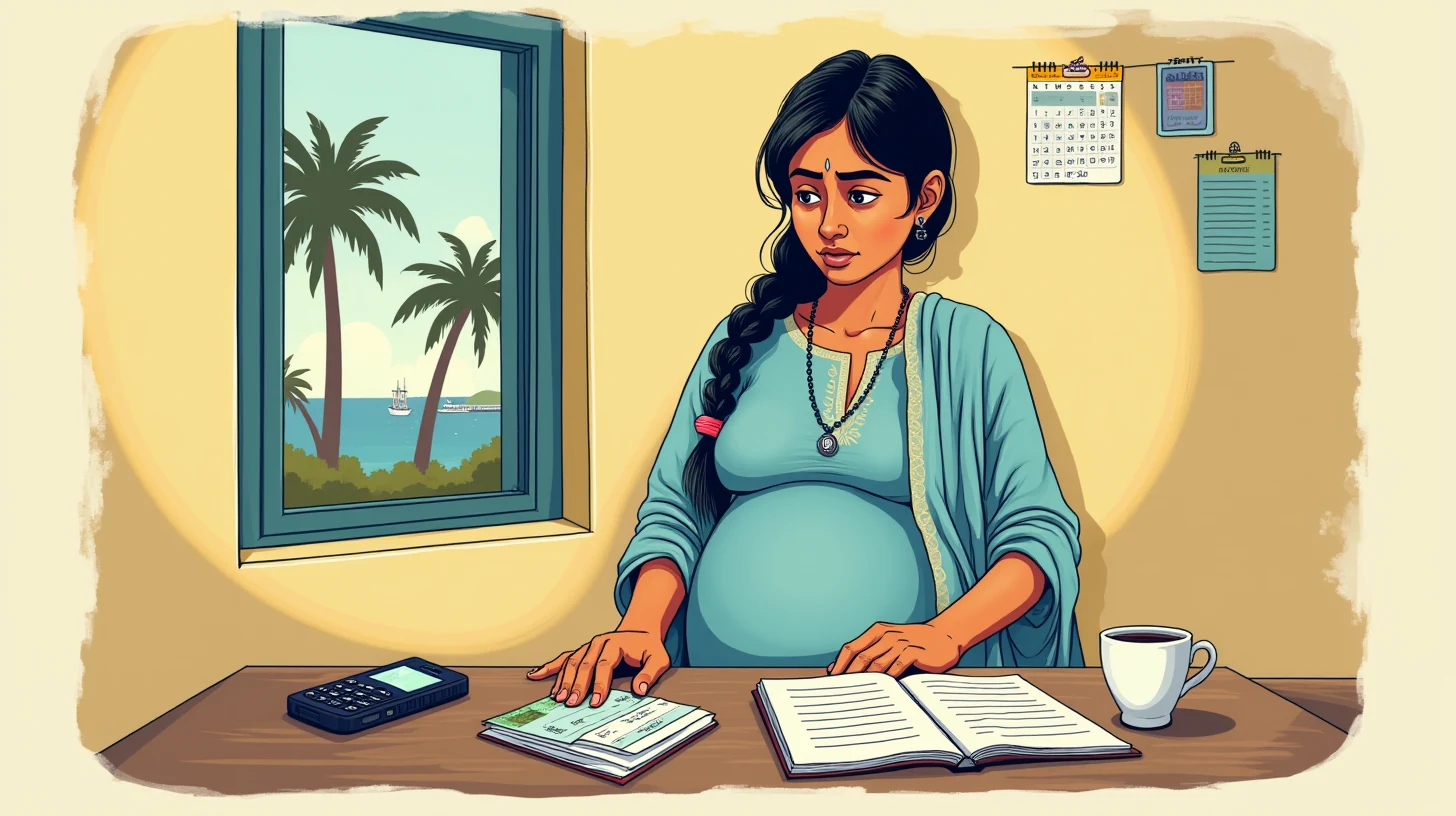
"The hospital you went to — the private clinic near Andhra Bazaar — it''s not showing up in the PMMVY list," Shalini had said, apologetically but firmly. "The government system only accepts registrations from empanelled facilities. You need to get your papers transferred to GB Pant."
Reena was 28, a merchant marine''s wife, with a small tailoring shop in a shuttered workshop space behind Junglighat market. She had a daughter from a previous relationship, now 11 and in school. This pregnancy was planned and wanted. She and her husband, Pritam, earned enough to live quietly — no luxury, but stable. Their monthly income from the tailoring and his shipping allowance totalled about ₹24,000. They saved when they could.
What Reena had not anticipated was that the maternity-benefit scheme the state had promised her — ₹5,000 in three installments across pregnancy and infancy — would be contingent on the luck of her first clinic choice. When she was six weeks pregnant, she had visited the clinic nearest her flat: a privately run facility run by a kind woman gynaecologist who charged ₹800 for the ultrasound. It felt legitimate. It had air-conditioning. It had a patient register. She had registered there, paid her fees, obtained her first maternity card, and felt she was doing what a mother-to-be should.
Three months later, trying to apply for PMMVY through the Anganwadi, she learned that her choice had placed her outside the system entirely.
🗓️ The rhythm of PMMVY in Port Blair
The Pradhan Mantri Matru Vandana Yojana is a direct cash benefit to pregnant women and new mothers. Launched nationally in 2017, it promises three installments: ₹1,000 when pregnancy is registered early at an empanelled centre; ₹2,000 after the first antenatal check-up is completed (typically after six weeks of pregnancy); and ₹2,000 after the child is born and vaccinated.
For Reena — a first-time mother — this meant a guaranteed ₹5,000 over the course of nine months and the early postnatal period. That money would cover her tailoring shop''s lost income during maternity leave. It would pay for maternity-specific nutrition, medicines, and hospital travel. It was not glamorous, but it was tangible. It was hers by right.
In most of India, PMMVY is implemented by the Integrated Child Development Services (ICDS), the network of Anganwadi workers who form the backbone of maternal and child welfare in rural and small-town India. The Anganwadi worker — usually a local woman with government training — becomes the first point of contact. She registers the pregnant woman at the nearest empanelled facility, collects the documents, and routes the application through the district''s Women & Child Development (WCD) department. If all goes well, the cash hits the mother''s bank account in under three weeks.
In Port Blair, this system worked. But it worked within strict boundaries.
Port Blair has a population of 140,000 spread across the Junglighat, Garacharama, Pheonix Bay, and Haddo neighbourhoods. It has three major hospitals: GB Pant District Hospital (government-run, 473 beds, the only secondary-care facility), Apollo Clinic (private), and a handful of smaller private nursing homes. Of these, only GB Pant Hospital is empanelled under PMMVY. The private clinics — including the one Reena had chosen — operate outside the government entitlement system.
This is not a deliberate exclusion. It is a gap in the system''s architecture. PMMVY is designed for mothers who enter the government health infrastructure from the start. Once a woman registers at a non-empanelled facility, reattaching her to the scheme becomes a manual, time-consuming process that most Anganwadi workers are not equipped to handle.
- 📋
February 15 — First pregnancy test, private clinic
Reena registers as a new patient at the clinic near Andhra Bazaar. She receives her first maternity card (hospital issue). The clinic charges ₹800 for ultrasound and ₹200 for registration. She feels she has begun prenatal care.
- 🏥
March 10 — First antenatal check-up (6 weeks)
Standard ANC: weight, blood pressure, urine test, foetal heart rate. The clinic issues a receipt. Reena has completed the milestone for the second PMMVY installment.
- ⚠️
May 10 — Application for PMMVY through Anganwadi
Shalini, the Anganwadi worker, begins the application process. She submits Reena''s documents — Aadhaar, marriage certificate, health card. Within a week, the district WCD office flags the application: the clinic is not on the empanelled list.
- 🛑
May 17 — Empanelment gap discovered, six-week wait looms
Reena learns she must transfer her registration to GB Pant Hospital to proceed. But GB Pant''s OB-GYN outpatient clinic is booked six weeks ahead. She is now 28 weeks pregnant.
⚠️ The six-week wait and the tightening deadline
By late May, Reena was in her seventh month. The sixth-month milestone — the second ₹2,000 installment — had already passed. She had not received the first ₹1,000 either. Her application was in limbo.
Shalini explained the path forward. Reena would need to attend an appointment at GB Pant Hospital''s Department of Obstetrics and Gynaecology, undergo a fresh registration examination, and provide fresh documentation. Only then could the Anganwadi office amend the application.
When Reena rang GB Pant''s outpatient department, the appointment line told her the OB-GYN clinic was fully booked until mid-June. The wait was six weeks.
This was the texture of the problem. PMMVY ''s rules were not wrong. They existed to ensure that cash benefits went to women in tracked, safe pregnancies where a government doctor had oversight. The empanelment requirement made sense in policy. But the implementation — the single OB-GYN clinic at the single empanelled hospital, serving an island population of 140,000 — had no slack. No backup. No alternate path for women who had chosen wrong at the start.
Reena had four weeks of safe delivery window remaining. The application was frozen. The money was not coming.
She did not blame anyone. She blamed the gap between what the scheme promised and what it could deliver when the system was understaffed. And she began to worry.
City with five empanelled hospitals
CommonA mother who registers at a non-empanelled clinic is advised to switch. She has choices: government PHC, district hospital, or a pre-empanelled private chain. Most have availability within two weeks. Application can proceed.
Port Blair: one empanelled facility
Reena''s realityA mother who registers at a non-empanelled clinic has one legal option: GB Pant Hospital. But GB Pant''s OB-GYN clinic is backlogged six weeks. The waiting period swallows the pregnancy window. Application stalls.
The cash benefit sits frozen
Impact₹5,000 earmarked for Reena under PMMVY cannot be released until she is re-registered with an empanelled facility. Her bank account remains empty. Her postnatal care is at financial risk.
🌗 The agent and the workaround
It was Shalini who mentioned the tablet.
One afternoon, as Reena sat in the Anganwadi centre for a routine weight check, Shalini said casually: "There''s a tool now. The district office uses it to verify hospital empanelment and find phone numbers for OB clinics. Let me show you."
She produced a basic Android tablet — a gift from the WCD department, donated by a nonprofit. On the screen, she navigated to the PMMVY portal, then to a linked state-level registry of empanelled hospitals. She searched for Port Blair.
Only GB Pant Hospital appeared.
But scrolling further, Shalini found a field marked "Alternate Contact: OB-GYN Duty Doctor." She noted the number: 03192 233455.
"These are the rotation doctors," Shalini explained. "Every day, one of them is on call for urgent cases. If your pregnancy has a complication, or if you''re close to labour and need a transfer appointment, you can call this number. They sometimes have same-day slots."
It was a sliver of possibility. Reena did not have a complication. Her pregnancy was textbook-normal. But she wrote the number down anyway.
The next morning, she called.
The duty doctor who answered — a woman named Dr. Dey — listened to Reena''s situation. A regular commercial appointment would indeed take six weeks. But Dr. Dey offered a pragmatic solution: come in for a "pre-labour readiness appointment" in two weeks. It was technically a clinical slot, not a routine registration, but it would give GB Pant a current baseline of her pregnancy and allow her to be re-registered in the system. Once that happened, the PMMVY application could be unlocked.
"Tell your Anganwadi worker to call my office," Dr. Dey said. "I''ll put your name in our system. When you come, bring all three maternity cards — the private clinic one and any documents the Anganwadi gave you."
Reena hung up with relief that surprised her. She had expected a closed door. Instead, there was a person on the other side who understood the gap and was willing to work around it.
"GB Pant ke duty doctor ne kaha, do hafte mein aao, pregnancy readiness check karunga, phir PMMVY ka form unlock ho jaega. Anganwadi se phone kar dena, mera naam likha dun."
(The duty doctor at GB Pant said to come in two weeks for a pregnancy-readiness check, which would unlock the PMMVY application. I should have the Anganwadi worker call so she''d have my name in the system.)
The appointment came through. Reena attended GB Pant Hospital on a June morning, was examined by Dr. Dey, and received a fresh maternity card stamped with the hospital''s official seal. The Anganwadi office was notified. Within two weeks, the PMMVY application was amended in the district WCD database.
By late June, Reena''s first ₹1,000 installment arrived in her bank account. By early July, the second ₹2,000 followed. Both were backdated to her original pregnancy milestone dates, even though they arrived months later. The state''s system, once corrected, had honoured the promise.
🧭 Why this gap persists and who else it traps
The PMMVY empanelment rule exists because the scheme was designed to create accountability. A government benefit should flow to a pregnancy that has been witnessed and documented by a qualified government health worker. If money goes to women who register outside the system, the argument goes, the state loses visibility into maternal outcomes. The woman might be at risk. The newborn might be at risk. The cash might not translate into actual safety or care.
This logic is sound. But it assumes something that is not always true: that an empanelled facility is available, accessible, and fast.
In Port Blair — an island UT with limited specialist staff and a single secondary-care hospital — the empanelment rule creates a one-way trap. A mother who starts at a private clinic cannot easily pivot to the government system without a significant cost in time and anxiety. She is not excluded from healthcare. She can continue her pregnancy privately. But she is excluded from the scheme that was meant to support her.
This affects not just Reena. It affects any mother in Port Blair who does not know, at the moment of her first pregnancy test, that she must choose GB Pant Hospital to be eligible for PMMVY. The Anganwadi worker cannot advise her until her application is already submitted and rejected. The private clinics have no incentive to inform her; they are outside the scheme entirely. The knowledge gap is not an oversight. It is structural.
Andaman and Nicobar has a maternal mortality ratio of 79 per 100,000 live births — lower than many Indian states, but higher than wealthy countries, and concentrated among mothers without consistent prenatal oversight. When PMMVY works, it incentivizes early, regular antenatal care and institutional delivery. But when it fails silently — when a woman registers at the wrong clinic and learns too late — it can delay her entry into the system at exactly the moment when she needs it most.
"Maine socha tha ki ₹5,000 meri hak hai, pehla bachcha. Lekin jo hospital nayi nai likha tha agle document mein, vo paise nahi aa sake. Jab Anganwadi ne kaha, 're-register karo GB Pant se,' tab samajh aaya — mera choice ek galat clinic ke naam ke barabar tha."— I thought the ₹5,000 was my right, for my first child. But the money could not come because the hospital name was not written on the correct documents. When the Anganwadi worker told me to re-register at GB Pant, I understood: my choice of the wrong clinic at the start was the same as not being registered at all.
The agent''s role in Reena''s case was small but catalytic. It was not to decide for her, or to submit her application, or to bypass the rules. It was to surface them: to show her the empanelment registry, to confirm that only one facility was listed, to provide the duty-doctor phone number, and to verify that a re-registration pathway existed.
The agent did not make the system work. The system had always had the capacity to work — Dr. Dey''s willingness to slot Reena in for a readiness appointment proved that. But without the agent''s navigation of the online registry, and without Shalini''s knowledge of the duty-doctor rotation, Reena would have been stalled indefinitely at the six-week wait, assuming no path existed.
🌱 The quiet lesson
Reena delivered a healthy daughter on August 18. She spent two nights at GB Pant Hospital''s maternity ward, paid for partly by the scheme, partly by her husband''s shipping insurance, and partly by the savings they had built over the year. The third ₹2,000 installment of PMMVY arrived a month after birth, once the infant''s vaccinations were registered.
The ₹5,000 total was not a fortune. It was three weeks of income. But it meant she did not have to close her tailoring shop for longer than the state maternity benefit allowed. It meant her husband did not have to borrow for the hospital stay. It meant that a first-time mother in a small island town could access the dignity of a state scheme without having to engineer her own workaround.
The deeper truth, though, is quieter. It is that the system — PMMVY, the Anganwadi, GB Pant Hospital — was not designed with the assumption that a woman would choose wrong at the start. The system was built on the premise of compliance, not choice. When a mother acts from her own knowledge and circumstances — seeking the nearest clinic, the one with air-conditioning, the one that feels safe — and that action places her outside the scheme''s boundaries, the system does not know how to gracefully include her again.
Reena''s story resolved because Dr. Dey was willing to do the labour of bridging that gap. Because Shalini knew where to find the duty-doctor number. Because the application could be amended retroactively. Because Reena had the confidence to call, and because her husband''s income gave her the breathing room to wait.
For a mother without those advantages, the six-week wait, the re-registration, and the application freeze can become permanent. The scheme promises ₹5,000. The gap in the system can cost her far more.