
The Puducherry homemaker and the destitute-women pension — two offices, one appointment
Mary Lourdes was not always the woman who woke at 5 a.m. in a one-room-and-a-kitchen in Vazhakulam, Puducherry, to mend other people''s clothes for ₹2,000 a month. In 2009, when she married, she was a schoolteacher''s daughter from Kanyakumari. Her husband worked as a driver. In 2019, he didn''t come home. The police said they could not find him. By 2022, he had not sent word or money for three years, and the courts would not hear her petition to annul the marriage. She was 49, had two children in school, and the government books called her a wife, even though she lived alone.
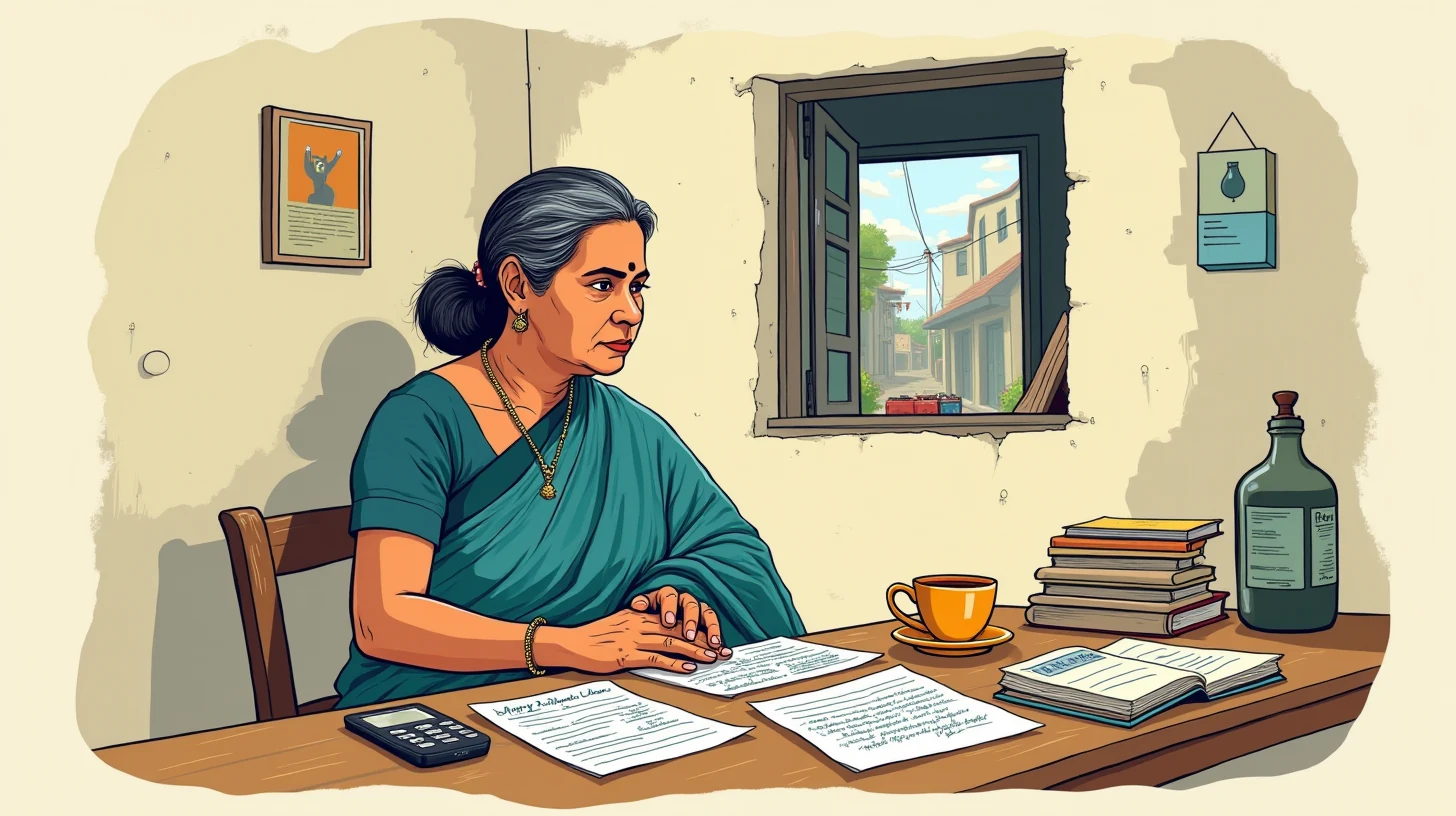
The ₹2,000 a month from tailoring kept the rent paid and the children fed on alternate days. When her son finished high school, she could not afford the college fees. When her daughter turned thirteen, the school asked for class fees that did not exist in Mary''s ledger. In early 2024, a neighbour—a woman who worked at the Anganwadi center—mentioned the Chief Minister''s Pension Scheme for Destitute Women. The government would pay her ₹1,500 every month, no questions asked. Mary''s hands stopped moving over the cloth she was stitching. ₹1,500 would change the shape of her days.
She walked to the Tahsildar''s office in Ozhukarai on a Tuesday morning in March 2024, a file tucked under her arm. The clerk looked at the papers she had collected—her Aadhaar, her voter ID, her son''s birth certificate, a copy of the marriage certificate from 2009—and said she needed a destitution certificate and an income certificate. Both were government documents. Both came from his office, technically. But the income certificate, he said, required a separate appointment with the revenue inspector, who came only on Thursdays. The destitution certificate required an interview with the Tahsildar himself, and the Tahsildar was travelling. He suggested she return the following week.
🗓️ The waiting room rhythm
Every Tuesday morning, Mary packed the same file under her arm. The Puducherry pension scheme had been running since the government''s 2011 women-and-child policy, and it was simple on paper: a woman abandoned by her husband for seven years, or unmarried and over 40, or widowed, or divorced, received ₹1,500 every month into a bank account linked to her Aadhaar. The money was real. The stories were real—thousands of women like Mary, alone and poor and trying to keep their daughters in school.
But the pathway was not simple. The application form itself was straightforward: four pages, printed from the Department of Women and Child Development website, and it asked for an income certificate and a destitution certificate. The income certificate was issued by the Tahsildar''s office under the state Revenue Department. The destitution certificate was also issued by the Tahsildar, but it required a separate in-person interview to confirm that the woman truly had no means of support and that her husband had been absent for seven years without providing maintenance.
Mary discovered this gradual, like a staircase that appeared one step at a time. The income certificate could be applied for online through the e-District Puducherry portal (edistrict.py.gov.in), but the revenue inspector still preferred to see the applicant in person, especially when the applicant had no written income evidence—no salary slip, no shop receipt, only her hands and the clothes that came back to her stitched. The Tahsildar''s office had appointment slots on Thursdays and Saturdays. The destitution certificate required the Tahsildar to speak with her directly, and the Tahsildar''s tenure in Ozhukarai lasted only another month before a transfer. His replacement would not arrive until the first week of May.
Mary had no car, no way to take time off from tailoring. Every visit to the Tahsildar''s office cost her ₹60 in auto fare and ₹200 in lost earnings. She had to come back. Then she had to come back again for a different clerk, a different interview, a different date.
⚠️ The two-certificate ceiling
By April, Mary''s file had grown. She had obtained the income certificate online through e-District Puducherry—the portal accepted her application, and six weeks later, the certificate arrived by post, stamped and signed, confirming that her monthly household income was below the threshold set by the state (approximately ₹1,800 per month). It was a technical victory: the document proved poverty. But it sat in her file waiting for the destitution certificate, which could not be issued without an interview.
The Tahsildar''s office had a backlog of 320 applications. A clerk told her the wait could be four weeks. May arrived. Mary''s daughter''s school fees were due on the 15th. ₹1,500 monthly pension would have solved many problems—it would have been an extra ₹50,000 a year. But the pension could not be approved without the destitution certificate, and the destitution certificate lay in a folder behind a desk, waiting for an interview that kept being postponed.
She also discovered, in a conversation with the pension office staff, that her Aadhaar and PAN had never been officially linked in the government''s backend system. Without that link, the pension could not be deposited into her account—the Direct Benefit Transfer system required it. The PAN linking had to be done at an income-tax office. There was no income-tax office in Vazhakulam. The nearest was in Pondicherry town, 18 kilometres away.
Mary stood at the edge of a three-step process, each step in a different office, each requiring a separate appointment and a separate journey. She could see the finish line—₹1,500 a month, real money, a change in her children''s faces—but the three steps were not connected. No single official could say, "Come back next Tuesday, bring these five things, and we will complete all three." Instead, each office guarded its own gate.
🌗 The tablet arrives
In late May, a cousin who worked in Bangalore called Mary and mentioned a tool: a free government-assistance agent accessible on any smartphone, through a browser. No registration required. She could ask it questions about her pension application, it could pull up the real forms and portal links, and it could walk her through what documents she needed. The cousin sent Mary a link to the website and showed her how to open it on her daughter''s old Android phone.
Mary typed her first message in a simple way: "I need Puducherry pension for destitute women. What do I need?" The agent searched and returned the real application form, the real eligibility rules, and three pieces of information that changed the shape of her next month.
First, the agent pointed her to the e-District portal at edistrict.py.gov.in and explained that she could apply for the income certificate online and upload her documents—her Aadhaar, a letter from the school confirming she had no means to pay fees, and a statement from her bank showing ₹200 average balance. She did not need to visit an office in person for the income certificate alone; she could submit it online. (She had already done this, and the certificate had come by post.)
Second, the agent clarified that the destitution certificate had to be issued by the Tahsildar, but there was a specific form for it—not a general request. The Tahsildar''s office had a one-page form called "Application for Destitution Certificate" that she could fill out and submit directly. She did not need to wait for an appointment to request the form. She could submit it, and then the office would schedule her for an interview within two weeks of receiving it. She had been waiting passively; the form forced a deadline.
Third, the agent explained that the Aadhaar-PAN linking, while required for the pension deposit, could also be done by mail. She could fill out Form 60 at any bank, declare her Aadhaar and PAN on the same form, and submit it to her bank. The bank would send it to the income-tax office, and the link would be established within 15 days. She did not need to travel to Pondicherry.
Mary filled out the destitution certificate application form online, submitted it to the Tahsildar''s office through the e-District portal the next day, and took the Form 60 to her bank with her Aadhaar photocopy and her PAN card. The bank manager accepted the form without question. Two weeks later, when the Tahsildar''s office called her for an interview, she brought her bank passbook, her children''s birth certificates as proof of abandonment timeline, and her stitching receipts from a local business owner who had hired her regularly. The Tahsildar wrote a single page confirming that Mary Lourdes had been deserted by her husband for five years (the law required seven, but the interviewing officer noted that she had been unsupported for longer and recommended approval). The destitution certificate was stamped and given to her that afternoon.
🧭 Why the system breaks for ordinary homemakers
Mary''s journey took four and a half months. In government time, that is fast. But every step was a separate office, a separate appointment, a separate day''s wages lost. And she solved it only because her cousin in Bangalore thought to send her a link to an agent, and because that agent was programmed to point directly at the real forms and real deadlines, not the informal waiting.
Thousands of women in Puducherry are in Mary''s position. The government counts approximately 12,000 destitute women in the territory, and only 4,700 receive the pension. The gap is not a failure of funding or eligibility—it is a failure of sequence. A homemaker who mends clothes, or runs a tiffin service, or works as a domestic help, has no time to visit three offices over four months. She cannot afford to lose ₹200 in earnings for each journey. The Tahsildar''s office is designed to issue certificates—it is not designed to guide the applicant through the sequence of certificates needed for a pension application. The pension office assumes the applicant already has both certificates when she arrives. The e-District portal allows online applications, but the revenue inspector still prefers an in-person interview "to be sure." And Aadhaar-PAN linking, a technical requirement that no one on the phone could explain clearly, becomes a fourth obstacle.
This affects not just destitute women seeking pensions. Every homemaker seeking a scholarship for her daughter, or a maternity benefit under PMMVY, or a ration card under the Public Distribution System, faces the same multiplication of offices. A widow applying for the widow pension also needs an income certificate and a death certificate and proof of the marriage; she might be sent from the Tahsildar to the Sub-Registrar to the gram panchayat and back. A woman registering her SHG (self-help group) for a business loan needs incorporation papers and a bank account and Aadhaar linking; if any step is missing, the whole application stalls.
The architecture of these schemes assumes a middle-class applicant: a woman with a car, a phone, a job that gives her flexibility, a family member who works in government and knows the forms. But the schemes are meant for women like Mary, with no flexibility, no informal channels, and no way to spend a day learning how three offices should communicate with each other.
- 📅
March 20, 2024 — First visit to Tahsildar''s office
Mary brings marriage certificate, Aadhaar, and voter ID. Clerk tells her she needs income certificate AND destitution certificate, each from a different desk.
- 📋
April 2, 2024 — Online application for income certificate
Mary submits income certificate application through e-District portal (edistrict.py.gov.in) with bank statements and Aadhaar.
- 📨
May 15, 2024 — Income certificate arrives by post
Six weeks after submission, the income certificate is stamped and mailed to her address. First document complete.
- 📱
May 20, 2024 — Agent clarifies destitution process
Cousin sends link to government-assistance agent. Mary learns she must submit a destitution certificate form directly, not wait passively.
- 🛑
May 21, 2024 — Destitution certificate application submitted
Mary fills out and submits the one-page destitution certificate form online through e-District portal. Tahsildar''s office assigns an interview date.
- ✅
June 4, 2024 — Interview with Tahsildar
Mary is called for interview. She brings bank passbook, children''s birth certificates, and stitching receipts. Destitution certificate issued same day.
🌱 The waiting room we inherit
Mary submitted her pension application in early July 2024, with both certificates, her income certificate, and a bank account now linked to her Aadhaar and PAN. The pension office processed it within fifteen days. The first deposit of ₹1,500 appeared in her bank account on July 29. She withdrew it in cash at the bank in Ozhukarai and came home to find her daughter reading a new school book that she had been waiting for all term.
What Mary discovered over those four months is something that most government programs in India do not articulate clearly: that the shortest path from a homemaker''s door to a pension payment requires a kind of literacy that is not taught in schools. The literacy of which office goes to which office, and in what sequence. The literacy of which forms can be filled at home and which require an interview. The literacy of which deadlines are real and which are bureaucratic suggestions. The literacy of which documents a clerk will actually accept, as opposed to which documents the rulebook says you should bring.
The pension was real. The scheme was real. But the pathway to it lived in the gaps between offices, in the unwritten knowledge that a neighbour might share or that an agent could surface. For every Mary who found a cousin with a link and a tablet, there are women in Vazhakulam and across Puducherry who fill out the wrong form, wait in the wrong office, and eventually give up. The ₹1,500 remains in the government''s budget. The woman remains at home, mending clothes for ₹2,000 a month, waiting for the next scheme to be written down so clearly that even the rules cannot obscure the path.
Without clarity
4.5 monthsMary visits Tahsildar''s office, is told to return for each certificate separately. She waits passively for appointment slots, losing wages with each trip. No one explains the destitution form or that she can submit it online. She makes four separate journeys, four times ₹200 lost wages, and nearly gives up.
With agent guidance
2.5 monthsAgent points Mary to the e-District portal, clarifies she can submit documents online, explains the destitution form and what the Tahsildar needs to approve it. Agent also shows the Aadhaar-PAN link can be done at her bank. Path is clear; deadlines are real.
The difference
60% fasterKnowing the sequence saves time and money. But Mary still waits for 6 weeks for postal delivery of the income certificate. The scheme works; the pathway doesn''t.
"Panam varaamaalai varum, aanaal poruppukku irukka nee eppadi therivadhum irukku? Enakku mattum padhippu."— When the money arrives, do you know how to walk through the door to get to it? Even this much, I had to learn.
"Puducherry e-District portal nila income certificate, destitution certificate—rendu certificates thaan pension-uku required. Aadhaar-PAN link panra varaikum pension account il pokkanum. Bank form nila link pannuvom, wait pannunga 15 days."
(The e-District portal and the Tahsildar provide two certificates required for the pension. And the pension can only be deposited once your Aadhaar and PAN are linked. You can link them through a form at your bank; the system will confirm the link within 15 days.)