
The Raipur homemaker and the Mahtari Vandana transfer that went to someone else
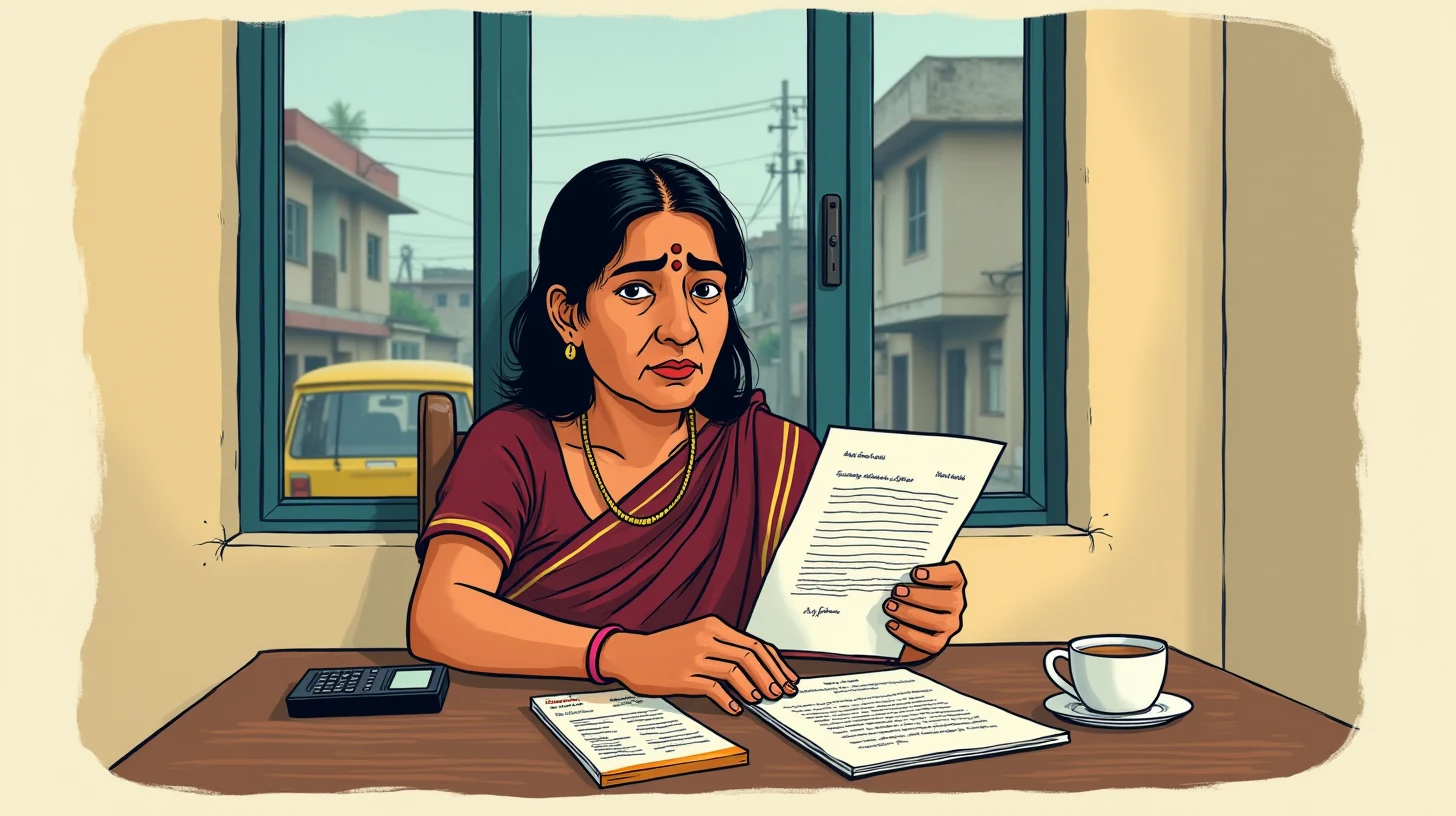
Sushma Sahu was 36, a quiet mother of one daughter, living with her elderly mother-in-law in a two-room rented flat in Pandri, a working-class neighborhood in east Raipur. Her days moved in a fixed rhythm: wake at five, light the kitchen lamp, boil water for tea, make breakfast rotli for her mother-in-law, wait for her daughter to return from school, cook lunch, manage what little was left after rent and food. Her husband worked on contract for the municipal corporation, his wages irregular. There was no "extra"—no savings, no buffer, no monthly surplus. The family lived on what arrived each month, and sometimes, what arrived was late.
In March 2024, a neighbor came by with news. The Mahtari Vandana Yojana had started—a new scheme from the Government of Chhattisgarh. Women like Sushma, who stayed home, who had no formal job, who kept the house and looked after children or elders, could apply. One thousand rupees every month, direct to the bank account. The neighbor had already registered; the district office in Pandri had set up camps. Sushma felt something quiet shift. One thousand rupees. That was dal three times a week. That was her daughter's school notebook budget for the year. That was real.
By mid-March, she had walked to the District Programme Office in Pandri, stood in the queue with forty other women, submitted her Aadhaar, bank account number, and a photocopy of her family register. The official had nodded, stamped her form, and told her to expect the money within two months. By May, it was there—₹1,000 in her bank account. She checked the passbook three times, unable to fully believe it. But it was real.
For twenty-two months, the money came. March 2024, April 2024, May 2024... on through December, January, February, and into the new year of 2025. Then June 2025, July, August, September, October, November. In January 2026, she checked the passbook as she always did and found no deposit.
She waited until the 20th of February. Still nothing. She walked back to the District Programme Office, passbook in hand. The man at the front desk was new—the usual officer on a long medical leave—and he looked tired. He took her passbook, squinted at the account number, and typed it into the system. "Yes, there is a Sushma Sahu listed. But this is a different Sushma Sahu. The payments are going to Bilaspur. You have a name match problem."
The words hung in the air. A name match problem.
🗓️ The rhythm of Mahtari Vandana and Aadhaar seeding
Mahtari Vandana is built on a simple idea: money should move directly into a woman's bank account, no middleman, no delay, no loss to a corrupt official. The Government of Chhattisgarh offers ₹1,000 per month to eligible women—housewives, widows, mothers on their own, daughters caring for elderly parents. The scheme runs on DBT, Direct Benefit Transfer, which means the state connects a woman's Aadhaar number to her bank account through the NPCI Aadhaar Mapper. When the monthly payment is released, a digital instruction travels from the Department of Women & Child Development to the NPCI system: "Send ₹1,000 to the bank account linked to Aadhaar XXXX XXXX XXXX XXXX." The payment arrives within days.
The system is elegant. But it depends entirely on the Aadhaar-to-bank-account link being correct. If a woman''s Aadhaar is linked to the wrong account—someone else''s account—the money will go there. If the account is in a different state, the money goes across state lines. If the account is in the name of another person who shares the same name (Sushma Sahu, Ravi Kumar, Maria Das—common names in India), the money vanishes into someone else''s life.
The annual cycle of Mahtari Vandana runs like this: applications open in January and February, early registrations are processed by June, payments begin by the next quarter. In April 2026, the scheme initiated a mandatory eKYC drive—video-verified identity for all beneficiaries. Those who don''t complete eKYC by the June 30 deadline will stop receiving payments. The rhythm is tight. Miss the deadline, and the money stops.
- 📋
March 2024: Application submitted
Sushma registers at the Pandri District Programme Office, submits Aadhaar, bank account, and family register. Told to expect money within two months.
- ₹
May 2024 onwards: 22 months of deposits
From May 2024 through December 2025, ₹1,000 arrives each month in Sushma''s account. She relies on this money for food, school supplies, and household basics.
- 🛑
January 2026: Deposit vanishes
For the first time in 22 months, no ₹1,000 appears in her bank statement. By February, the money still has not arrived.
- ⚠️
February 2026: Name mismatch discovered
Sushma visits the office with her passbook. A junior official finds the reason: there is another Sushma Sahu in Bilaspur, and the NPCI system has been routing Mahtari Vandana payments to that account, not hers. ₹24,000 (24 months × ₹1,000) is unaccounted for.
⚠️ The near-miss and the waiting
The District Programme Officer in Pandri was on a special assignment—a four-week training for new officers in Raipur city. He would return by late February, the junior told her. The office had no authority to fix account mismatches without him. Could she come back?
Sushma came back on March 2. The Officer had returned. She walked through the same door she had entered two years earlier and sat across from him with her passbook open. The Officer was sympathetic. He said the problem was clear—the NPCI Aadhaar Mapper had a duplicate or conflicting record. Another Sushma Sahu, age 34, in a different Raipur ward, had also applied for Mahtari Vandana. The system had confused the two, and for twenty-two months, payments to "Sushma Sahu" had gone to the wrong woman. Her own account had been skipped.
"How do I fix this?" Sushma asked.
The Officer said the Department of Women & Child Development in Raipur had a special resolution team, but they were backed up. The request would need to be filed in writing, in triplicate, with her Aadhaar, bank account statement, and proof of the mismatch. The process usually took 45 to 60 days. Could she come back?
She had no choice. She filed the forms on March 5. The office stamped them and gave her a receipt number. She called twice in April. The woman who answered said the request was "in queue." She called in May. The voice on the other end had changed; the woman didn''t know which queue she meant. She said to check the website portal.
Sushma has a very old Nokia phone—not a smartphone. She has never used the Mahtari Vandana portal. Her daughter, who is in school, tried to check it on a friend''s phone, but the portal only told her that the status was "pending." No expected resolution date. No next step.
The story appeared to stall. By mid-May, two months had passed since she filed her correction request. No message, no update, no money in her account. She had begun to contemplate a scenario she had not imagined before: What if the money never came back? What if, by the time they fixed this, another three months had passed, and it was ₹3,000 more gone?
🌗 When a neighbor and a smartphone broke the silence
In the third week of May, her neighbor Priya, the same one who had told her about Mahtari Vandana two years ago, came to visit. Sushma mentioned the mismatch and the long wait. Priya had a smartphone—a basic Android—and she said, "Let me check the portal for you."
Priya opened the Mahtari Vandana portal on her phone. She navigated to the "Check Payment Status" section and entered Sushma''s Aadhaar number. The portal showed that the account was still listed as "under correction." But there was a link to an FAQ section that said if a beneficiary suspected a wrong account number, she should also verify her Aadhaar seeding with the NPCI BASE Portal.
Priya opened a second link in a browser window. The NPCI BASE Portal allowed anyone to check which bank account was linked to their Aadhaar. You entered your Aadhaar, solved a Captcha, received an OTP on your registered phone number, and could see the mapped account. When Priya entered Sushma''s details and received the OTP, Sushma read the code aloud. The portal confirmed: Sushma''s Aadhaar (XXXX XXXX XXXX 5847) was still linked to an account in Bilaspur.
"यह खाता तो दूसरी औरत का है। हमारा खाता तो बिलासपुर में चला गया।"— This account isn't ours. Our account went to Bilaspur.
It was the first time Sushma had seen, in real time, where the money was supposed to go and where it was actually going. The knowledge was both clarifying and helpless—she now understood the system, but she still could not change it alone.
The NPCI BASE Portal had a link to report a seeding error. It said she could file a correction request directly with the portal, and it would notify the bank and the state department. Priya, with Sushma''s permission and by Sushma''s instruction, filed the online correction notice. The portal issued a reference number and said the rectification would be processed within 5 working days.
Five working days came and went. On the 10th day, Sushma''s bank called her. The bank manager said that the Chhattisgarh Women & Child Development Department had submitted a corrected Aadhaar-to-account mapping. They were updating their records now. He asked her to come in and verify. When she did, the bank had relinked her account correctly to her Aadhaar. Two days later, the June ₹1,000 deposit arrived.
🧭 Why this happens to ordinary women
Sushma''s story is not unusual. The NPCI Aadhaar Mapper is a database of 220 million seeded accounts. It is built to scale, to move money fast, to eliminate corruption. But it has three silent fractures.
First: Name ambiguity. In India, millions of women share common names—Sushma Sahu, Priya Sharma, Lakshmi Das. When two beneficiaries with identical or near-identical names apply for a scheme, and their applications are entered by different data-entry clerks in different offices, the Aadhaar-to-account mapping can conflict. The system does not catch this; it only surfaces it when a payment fails to process or when a woman checks her bank statement and finds the money gone.
Second: No self-service correction. The Mahtari Vandana portal is read-only. A woman can check her status, see if she is approved, but she cannot correct her own account number. She must go to the District Programme Office, wait for the right officer, file forms in triplicate. The process is designed for the system''s convenience, not for her.
Third: Aadhaar Seeding is invisible. Most women do not know that their Aadhaar is linked to a bank account at all. They do not know about the NPCI Mapper. They believe that when they give their Aadhaar and bank account number to the government office, the system will connect them. They do not have a way to verify this until they check their bank statement and find the money is missing.
Sushma discovered the problem only because she opened her passbook. She might never have known. Across Chhattisgarh, the Department of Women & Child Development estimates that between 2 and 5 percent of Mahtari Vandana payments are routed to the wrong account. On a scheme worth ₹2,500 crore per year, this is ₹50 to 125 crore in annual leakage—money that reached the system but not the women it was meant for.
System assumption
Government designWomen have smartphones, access to government portals, know about NPCI Aadhaar Mapping, and can file online corrections.
Reality: Sushma''s world
What actually happensSushma has a Nokia phone from 2012. No internet. She discovered the mismatch by comparing her passbook to what didn''t arrive. She needed a neighbor with a smartphone to verify the NPCI portal.
System assumption
Process speedCorrections take 45–60 days through the District office, 5 days through NPCI. Officials are available, responsive, and never on backlog.
Reality: Waiting
What Sushma experiencedThe Program Officer was unavailable for a month. The Department of Women & Child Development had no ETA. The NPCI correction worked—but only after her neighbor initiated it.
Sushma''s neighbor Priya, who carried a smartphone and knew how to navigate a government portal, became the bridge. Without Priya, Sushma would still be waiting, or she would have accepted the loss.
🌱 What happens when the system runs on assumption
By late May, when the June deposit finally arrived and Sushma''s account was corrected, she had missed two months of payments. That was ₹2,000. The earlier months that had gone to the other Sushma Sahu—that money was effectively lost. There was no process to recover it. The Department of Women & Child Development said that if another woman had received the payment, it was their responsibility to return it. But they would not do so. The other Sushma Sahu, somewhere in Bilaspur, had already spent or saved the money. By the time the department could trace her account and ask for repayment, weeks would have gone by.
Sushma did not pursue the matter further. The important thing was that the June payment was correct, and July would be correct, and the future would be on track. She has not been compensated for the lost ₹24,000. She has no recourse. The system was fixed, but the loss remains.
She thinks often about what would have happened if she had not checked her passbook so carefully. Or if Priya had not visited that day. Or if Priya had not carried a smartphone. She knows women—she has learned from her own experience—who do not check their bank statements monthly. They learn only when a shopkeeper asks why their regular automatic payment for goods has stopped. They learn when the house-owner asks for proof of income, and they cannot show recent deposits. By then, months have passed. By then, the money is someone else''s.
The Mahtari Vandana Yojana is a real thing, a real transfer of real money. It exists in law, in policy, in the Department of Women & Child Development. But between that law and the woman sitting in her kitchen at the end of the month, checking her balance—between that intention and that moment—there is a vast space where a woman''s name can be confused, where a smartphone can become essential, where waiting becomes the only option. Sushma learned to live in that space, to check, to verify, to ask her neighbor for help. But the system should not ask that of her. It should be built so that the money moves directly from the policy to her account, with no loss, no confusion, no waiting. Until it is, every woman in the scheme carries the silent weight of Sushma''s experience.
"आपका आधार कौन से खाते में लिंक है, यह आप जानते नहीं हो सकते बिना स्मार्टफोन के। सरकार को यह बता देना चाहिए कि आपका पैसा कहाँ जा रहा है।"
(You cannot know which account your Aadhaar is linked to without a smartphone. The government should tell you where your money is going.)
For homemakers like Sushma navigating similar issues:
- Check the NPCI BASE Portal (https://base.npci.org.in/) quarterly to verify your Aadhaar-to-account seeding is correct. You need only your Aadhaar and registered mobile number.
- Keep your bank passbook and statements from the scheme''s first month. If a payment arrives out of sequence or is missing, you have proof to show the District office.
- Ask a trusted friend or family member with a smartphone to help you verify your portal status if you do not have internet access. The Mahtari Vandana portal (https://mahtarivandan.cgstate.gov.in/) shows your payment history and status.
- If you find an account mismatch, file a correction with both the District Programme Office AND the NPCI BASE Portal. The NPCI channel is faster (5 days typically) than the government office route (45–60 days).
- Know your rights: You are entitled to compensation for payments routed to the wrong account. If you cannot recover the money from the Department of Women & Child Development, document the loss with your bank statement, your Aadhaar, and your original application form.