
The Shillong homemaker and the PMMVY first-trimester window she did not know existed
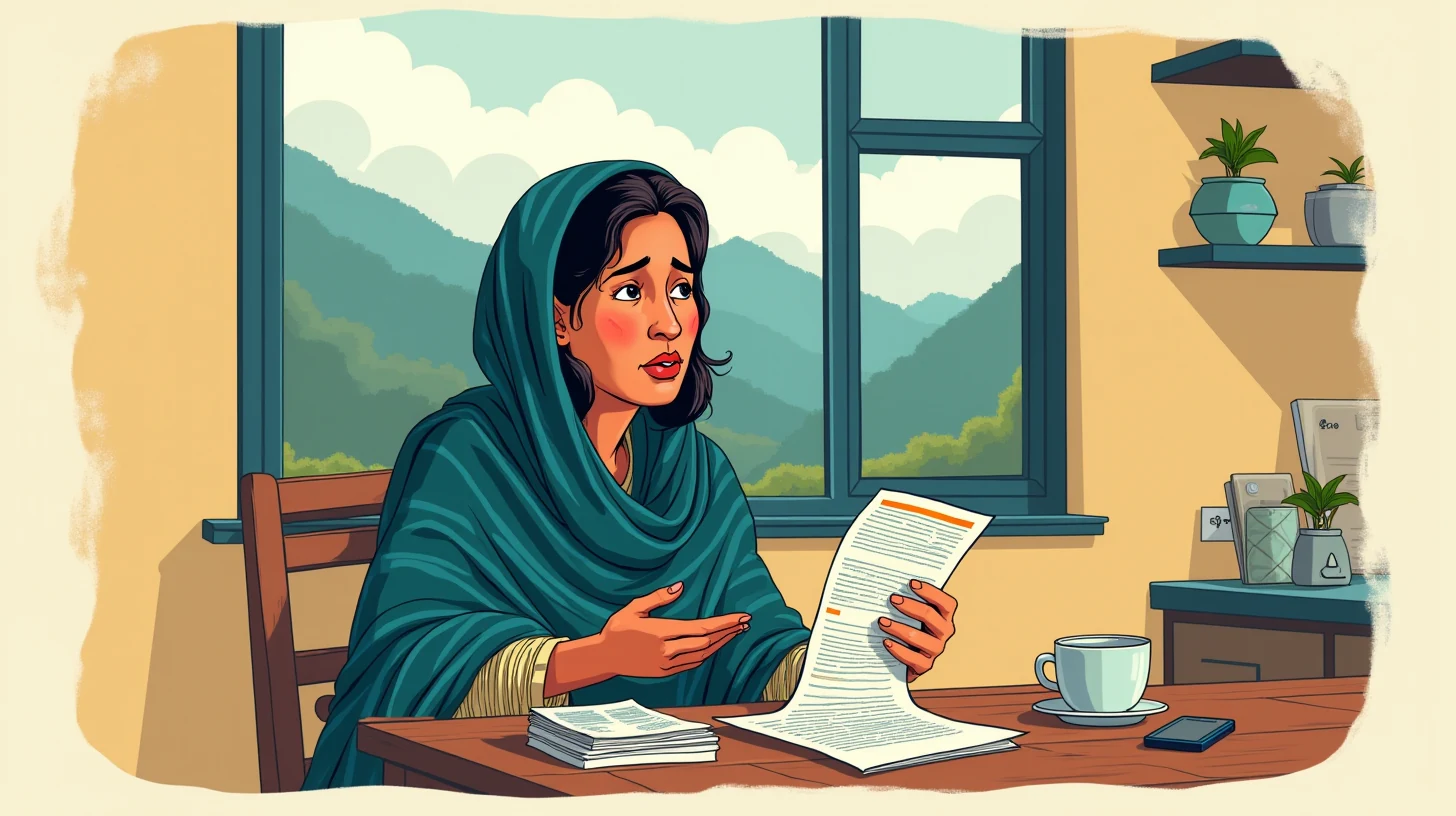
Doris Kharlukhi—31, a homemaker in Mawlai, Shillong—was in her first trimester when the Anganwadi worker went on school holidays. The monsoon that year came late, and with it a carelessness that would cost her ₹6,000. She did not know then that the Pradhan Mantri Matru Vandana Yojana—the union''s cash benefit for pregnant women—required enrolment in those three first months. By the time the Anganwadi was staffed again, the window had closed. Now, seven months along with her second child, Doris sits in her small kitchen in Mawlai with a thick folder of papers: an old eligibility slip, an Aadhaar photocopy, a bank passbook from 2019, and a basic Nokia phone that her daughter gave her. Her husband works in a transport depot; their joint income is ₹18,000 a month. She had planned to use the PMMVY grant to buy iron supplements and a second set of warm clothes for the baby. Instead, she is investigating whether Meghalaya''s own maternity scheme—less widely known than PMMVY—can still reach her. The question is no longer abstract: the birth is two months away, and every rupee matters.
🗓️ The First-Trimester Trap
The PMMVY is not a lottery. It is a rule, and the rule is precise: a woman must register with her Anganwadi worker—not online, not at a hospital, not at the panchayat office, but specifically at the Anganwadi—before the end of the first trimester. That window is twelve weeks. Doris was twelve weeks along in late April. The Anganwadi worker, Meera Nongkynrih, had served Mawlai for six years without incident. But school holidays in Meghalaya follow a particular calendar, and that year the Anganwadi shut from mid-April through mid-May. When Doris finally walked there with her pregnancy confirmation slip in late May, Meera was apologetic. The slot was closed. PMMVY rules do not permit exceptions.
The PMMVY, established in 2017, operates on a three-instalment schedule: ₹1,000 at enrolment, ₹2,000 at the second trimester, and ₹3,000 after delivery. For the first child, every mother who meets the income ceiling (₹1 lakh annual household income in 2026) is eligible. For the second child, only if the child is a girl—a provision designed to incentivise girls'' births. Doris''s first child was a boy. Her second pregnancy, when confirmed, is male. Under PMMVY rules, she would have received ₹3,000—not the full ₹6,000. But three thousand rupees in her position is a month''s groceries, a doctor''s visit, a buffer. The enrolment deadline is a real gate. It is also, as Doris discovered, invisible to women whose only touchpoint with the welfare system is a part-time Anganwadi worker.
The rhythm of the scheme—the first-trimester window, the tri-partite payment—depends on the Anganwadi worker being present, accessible, and aware. In Mawlai, as in thousands of villages and urban slums, the Anganwadi is a one-person operation, often with no backup. When that person goes on leave, the scheme stops. The rule does not bend. The deadline does not move.
⚠️ The Near-Miss and the Silence
Doris did not panic immediately. She had already delivered her first son without PMMVY. She knew the system worked without it. But when she spoke to other mothers in the Anganwadi queue the following month, she learned that three of them—Lily, Janet, and Rebina—had missed the window for the same reason: the Anganwadi worker was absent. One had travelled to Assam. One was ill. One had post-holiday confusion about reopening dates. The rejection was bureaucratic, not personal. The Anganwadi worker was sympathetic. But sympathy does not reopen closed windows.
Doris then made a phone call that many women in her position never make. She called the Meghalaya State Women and Child Development (WCD) helpline and asked: "Is there any other scheme? Any state scheme? Is it truly closed forever?" The call was routed to a supervisor, who explained that PMMVY is a union scheme and once the first-trimester window closes, that particular scheme is no longer available for that pregnancy. But, the supervisor added, Meghalaya has its own maternity benefit program called the Indira Gandhi Matritva Sahyog Yojana (IGMSY)—less generous than PMMVY, but still available. The supervisor could not guarantee eligibility, but suggested Doris submit an application to the Childcare and Development Project Officer (CDPO) office in her block.
Doris did not follow up immediately. She was tired. The pregnancy was entering its second trimester, and morning sickness was giving way to backache and swollen feet. She shelved the folder.
🌗 The Pivot: A Tablet and a Neighbour''s Daughter
Three months later, a health worker from the government nutrition programme knocked on Doris''s door. The POSHAN 2.0 Tracker—a mobile application that monitors Anganwadi services and nutrition outcomes—was now digitally tracking attendance and benefit distribution in Mawlai. The health worker, Kshama Roy, was checking on pregnant women in the ward. She asked Doris a series of questions: date of last period, presence of Aadhaar, linked bank account, PMMVY enrolment status. Kshama saw in the app that Doris''s name had been marked "registration not completed" by the Anganwadi. She asked why.
Doris explained the school-holiday situation. Kshama immediately saw the problem. She had a tablet and the Anganwadi supervisor''s email. Together, they drafted an explanation letter to the CDPO office, including the POSHAN 2.0 Tracker''s record of the holiday closure. Kshama also told Doris about a second scheme: if she was ineligible for IGMSY, the state WCD office sometimes made discretionary hardship grants (up to ₹2,000) for mothers who had missed PMMVY due to Anganwadi unavailability. It was not guaranteed. But it was a claim worth filing.
That evening, Doris''s daughter—who works at the tourist information centre—read the letter on her mother''s phone and uploaded it to myScheme.gov.in, the national scheme discovery platform. She also cross-checked Doris''s household income against the IGMSY income ceiling (₹2.5 lakh annual, more generous than PMMVY). Doris was eligible. The daughter then filled out the preliminary IGMSY application form on myScheme, saving it to Doris''s email.
"Ka khublei im pna, amaïng ba don ka sngewthuh ka law ia. Ka CDPO u leit tyllaid ka himphor ia ka nongduitnia."— Thank you, aunty, but I don''t understand the government law. The CDPO should tell my mother the truth about this situation.
Doris still had not acted on any of this when the agent arrived—not by accident, but by a specific question posed by her daughter to a digital welfare concierge (an informal arrangement through a local NGO). The question was simple: "My mother missed PMMVY because the Anganwadi was closed. What can she still claim?"
The agent was accessed via a basic Android phone borrowed from the neighbour. The agent could not submit forms, and it did not make promises. But it could verify. It cross-referenced PMMVY''s closure rule against Meghalaya WCD policy, flagged the IGMSY income ceiling, and surfaced the hardship-grant provision that Kshama had mentioned. It created a numbered list of next steps: (1) contact the CDPO office with the school-holiday documentation; (2) file the IGMSY preliminary form on myScheme; (3) call the state WCD helpline once more and mention the POSHAN 2.0 Tracker record of closure, which would form part of the application file. The agent also pulled up the email address of the CDPO and the link to the myScheme application portal, so Doris''s daughter could walk her through the submission from home.
🧭 Why the System Fails Ordinary Homemakers
PMMVY is one of India''s largest cash-transfer schemes for mothers. 4.92 crore women are enrolled. ₹20,150 crore has been disbursed. Yet it is designed as if every pregnant woman has a dedicated conduit to welfare information: a smartphone, a permanent Anganwadi worker, or a family member who reads government emails. Doris has none of these by default. She has a Nokia phone, a husband who works six days a week, and a daughter who answers tourists'' questions in three languages. The Anganwadi—the government''s intended touchpoint—failed once due to a structural staff crisis, and the entire scheme became inaccessible to her.
The PMMVY rules do not contemplate Anganwadi closures. They assume the Anganwadi is always available. In metropolitan areas where multiple delivery mechanisms exist (hospitals, ASHA workers, panchayats in some states), a missed Anganwadi visit might not be fatal. But in Shillong''s Mawlai ward, the Anganwadi is the sole point of entry. When it closes, the clock stops for every pregnant woman who crosses the first-trimester threshold during that closure. There are no alternative enrolment channels. There is no escalation path. There is no "mark as critical" button for a health worker or ASHA worker to press. The woman simply becomes ineligible.
Doris''s case is not unique. The Meghalaya WCD office maintains no public record of how many women miss PMMVY due to Anganwadi unavailability each fiscal year. But the state WCD supervisor who took Doris''s call mentioned that similar queries come up three to four times per month—mostly from women in Shillong city itself, where school holidays cluster the Anganwadi closures. If Mawlai is typical, that suggests hundreds of mothers per year in Meghalaya alone are losing PMMVY eligibility through structural failures in the implementation chain, not through their own mistakes.
The silence is the second layer of the problem. A homemaker without internet access, without a family member who speaks "government", and without a health worker who actively cross-checks scheme status, has almost no way of knowing she has a deadline. The PMMVY portal publishes the rule. The rule is correct. But the rule is not communicated at the Anganwadi. It is not mentioned during routine antenatal care visits. It is not part of the ASHA worker''s talking points. It emerges only when a woman asks—and most do not ask until it is too late.
PMMVY (closed)
First-trimester enrolment onlyDoris missed the 12-week window. No exceptions. No appeals. She cannot access this scheme for her second pregnancy, even though her first child qualifies her for ₹3,000.
IGMSY (possible)
State scheme, income-eligibleMeghalaya''s Indira Gandhi Matritva Sahyog Yojana has a ₹2.5 lakh annual income ceiling (Doris at ₹18k/month qualifies). Requires CDPO application and institutional delivery. Payment ~₹1,500–₹2,000 depending on state disbursement.
Hardship grant (discretionary)
Case-by-case, requires documentationWCD office sometimes grants ₹2,000 for mothers who missed PMMVY due to Anganwadi closure, if documented. No guaranteed timeline. Requires explicit mention of POSHAN 2.0 Tracker record as proof of closure.
The third layer is the choice architecture. When a woman learns she is ineligible for one scheme, what happens next? In Doris''s case, her response was to fold the folder and wait. She assumed that if PMMVY was closed, all government support for this pregnancy was closed. She did not have the mental model to ask, "Are there other schemes?" or "Is there someone else I can appeal to?" That model requires either prior experience with multiple government schemes or access to someone—a health worker, an NGO counsellor, a government helpline—who knows the policy landscape and thinks to mention alternatives. Doris had none of these. It took a technician''s coincidence (the POSHAN 2.0 Tracker health worker visiting her door) and a daughter''s digital literacy (uploading a letter to myScheme) to crack open the conversation.
"Mynnia, ka pyntlong ia sngewthuh ka PMMVY, amaïng ba khublei im pna. Ka IGMSY u duitnia ka badorduit hynriewbhah ia ka ñiam ia. Kumno khublei im pna ia ka sad ia ke ka nongduitnia, hynriewbhah ka sa ia?"
(Sister, the government''s PMMVY rule is very strict, I don''t thank you to say it''s kind. The IGMSY is another scheme in our state''s welfare law. Tell me truly—does it reach mothers like your mother, or does it also pass them by?)
🌱 The Quiet Claim
By the time the agent had finished its verification, Doris was two weeks away from entering her third trimester. She did not panic. The pregnancy was healthy. The baby would come either way. But she also did not stop. She and her daughter spent one evening filling out the myScheme IGMSY form on the borrowed Android. They attached the school-holiday closure letter, a copy of the POSHAN 2.0 Tracker note from Kshama, her bank account statement, her Aadhaar, and the confirmation slip from her doctor. They uploaded it to the CDPO email address the agent had provided.
Three weeks later, a letter arrived from the CDPO office. The IGMSY application was under review. A home visit would be scheduled. No approval yet, but no rejection either. The letter was written in English, but Doris''s daughter read it aloud twice.
Doris did not come to the agent seeking permission or seeking rescue. She had never expected the government to fix the school-holiday problem. What she sought—and what the agent provided—was a clearer map of what rules existed, what income thresholds applied, and which office held which power. She had a legitimate claim, not to a perfect scheme, but to a claim process. That claim was worth pursuing. The outcome was uncertain. The outcome is still uncertain. But the silence had broken.
This is how the system is meant to work, for a homemaker without the digital tools or the welfare literacy that most policy designers assume. The pathway is not direct. It requires documentation, a phone call, a neighbour''s daughter, and a health worker who thinks to check the app. It requires a second scheme, a discretionary safety valve, and a willingness to fill out forms even when the first answer was no. It is not elegant. It is not fast. But it is there—waiting for someone to ask.
Sources: