
The Shimla aunt and the Sukh-Aashray guardianship paper
Sunita Sharma, forty-four, had not planned to be a guardian. In March 2022, her sister Priya—a cook in a government guesthouse in Chandigarh—collapsed from a sudden cardiac event. Within days, Priya was gone, and Anjali, her fourteen-year-old daughter, had no one else. Sunita had already lost her husband five years earlier to pneumonia, leaving her with two school-age daughters of her own. She worked from a narrow kitchen in her rented two-room ground-floor flat in Shimla''s Lower Bazar, preparing and delivering fifty to eighty lunch boxes—tiffins—to offices and schools each day. The margins were thin: ₹3,500 per month net, enough for rent, rice, and beans, but not for an extra mouth.
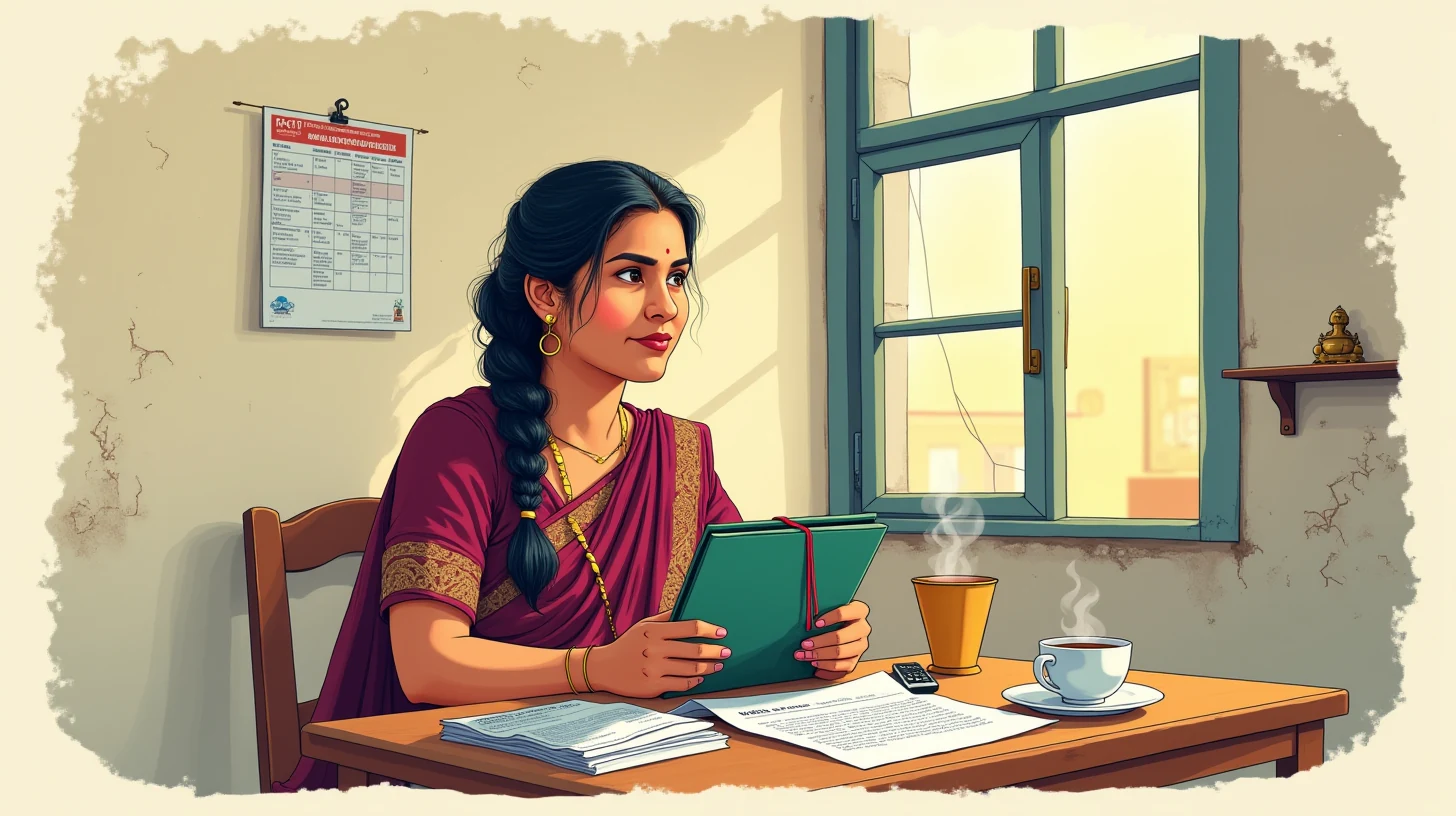
Yet Anjali came to live with her that April, sleeping on a mat rolled against the kitchen wall at night, sitting in the corner of the tiffin space during morning prep. By June, the girl had become another pair of hands: chopping vegetables, packing boxes, running to the post office. By December, Sunita could not imagine her gone.
In January 2023, a woman from the Anganwadi center—a government nutrition and early-childhood program—came to the flat to check on Anjali''s school enrollment and health status. During that visit, she mentioned the scheme: the Mukhyamantri Sukh-Aashray Yojana, a Himachal Pradesh state program that declared orphans as "children of the state" and provided ₹4,000 per month, scholarships, free education up to age twenty-seven, and eventually help with housing and marriage. The Anganwadi worker''s voice had carried a note of inevitability—this money, she said, could change things. But there was one gate: a legal guardianship paper from the District Court. Without that document, the state could not recognize Sunita as Anjali''s guardian. Without guardianship, no scheme, no ₹4,000. Just Sunita, a tiffin service, and a calculation that never came out even.
🗓️ The paper cage
The requirement was not unreasonable in the abstract. India''s guardianship law—Part III of the Guardians and Wards Act, 1890—existed to protect children from trafficking, exploitation, and predatory relationships. A court order ensured that the guardian''s motives had been examined, that the child''s best interests had been independently verified, that the arrangement was voluntary and enforceable. On paper, it was a safeguard.
In practice, in a district court in Shimla, it became a gate that only those who could afford to open it could pass through.
Sunita began making visits to the District Court in March 2023. The building sat off Cart Road, a three-story building of pale concrete with a small waiting area where advocates in black waistcoats clustered near the filing windows. She was told to consult an advocate to draft the petition for guardianship. The first advocate she spoke to, outside the court building, quoted ₹15,000 for his fee—drafting, filing, one court appearance. "And the court fee?" she asked. He waved his hand. "That depends on the judge, but another three thousand, maybe more."
She had ₹8,000 saved in a tin under the kitchen shelf.
Every day in that three-month stretch felt like two days. Anjali''s school term was passing. The Anganwadi worker kept asking if the paperwork was done. Sunita''s own daughters, Priya, seventeen, and Meera, twelve, watched her worry in the kitchen while she mixed dal and filled boxes. At night, in the flat, she lay awake calculating. If she took a loan from the local moneylender—the one who came to Lower Bazar every Friday—at 36 percent annual interest for ₹10,000, the repayment would be ₹830 per month. Against the ₹3,500 from the tiffin business, that was almost a quarter of her income. But once the Sukh-Aashray began, she''d have ₹4,000 more. The math was tight but it could work. She would have to take the loan.
She was one week away from visiting the moneylender when Meera—Sunita''s younger daughter, a class eight student—came home from school and asked, "Why are you sad about Anjali''s paper?"
⚠️ The near-miss
Meera had told her economics teacher, Mrs. Kapoor, that her mother was trying to get a guardianship document but couldn''t afford an advocate. Mrs. Kapoor, a woman in her fifties who lived in Officer''s Lane near the Shimla Club, had worked with the District Legal Services Committee as a paralegal during law school. She replied to Meera with a single sentence: "The services are free. Tell your mother the court provides free advocates for this."
Sunita had not known. She had assumed that advocates, like everything else, required payment upfront.
The next afternoon, she took the city bus to the Himachal Pradesh State Legal Services Authority office, a small wing adjacent to the District Court. The woman at the desk—her name was Madhuri, she had been working there for twelve years—listened to Sunita''s story, asked for her Aadhaar card and a copy of Anjali''s birth certificate, and then said, "We''ll file a petition on your behalf. No advocate fee. The court fee is waived for women guardians of orphan children. You do not pay anything."
Sunita had felt her shoulders drop. She had not cried in front of anyone in two years.
The paperwork—a guardianship petition, affidavit, Aadhaar copies, school enrollment proof, a statement of income—took four weeks. Madhuri helped her fill out each form, explaining the purpose of each section. By June 2023, the petition was filed. The first court date was set for July. Sunita made sure Anjali was in her one clean school uniform on that July morning, and they both walked to the court building together.
The judge, a woman named Justice Sharma, asked Sunita three questions: Did she have any criminal record? Did Anjali want to be her ward? And why did she believe she could provide for her? Sunita answered each one. Justice Sharma granted the petition within fifteen minutes. The guardianship order was signed and sealed on a court letterhead, dated July 12, 2023. The cost: zero rupees.
🌗 The pivot
Madhuri at the Legal Services office became the hinge on which everything turned. After the court order was issued, she told Sunita the next step: take the guardianship paper to the District Welfare Office in Shimla, where staff would verify the documents and process Anjali''s enrollment in the Sukh-Aashray scheme. The verification would take fifteen days. After that, the District Welfare Office would recommend the case to the state capital, and within a month, Anjali''s account would be opened.
"सुनीता जी, आपकी पेटीशन 28 जून को फाइल हुई थी। पोर्टल पर स्टेटस दिख रहा है: 'Verification Pending — District Welfare Office, Shimla'. जिला कल्याण कार्यालय को कोर्ट का आदेश मिलना जरूरी है — उसके बिना एनरोलमेंट आगे नहीं बढ़ेगा। अगली स्टेप: ऑफिस जाइए, गार्जियनशिप ऑर्डर की एक फोटोकॉपी जमा कीजिए, और 15 दिन में वेरिफिकेशन हो जाएगी।"
(Sunita, your petition was filed on 28 June. The portal shows: 'Verification Pending — District Welfare Office, Shimla.' The court order needs to reach the District Welfare Office before enrollment can proceed. Next step: visit their office, submit one photocopy of the guardianship order, and verification will complete within fifteen days.)
By September 2023, the first ₹4,000 transfer arrived in a bank account that Sunita had opened for Anjali at a cooperative bank near Lower Bazar. The account was in Anjali''s name, but Sunita held the passbook and ATM card. That month, she received ₹4,000. The next month, ₹4,000 again. A scholarship for Anjali''s school uniform and books—₹1,200—came through in October.
The tiffin business still earned ₹3,500. The Sukh-Aashray gave ₹4,000. It was not abundance, but it was breath.
By 2024, with the scheme income and a small expansion of her tiffin route (she had hired a neighborhood woman, Reena, to help with packing), Sunita''s household income had nearly doubled. Anjali, now fifteen, was doing better in school—the pressure of her keeping up was gone. Priya, Sunita''s eldest, had joined a hospitality course at a local institute. Meera was reading more, and Sunita had bought her a second-hand physics tuition book from a bazaar stall.
In that quiet year, Sunita also learned something about how institutions actually worked, not how they were supposed to work. She learned that the law existed—the law protecting children, the free legal aid, the state''s promise of guardianship—but it was written in a language that assumed you already knew how to read bureaucracy. She learned that the Anganwadi worker had known about free legal aid but had not mentioned it, perhaps assuming it was obvious. She learned that her daughter''s teacher knew a door that most parents in Lower Bazar did not even know was a door. She learned that one person—Madhuri, who spent her days explaining forms and walking women through the court building—made the difference between a child staying and a child gone.
And she learned that having a scheme on paper and actually accessing it were two entirely different things.
- 📋
March 2023 — Petition filed
Sunita visits the HP State Legal Services Authority with Aadhaar, birth certificate, school proof. Free advocate drafts guardianship petition. Court fee waived for orphan guardianship.
- ⚖️
July 2023 — Court hearing and order
Justice Sharma hears the case, verifies intent and capability, grants guardianship order. Signed court document in Sunita''s hand. Zero cost. Order dated July 12, 2023.
- 🏛️
July–August 2023 — District Welfare verification
Sunita submits guardianship order to District Welfare Office, Shimla. Staff verify the court order and Anjali''s identity. Verification takes 15 days. Recommendation sent to state capital.
- 💸
September 2023 — First stipend
Sukh-Aashray account opened in Anjali''s name. First ₹4,000 transfer arrives. Scholarship (₹1,200) follows in October. Recurs monthly thereafter. No further filings required.
⚠️ The system''s own gap
The Sukh-Aashray Yojana was a genuine scheme, and the state''s generosity in declaring orphans as "children of the state" was real. The problem was not the scheme. The problem was the moat: the guardianship requirement.
Guardianship orders were necessary. But the path to get them was designed as if everyone had already cleared the field. The court assumes you know to go to the Legal Services Authority instead of hiring a private advocate. The Legal Services Authority assumes you know the court process and that you can read petition forms written in English. The District Welfare Office assumes you know to bring the court order there after the hearing. The scheme itself assumes the guardianship is already done.
For women like Sunita, who had stopped schooling in class nine and whose literacy was conversational rather than legal, these assumptions were invisible traps.
Across Himachal Pradesh, the parallel was clear. In 2023, the state had formally adopted 6,000 orphans as "Children of the State" under Sukh-Aashray. But how many guardians never filed the petition because they thought it would cost ₹15,000? How many children had been with their relatives for months or years, living within the scheme''s shadow, receiving nothing because the paperwork gate had seemed too high?
The legal aid was there. The advocate was there. The court was there. But none of them advertised themselves to Lower Bazar. A single mention from a school teacher, a single woman at the Legal Services office who took the time to explain the next step, a judge who was efficient enough to grant the petition in one hearing—these had been luck, not system.
Private Advocate Route
₹18,000–25,000Hire advocate outside court building. Advocate drafts petition, submits fee to court, schedules hearing. Guardian pays advocate fee (₹15,000+) plus court fee (₹3,000–10,000). Timeline: 4–6 weeks. Result: Signed guardianship order.
Free Legal Aid Route
₹0Visit HP State Legal Services Authority office. Provide Aadhaar, birth cert, school proof. Authority assigns free advocate, waives court fee for orphan cases. Timeline: 4–6 weeks. Result: Identical signed guardianship order.
The Difference
KnowledgeBoth paths take the same time and produce the same legal outcome. The only barrier is knowing the free path exists — and being told by someone who knows.
🌱 Quiet arithmetic
By 2025, Sunita had been receiving the Sukh-Aashray stipend for eighteen months. She had not made a single additional application. The system, once in motion, continued. The ₹4,000 arrived every month as reliably as her own daughters'' school fees did not. She had bought a small additional equipment—a larger cutting board, a new insulated container—and taken on two more clients. Her tiffin boxes now fed seventy people a day instead of fifty. The business had crept up to ₹4,800 a month. Together with the stipend, the household now had ₹8,800.
In the mathematics of Lower Bazar, that was not wealth. It was, however, no longer a constant choice between two things. Anjali was in class ten. Priya had finished her hospitality course and was working a part-time shift at a cafe near the Shimla Club. Meera had asked for a mathematics tuition, and Sunita had said yes without calculating it first.
When asked about the legal guardianship process—what she would tell another woman in the same situation—Sunita''s first words were always about Madhuri. She would say: go to the Legal Services office, not to an advocate you find on the street. Ask for Madhuri, or ask whoever is there to explain the form you are filling out. Do not be shy about asking them to re-explain something. They are paid by the state to answer your questions. The paper they give you, the petition, it is not a mystery—it is just explaining who you are and why you want to be the guardian. The judge is not angry. The judge just wants to know you''re serious.
She had learned this late, at great cost to her peace of mind. But once the learning was done, it became simple. The system was not kind, but it was knowable. The papers were not easy, but they were not impossible either. The gate was high, but there was a door, and someone there who would open it if you asked.
What stayed with her, though, was the earlier feeling: the months of believing the only path was the expensive one, of planning a loan she could not afford, of watching her youngest child figure out that her mother was carrying a weight she could not name. That hurt had been real, even though it turned out to be unnecessary. And she knew, in the quiet mornings when she was alone in the kitchen filling boxes, that somewhere in Shimla, in some other rented flat, another woman was right now calculating that loan, believing it was her only option, not knowing that a free advocate and a court fee waiver existed just one bus ride away.
"मैंने सोचा था पैसा नहीं है तो दरवाज़ा बंद है। लेकिन दरवाज़ा तो पहले से खुला था — बस किसी ने बताया नहीं था।"— I thought that without money, the door was closed. But the door had been open all along — no one had told me.
That knowledge—that the scheme was real, that it could work, that she had a right to it, that she did not have to bleed for it—that was the quiet close. Not a rescue, not a miracle, just the arithmetic of a woman learning where the door was and stepping through it.
Key Resources for Guardianship in Himachal Pradesh
If you are raising an orphan relative in Himachal Pradesh:
- Visit the HP State Legal Services Authority office (attached to your District Court) — free guardianship petition filing, court fee waivers for orphan cases.
- Contact: Helpline for the Sukh-Aashray Yojana at 0177-2629763 (questions about stipends and enrollment).
- After court order is granted, submit the guardianship certificate to your District Welfare Office for Sukh-Aashray enrollment verification.
- Monthly stipend (as of 2025): ₹4,000 for children aged 18–27 living with verified guardians; ₹2,500 for ages 14–18; ₹1,000 for ages 0–14.
(Note: This article is based on real scheme structures and processes. Amounts and eligibility rules may vary slightly by district; confirm current details via the official portal or District Welfare Office.)