
The Srinagar homemaker and the Ladli Beti Tehsildar countersignature
Mehbooba Lone had been tracking the calendar on her Nokia since the day Aisha was born in early October. Her daughter—warm, dark-eyed, sleeping through the pre-dawn hours when the tiffin deliveries began—was eligible for the J&K Ladli Beti Scheme the moment the birth certificate arrived from the district hospital. ₹1,000 every month. For fourteen years. Then a lump sum of ₹6.5 lakh when Aisha turned twenty-one.
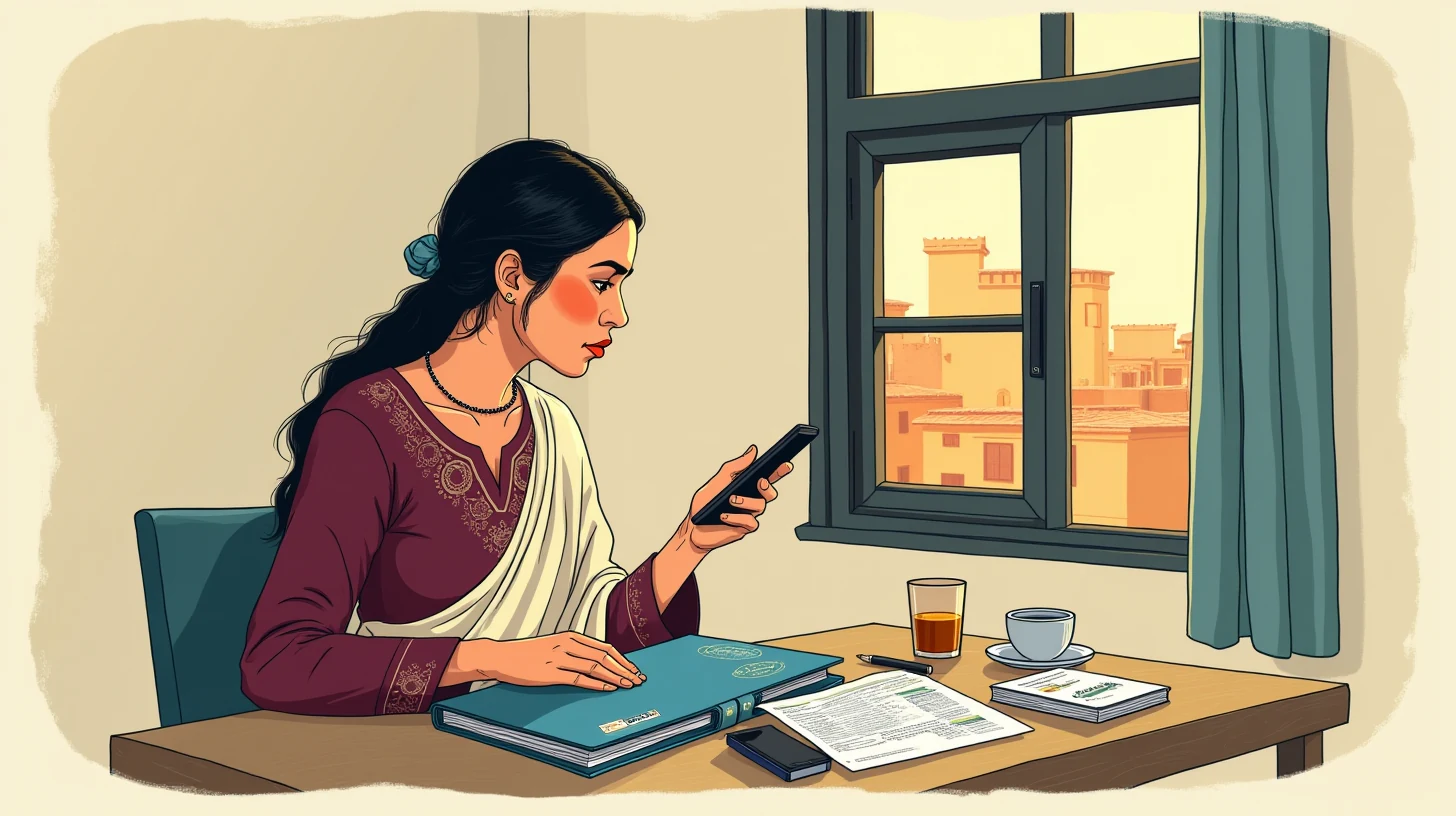
To a woman who ran a tiffin service for sixty dabbas a day from her two-room flat in Lal Bazaar, Srinagar—who counted rupees at the end of each week and set aside money for her son''s school fees and her mother-in-law''s blood pressure tablets—the scheme was not a gift. It was a deliberate investment. Her daughter would have college fees covered, or a start toward a wedding, or her own choice to refuse both.
But between the birth certificate and the first deposit, there lay a single administrative wall: the Tehsildar''s countersignature on the income certificate.
🗓️ The annual rhythm of the income certificate
The J&K Ladli Beti Scheme''s architecture was simple in principle. A girl child born to a family earning ₹75,000 per year or less qualified. The beneficiary''s family filed an application on the Jansugam portal with three documents: the birth certificate (hospital-issued), proof of annual family income, and the family register. The income certificate itself came from the Tehsildar—the revenue officer of the taluk, or administrative block—and had to bear his countersignature to be valid.
Mehbooba''s taluk was Khanyar, in the old city. She had obtained her birth certificate within two weeks of Aisha''s arrival. She had the family register, which her husband kept with his other official papers. Income proof was the stumbling block. She was not registered as self-employed; her tiffin business had no formal accounting, no GST number, no lease for the flat she worked from. The Tehsildar''s office was meant to certify her annual earnings by interviewing her and comparing against neighbourhood estimates and household assets. It was routine work, but it required the Tehsildar to be at his desk.
The Khanyar Tehsildar had gone on training leave in early May. The leave notice, posted in his office and on the Jansugam portal''s service-status page, said he would return in five weeks. It was mid-May now.
Mehbooba had called the office twice. The first time, a junior clerk had taken her name and told her to return in June. The second time, she had been put on hold for fifteen minutes before the line disconnected.
⚠️ The deadline that no one had explained
Technically, the Ladli Beti Scheme had no strict deadline. Aisha could be registered any time before her fifteenth birthday. But Mehbooba''s mother-in-law had mentioned, in passing, that a cousin''s child born in a neighbouring block had been registered within three months, and the first deposit had arrived by the child''s sixth month. Mehbooba wanted the same sequence: register early, let the money accumulate, know it was safe.
There was no rule against applying after the Tehsildar returned. There was also no guarantee that when he returned—in five weeks, or perhaps six—the intake of applications would move quickly. Mehbooba had heard stories from other women in the neighbourhood: files stuck in trays, follow-up visits required, dates mixed up.
She had begun to feel a peculiar pressure. The scheme was there. The eligibility was clear. The form could be filled out. But one human being, unavailable for reasons of bureaucratic necessity, was the only person who could stamp the certificate as valid.
On the third week of May, she learned that the Tehsildar''s leave had been extended by two weeks. The notice appeared on the portal without explanation. She sat at her kitchen table with Aisha asleep beside her on the small bed, staring at the message on the Nokia''s small screen, and felt the first sharp edge of frustration.
🌗 The neighbour''s suggestion
It was Nasreen, who bought dabbas for her office every Tuesday, who mentioned the agent during a handover at the building entrance. Nasreen worked at a community health centre three streets over and had been helping other mothers navigate the Anganwadi scheme documents. She had a tablet at home—an old one, given by her daughter, who worked in Bangalore—and she had found something called "the tablet" in her voice-search results. It answered questions about government schemes.
"It knows about the Tehsildar leave too," Nasreen had said. "It told me the Khanyar office number and when to call, and it read the leave notice right from the website."
Mehbooba borrowed the tablet from Nasreen on a Friday afternoon. She sat in the doorway where the light was best, with Aisha in a cloth sling on her chest, and asked the agent about the Ladli Beti income certificate.
The agent''s first response listed the three documents she already knew about. But when she asked—specifically—"What if the Tehsildar is on leave?"—the agent found the portal notice and read the dates aloud. May 15 to June 12. Fourteen more days.
"You could call the helpline on Monday morning," the agent said. "That''s the Social Welfare Department, not the Tehsildar''s office. They manage the scheme and might know if there is an acting Tehsildar or if applications are being taken in the meantime."
The number was 0191-2542759.
Mehbooba called on Monday. The helpline put her through to a woman who said, after a pause, that applications could be filed while the Tehsildar was away, but the income certificate itself could not be countersigned until his return. It was possible to submit a partial application and update it later. But there was a risk: if the portal''s system closed the application window after thirty days, she would have to reopen and re-upload all documents again.
The agent, when Nasreen brought the tablet back the next day, helped Mehbooba think through the options: she could file the partial application now (birth certificate and family register only, no income certificate), let it sit in draft, and then add the income certificate when the Tehsildar returned and verified her. Or she could wait until the Tehsildar returned, gather everything, and file a complete application in one go.
"The partial route is riskier," the agent said, "because if the draft expires, you start over. But it puts your application in the queue earlier. The complete route is safer, but you lose two more weeks."
Mehbooba asked: "If I file partial now, and then he comes back late—he might come back late—do I have to start over?"
"جنسگم کے سسٹم میں سب سے بہتر ہے کہ آپ اپنی صورتِ حال کو براہ براہ سوشل ویلفیئر ہیلپ لائن کو بتائیں۔ وہ بتائیں گے کہ اگر درخواست کا ڈرافٹ ختم ہو تو کیا ہوگا۔"
(The safest approach is to tell the Social Welfare helpline your exact situation—that the Tehsildar is extended on leave. Ask them directly whether the draft application expires, and if so, whether they can extend it given the administrative delay. They have some flexibility.)
So Mehbooba called the helpline again. She spoke to a different woman, explained that she wanted to file early but could not get the Tehsildar''s signature for two more weeks, and asked if there was any way to prevent the application from timing out.
The second woman—warmer than the first—said she understood the situation and gave her the email address of the district-level coordinator for the scheme. She said that if Mehbooba sent a note explaining the Tehsildar''s leave, the coordinator might be able to flag her application so it would not expire.
It was not a promise. It was a door.
🧭 Why the system makes ordinary homemakers into administrators
Mehbooba''s situation was not exceptional. It was, in fact, almost the default condition for homemakers applying for state welfare schemes in J&K and across India.
The schemes themselves—the Ladli Beti, the state''s maternity benefit, the Anganwadi nutrition transfers—were designed with the assumption that an ordinary family had access to a government official during his office hours. But ordinary families did not keep office hours. Mehbooba ran her tiffin service from five in the morning until four in the afternoon. The Tehsildar''s office opened at ten. If she closed her kitchen to visit the office, she lost a day''s deliveries and money. If she hired someone to keep the kitchen going, that person needed wages she could not afford.
The leave system, too, assumed no urgency. A Tehsildar''s two-week training was reasonable. A two-week extension—because other officials needed covering, because administrative cycles moved slowly—was also reasonable. But the beneficiary''s calendar was not aligned to the bureaucrat''s calendar. Aisha''s first six months of life would not pause for the Tehsildar''s return. The window for early registration, which offered the psychological benefit of acting sooner, was shrinking.
Moreover, the income certificate itself was a point of friction that the digital age had not yet smoothed. The Jansugam portal could accept birth certificates and family registers scanned and uploaded in seconds. But the income certificate had to be manually verified by an official, in person, in his office. There was no video call option, no postal route, no deputized local official who could counter-sign on his behalf. The bottleneck was not technology. It was the physical presence of one human being.
Other women Mehbooba knew—a widow in Zadibal waiting for a pension letter, a mother of twins trying to register for school-meal benefits, a young bride applying for maternity assistance before her first child—were in identical situations. They had digital forms. They had Aadhaar and phone numbers. But they were waiting for officials to return from leave, or to respond to emails, or to sit at their desks long enough to review files.
The system treated this delay as an acceptable friction. The women treated it as a theft of their time and energy. And the gap between those two perspectives was where schemes failed quietly—not because the rules were wrong, but because the rhythm of implementation did not match the rhythm of living.
🌱 The thin line between eligibility and access
By the end of May, the Tehsildar still had not returned. The leave notice on the portal now said June 12. Mehbooba had filed a partial application through the Jansugam portal, with the birth certificate and family register. She had sent the coordinator an email, with Nasreen''s help and the agent''s prompting, explaining her situation. She did not expect a response.
What surprised her was the silence itself. The system acknowledged her partial application—she received an SMS with a file number—but gave no sense of what would happen next. The coordinator''s email went unanswered. The helpline, when she called again, had no new information.
She continued to make her sixty dabbas a day. Aisha grew. The weeks passed.
On the second week of June, the Tehsildar returned. The office reopened for income certificate applications. Mehbooba dressed in her best kameez, called her sister-in-law to watch Aisha, and walked to the office with her documents and her identity card.
The verification took twenty minutes. The Tehsildar''s junior asked her income questions—how many dabbas, what her weekly gross was, what her rent and supplies cost. He called the office above hers to confirm she was a registered tenant. He wrote a figure in his notebook and handed it to the Tehsildar, who read it, nodded, and signed the income certificate in a practised hand.
The stamp came down. It was done.
Mehbooba filed the complete application that afternoon. The Jansugam system accepted it and merged it with her partial file. Within ten days, the first deposit notification arrived on the Nokia: ₹1,000 credited to the account she had opened at the State Bank for Aisha, held jointly with her husband.
The money was not urgent in the way that daily supplies were. It would sit in the account, accumulating interest, for fourteen years. But having it there—having it official, transferred, registered, beyond the reach of circumstance or argument—offered a kind of peace. Aisha had a foothold in a system larger than her parents'' wages.
It was an absurd thing to say about a government scheme. But ordinariness, for homemakers in Srinagar and across India, was not guaranteed. It had to be fought for, one Tehsildar''s return date at a time.
- 👶
Early October 2025 — Aisha born
Birth certificate issued by the hospital. Mehbooba learns she is eligible for the Ladli Beti Scheme—₹1,000/month for 14 years.
- 📋
Early May 2026 — First call to Tehsildar''s office
Mehbooba discovers she needs an income certificate countersigned by the Tehsildar. The office notice says he is on training leave until June 12.
- ⏰
Mid-May 2026 — Leave extended
The Tehsildar''s absence is extended by two weeks, now until June 26. Mehbooba feels the pressure of waiting.
- 📱
May 22, 2026 — Agent consultation via borrowed tablet
A neighbour lends her tablet. The agent reads the leave notice, suggests calling the helpline and filing a partial application.
- 📞
May 25, 2026 — Helpline call + partial application filed
Mehbooba files with birth certificate and family register only. The district coordinator is contacted via email to prevent application expiry.
- ⚖️
June 10, 2026 — Tehsildar returns, income verified
Certificate is countersigned in 20 minutes. Mehbooba files the complete application the same day.
- 💸
June 20, 2026 — First deposit
₹1,000 appears in Aisha''s account. The system is in motion. Thirteen more years to go.
Device and literacy
CommonMehbooba had a Nokia, not a smartphone. Jansugam portal is optimised for web, not SMS-capable. Nasreen''s borrowed tablet made the difference.
Office hours vs. work hours
StructuralThe Tehsildar''s office opens at 10am. Mehbooba''s tiffin service runs 5am–4pm. A visit costs half a day''s income. No video or postal option exists.
Administrative leave vs. life''s calendar
MisalignedA two-week training is reasonable for the bureaucrat. Aisha''s early months are not paused. The scheme''s early-registration window is shrinking.
"اگر ہمیں یہ نہیں معلوم ہوتا کہ ڈرافٹ درخواست دی جا سکتی ہے، تو ہم چھے ہفتے انتظار کرتے۔ اور اگر چھے ہفتے میں ہم بھول جاتے، یا کاغذات گم ہو جاتے، تو پھر کیا؟"— If we hadn't learned that a partial application could be filed, we would have waited six weeks. And if in those six weeks we had forgotten, or the papers had been lost, what then?
"بہت سی خواتین یہ نہیں جانتیں کہ انہیں کیا کرنا ہے۔ ہیلپ لائن اچھی ہے، لیکن دوسری کال میں دوسرا جواب ملتا ہے۔ اور کوئی نہیں بتاتا کہ اگر درخواست ختم ہو تو کیا کریں۔"
(Many women don't know what to do. The helpline exists, but a different call gets a different answer. And no one tells you what to do if the application times out.)