
The Vijayawada homemaker and the YSR Cheyutha eligibility audit
Lakshmi's kitchen faced north, toward the railway line. The two-room tenement in Patamata, Vijayawada, was cool in the morning—the kind of cool that came from thick render walls and no air conditioning. She sat at the low wooden table where she sorted rice and lentils, where she had taught her daughter to make rotli, where she now kept the file of her government benefit papers.
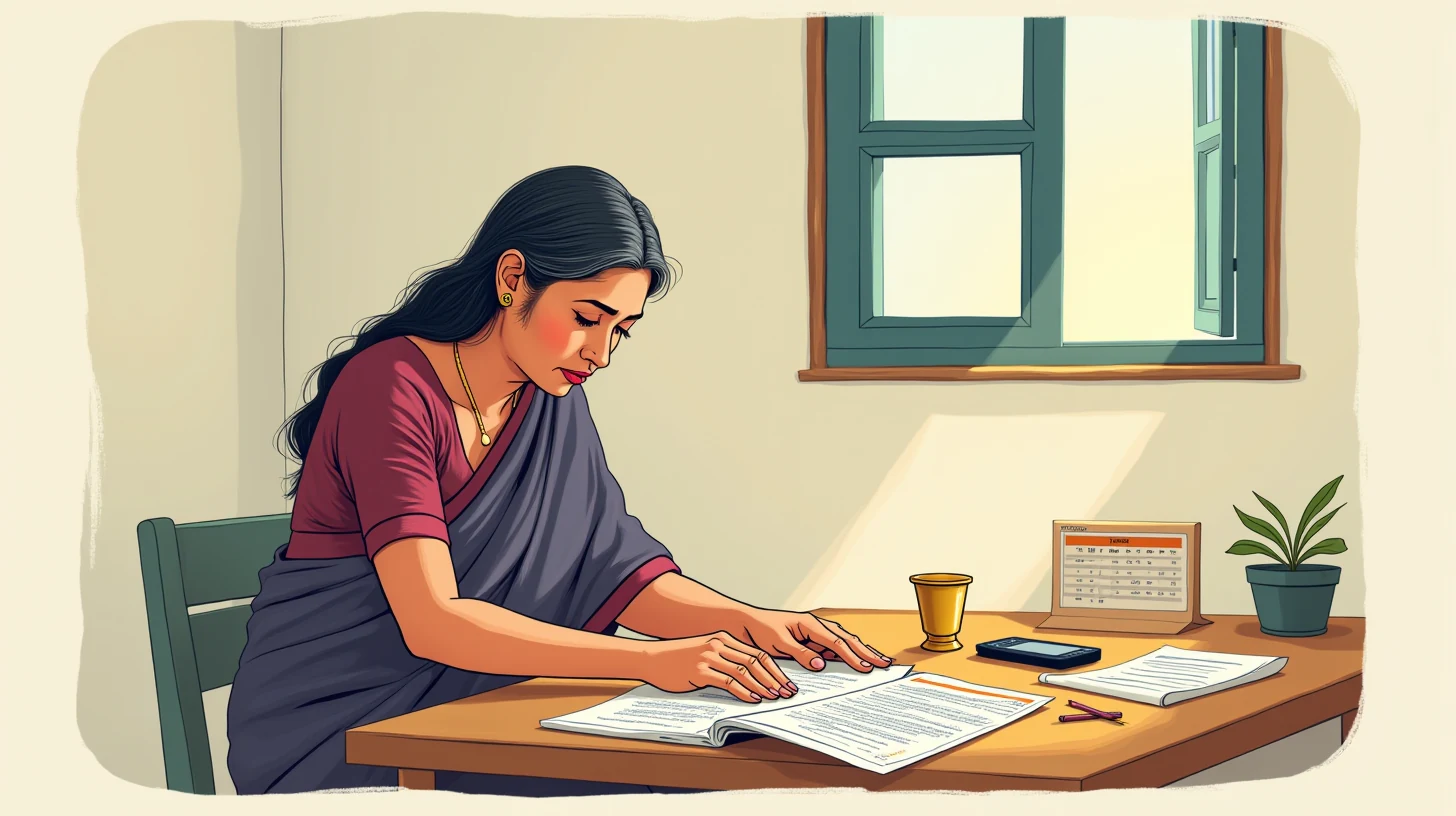
She was forty-seven. She had been an SC homemaker for twenty-six years—not idle, but busy in the way that census forms ignored: she had raised two children, tended a neighbour's garden on contract, assisted at the panchayat's anganwadi during the monsoon, and managed the joint account her mother-in-law had left her. Her income was nothing on paper. Her husband did odd carpentry work—some months ₹4,000, some months less.
In February, the third installment of her YSR Cheyutha transfer should have arrived. ₹18,750. It should have come like the other two, a quiet deposit the morning after payday. She had been approved in 2023. She had attended the SHG meetings. Her name was on the panchayat list. The scheme—Andhra Pradesh's cash grant for women like her, ₹75,000 over four years—was supposed to be the one reliable thing.
But March came. The money did not. A text from her bank said: Account seeding failed. Name mismatch. Contact branch.
That afternoon, she walked to the Mee Seva centre in Patamata market with the file under her arm.
🗓️ The annual rhythm of a small transfer
YSR Cheyutha was straightforward in theory. The Andhra Pradesh government identified women—Scheduled Caste, Scheduled Tribe, Backward Caste, or minority communities, aged 45 to 60, with family income below ₹10,000 (rural) or ₹12,000 (urban) per month—and gave them ₹18,750 each year for four years. ₹75,000 total. It was not a pension. It was not a loan. It was a one-time transfer, supposed to sit in a woman's bank account and give her some weight, some choice.
The payment had a rhythm. Lakshmi's first installment came in June 2023. ₹18,750. The second arrived in September 2023. ₹18,750. Both times, she stood at the bank and watched the balance grow. She did not touch it. Her husband did not know about it—not because they had secrets, but because he would worry about it, and she wanted to keep the worry for herself.
The scheme was meant to reach women like her: women who were not poor enough to qualify for rations, not educated enough for state jobs, not organized enough for SHGs to notice, too old to be hired for anything but piece work. Lakshmi fit that category perfectly. She was the invisible backbone of a thousand households.
But the transfer was not automatic. It moved through the NPCI system—the National Payments Corporation of India—which handled all Direct Benefit Transfers, or DBT, for the government. Your Aadhaar had to be linked to your bank account. The name on your Aadhaar had to match the name in the bank's system. The account number had to be correct. The bank had to be on the approved list. If any one thing was wrong, the transfer would stall.
Lakshmi's first two transfers had gone through. The system had recognized her. And then, in March, it had stopped.
⚠️ The name mismatch that no one told her about
The bank letter was cryptic: Aadhar seeding rejected due to name mismatch. Please contact branch with proof of identity.
Lakshmi had no proof of "identity" beyond her Aadhaar and her voter ID. She had borrowed someone's basic phone to check her bank balance online—a task that took her fifteen minutes and left her exhausted. She decided to visit the bank in person.
The bank manager told her something that made her sitting room cold even in daylight.
Her bank account had been opened in 2008 as a joint account with her mother-in-law. When her mother-in-law died in 2015, Lakshmi had converted it to a solo account—or tried to. The bank had added a "nominee" field to protect the account. That nominee was her father, who had co-signed the paperwork, because the bank required a second witness. But the system, when the paperwork was scanned into the NPCI Aadhaar Mapper, had read her father's name as the "primary holder" of the account, not as a nominee.
So when the YSR Cheyutha transfer tried to deposit ₹18,750 into "Lakshmi, SC homemaker, Aadhaar XXXX-XXXX-XXXX," the NPCI system found an account that said "Lakshmi (nominee: Father''s name, primary holder)" and rejected the seeding. Name mismatch. No transfer.
The bank told her to fix it at the Mee Seva centre.
🌗 The unofficial fee and the neighbour's daughter who knew better
Lakshmi was not alone in Patamata. There was a young woman, Anjali, a neighbour's daughter, who had worked at a local NGO for three years before it shut down. Anjali had helped with government forms, SHG registrations, pension applications. She understood the systems in a way that Lakshmi did not.
Anjali walked with her to Mee Seva.
The Mee Seva operator—a man in a blue shirt behind a laminated desk—listened to Lakshmi's story. He nodded. He said he could fix it. He would need to file an "account holder name amendment" form, submit it to the bank, get the bank to confirm, and then re-seed the Aadhaar in the NPCI system. It would take five to seven days.
His fee: ₹500.
Anjali leaned forward. "What is the government charge for this?"
The man paused. "No government charge. That is the service fee."
"But this is a correction of a bank error," Anjali said quietly. "The woman should not pay for it."
"That is the charge," he said.
Lakshmi was about to agree. ₹500 was not impossible—it was less than one day's vegetable-vending income, if she had a good day. But Anjali put a hand on her shoulder.
"This is not legal," Anjali said in Telugu. "Let me take the phone and check."
Before visiting Mee Seva, Anjali had helped Lakshmi check her application status using a community phone and the GabFORGE agent. The agent had found her record quickly.
"మీ YSR చేయూత దరఖాస్తు స్థితి చూశాను — మూడవ వాయిదా అక్టోబర్ 14 తేదీన NBM పోర్టల్లో 'పెండింగ్ సీడింగ్ వెరిఫికేషన్' అని చూపిస్తోంది. NPCI మ్యాపర్ మీ ఖాతాలో పేరు వ్యత్యాసాన్ని గుర్తించింది — బ్యాంకు రికార్డుల్లో నామినీగా నమోదైన వ్యక్తి పేరు ప్రాథమిక ఖాతాదారుగా చదవబడింది. మీ సమీపంలోని మీ సేవ కేంద్రానికి వెళ్ళి ఖాతా హోల్డర్ పేరు సవరణ ఫారమ్ దాఖలు చేయడం ద్వారా ఈ సమస్యను పరిష్కరించవచ్చు — ఈ సేవ లబ్ధిదారులకు ఉచితం."
(Your YSR Cheyutha application status shows "pending seeding verification" on the NBM portal as of October 14. The NPCI mapper detected a name discrepancy — the nominee listed in the old bank records was read as the primary account holder. You can resolve this by filing an account-holder name amendment form at your nearest Mee Seva centre. This service is free for beneficiaries.)
Anjali used the Mee Seva centre's own tablet. She searched for the Mee Seva portal guidelines and read aloud: Aadhaar-bank seeding corrections are free for beneficiaries. Unofficial charges are not permitted.
The man's face did not change, but he stood up and said he would file the form at no cost.
Five days later, Lakshmi received an SMS: Your Aadhar seeding is successful. Your account is now active for government transfers.
Three days after that, ₹18,750 arrived in her account.
But Anjali''s knowledge—that quick check, that quiet insistence—had been the difference between accepting the unofficial fee and refusing it. Most women in Patamata did not have an Anjali. Most paid the ₹500 without question, without recourse.
🧭 Why the system fails homemakers, and who else it catches
The problem was not YSR Cheyutha itself. The problem was the NPCI Aadhaar Mapper—the system that linked Aadhaar to bank accounts for all Direct Benefit Transfers across India. It was designed for simplicity: one Aadhaar, one name, one account, one seeding, one transfer.
But for women like Lakshmi, nothing was simple.
Many had opened bank accounts decades ago, when KYC rules were looser and family members—fathers, husbands, sons—were listed as "nominees" or "witnesses" in the paperwork. The digitization of these old records had misread who was the "primary holder" and who was the "nominee." When Aadhaar came along with a single name, the system could not reconcile the discrepancy.
Others had accounts in villages that had been renamed or absorbed into towns. The address on the Aadhaar did not match the address on the bank records. The system flagged it as a name mismatch (even though the mismatch was geographic, not nominal).
Some had changed their names after marriage but kept old accounts. Some had died and been replaced by relatives with similar names who tried to claim the account. Some had Aadhaar spelled "Lakshmi" and bank records spelled "Lakshmy"—one letter—and the system was rigid.
The NPCI system was correct in principle: it prevented fraud. But it also prevented legitimate women from receiving money that was legally theirs.
Lakshmi knew of three other women in her panchayat SHG whose YSR Cheyutha transfers had stalled. One had a different surname on her Aadhaar than on her bank account (her mother''s name versus her husband''s). Another had opened the account in a town fifty kilometers away and moved to Vijayawada; the address mismatch had triggered the rejection. The third had a typo: her Aadhaar spelled her daughter's name as a middle name, but the bank did not have it.
All three had been told—by Mee Seva operators, by bank managers, by other women—that it would cost money to fix. None of them had an Anjali to check.
- 📨
June 2023 — First Transfer Approved
YSR Cheyutha approves Lakshmi. First installment of ₹18,750 is transferred successfully to her bank account. The Aadhaar-seeding had worked on the first attempt.
- 💸
September 2023 — Second Transfer Approved
Second installment of ₹18,750 arrives without incident. Lakshmi begins to trust the system. She does not touch the money. Her bank balance is now ₹37,500.
- 🛑
March 2024 — Third Transfer Rejected
The third installment is due, but NPCI Aadhaar Mapper detects a discrepancy: Lakshmi''s father is listed as ''primary holder'' in the bank''s digitized records (he was a nominee co-signer in 2008). The system flags it as a name mismatch. The transfer is held.
- ⚖️
April 2024 — Correction Filed (Free)
After Anjali''s intervention, the Mee Seva centre files an account-holder name amendment at no cost. NPCI re-seeds the Aadhaar. Five days later, the stalled ₹18,750 is finally credited.
Verify the Problem
Do thisCheck the bank''s NPCI seeding status using the official Mee Seva portal. Confirm what the actual discrepancy is (name spelling, address mismatch, nominee listed as holder, etc.) before asking the woman to take action.
Surface the Options
Do thisExplain that corrections filed through Mee Seva are free for beneficiaries. If an unofficial charge is quoted, search the official Mee Seva guidelines on the portal itself and show the woman the rule. Do not let her accept a fee without confirmation.
Connect to the Right Authority
Do thisHelp her locate the correct Mee Seva centre for her mandal. Provide the official portal link (meeseva.ap.gov.in) so she can check service availability before visiting. Ask her to request a receipt or confirmation number when the form is filed.
Never Ask for Credentials
NeverDo not ask her for her Aadhaar number, bank account details, or OTP during verification. Never submit a correction form on her behalf. Let her decide to visit Mee Seva or call her bank.
Never Assume It Is Her Fault
NeverDo not suggest she made an error or that the account was set up wrong. The NPCI system often misreads old bank records and digitized nominee fields. The fault is usually in the data migration, not in her record.
Never Promise a Timeline
NeverDo not tell her the correction will take exactly five days or that the money will arrive by a certain date. Delays happen at the bank, the Mee Seva centre, and NPCI. Ask her to follow up after seven days with a confirmation SMS to her bank.
🌱 The quiet weight of eligibility
Three weeks after the money arrived, Lakshmi went to the market with her daughter and bought a goat. Not for meat—for milk. She would milk it herself every morning, sell the milk to the tea vendor and the temple. It was not much income. But it was income that came from something she owned, not something she did for other people.
She did not think of it as a result of YSR Cheyutha. She thought of it as something that had become possible because ₹37,500 was sitting in her account, and because she knew the money would keep arriving, and because she had been right not to touch it when she was afraid.
The remaining two installments of her YSR Cheyutha were now scheduled: September 2024, and March 2025. The NPCI seeding had been corrected. The money would arrive. She could plan forward in a way that ₹4,000-a-month carpentry did not allow.
But she also knew that the moment of correction had been fragile. A different Mee Seva operator, an impatient bank manager, no one to check the guidelines—and she would have paid the ₹500. Most women like her had paid it. They had no choice.
The system had not intended to exclude her. It had intended to protect her, to make sure that someone else could not steal her transfer. But protection and exclusion lived in the same machinery. They were not opposite things. They were the same bureaucracy, seen from different sides.
"పోర్టల్ నమ్మకం పోయింది — ఈ ఫైలే నా దగ్గర ఉన్న నిజమైన ఆధారం."— I had stopped trusting the portal. This folder of papers is the only proof I actually trust.
Lakshmi did not think about this in words. She thought about it the way she thought about cooking: small corrections, small adjustments, a steady hand, and the knowledge that even careful work sometimes failed. But when it worked, when the money arrived and the goat came home and the milk vendor asked for regular delivery, then it had been worth the care.
The YSR Cheyutha transfer would arrive for three more years. After that, there was no scheme. She would be fifty by then. She would milk the goat in the morning and sell in the market, and the ₹75,000 would have been the foundation of something she owned, not something she did.
That was quieter than a pension. But for women like Lakshmi, it was enough to build on.
Sources: