
The Bhubaneswar Odissi creator and the GI-tag foreign-brand collab
Priyamvada Mohanty is thirty-one years old. She lives with her parents in the lane behind Ananta Vasudeva temple in Old Town, Bhubaneswar — one of those narrow-fronted houses with a brass doorbell and a tulsi-katte in the courtyard and a first-floor balcony from which, on still mornings, you can hear the temple bells at five-thirty. Her father retired from the State Bank of India. Her mother taught Odia at a government school. They are not a family that discusses contracts or intellectual property over morning tea; they discuss whether the brass vessels have been polished and whether the neighbour's son has found employment.
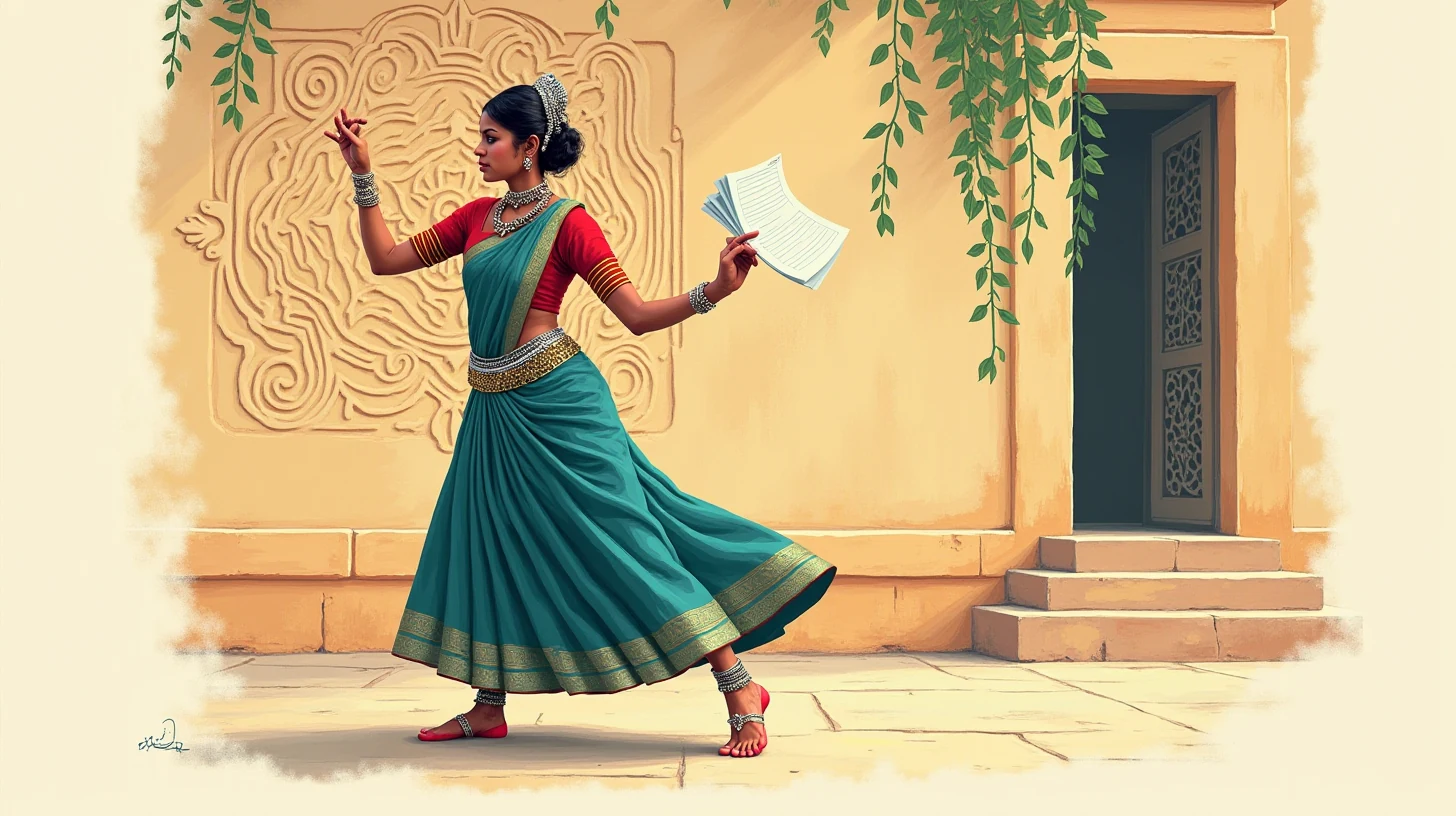
Priyamvada trained in Odissi from the age of nine — first under Guru Kumari Mohanty in the gurukul near Saheed Nagar, then, after her Plus Two exams, at the Odissi Research Centre on Museum Road. The ORC is one of the oldest institutions of its kind in India: it trains dancers in the classical grammar of Odissi — the Bhumipranaama, the Chouka, the Tribhangi postures — but also runs documentation programmes for the Mahari temple-dance tradition and the Gotipua all-male performance form. Priyamvada spent four years at the ORC, received her Sangeet Prabhakar, and now teaches the junior batch on Tuesday and Thursday evenings. She earns ₹18,000 a month from the gurukul, supplemented by ₹22,000 in average monthly brand income from her Instagram and YouTube channels.
The Instagram channel, at 180,000 followers, is built on two content streams: mudra explainers — thirty-second reels demonstrating the twenty-eight Asamyuta and twenty-three Samyuta hand gestures of Odissi, voiced in Odia and English — and a longer documentary series on Odissi costume history, covering the Tarakasi silver filigree work on her bahubandha, the provenance of the Sambalpuri-weave saris she performs in, the evolution of the Chandra-patta headdress from the Konark temple reliefs to the 1950s revival. The YouTube channel, at 95,000 subscribers, carries the longer documentary cuts. Both channels have grown without a manager: Priyamvada shoots on her phone, edits on a laptop, and answers brand enquiries herself on Sunday mornings after the temple visit.
One Sunday in March 2026, she opened her inbox to find a message from Heilkraft Naturals GmbH — a German wellness brand headquartered in Hamburg, known in the European market for plant-based supplements and meditation accessories — offering her a paid international campaign. The campaign brief was twelve seconds of her performance in Odissi costume, product-placed with a Heilkraft herbal supplement in frame, to run across their Instagram, YouTube, and European retail partner channels. The offered fee: €4,200 — roughly ₹3,76,000 at current rates. She had been offered larger amounts in India; she had never been offered European distribution. She typed a preliminary yes in her drafts folder. She did not send it.
🗓️ The annual ritual
Odissi was recognised as one of the eight classical dance forms of India by the Sangeet Natak Akademi in 1958. Its GI registration — Geographical Indication Application No. 149, filed under the Geographical Indications of Goods (Registration and Protection) Act, 1999 — formally establishes Odissi classical dance as a GI-tagged art form originating in Odisha. The GI Act, which India enacted in 1999 as part of its TRIPS commitments under the WTO, was designed for goods — Darjeeling Tea, Kanchipuram Silk, Chanderi Sarees — but its scope extends to any indication that identifies goods or services as originating from a specific region with qualities, reputation, or characteristics attributable to that origin. Odissi's GI tag is unusual precisely because it applies to a performance form rather than a tangible product: it establishes Odisha, and specifically the classical gharana descended from the Mahari and Gotipua traditions, as the geographical and cultural origin of the art.
The GI tag has a specific commercial consequence that most practitioners — including most Odissi dancers — do not know. Section 22 of the GI Act prohibits the commercial use of a registered GI by any person who is not an authorised user or a producer in the relevant goods, and who uses the indication "in a manner which misleads the public as to the true place of origin." In the context of a classical dance form, the Odisha state government and the Ministry of Culture have jointly interpreted this to mean that commercial use of Odissi as a branded or product-placed performance — specifically for international commercial distribution — requires a chain of approvals that a solo creator cannot self-authorise.
- ⚖️
1999 — Geographical Indications of Goods Act enacted
India passed the GI Act under TRIPS obligations. Registration began at the GI Registry, Chennai (now under CGPDTM/IPINDIA). Art forms, textiles, agricultural products, and handicrafts were eligible. Odissi filed under Application No. 149.
- 📋
2013 — Odisha Cultural Policy notified
Odisha's Department of Odia Language, Literature and Culture notified a formal cultural policy requiring state-level permission for international commercial performances featuring Odissi. Policy aims to prevent decontextualised commercial use abroad — the 'yoga appropriation' concern applied to classical dance.
- 🔍
2018 — Ministry of Culture ICH advisory
Ministry of Culture issued an advisory under India's commitment to UNESCO's 2003 Convention on Intangible Cultural Heritage. Commercial exploitation of GI-tagged traditional art forms for international brand campaigns requires a Ministry of Culture NOC for international distribution.
- ⚠️
2024 — TKDL expands to traditional performing arts
The Traditional Knowledge Digital Library, run by CSIR, expanded its defensive publication framework to include classical dance repertoires. Odissi's core compositions are partially documented. TKDL documentation strengthens complaints against commercial appropriation under both GI Act and copyright law.
- 📨
March 2026 — Heilkraft Naturals GmbH offer
A German wellness brand offered Priyamvada €4,200 for a twelve-second Odissi performance reel with product placement, for distribution across European Instagram, YouTube, and retail partner channels. No mention of GI compliance, no mention of cultural NOC, no mention of TKDL. Standard commercial contract.
The Ministry of Culture's framework draws a distinction that most creators, and many cultural lawyers, find unintuitive. Art-as-expression — a dancer performing Odissi for appreciation, documentation, or teaching — carries no NOC requirement. Art-as-commercial-asset — the same performance monetised for a brand, especially for international distribution, where the classical form becomes a backdrop or lifestyle signal for a product — triggers the cultural-permission chain. The line between them is not always visible to someone who has spent twenty years treating their dance as expression and only recently begun treating it as content.
Art-as-expression
No NOC requiredPerformance for appreciation, teaching, documentation, and self-funded content creation. Instagram reels showing mudras, costume history, ORC training — these are expression. GI registration protects the art form's origin; it does not restrict a trained practitioner from expressing it freely.
Art-as-commercial-asset (domestic)
GST + income declarationBrand-sponsored domestic campaigns — a Sambalpuri saree brand, an Odia jewellery company, an Indian tourism board — are commercial but within Indian jurisdiction. Standard creator compliance: GST, income tax, Section 194R. No specific GI NOC required for domestic commercial use by a trained practitioner.
Art-as-commercial-asset (international)
Ministry of Culture NOC + state permission + TKDL checkInternational commercial distribution of a GI-tagged classical art form with a foreign product placement triggers the full cultural chain: Ministry of Culture NOC, Odisha state cultural board permission, and a TKDL verification that the repertoire elements used are not the subject of active defensive documentation. The foreign brand will not tell you this.
⚠️ What very nearly happened
Priyamvada spent five days with the Heilkraft draft contract before she mentioned it to anyone. She showed it to a friend from the ORC — a performer who had done a domestic wellness brand campaign the previous year — who said: this is bigger than anything I've done, take it. She showed it to her mother, who said: it is from Germany, is it safe? She did not show it to her guru, Guru Kumari Mohanty, because her guru does not use email and because Priyamvada had a particular anxiety — precise and familiar to anyone who has grown beyond a teacher's vocabulary without growing beyond their respect — about bringing a commercial transaction into a relationship she kept separate from commerce.
The contract, translated from its German parent and issued in English, was standard influencer boilerplate: twelve-second performance clip, product placement of Heilkraft's Ashwagandha-based supplement in the final two seconds, usage rights assigned to Heilkraft Naturals GmbH for eighteen months across all digital and physical retail channels, payment in EUR via international wire transfer. No clause mentioned GI status. No clause mentioned Ministry of Culture permissions. No clause asked whether the performer had the cultural authority to assign international commercial rights to a GI-tagged classical art form. The contract was written by a Hamburg marketing legal team; it assumed that a creator who owned the performance owned all the rights needed to assign it.
"ମୁଁ ଭାବୁଥିଲି ସ୍ୱାକ୍ଷର କଲେ ଅର୍ଥ ହୁଏ ଆମ ଓଡ଼ିଶୀ ଆମ ଅଟେ — ମୁଁ ଜାଣି ନ ଥିଲି ଏ ଆର୍ଟ ଫର୍ମ୍ ର ଏକ ଭିନ୍ନ ଠିକଣା ଅଛି।"— I thought that signing meant the dance was mine to give — I didn't know this art form has a legal address of its own.
Had she signed: Heilkraft would have published the campaign across their European Instagram, YouTube, and retail partner networks in Germany, Austria, and Switzerland. The ORC and the Odisha cultural board would not have been notified. The Ministry of Culture would not have issued an NOC. At some point — within days of publication, most likely — someone at the Sangeet Natak Akademi or among the classical dance scholars who monitor the international licensing of Indian classical forms would have seen an Odissi Trikhandi Bhangi beside a Hamburg supplement bottle. The complaint under Section 22 of the GI Act allows any "interested party" to file against commercial misuse. In the classical dance world, "interested party" has a wide and energetic definition.
The consequences would have been specific: a GI infringement complaint, a state cultural board notice, and — most durably — the end of Priyamvada's relationship with the ORC. Not through any formal proceeding; simply through the quiet institutional withdrawal that organisations practice when a member has embarrassed the tradition. She would have kept the €4,200. She would have lost the gurukul teaching position, the ORC affiliation, and the trust of the community from which her content draws its credibility. The irony is precise: the thing that made her Instagram valuable — her classical training, her authentic relationship with the tradition — was the exact thing the contract would have put at risk.
🌗 What changed
Guru Kumari Mohanty's nephew is Amitav Mohanty. He is twenty-eight, the son of the guru's younger brother, trained at National Law University Delhi and now doing IP law at a firm in Connaught Place. He comes to Bhubaneswar twice a year: for Rath Yatra, and in March for his grandmother's death anniversary. He arrived on a Saturday, spent the afternoon at the gurukul watching the junior students practice their Bhumipranaama, and had evening tea with Priyamvada and her parents in their Old Town courtyard.
The draft contract was on the table between the teacups. Priyamvada had printed it on five pages. Amitav picked it up without being asked.
"ଦିଦି, ଏଠାରେ ସ୍ୱାକ୍ଷର କରିବ ନାହିଁ। ଏ ଚୁକ୍ତି Odissi ର GI ସ୍ଥିତି ଉପରେ ଚୁପ ଅଛି — ଜର୍ମାନ୍ ବ୍ରାଣ୍ଡ ଜାଣି ନ ଥିବ ଯେ ଏ ଆର୍ଟ ଫର୍ମ GI Act 1999 ଅଧୀନରେ registered। ତୁ ଯାହା assign କରୁଛ — international commercial rights — ତୁ ଏକୁଟୁଆ assign କରିବାର ଅଧିକାର ନ ଥାଏ। Ministry of Culture NOC ଚାଇ। Odisha state board permission ଚାଇ। ଏ process ସରିଲେ sign କର, ₹3,76,000 ର assignment ଦ।"
(Didi, do not sign this. The contract is silent on Odissi's GI status — the German brand probably does not know this art form is registered under the GI Act 1999. What you are assigning — international commercial rights — you do not have the unilateral authority to assign. Ministry of Culture NOC is required. Odisha state board permission is required. Once that process is complete, sign it, collect ₹3,76,000.)
She typed the question into the agent that Amitav installed on her laptop that same evening, in Odia: "Odissi ର GI registration ଅଛି କି ଏବଂ international commercial use ପାଇଁ permission procedure କ'ଣ?" — Does Odissi have a GI registration and what is the permission procedure for international commercial use?
The agent checked the CGPDTM database at ipindia.gov.in, confirmed GI Application No. 149, and produced a Odia-language summary:
"ହଁ, Odissi classical dance Application No. 149 ଅଧୀନରେ registered GI ଅଟେ। International commercial use — foreign brand campaign including product placement — ପାଇଁ ତିନୋଟି permission ଦରକାର: (1) Ministry of Culture NOC via indiaculture.gov.in — average processing time 6-8 weeks; (2) Odisha Department of Odia Language, Literature and Culture permission via odisha.gov.in — state-level cultural performance clearance; (3) TKDL verification via cdf.gov.in — repertoire elements ଯାଞ୍ଚ। Heilkraft ର contract ରେ ଏ ତିନୋଟିର ଉଲ୍ଲେଖ ନ ଥାଏ। ଆପଣ ଏକୁଟୁଆ international commercial rights assign କରିବାର ଆଇନ୍ ଗତ ଅଧିକାର ନ ଥାଏ।"
(Yes, Odissi classical dance is a registered GI under Application No. 149. For international commercial use — a foreign brand campaign including product placement — three permissions are needed: Ministry of Culture NOC via indiaculture.gov.in, average processing time 6-8 weeks; Odisha Department of Odia Language, Literature and Culture permission via odisha.gov.in; TKDL verification via cdf.gov.in. Heilkraft's contract mentions none of these. You are not legally in a position to assign international commercial rights unilaterally.)
Priyamvada read it twice. She looked at Amitav. He said: the good news is the brand is legitimate, the fee is real, and there is an actual path to doing this correctly. The bad news is it takes eight weeks and requires the ORC to co-sign the cultural permission application as the custodian institution.
She called her guru the next morning. Guru Kumari Mohanty listened without interruption, then said she had seen this before — a Mumbai advertising house, in 2019, had used footage of an ORC student's arangetram in a national insurance commercial without permission; the complaint took three years to resolve. She would co-sign the Ministry of Culture application.
Amitav drafted a reply to Heilkraft Naturals GmbH explaining the GI status and NOC requirement, attaching a brief on the GI Act 1999 and India's ICH framework. The German brand's legal team responded within forty-eight hours: they had no idea, they were willing to wait, and they would hold the fee in escrow.
The application was filed in April 2026. The Ministry of Culture acknowledged within two weeks. The Odisha state cultural board clearance came within three. As of the date of writing, the Ministry NOC is in its fifth week of processing.
🧭 Why we built it
There are, by the Sangeet Natak Akademi's last count, over forty thousand trained Odissi practitioners in India. Among them, a growing cohort who have built digital presences and receive brand enquiries from companies that have no institutional knowledge of GI law. The brands are often well-intentioned. The creators are often well-trained. The gap is not bad faith; it is the specific ignorance of a regulatory framework that lives between two ministries and a state cultural department, documented in an IP registry in Chennai that no marketing team in Hamburg has ever searched.
The GI Act's protections exist precisely to prevent the Heilkraft contract's outcome: the use of a classical tradition as a lifestyle signal for a product without the cultural community receiving any acknowledgement or consent. But the protection is passive — it files no automatic complaint when a creator assigns international commercial rights without an NOC. The burden of knowing the law falls on the creator, who is also managing a gurukul schedule, editing reels, answering brand DMs, and trying to keep her parents from worrying. The agent cannot appear in a Hamburg marketing meeting to explain the GI Act. But it can, when Priyamvada types her question in Odia at eleven at night in an Old Town courtyard, tell her what she is looking at — the GI registration number, the three-permission chain, the realistic timeline, the portal where the application goes — before she sends the email that begins with yes.
What it does
- 🔍Checks the CGPDTM/IPINDIA GI registry in real time and confirms whether a given art form, craft, or product has an active GI registration — including the application number, registered proprietor, and authorised users list.
- 🗂️Maps the permission chain for the specific commercial use type — domestic vs international, brand-placed vs documentary, product-adjacent vs incidental — and names the exact portals and likely timelines for each authority.
- 📞Identifies when a contract's rights-assignment clause exceeds what the creator can unilaterally grant, and flags the specific clause with a plain-language explanation of why — without legal advice, but with enough precision to know what question to ask a lawyer.
What it does not do
- 🔒Never files an NOC application on the creator's behalf, submits documents to any government portal, or signs any cultural clearance form — every submission requires the creator's explicit review and the co-signature of the custodian institution.
- 💳Never negotiates contract terms with the brand, contacts Heilkraft, or drafts correspondence in the creator's name without her review and approval of every word.
- ✅Never advises whether to take or decline a specific collab — that judgment belongs to the creator, the guru, and in this case an IP lawyer who happened to be at tea.
The line between art-as-expression and art-as-commercial-asset is one a creator encounters exactly once before they know it exists. It could arrive as a US yoga app wanting a Bharatanatyam sequence, or a British luxury brand wanting a Kuchipudi dancer for a fashion campaign. The GI registrations are not well-known. The Ministry of Culture's NOC process is not well-advertised. The TKDL is not a household name even among classical dancers. The agent does not solve this invisibility — but it reads the contract before the creator sends the yes.
🌱 What we hope happens
In the last week of May, Priyamvada filmed a new reel in the ORC courtyard: the Pallavi sequence, the one she teaches the junior students on Tuesday evenings. She posted it without any brand placement. It received 42,000 views in forty-eight hours — the best-performing reel she had posted in six months. In the caption, she wrote, in Odia: ଆମ ନୃତ୍ୟ ଆମ ସ୍ୱର — ଏ ଶୁଦ୍ଧ ଭାଷା। Our dance is our voice — this is the pure language. She did not mention Heilkraft or Germany or the contract.
The Ministry of Culture NOC will allow the Heilkraft campaign to proceed. The ORC will be acknowledged in the campaign credits. Priyamvada will receive her €4,200, a portion already earmarked for new costumes for the junior batch. The campaign will run with Odissi in it, but with Odisha's institutional knowledge visible in its permission chain — which is all the GI Act was asking for in the first place.
There are thousands of classical-art creators in India — Bharatanatyam practitioners in Chennai, Kuchipudi dancers in Vijayawada, Mohiniyattam performers in Kerala, Sattriya practitioners in Assam — who receive international brand enquiries and do not know that the art form they have spent their lives learning has a legal address. Most will not have an IP lawyer at tea. Most will send the preliminary yes without knowing what they are giving away — not the dance, which no contract can take, but the institutional relationship that makes the dance real: the guru's trust, the ORC's affiliation, the community's willingness to let you carry the tradition forward.
There is a particular kind of loss that happens when a tradition is used without its own permission. Nobody takes the dance. The dancer still knows every mudra. But something in the relationship between dancer and tradition shifts when a supplement brand has used it as a lifestyle backdrop without the custodian institution knowing. The GI Act exists, imperfectly, to prevent that shift. The agent exists, imperfectly, to make sure the creator knows the Act before the contract arrives.
If you are a classical-art creator, a folk practitioner, a traditional craft maker — anyone whose work is grounded in a GI-tagged or TKDL-documented tradition — the agent is available free at gabforge.in. We support Odia, Tamil, Telugu, Kannada, Malayalam, Bengali, Marathi, Hindi, Gujarati, Punjabi, and Assamese, and the routing knows the GI registry, the Ministry of Culture NOC process, and the Odisha state cultural board procedures. We will not turn your tradition into a product feature. We will read the contract with you — before you say yes.