
The Dehradun Char Dham creator and the FCRA bhandara portal
Deepak Negi is thirty-six years old. He lives on the second floor of a concrete-and-marble building on Rajpur Road in Dehradun — the road that climbs from the city toward Mussoorie, where the hotels begin to thin and the pine trees start. The flat is his parents' home: his father, a retired PWD supervisor, uses the ground floor; his mother keeps the puja room on the first floor with a precision that mirrors Deepak's own obsessiveness about camera angles. His wife Kamla teaches at a CBSE school three kilometres away. They have no children yet. Most of the spare room is occupied by camera bags, a ring light, two external hard drives, and, in one corner, a steel trunk of bhandara supplies — steel thalis, ladles, a brass bhog plate — that travel to Yamunotri every May.
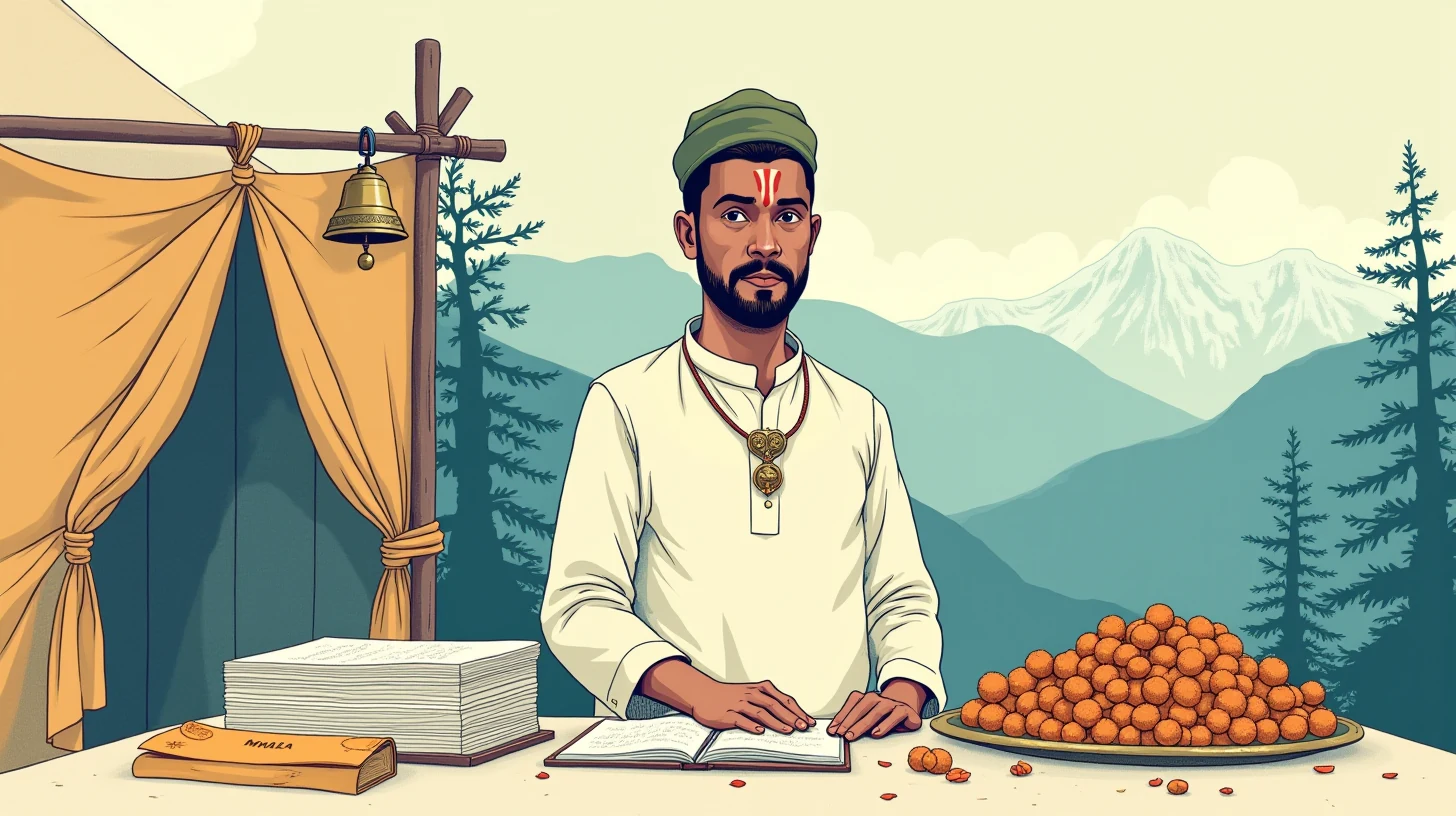
He runs a YouTube channel called Char Dham Darshan. It has 410,000 subscribers and an upload rhythm that follows the yatra calendar: Akshaya Tritiya for the Yamunotri opening, late May for Gangotri, Kedarnath and Badrinath through June and July, then bhajan recordings and Rishikesh content through the winter. Instagram has 230,000 followers. He does not run ads. He does not take brand deals from tour operators or hotel chains. His income from the channel — YouTube Partner Programme and channel memberships — runs to roughly ₹1.9 lakh per month in peak season and about ₹60,000 in the off months, when he lives partly in Rishikesh, recording evening aarti and teaching a small morning satsang group. His parents think of the channel the way they think of other people's government jobs: steady, dignified, slightly mysterious in its workings.
The bhandaras started in 2021, almost accidentally. A video he posted from the Yamunotri pilgrim path — a single slow pan of a queue of elderly pilgrims waiting for tea in freezing drizzle — received more comments than any video he had made. Several NRI viewers in London, Dallas, and Melbourne wrote that they wanted to help. He set up a UPI ID and a PayPal account. Over the 2021 season, ₹1.2 lakh arrived. He spent it all on rice, dal, fuel, and firewood. He posted a receipt video. More people sent money for 2022. By the 2024 yatra season, the PayPal receipts alone were ₹4.2 lakh — from a US-origin Uttarakhandi diaspora community in Houston, a group of Gujarati NRIs in Melbourne, and individual donors in Leicester and Birmingham. He had no trust, no society, no FCRA registration. He had a spreadsheet in Google Sheets, a UPI QR code, and a PayPal link in his YouTube bio.
The speed-post letter arrived at Rajpur Road on a Tuesday morning in October 2024, while he was editing a Kedarnath monsoon drone video in the spare room. His mother signed for it. She brought it upstairs with the expression she reserves for government envelopes.
🗓️ The annual ritual
The Char Dham yatra — Yamunotri, Gangotri, Kedarnath, Badrinath — is not merely a religious pilgrimage. It is, in the concentrated months of May through November, one of the largest mass-movement events on the Indian subcontinent. Uttarakhand's Tourism Department registered 56 lakh pilgrims in the 2023 yatra season, up from 42 lakh in 2022. Along the four routes, the infrastructure of devotion has always included bhandaras: community kitchens run by individuals, trusts, dharamshalas, and community organisations, offering free meals to pilgrims regardless of caste, income, or origin. The bhandara tradition is as old as the yatra itself. It is also, since 2022, subject to a set of overlapping regulations that most operators have never heard of.
The Uttarakhand Char Dham Devasthanam Management Board (CDMB) was constituted in 2019 under the Uttarakhand Char Dham Devasthanam Management Act. It absorbed fifty-one shrines — including the four Char Dhams — into a state-managed trust structure. The Board was subsequently subject to political controversy (the priests' unions opposed state control of the temples), and a partial restructuring returned management of Kedarnath and Badrinath to the Badrinath Kedarnath Temple Committee (BKTC) in 2022. The key policy output that survived the restructuring was this: organised bhandara operations within notified yatra zones, particularly those collecting donations from the public, were required to register with the relevant shrine committee. An "organised bhandara operation" was defined broadly — any operation feeding more than five hundred pilgrims per day, using publicly solicited donations, on a recurring basis across seasons.
FCRA — the Foreign Contribution (Regulation) Act, 2010 — operates on a separate, national layer. Section 11(1) of the Act prohibits any person (other than those on the government list) from accepting foreign contributions without prior registration or prior permission from the Ministry of Home Affairs. "Foreign contribution" is defined at Section 2(1)(h) broadly enough to include a PayPal transfer from an Indian-origin person holding a US passport or OCI card. The income does not need to be large. The donor does not need to be a foreign national. If the money originates from a foreign bank account in a foreign currency, it is a foreign contribution under the Act. The threshold for registration obligation is zero. ₹1 received from a PayPal account in Houston without FCRA registration is a Section 11 violation.
- 🛕
2021 — First bhandara, informal donations
₹1.2 lakh received via UPI from domestic donors + early PayPal from NRI viewers. No trust, no registration. Deepak spends everything on food and fuel. Posts a receipt video. Comments flood in.
- 📱
2022–2023 — Scale crosses thresholds
PayPal inflows grow to ₹2.8 lakh in 2022 and ₹4.2 lakh in 2024. CDMB's Yamunotri shrine committee begins requiring registration for recurring bhandara operators. Deepak is not registered. The Uttarakhand Tourism portal's authorised-provider directory does not list him.
- ⚖️
Mid-2024 — MHA flags PayPal inflows
RBI's bank reporting of inward remittances surfaces Deepak's PayPal receipts to MHA's FCRA Division. The amount (₹4.2 lakh over three seasons) triggers a query. MHA's Foreign Contribution Wing issues a show-cause notice under Section 11(1) and Section 35 of FCRA 2010.
- 📨
October 2024 — Speed-post letter arrives
Four pages from MHA's FCRA Division: cessation of foreign-contribution receipt, mandatory FC-4 return for prior receipts, requirement to open a designated FCRA bank account (SBI, Main Branch only), and a 60-day window to apply for registration or face Section 34 prosecution.
Deepak read the letter once. He put it down. He read it again, more slowly, because the first reading had not fully resolved the sentence that said "prosecution under Section 34 of the Foreign Contribution (Regulation) Act, 2010, which carries imprisonment of up to five years." He is not a man who uses the word "panic" about himself — he has walked to Kedarnath in pre-dawn snowfall, he has organised meals for 4,200 pilgrims on a kerosene-stove budget — but he sat with the letter for a long time before he called his wife.
⚠️ What very nearly happened
The first lawyer Deepak consulted in Dehradun was a civil property advocate who had handled his parents' registry. The advice was swift and general: form a trust, file the FCRA application, stop the PayPal link immediately. The advocate did not know what an FC-4 return was. He did not know the designated FCRA bank account requirement (SBI Main Branch only, separate from all operational accounts). He quoted a retainer of ₹40,000 for "trust formation and MHA compliance," which Deepak paid in advance.
Three weeks later, the trust registration was stuck at the Charitable Trust Registry in Dehradun because the advocate had used "Char Dham Bhandara Trust" as the name, which the registry objected to because it incorporated a shrine name under the CDMB framework — a separate complication that neither the advocate nor Deepak had anticipated. The 60-day MHA window was now at 33 days. Deepak had a draft trust deed that could not be registered, a PayPal account he had already frozen, ₹4.2 lakh of received funds sitting in his personal savings account with no designated FCRA account to transfer them to, and an MHA letter that had not yet been answered.
"भंडारे की रोटी तो भगवान का प्रसाद है — पर कागज़ात बिना भगवान भी नहीं पहुँचते।"— The bhandara bread is God's prasad — but even God doesn't reach without paperwork.
He did not tell his parents what the letter said. His father had spent thirty years in the PWD and associated government formality with delay, not with prosecution risk. His mother would have told extended family in Pauri Garhwal within forty-eight hours. He told Kamla, who told him to call their CA — a Saharanpur-based accountant who filed the channel's ITR-3 and GST returns. The CA, to his credit, told Deepak directly: this is outside his practice area. But he knew a religious-trust lawyer in Dehradun who had handled FCRA matters for a temple trust in Rishikesh.
🌗 What changed
Adv. Prashant Dimri has an office in a first-floor room above a stationery shop on Astley Hall Road in Dehradun, forty minutes from Rajpur Road on a clear morning and ninety on a bad traffic day. He has handled the FCRA compliance for three charitable trusts in Uttarakhand, including one temple-associated educational foundation that received foreign contributions for a hostel in Tehri. He came recommended by Deepak's CA, who had encountered him at a tax litigation seminar in Rishikesh.
Deepak arrived at the office with the MHA letter, the PayPal transaction export, and the stuck trust deed. Dimri read the letter in four minutes. He set it down and said, in Garhwali, with the mild tone of someone who has seen this particular disaster before:
"दीपक भाई, दो अलग-अलग काम हैं — CDMB का भंडारा पंजीकरण और FCRA। दोनों साथ-साथ करने पड़ेंगे, पर दोनों का रास्ता अलग है। ट्रस्ट का नाम बदलना पड़ेगा — 'चार धाम' नाम नहीं चलेगा। और MHA को जवाब पहले जाना चाहिए — 60 दिन का विंडो है, उसमें से 33 दिन जा चुके हैं।"
(Deepak bhai, there are two separate things here — the CDMB bhandara registration and the FCRA. Both have to run together, but the paths are different. The trust name will have to change — 'Char Dham' won't work. And the MHA reply needs to go first — the 60-day window is open, 33 days are already gone.)
He suggested the agent to help Deepak map the FCRA workflow while he prepared the MHA reply draft. An associate installed it on Deepak's phone and set the interface to Hindi. Deepak typed the question he had been sitting with for three weeks: "FCRA में बिना पूर्व अनुमति के PayPal से पैसे लेना क्या वाकई अपराध है अगर मैं भंडारे पर ही खर्च कर रहा हूँ?" — Is receiving PayPal money without prior FCRA permission really an offence if I'm spending it only on bhandaras?
"हाँ, दीपक जी। FCRA 2010 की धारा 2(1)(h) के अनुसार 'विदेशी अंशदान' की परिभाषा में विदेशी बैंक खाते से आई कोई भी राशि शामिल है — चाहे दाता भारतीय मूल के हों या OCI कार्डधारक। खर्च का उद्देश्य — भंडारा, शिक्षा, या कोई भी धार्मिक कार्य — धारा 11(1) के उल्लंघन से छूट नहीं देता। लेकिन MHA 60-दिन के भीतर 'Prior Permission' के लिए आवेदन स्वीकार करता है, जो पूर्व प्राप्त राशि को regularise कर सकती है, बशर्ते FC-4 वार्षिक विवरण दाखिल किया जाए और FCRA नामित बैंक खाता SBI की मुख्य शाखा में खोला जाए।"
(Yes, Deepak ji. Under Section 2(1)(h) of FCRA 2010, the definition of 'foreign contribution' includes any amount from a foreign bank account — whether the donor is of Indian origin or an OCI cardholder. The purpose of the expenditure — bhandara, education, or any religious work — does not grant an exemption from Section 11(1) violation. However, MHA accepts a 'Prior Permission' application within 60 days, which can regularise previously received amounts, provided the FC-4 annual return is filed and an FCRA designated bank account is opened at SBI's main branch.)
Deepak read it twice and then read it to Dimri, who nodded and said that was accurate and that they needed to move on the trust name, the SBI account, and the MHA response simultaneously.
Trust name + registration
Dehradun Charitable Trust RegistryName changed from 'Char Dham Bhandara Trust' to 'Negi Bhakti Seva Trust' — avoiding restricted shrine terminology. New deed filed with Dimri as witness. Registry approval in eleven working days. Cost: ₹8,200 in stamp duty and filing fees.
FCRA Prior Permission + FC-4
fcraonline.nic.in, SBI Main BranchMHA reply filed within the 60-day window citing Prior Permission application under Rule 9 of FCRA Rules 2011. FC-4 return for three seasons prepared. Designated FCRA bank account opened at SBI's Paltan Bazaar Main Branch (the only SBI branch in Dehradun designated for FCRA accounts). ₹4.2 lakh transferred from personal savings to designated account.
CDMB / BKTC bhandara registration
badrinath-kedarnath.gov.inSeparate registration filed with the Yamunotri Shrine Committee (under CDMB's remaining authority) and the BKTC portal for Kedarnath and Badrinath. Registration required: trust deed, annual budget estimate, operator photograph, and a camp-location diagram. Processing: 21 days. The Uttarakhand Tourism authorised-provider directory listing followed automatically.
The agent helped Deepak map each document to each portal in the right sequence. The SBI FCRA account had a specific requirement he had nearly missed: the account must be opened in person at the branch with the FCRA Prior Permission application acknowledgement number, not with the registration certificate (which comes later). Getting the sequence wrong — opening the account too early or too late — would delay the MHA's processing. The agent flagged this explicitly, citing the Ministry's own FCRA-FAQ document on fcraonline.nic.in, which Deepak would not have found without knowing to look for it.
Dimri filed the MHA reply on day 51 of the 60-day window. The Prior Permission application was acknowledged by fcraonline.nic.in within 72 hours. MHA's review period is 90 days from acknowledgement. The FCRA registration — the longer-term goal, which requires two years of operations under Prior Permission — was begun as a parallel track. The 2025 yatra season operated under the Prior Permission framework: PayPal donations reinstated, routed through the FCRA designated SBI account, FC-4 return filed quarterly, donor receipts issued with the trust's FCRA application reference.
🧭 Why we built it
There are, by the most conservative estimates, several thousand devotional creators in India running bhandara or langar operations of some scale during pilgrimage seasons — Char Dham, the Amarnath yatra, Shirdi, Vaishno Devi, the Pandharpur Wari. Among them, a significant subset have discovered, as India's NRI diaspora has increasingly found ways to participate in devotion from abroad, that PayPal links and Google Pay QR codes in YouTube bios attract foreign-origin contributions with a speed that outpaces any awareness of FCRA. The MHA's FCRA Division does not send warning letters before the show-cause notice. The flag arrives from the RBI's bank-reporting system, which is automatic and does not distinguish between a devotional creator spending every rupee on pilgrims' rice and a political organisation receiving foreign funds for prohibited purposes.
The compliance gap is compounded by a specific cultural assumption: that bhakti — sincere religious service — is self-evidently distinct from the political or commercial motivations FCRA was designed to police. Section 11 of the Act does not make that distinction. The law's purpose is to regulate the volume and transparency of foreign money in India's civil society and religious sector, not to evaluate the sincerity of the recipient's intentions. Deepak's bhandaras were genuinely what they appeared to be. That is not a defence under Section 11.
What it does
- 🔍Verifies the legal basis of an MHA notice — cites the specific FCRA section, the applicable threshold, and whether Prior Permission or full Registration is the right application path, sourced from fcraonline.nic.in documentation.
- 🗂️Maps the sequence of parallel compliance actions — trust registration, FCRA designated bank account, FC-4 return, BKTC bhandara registration — and flags order-of-operations errors before they cause processing delays.
- 📞Identifies the single SBI branch in each city designated for FCRA account opening, and the document required at the time of opening (acknowledgement number, not registration certificate).
What it does not do
- 🔒Never files the MHA application, trust registration, or FC-4 return — each submission was made by Deepak and Adv. Dimri in person or on the portal, with explicit confirmation at each step.
- 💳Never transfers funds between accounts or touches the PayPal or SBI designated account — Deepak moved the ₹4.2 lakh himself, with a CA-verified paper trail.
- ✅Never provides legal opinion on whether a specific transaction is or is not a 'foreign contribution' — it surfaces the statutory definition and the MHA's FAQ; the lawyer confirms the application to Deepak's facts.
What a creator in this situation needs, in the first seventy-two hours, is the answer to three specific questions: Is the notice real? What is the actual legal exposure? What is the sequence of steps that resolves it within the window? Those are questions that require reading three government portals, two statutory provisions, and one Ministry FAQ document. They are also questions where the wrong answer — a generic "form a trust and apply" without flagging the trust-name restriction, the SBI branch constraint, or the CDMB parallel track — costs twenty days and potentially the compliance window. Most devotional creators have a CA for tax purposes and a lawyer for property matters. Neither is likely to know FCRA's specific trust-naming constraints or the designated-account sequencing rule until they encounter it.
🌱 What we hope happens
The 2025 Char Dham yatra opened in early May, as it always does, with the Yamunotri temple doors unlocking to a crowd that had been walking since 4 a.m. Deepak was there with his camera, as he has been every season since 2017. The bhandara tent was up by 7 a.m. The steel thalis were counted. The trust registration document, laminated in a plastic sleeve, was posted at the tent entrance — a small rectangle of text that most pilgrims walked past without reading, because they were hungry and the prasad was hot and the Yamuna was running white in the gorge below.
He posted a video that evening from the tent. The description included, for the first time, the trust name and the FCRA Prior Permission application reference number for international donors. The comments from Houston and Melbourne arrived as they always had — "Har Har Mahadev," "jai Badri Vishal," a Melbourne-based Uttarakhandi family who had sent ₹22,000 over three seasons and asked if they could donate again. This time there was a correct answer: yes, through the designated trust account, with a tax-receipt process that Dimri's office would handle.
The FCRA registration — the permanent one, not the Prior Permission — is a two-year process. Deepak expects it to be approved in late 2026 or early 2027, assuming the FC-4 returns remain clean and no further MHA queries arise. The CDMB registration renewal is annual. The BKTC bhandara permit for Kedarnath and Badrinath requires a fresh camp-location diagram each season because the permitted zones shift with the crowd management plan. None of this is simple. None of it was mentioned, anywhere, in the YouTube comments that asked him to set up a PayPal link in 2021.
This is the specific situation the agent was built for: not the creator who knows they need FCRA registration and is looking for the form, but the creator who has been running a sincere and genuinely charitable operation for three seasons and receives a government letter that seems, at first, to be about something other people do. The distinction between "I was collecting donations" and "I was receiving foreign contributions under FCRA 2010" is not intuitive. It is a legal classification that exists independently of intent. The faster that classification is named and mapped — specific section, specific portal, specific sequence — the more of the 60-day window remains for the lawyer and the registry.
If you run a devotional channel, a pilgrimage support service, a bhandara operation, or any religious or cultural activity that receives donations from NRIs or foreign-based supporters via PayPal, Wise, or bank transfer — the agent at gabforge.in can surface the FCRA exposure in the first conversation, in Hindi, in Garhwali, in whatever language you think in when you're reading a government letter on a Tuesday morning in October. We will not file for you. We will not replace Adv. Dimri. But we will tell you, before you pay a retainer to a property lawyer, that the trust name cannot include a shrine's name, that the SBI account needs the acknowledgement number, and that the window is 60 days and you have already spent some of them.