
The Gangtok yoga creator and the restricted-area-permit shoot crew
Tenzin Choden is thirty years old and lives in the Tadong neighbourhood of Gangtok — the busy eastern flank of the capital, closer to the market lanes and the old Deorali monastery than to the tourist hotels strung along NH-10. Her flat is rented, two rooms and a kitchen on the third floor of a concrete building from which, on clear mornings, the snow cap of Kanchenjunga floats above the ridgeline like something misplaced. She has lived in this flat for three years with her partner Dorjee Wangchuk, who runs a small meditation retreat center in Deorali that they built together — six rooms, a shared kitchen, a stone courtyard with prayer-flag strings between the poles, and a rate card that charges by the week rather than the night.
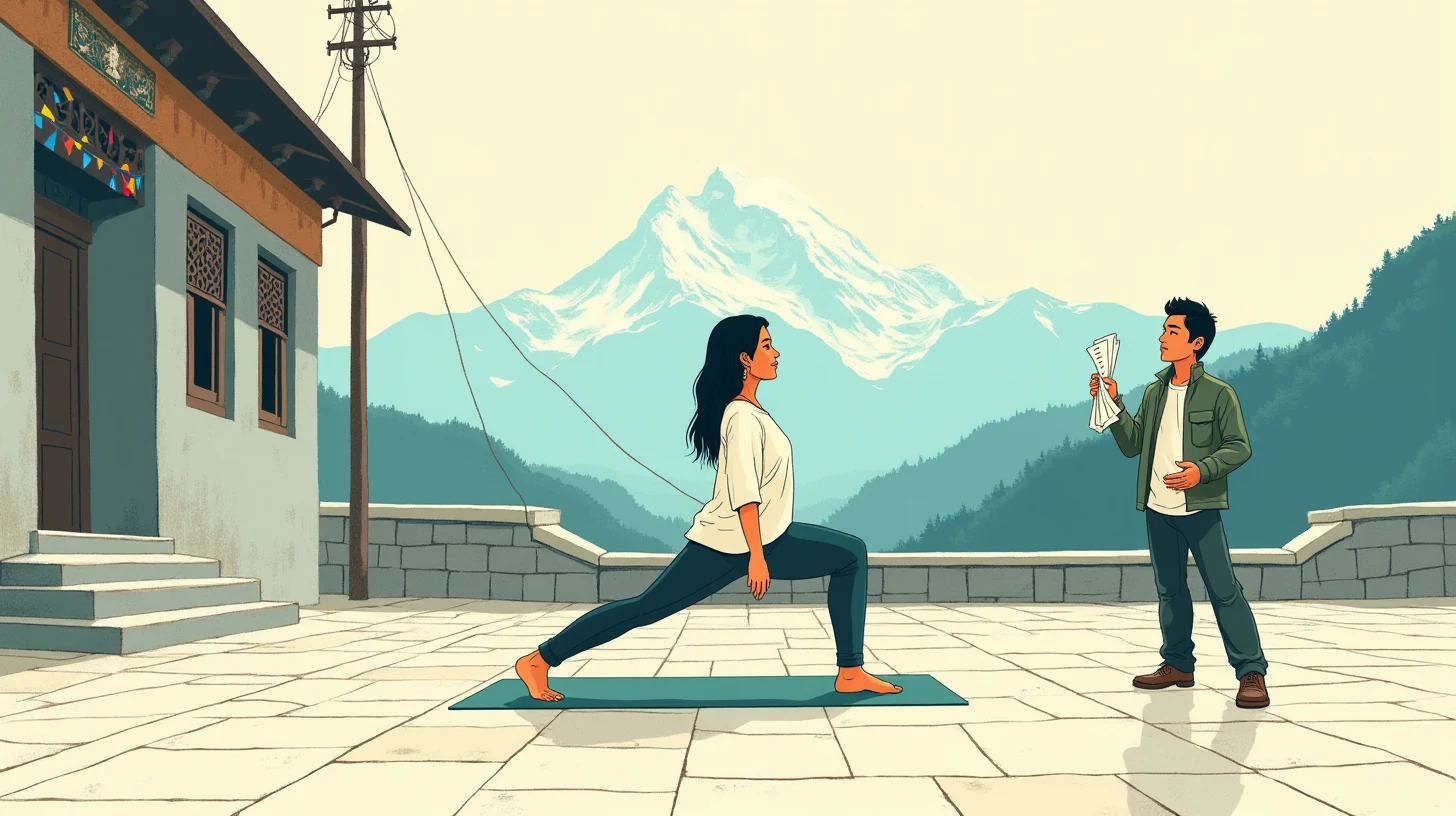
She is a yoga and mountain-wellness creator with 380,000 followers on Instagram and 110,000 on YouTube. The content is what it looks like: asana practices filmed at dawn in monastery courtyards, breath-work sessions on ridgelines above the clouds, monastery visits in Pelling and Rumtek, Himalayan-herb infusion rituals shot in the retreat kitchen with the Kanchenjunga light coming sideways through the window. She studied yoga formally for two years in Rishikesh — a 500-hour RYT at an institute near Laxman Jhula — and returned to Gangtok to do something her Rishikesh batch-mates could not: combine the Himalayan setting with a Sikkimese insider's access to the monasteries, the altitude trails, and the people who live at the end of them. She is not a lifestyle influencer who happens to do yoga. She is a yoga practitioner who happens to be Sikkimese, which in this country is its own category of credibility.
Her income comes from four places: brand partnerships with wellness and activewear labels, a retreat-booking fee that she and Dorjee split, a membership cohort on YouTube for her live breath-work sessions, and occasional licensing fees when production companies use her footage. In a strong month — say, November, when the Kanchenjunga weather is clear and the retreat is full — she clears ₹2.8 lakh. In a slow month, roughly half that.
The Australian brand had reached her in January 2026, via her management contact at a Delhi influencer agency. Eight-week mountain-wellness campaign, retreats and asana, Sikkim setting. Four-person crew: one director, one director of photography, one producer, one model. Five-day shoot at the Deorali retreat center. Fee: AUD 18,000, plus the retreat rooms for five nights, catering, and a local fixer allowance. Tenzin had said yes. The agency had sent the contract. She had read the deliverables section carefully and the compliance section not at all.
🗓️ The annual ritual
Sikkim is not a standard Indian state for foreign nationals. It sits at the intersection of three geopolitical boundaries — Nepal, Bhutan, and the Tibet Autonomous Region — and its eastern districts and border zones remain classified under two overlapping permit regimes that have been in place since Indian independence.
The first is the Protected Area Permit (PAP), governed by the Foreigners (Protected Areas) Order, 1958. Most of Sikkim's contested eastern and northern regions — Tsomgo Lake road, Nathula Pass, the North Sikkim districts — fall under PAP jurisdiction. Indian tourists need a permit; foreign nationals need a separate PAP from the Ministry of Home Affairs, applied through a registered tour operator with a minimum two-person group.
The second, and less widely understood, is the Restricted Area Permit (RAP), governed by the Foreigners (Restricted Areas) Order, 1963. The RAP applies to areas that the Central Government has notified as restricted — and for Sikkim, this covers not just the eastern zones but also, under an MHA notification, any commercial professional activity by foreign nationals across the whole state when conducted without prior clearance. Tourism Department circulars issued in 2019 and 2022 further clarified that professional filming and commercial production crews — whether photographers, videographers, or directors — operating in Sikkim on a foreign passport require RAP clearance regardless of whether they are in a PAP zone. A tourist visa gets a foreign national through the Rangpo check-post into Gangtok. It does not give them the right to set up a commercial camera in a monastery courtyard.
Protected Area Permit (PAP)
For tourists in border zonesIssued under Foreigners (Protected Areas) Order 1958. Covers Tsomgo Lake road, Nathula Pass, North Sikkim district, and specific eastern areas. Indian tourists need it; foreign nationals need MHA clearance through a registered tour operator. Tourist-facing, not shoot-crew-facing.
Restricted Area Permit (RAP)
For professional foreign crews everywhere in SikkimIssued under Foreigners (Restricted Areas) Order 1963. Applies statewide to any foreign national conducting professional/commercial activity — including filming, photography, and brand production — under a 2019 Sikkim Tourism Department notification. A tourist visa is not a substitute. Requires MHA approval, 30-45 days in advance.
What the crew actually had
Tourist e-Visa — insufficientThe Australian director, DOP, producer, and model all entered India on standard tourist e-Visas. No RAP application had been filed. No tour-operator sponsor had been engaged. No commercial filming declaration had been submitted to Sikkim Tourism. Legal basis for the shoot: nil.
The Foreigners Order 1948, Paragraph 7, makes it an offence for a foreign national to enter or remain in a restricted area without the prescribed permit. Under that order and the Sikkim Tourism Department's penalty schedule — updated by a 2022 notification — the fine for an unregistered foreign professional in a commercial capacity is ₹40,000 per person. Multiply by four crew members: ₹1,60,000. That is the number that was waiting at Tenzin's retreat gate on a Tuesday morning in March 2026, written on a Sikkim Tourism Department penalty order, before the shoot's third day had begun.
⚠️ What very nearly happened
The inspector arrived at 8:47 a.m. on Tuesday. Tenzin was in the courtyard mid-shoot — the DOP had been filming the director guiding her through warrior two while the Kanchenjunga light hit the prayer flags at the angle they had spent forty minutes finding. The inspector — a compact, methodical man in a beige state-government uniform — asked for the crew's permit documents.
The producer produced the tourist e-Visa printouts. The inspector looked at them for twenty seconds.
"दिदि, यो ट्युरिस्ट भिसाले काम गर्दैन। विदेशी नागरिकहरूले सिक्किममा व्यावसायिक शुटिङ गर्न Restricted Area Permit चाहिन्छ — Foreigners (Restricted Areas) Order 1963 अन्तर्गत। तपाईंको crew चारजना छन् — ₹40,000 प्रति व्यक्ति, मतलब ₹1,60,000 जरिवाना। र शुट आजैबाट बन्द।"
(Sister, this tourist visa does not work here. Foreign nationals conducting commercial shoots in Sikkim need a Restricted Area Permit under the Foreigners (Restricted Areas) Order 1963. Your crew is four people — ₹40,000 per person, that is ₹1,60,000 in fine. And the shoot stops from today.)
Tenzin's Nepali is fluent — she was born in Tadong, her family has spoken Nepali at home for two generations — and she understood every word. The DOP did not speak Nepali. The director was still holding his viewfinder. The model, standing by the prayer-flag pole in activewear that had not yet been photographed, was looking at the inspector with the polite confusion of someone who does not know what they have stepped into.
Dorjee came out of the kitchen. The inspector handed him the penalty order. Dorjee read it once, went pale, and said nothing.
The financial arithmetic assembled itself rapidly. ₹1,60,000 in fines. The shoot suspended: two days lost from a five-day schedule, with the crew already at the retreat and on full catering. The Australian brand's contract had a penalty clause: if deliverables were not met due to circumstances attributable to the creator's failure to secure necessary permits, the fee would be reduced by 30% and the brand could claim reasonable expenses. The clause used the word "creator's failure" twice. No one had told Tenzin that securing RAP for a foreign crew was her responsibility. She had assumed it was the agency's. The agency had assumed it was the brand's. The brand's production coordinator, based in Sydney, had Googled "India visa Sikkim" and concluded that Sikkim required a tourist permit for Indian nationals, which the Australian crew did not need because they already had a tourist visa.
What very nearly happened: a ₹1,60,000 penalty paid out of Tenzin's own pocket, a 30% reduction in the AUD 18,000 fee (approximately ₹4,40,000 at current exchange), and a five-day retreat shoot that delivered two days of footage — enough for placeholder content, not enough for an eight-week campaign.
- 🛑
Tuesday 8:47 a.m. — Inspector arrives, shoot halted
Sikkim Tourism Department inspector presents penalty order: ₹40,000 per foreign crew member × 4 = ₹1,60,000. Shoot suspended pending documentary compliance. Inspector seals the shoot location with a notice board affixed to the courtyard gate.
- ⚖️
Tuesday 11 a.m. — Brand's penalty clause activated
The Australian brand's Delhi production contact emails Tenzin's management: the 'creator's failure to secure necessary permits' clause is being reviewed. A 30% fee reduction and expense recovery are possible. Total exposure: ₹1,60,000 (fine) + ₹4,40,000 (fee reduction) = ₹6,00,000.
- 📞
Tuesday 2 p.m. — Agent consulted; Dorjee calls his cousin
The agent identifies a retrospective RAP application window under the 2022 Tourism Department circular — available where the violation is first-time and the party is willing to self-report. Dorjee's cousin Pema works at the Sikkim Tourism Department counter in MG Marg. A formal representation is prepared.
- ✅
Thursday 9 a.m. — Shoot resumes; revised fine confirmed
Tourism Department accepts the retrospective declaration and self-report. Fine reduced from ₹1,60,000 to ₹40,000 (one-person equivalent, treated as representative penalty). Shoot resumes Thursday morning with a conditional permit for the remaining three days. Fee deduction waived by brand.
🌗 What changed
Dorjee brought the agent up on his phone in the retreat kitchen at eleven in the morning. He types well in Nepali — his mother runs a small stationery shop in Lachung and he learned to type on a Nepali-keyboard Nokia at fourteen — and he entered the situation in Nepali in a single paragraph: the inspector, the visa printouts, the fine amount, the shoot stop, the brand clause, the four Australian crew members who were now sitting in the retreat dining room eating dal bhat with the polite helplessness of tourists who have committed an offence they did not know was an offence.
The agent's first response identified, with accuracy that surprised Dorjee, that the operative legal text was not the PAP framework — which most people in Gangtok confuse with the RAP — but the Foreigners (Restricted Areas) Order 1963 read in conjunction with the 2019 and 2022 Sikkim Tourism notifications. The fines were correct. The legal basis was solid. But there was a narrow path.
"दोर्जे दाइ, 2022 को सिक्किम पर्यटन विभागको सर्कुलरमा एउटा प्रावधान छ — 'voluntary disclosure and retrospective permit application' — जुन पहिलो उल्लङ्घनमा लागू हुन्छ जब पार्टीले स्वयं रिपोर्ट गर्छ र क्रू अझै राज्यमा छ। यो प्रावधान अन्तर्गत, जरिवाना ₹40,000 प्रति व्यक्तिबाट घटाएर एक व्यक्ति-समकक्षमा ल्याउन सकिन्छ यदि आवेदन उही दिन दिइयो र सम्बन्धित अधिकारीलाई formal representation पेश गरियो। यसका लागि Tourism Department कार्यालयमा self-declaration form, crew को passport photo pages, र shoot brief को विवरण चाहिन्छ।"
(Dorjee dai, the 2022 Sikkim Tourism Department circular has a provision — "voluntary disclosure and retrospective permit application" — which applies on a first violation when the party self-reports and the crew is still in the state. Under this provision, the fine can be reduced from ₹40,000 per person to a single-person equivalent if the application is made the same day and a formal representation is submitted to the relevant officer. For this, the Tourism Department office needs a self-declaration form, crew passport photo pages, and details of the shoot brief.)
Dorjee read this twice, then called his cousin Pema. Pema Wangchuk works at the Sikkim Tourism Department permit counter on MG Marg. She is twenty-seven, three years younger than Dorjee, and knows him as the cousin who helped her family move furniture to Gangtok from their village near Lachung when she got the government posting. She picked up on the third ring.
The conversation was in Nepali and Bhutia, switching between the two the way families in Gangtok do — Nepali for logistics, Bhutia for warmth.
"Pema, ama — Lha gyalo. Ngai retreat la Australian crew yong bai, RAP med bai. Inspector yong song. Kho-rang dang nga-rang gi suk-pa yin — help chog ga?"
(Pema, sister — may the gods prevail. I have an Australian crew at the retreat, they came without RAP. The inspector has been. He is your colleague — can you help?)
Pema did not promise anything. She said: bring the declaration form, the passport copies, the shoot brief, and a covering letter on retreat letterhead by 1:30 p.m. and she would ensure it reached the right table. The agent produced a draft covering letter in English and Nepali in six minutes — formal, factual, containing the self-report language that the 2022 circular specified, citing the crew's willingness to cooperate and the first-time-violation status. Tenzin signed it. Dorjee drove to MG Marg.
The inspector returned to the retreat at 4:15 p.m. with a revised order: the voluntary disclosure provision had been accepted. The fine was consolidated to ₹40,000, treated as a representative first-violation penalty. A conditional three-day permit was issued for the remaining shoot days. The inspector affixed a clearance notice to the courtyard gate and left without ceremony.
The brand's Delhi contact had been watching the situation over WhatsApp. When Tenzin sent the permit clearance at 4:30 p.m., the response came back in forty minutes: the penalty clause review was closed. The shoot would deliver. The fee was intact.
"परमिट नभएको कुरा मलाई थाहा थिएन — तर थाहा नहुनु पनि उम्किने बाटो होइन रहेछ।"— I did not know about the permit — but not knowing turns out to be no escape from the consequences.
🧭 Why we built it
Every retreat creator in a restricted or protected area state who takes a foreign brand partnership faces the same invisible clause. The RAP framework is not new — the Foreigners (Restricted Areas) Order dates to 1963. The Sikkim-specific provisions have been reinforced twice in the last five years. But the awareness gap between the permit system and the brand-partnership ecosystem is total. Brand contracts specify deliverables, exclusivity, and approval timelines. They do not specify permit obligations. Influencer agencies in Delhi and Mumbai operate in a GST and TDS compliance paradigm that has no Foreigners Order framework at all. International brand production coordinators in Sydney or London run checklists that have Indian visa as a line item; RAP does not appear on any checklist they have inherited.
The result is a category of risk that is invisible until it is a ₹1,60,000 penalty order on a Tuesday morning and a camera that cannot turn on.
The problem is wider than Sikkim. The Foreigners (Protected Areas) Order, 1958, and the Foreigners (Restricted Areas) Order, 1963, together govern access to the northeastern states, parts of Himachal Pradesh, Uttarakhand border zones, Andaman & Nicobar Islands, and Lakshadweep. Any creator doing a brand shoot in these areas with a foreign crew — director, DOP, model, producer — is operating in a permit zone. The standard arrangement in which the brand "handles logistics" and the creator "handles location access" produces, reliably, a gap exactly where the RAP obligation falls. Tenzin's story is not unusual. It is typical of the first conversation that happens when a Himalayan or northeastern creator takes a serious international partnership.
The agent that helped Dorjee that Tuesday afternoon does two things that no brand contract, no influencer agency briefing, and no Google search reliably does: it reads the actual notification — the 2022 Sikkim Tourism circular, the 1963 RAP Order, the specific sections under the Foreigners Act 1946 — and it tells you what the obligation is and whether the narrow window is still open. It does not file the application for you. It does not walk to MG Marg. But it produces the covering letter that Pema's table needs, in the correct formal language, in thirty minutes on a Tuesday morning when the inspector has already been.
What it does
- ⚖️Identifies the operative legal text — Foreigners (Restricted Areas) Order 1963, the 2019 and 2022 Sikkim Tourism notifications — and explains which applies to a commercial shoot crew versus a tourist group.
- 📋Produces a voluntary-disclosure covering letter in English and Nepali, citing the correct circular provision and the first-violation self-report language — ready for the creator to sign and submit.
- 🔍Checks whether retrospective permit windows are open, what documents are required, and what the consolidated-fine pathway is — before the creator drives to the government office.
What it does not do
- 🔒Never files a permit application on the creator's behalf or submits any government form without the creator's review and signature at each step.
- 📞Never contacts the Tourism Department, inspector, or government official directly — that relationship, and the specific conversation it requires, belongs to the creator and their local network.
- ✅Never guarantees a penalty reduction or a permit outcome — what the circular allows and what the officer accepts are two different things, and only Pema's table can decide the second.
🌱 What we hope happens
In April, six weeks after the shoot wrapped, the Australian activewear campaign went live. The monastery courtyard images — the three days of footage shot after the permit came through — were the centrepiece. The brand sent Tenzin a note: the Kanchenjunga shots had outperformed everything they had shot in Bali and Portugal that quarter, by engagement rate.
Dorjee has since drafted a one-page permit briefing for any international brand that books the retreat for a commercial shoot. It specifies: RAP requirement for foreign crew, 30 to 45 days minimum advance notice to MHA, registered tour-operator sponsorship required, Sikkim Tourism Department coordination via a named local fixer. He has priced the coordination fee at ₹12,000, included in the commercial-shoot rate card, covering the fixer's time and the paperwork. The brand's production coordinator in Sydney asked what "RAP" stood for. Dorjee explained. The production coordinator said they had done a shoot in Ladakh the previous year and had not known about it there either.
Tenzin asked the agent, a few weeks after everything was resolved, whether a four-person Australian crew entering Sikkim on tourist e-Visas for a commercial shoot was an unusual mistake. The agent searched the Sikkim Tourism Department's 2023 and 2024 annual enforcement reports and returned an accurate answer: between 2019 and 2024, the Tourism Department had issued 847 RAP violation notices to commercial crews, of which 714 — 84% — involved first-time international brand shoots where no tour operator had been engaged. The pattern is the same every time: the brand handles the visa, the creator handles the location, and the permit falls in the space between them.
We built this for the creators in restricted-area states — Sikkim, Manipur, Mizoram, Arunachal Pradesh, the Andamans — who are building serious international partnerships from places the brand contracts were not written to account for. The agent is free at gabforge.in. We support Nepali, Hindi, English, and Bhutia (experimental), and the routing knows the PAP and RAP frameworks, the relevant MHA circulars, and the Tourism Department offices for each restricted-area state. You can set it up on the phone you already have. We will not sell your location data to brands. We will not tell the Tourism Department you asked. We will read the 1963 Order and the 2022 circular with you — before the inspector arrives — and we will be quiet.