
The Gurgaon gaming streamer and the online gaming SRB grey zone
Arjun Mehta is twenty-four years old. He lives in his parents' fourth-floor flat in DLF Phase 4, Gurgaon — the kind of residential enclave where the society name is printed on a marbled archway and the parking lot fills at nine in the morning when the corporate campuses a kilometre away have already emptied. His parents work at one of those campuses: his father in finance, his mother in HR. They are proud, in a general way, of Arjun's channel. The specifics have never been fully discussed. His mother knows there is a YouTube — she shared one of his thumbnail cards once on the family WhatsApp group, with a modest caption. His father knows the gaming setup cost more than his first car. Neither knows that the channel earned ₹18.4 lakh last financial year, or that Razer India and JBL India have sent product agreements for the next six months, or that Mountain Dew's marketing agency has an open conversation about a quarterly retainer.
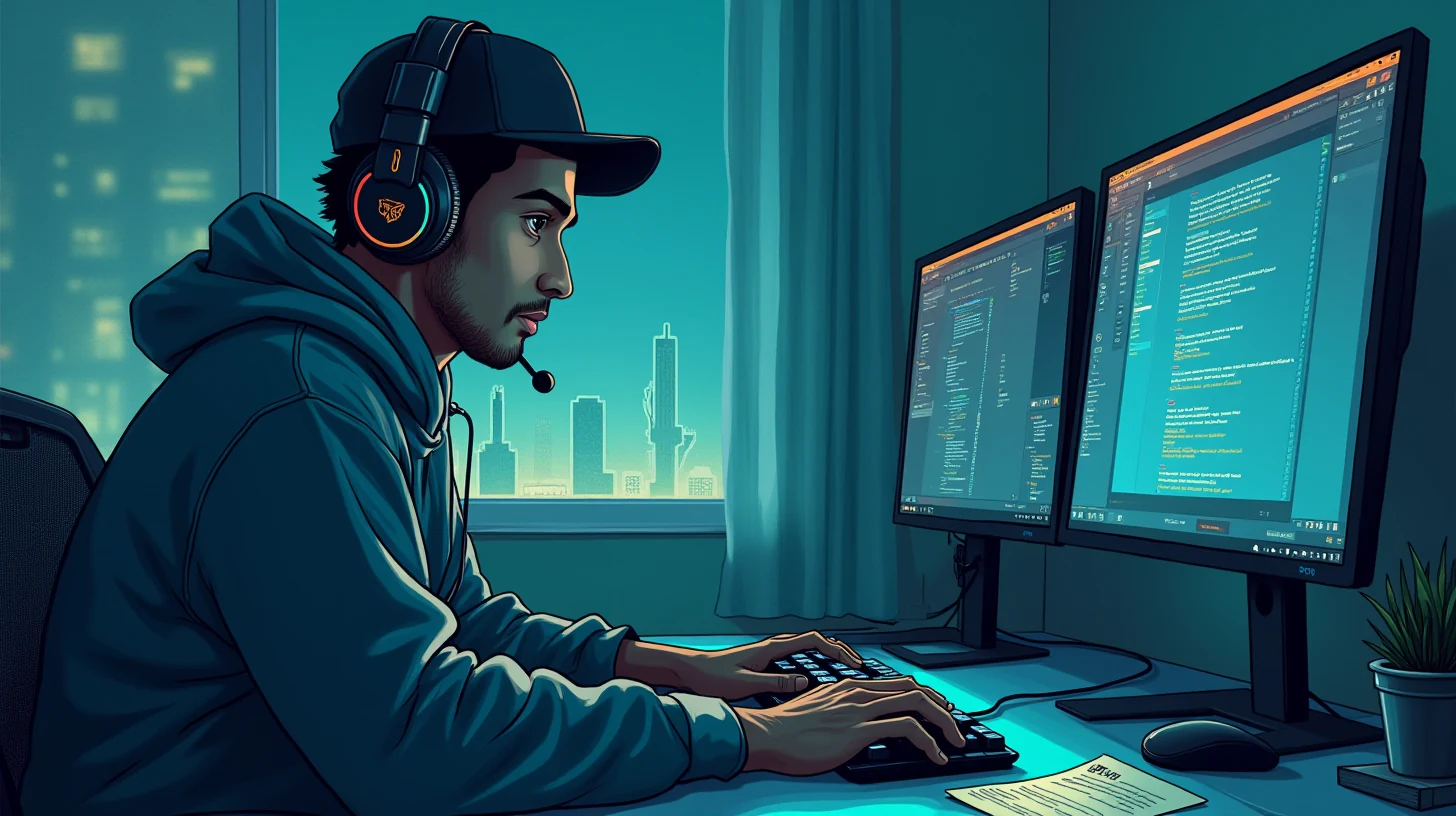
The setup occupies the smaller bedroom — the one that used to be a home office. Dual monitors on a steel-frame desk, an Elgato capture card, a Blue Yeti mic on a boom arm, Razer peripherals with RGB lighting that throws the back wall into a perpetual wash of shifting colour. A ring light sits folded in the corner, mostly unused because Arjun has learned that a desk LED strip at 4,000K, angled slightly off-axis, flatters the face better than a softbox and makes the background glow in the way his audience has come to expect. He streams nightly, starting between nine and ten pm, running four to six hours on BGMI and Valorant, with a weekly Sunday session that regularly hits eight hours and pulls his highest concurrent numbers. His YouTube subscriber count crossed 4.5 lakh in February. His Loco channel — where he cross-publishes the stream — has another eighty-five thousand followers.
His family knows little about the daily mechanics. They know there is a setup. They know there is an audience. They do not know that on a Thursday night in March, while the household slept two rooms away, Arjun sat at that desk for forty-seven minutes reading a letter from the Ministry of Information & Broadcasting that threatened, in the measured language of government notices, consequences sufficient to end everything he had built.
The letter came because of eleven minutes during a sponsored Razer India stream on February 8th.
🗓️ The annual ritual
The history of gaming regulation in India is the history of a government learning what it is dealing with, in real time, with all the characteristic delay of a regulatory apparatus confronting a fast-moving medium.
PUBG Mobile was banned in September 2020 under Section 69A of the Information Technology Act — the same blocking power that removes websites and apps — citing data privacy concerns and the risk of addiction, primarily to young users. The ban lasted just over eighteen months. Battlegrounds Mobile India (BGMI), the localised version with Indian data-hosting and additional age-gating features, launched in July 2021 and was itself suspended by Google and Apple in August 2022 after an Indian government review. It returned in May 2023, with stricter play-time limits for users under eighteen and a government-mandated real-name verification layer. The period between the two bans was long enough for a generation of BGMI streamers to build audiences, lose their primary game, pivot to Valorant and Free Fire, and then pivot back. Arjun's channel, which he started in 2021 at age nineteen, survived both disruptions.
What changed permanently was the regulatory framework. In April 2023, the Ministry of Electronics and Information Technology (MeitY) notified amendments to the IT Rules 2021, creating a new category: "Online Real Money Game" (ORMG), defined as any online game where a user deposits money with an expectation of winning money based on an outcome — including games of skill and games of chance, with differing regulatory consequences. Games classified purely as skill-based (fantasy sports, card games like rummy, esports tournaments under certain structures) are permitted but regulated: the operators must register with a MIB-notified Self-Regulatory Body (SRB), implement user verification, age-gate under-eighteens, and publish deposit-protection disclosures. Games classified as involving significant chance elements face stricter restrictions. In December 2023, the Ministry of Information & Broadcasting issued supplementary guidance making clear that content creators who promote ORMG content are also within scope — specifically, that streaming or sponsoring a segment that encourages users to deposit money in an ORMG platform triggers the same SRB verification requirement on the creator side.
By early 2026, three SRBs had received formal government notification: the E-Gaming Federation (EGF), the Federation of Indian Fantasy Sports (FIFS), and the All India Gaming Federation (AIGF). A fourth — the Online Rummy Federation — had applied but not yet received notification. Every ORMG operator streaming real-money gaming content through any channel was supposed to be registered with one of these three bodies before going live. The problem — and it is a structural problem that affects hundreds of creators, not just Arjun — is that the line between "promoting a registered ORMG platform" and "promoting an unregistered one" is invisible to the streamer, and the line between "skill-game sponsorship" and "ORMG content" is not always clear even to the lawyers.
- ⚖️
Sep 2020 / Aug 2022 — PUBG ban, then BGMI suspension
Section 69A blocks PUBG Mobile (Sep 2020). BGMI, its successor, launches Jul 2021 but is suspended again (Aug 2022) after government review. Returns May 2023 with age-gating and real-name verification. The regulatory pattern is set: government will move fast, on platforms and on content.
- 📨
Apr 2023 — MeitY ORMG rules notified
IT Rules 2021 amended to define Online Real Money Game. Operators must register with a government-notified SRB, implement user verification, and publish deposit-protection disclosures. Three SRBs receive notification: EGF, FIFS, and AIGF.
- 🛑
Dec 2023 — MIB guidance extends scope to streamers
MIB clarifies that content creators promoting ORMG platforms on live streams are within scope of the SRB verification requirement. Age-gating and deposit-protection disclosure obligations attach to the content, not just the platform.
- 📋
Feb 2026 — Arjun promotes a fantasy esports tournament
During a sponsored Razer India stream, Arjun reads out a brand partner segment promoting a fantasy esports tournament with cash prizes. The tournament operator is not SRB-registered. MIB sends a show-cause notice three weeks later.
⚠️ What very nearly happened
The February 8th stream was a standard Razer India integration — product placement, a gameplay session with the new Razer Huntsman keyboard, and a twenty-minute brand-deal segment in the third hour. Arjun had done forty or fifty of these; the format is familiar. Brand provides a script or a brief, he adapts it to his voice, he runs it live with his usual energy, audience recognises it as a sponsored segment, and life continues. The Razer brief that evening included, as a small addition, a promotion for a third-party "Fantasy Esports Tournament" running concurrently with a major BGMI championship — a cash-prize format where viewers could register, pick teams, and earn prize money if their selections performed well.
Arjun read the segment. He did it with the authenticity that has built his following: he explained the format, mentioned the prize pool (₹40 lakh distributed across three bracket levels), and included an on-screen overlay with the registration link for eleven minutes while he played. His producer had not flagged anything. Razer's Indian marketing team had not flagged anything. The third-party tournament operator had not mentioned anything about SRB registration status. The segment ran without incident. Stream ended at 2:11 a.m. Arjun went to bed.
The MIB letter arrived on March 3rd, addressed to Arjun by name, channelled through YouTube India's compliance team, with a copy sent to Razer India. The show-cause cited three failures: first, that the tournament operator was not registered with any of the three MIB-notified SRBs (EGF, FIFS, or AIGF) and therefore the promotion constituted endorsement of a non-compliant ORMG platform; second, that the stream had no age-gating mechanism to prevent under-eighteen viewers from accessing the promotion; third, that no deposit-protection disclosure — the mandated statement informing viewers of financial risk — had been made before the segment ran. MIB gave fourteen days to respond before initiating a Section 79 takedown request to YouTube and Loco for the February 8th VOD.
"यार, मैंने गेम बनाया — रेगुलेशन नहीं। किसी ने बताया ही नहीं कि ये तीसरे का टूर्नामेंट SRB में है या नहीं।"— I built the game — not the regulation. Nobody told me whether the third party's tournament was on the SRB list or not.
What very nearly happened was a channel strike on a five-year-old YouTube account with 4.5 lakh subscribers, a secondary Loco penalty for the cross-published VOD, a termination of the Razer India partnership (Razer's compliance manager reached out the same day MIB's letter arrived), and a potential personal liability under Section 79(3) — which removes the intermediary safe harbour for a creator who has actual knowledge of unlawful content and fails to act. That last clause is the one that matters. YouTube is the intermediary. Arjun is the content producer. The safe harbour that protects YouTube from liability for his content does not automatically extend to him; a promoter who endorses an unlawful ORMG platform with "actual knowledge" — which a show-cause notice provides — is exposed.
🌗 What changed
Razer India's compliance manager, a woman named Preeti Jha, called Arjun on the morning of March 4th. She had been on the gaming-brand regulatory beat for three years; she had seen this category of MIB notice before. She was matter-of-fact: Razer would not be terminating the partnership at this stage, but the February 8th integration would need to be addressed, and she was suggesting Arjun use an AI agent her team had been trialling for compliance queries. She sent him a link.
That evening, Arjun opened the agent on his laptop, typed the situation in rapid-fire Hindi, and uploaded the MIB letter as a PDF. The agent processed the fourteen-page document — show-cause, regulatory citation, fourteen-day response window, the specific provisions cited — and came back in Hindi:
"अर्जुन, MIB का नोटिस तीन अलग-अलग grounds पर है। पहला: जिस tournament का तुमने promote किया, वो EGF, FIFS, AIGF — तीनों में से किसी भी SRB में register नहीं था। MeitY की notified SRB list पर check करो — tournament operator का नाम नहीं है। दूसरा: IT Rules 2021 Rule 4A(5) के तहत, ORMG content stream करने से पहले age-gating mechanism और deposit-protection disclosure mandatory है। तुम्हारे Feb 8 stream में दोनों absent थे। तीसरा: Section 79(3) का exposure — अब notice मिल गया है, इसलिए 'actual knowledge' established है। 14 days के अंदर response draft करना होगा — और VOD को privately archive कर दो अभी, takedown से पहले।"
(Arjun, the MIB notice rests on three separate grounds. First: the tournament you promoted was not registered with any of the three notified SRBs — EGF, FIFS, or AIGF. Check the MeitY SRB registry — the tournament operator's name is absent. Second: under IT Rules 2021 Rule 4A(5), an age-gating mechanism and deposit-protection disclosure are mandatory before any ORMG content goes live. Both were absent from your February 8th stream. Third: the Section 79(3) exposure — now that a notice has arrived, "actual knowledge" is established. A response must be drafted within fourteen days — and archive the VOD privately right now, before any takedown.)
Arjun archived the VOD within the hour. He then asked the agent what a proper response looked like.
The agent walked him through the architecture of the defence: the response should establish that Arjun had no prior knowledge of the tournament operator's SRB registration status, that Razer India's brand brief had not disclosed this, and that on receiving actual notice (the MIB letter), he had immediately taken remedial action — archiving the VOD, notifying Razer and the tournament operator, and committing to a prospective compliance framework. The agent drafted a Hindi-English bilingual letter, cited Rule 4A and the MIB SRB notification timeline, and attached a three-point compliance commitment: mandatory SRB status verification before any ORMG brand partnership; age-gate overlay for any real-money gaming segment; deposit-protection disclosure script to be read verbatim before any such segment.
The agent also surfaced something Preeti had not mentioned: the tournament operator itself was potentially in violation of MeitY's ORMG registration requirement, which is separate from the MIB streaming compliance issue. If the operator was operating an ORMG without SRB registration, the MIB complaint was secondary to a MeitY enforcement action — and being the platform that publicised an unregistered ORMG without knowledge could be framed as a bona fide compliance failure rather than willful promotion.
Skill-based game (no real money)
No SRB check neededBGMI tournament streams, Valorant ranked matches, esports team sponsorships where no money deposit is involved. Standard creator-brand deal. No age-gating requirement specific to gaming rules, no deposit disclosure. The original Razer hardware integration falls here.
ORMG (SRB-registered platform)
3 mandatory disclosuresFantasy esports, online rummy, skill-based poker platforms registered with EGF, FIFS, or AIGF. Creator must: (1) verify operator's SRB registration status on MeitY's list, (2) enable an age-gating overlay for the segment, (3) read a deposit-protection disclosure before the segment begins. Then proceed.
ORMG (unregistered operator)
Do not promoteIf the operator cannot produce a current SRB registration certificate — and their name does not appear on MeitY's notified list — the segment must not run. Not with disclaimers, not with reduced screen time. The MIB show-cause, Section 79(3) exposure, and partner-contract risk all attach to promotion of an unregistered ORMG. Return the brief.
The response letter went to MIB's gaming-regulation cell on March 15th, one day before the deadline. Razer India co-signed a supporting letter confirming the brief had not included SRB disclosure. The tournament operator — reached through the brief's point of contact — confirmed they were in the SRB application process but had not yet received notification. MIB acknowledged the response in early April. As of May 2026, the show-cause had not escalated to a formal Section 69A or Section 79 action. The VOD remained archived. The channel was intact.
🧭 Why we built it
Arjun's situation is not unusual. It is the situation of every gaming streamer in India who has ever run a brand deal in the real-money gaming adjacency — fantasy sports, skill tournaments, cash-prize brackets — without checking the SRB registry. The registry is real, public, and updated: it is on MeitY's portal, it lists the three currently notified SRBs, and it is not difficult to search. The problem is that no one in the creator's immediate circle — not the brand, not the MCN, not the fellow streamer, not the parent — knows to check it, because the regulatory framework is eighteen months old, the compliance industry has not yet built the muscle memory, and the ORMG rules read like documents that belong to platform lawyers rather than the twenty-four-year-old with a ring light in DLF Phase 4.
The structural problem is the information gap between the regulatory document and the moment the creator reads the brand brief. The gap is not a matter of intelligence or negligence; it is a matter of translation. Rule 4A(5) of the Information Technology (Intermediary Guidelines and Digital Media Ethics Code) Amendment Rules 2023 is a dense piece of administrative text. It specifies, in legal prose, that a permissible online real-money game must not be promoted by any entity — including a social media creator — without verification of the operator's SRB status, an age-gating mechanism, and a deposit-protection disclosure. A creator reading that rule cold, in a gap between streams, on a Tuesday night, would not know how it applies to an eleven-minute segment during a Razer deal. The agent does.
What also tends to be invisible is the BGMI/PUBG history — the regulatory context that explains why the MIB moves quickly on gaming-adjacent content. BGMI's two suspensions established a precedent: the government will block a game with 130 million users if it perceives sufficient risk, and it will not require extended process to do so. The same instinct applies to creator-facing enforcement. The window between a show-cause and a Section 79 takedown request is fourteen days. A creator without a compliance framework in place before the notice arrives is already behind.
What it does
- 🔍Checks the MeitY SRB registry against the tournament operator's name before a brief is accepted — flags unregistered operators in real time, so the creator knows before going live, not fourteen days after.
- 🗂️Reads MIB show-cause notices in plain Hindi and English — identifies which specific rules are cited, what the fourteen-day response window requires, and what remedial actions carry the most weight with the regulator.
- 📞Drafts the bilingual response letter, attaches the correct regulatory citations, and surfaces the bona fide-compliance-failure framing — the argument that distinguishes a creator who did not know from one who chose not to check.
What it does not do
- 🔒Does not submit the response to MIB — every letter was reviewed and sent by Arjun, with Preeti's co-sign and the IP lawyer's final read. The agent drafts; the humans decide.
- 💳Does not guarantee the MIB outcome — compliance frameworks reduce risk, they do not eliminate it. The show-cause is still open as of May 2026.
- ✅Does not review every brand brief unprompted — Arjun pastes the brief into the agent before accepting; the verification is initiated by him, not autonomous.
The creator economy's regulatory environment in 2026 has reached the point where the compliance burden on mid-tier creators is genuinely non-trivial — Section 194R TDS, GST thresholds, FEMA for foreign brand payments, IT Rules 2021 grievance obligations, the SEBI finfluencer advisory for finance creators, and now the ORMG framework for gaming creators. Each of these is a separate regulatory layer, from a separate ministry, built on a separate act, with separate timelines and separate enforcement mechanisms. No one reads all of them. A compliance manager at a large brand reads some of them. A creator at 4.5 lakh subscribers reads none of them until a notice arrives.
The agent does not make creators compliant. It makes the knowledge of what compliance requires available at the moment when it is actually needed — when the brief is in the inbox, when the tournament segment is being scripted, when the MIB letter is on the desk at 3 a.m. and the channel has fourteen days.
🌱 What we hope happens
Preeti Jha sent a message in early May, shortly after MIB's acknowledgement came through. She said Arjun had been the most thorough about the compliance process of any creator she had worked with on a post-notice situation — and that the compliance framework they had drafted together was something she was now proposing Razer India use as a standard due-diligence checklist before any ORMG-adjacent integration, across all their creator partners. She added, briefly, that she hoped Arjun's parents had not been woken up by any of it.
They had not been. His mother knew the channel had been through "some compliance thing." His father had asked once, at dinner, if everything was sorted. Arjun had said yes. He had not been lying — by that point, the VOD was archived, the response was filed, the channel was clean, and the SRB verification step had been added permanently to his pre-integration checklist. The resolution was quiet and almost entirely invisible to the household.
What strikes us about Arjun's story is not the near-miss — it is the information structure around the near-miss. The rule that he should have checked existed. The registry he should have searched was public. The disclosure he should have made was specific and scriptable. None of it was hidden from him. It was simply located in a regulatory document that no one in his circle had read, and it arrived in his awareness via a Ministry notice at a moment when all it could do was become a response to be filed rather than a prevention to be practised.
The gaming creator community in India is building an audience the size of a mid-sized country — BGMI alone returned to 50 million monthly active users after its May 2023 comeback. The streamers who serve that audience are not media companies with legal departments; they are people like Arjun, in fourth-floor flats in DLF Phase 4, streaming until 2 a.m. while their families sleep. The ORMG rules are going to keep evolving — the SRB list will grow, the definition of ORMG will be contested in courts, the MIB's enforcement appetite will shift with the political weather. What will not change is the fourteen-day window and the need for someone, at eleven minutes into a brand segment, to have already checked the registry.
If you are a gaming creator in India — BGMI, Valorant, Free Fire, fantasy sports, esports — the agent is free at gabforge.in. It knows the MeitY SRB registry, the three currently notified bodies, the IT Rules 2021 amendment framework, and the specific disclosure requirements for ORMG content. It reads brand briefs in Hindi and English. It flags what you need to check before the stream, not after the notice. We will not sell your channel data. We will not advertise to your audience. We will be in the background when the brief arrives — quiet, quick, specific — so that the eleven-minute segment stays a sponsored integration and does not become a show-cause.