
The Guwahati pithe vlogger and the Northeast ₹10 lakh GST threshold
Priyanka Borah is twenty-nine years old. She lives in a ground-floor flat in Khanapara, on the southeastern edge of Guwahati — close enough to the ISBT bus terminal that she can hear the night buses from her kitchen at two in the morning, far enough from the city centre that the neighbourhood still has banana trees overhanging the lane and neighbours who leave mustard oil on each other's doorsteps during Bihu. She rents the flat with her younger sister Rina, who is studying nursing at GNRC Institute of Medical Sciences. Their mother comes from the village in Nalbari every six weeks and brings dried fish, black sesame, and the particular pressure of a woman watching her eldest daughter run a business she does not entirely understand.
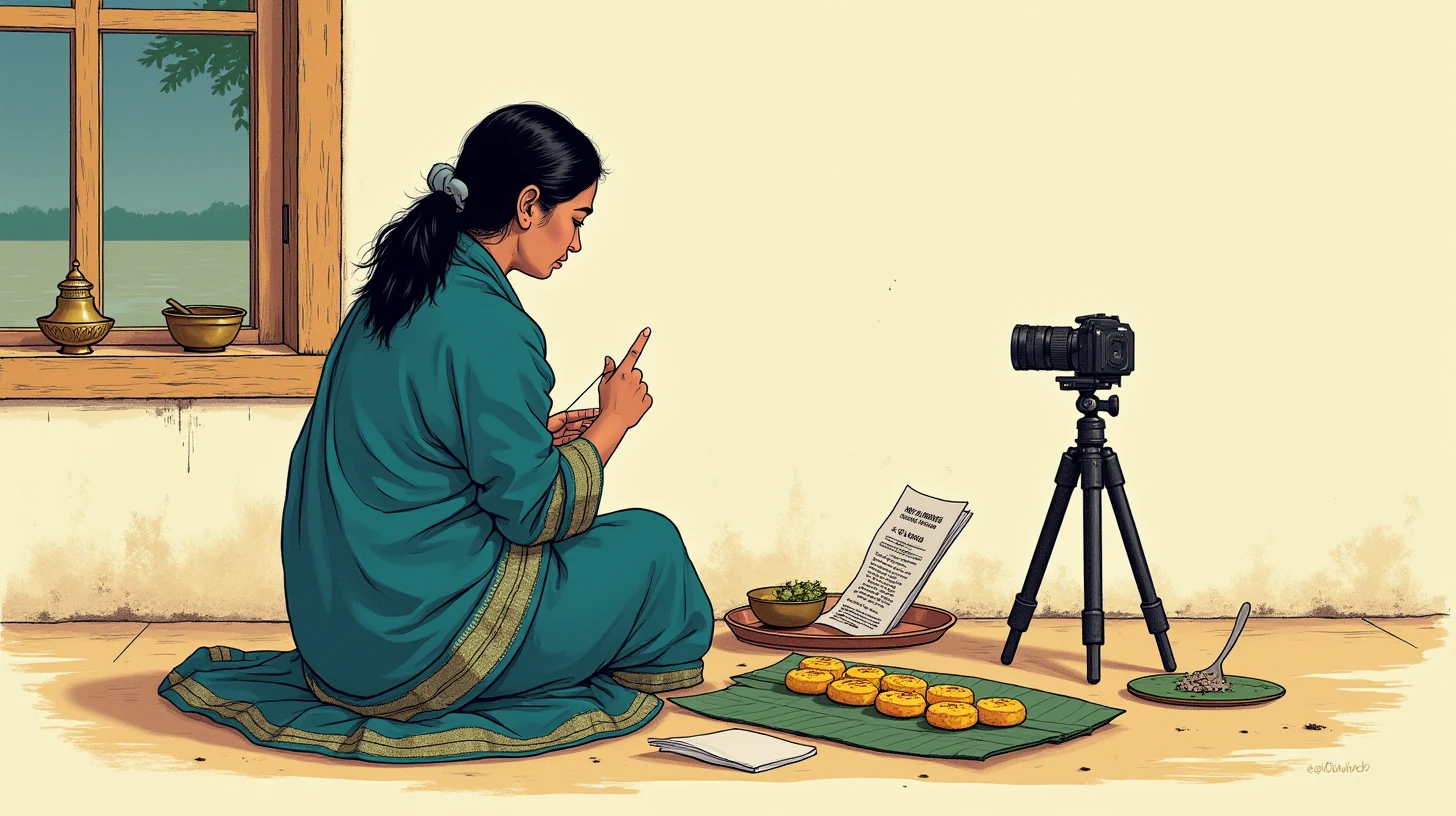
Priyanka started her YouTube channel, Priyanka'r Rannaghar, in late 2021, filming Assamese traditional sweets on a borrowed DSLR and editing on her laptop at the kitchen table. The channel grew slowly for eighteen months and then, in the winter of 2022, a nine-minute video on ghila pitha — the rice-flour fritters fried in a shallow brass pan with jaggery — crossed four lakh views in a week. She has not looked backward since. By May 2026 she has 195,000 subscribers on YouTube and 80,000 on Instagram, a festival-prep series that runs every year from two weeks before Bihu through the last day of the celebrations, and a sideline in paid pithe-making sessions — two-hour workshops at ₹1,500 per head, held in her kitchen for groups of six to ten, usually working women from Beltola and Hatigaon who grew up eating their grandmothers' pithas but never learned to make them.
She earns money in four directions: YouTube creator fund credits, brand collabs (cooking oil brands, organic jaggery suppliers, a Guwahati-based steel utensil company), affiliate links for brass cookware on an Assam handicrafts marketplace, and the workshop fees. In FY 2024-25, combined income was ₹8.6 lakh — comfortable, below every threshold she had vaguely heard about, not a number she had thought to worry over. In FY 2025-26 it moved differently. The Bihu series in April 2025 ran for three weeks and brought a brand collaboration with an organic sesame oil brand at ₹2.2 lakh — her single largest brand deal. The workshops sold out through October. The YouTube numbers climbed. By late January 2026, her aggregate turnover for the financial year had crossed ₹13.5 lakh.
The show-cause notice from the SGST Range Office, Guwahati, arrived on a Thursday morning in February, slid under her door by the postman at eight-fifteen while she was frying the first batch of til pitha for a workshop that afternoon.
🗓️ The threshold nobody told her about
Section 22 of the Central Goods and Services Tax Act, 2017 makes every supplier whose aggregate turnover in a financial year exceeds the prescribed threshold liable for GST registration — from the date of crossing, not from the next financial year or the next quarter. The general threshold is ₹20 lakh. But the Act, via a notification under Section 22(1), sets a lower threshold of ₹10 lakh for what it calls "special-category states" — a list drawn from Article 279A(4)(g) of the Constitution.
That list has eleven members. Creators, freelancers, and small-business owners operating in any of them cross the registration threshold at half the number — and most of them do not know the list exists.
What it does
- ⚖️Arunachal Pradesh — ₹10 lakh aggregate turnover threshold for GST registration.
- ⚖️Assam — ₹10 lakh threshold. Covers all eight districts including Guwahati (Kamrup Metro).
- ⚖️Manipur, Meghalaya, Mizoram, Nagaland, Sikkim, Tripura — ₹10 lakh each.
- ⚖️Himachal Pradesh, Uttarakhand, Jammu & Kashmir (post-370 reorganisation) — ₹10 lakh each.
What it does not do
- ₹All other states and union territories — ₹20 lakh threshold for service providers (₹40 lakh for goods-only suppliers).
- 📋Composition scheme threshold also differs: ₹50 lakh (special-category) vs ₹1.5 crore (general), making it unavailable to most creators at any realistic income level.
- 🔒The threshold applies to aggregate turnover: all taxable + exempt + export supplies counted together. For creators: brand fees + ad revenue + workshop income + affiliate commissions — combined, not each separately.
For a creator in Hyderabad, Pune, or Lucknow, the ₹20 lakh threshold is a comfortable buffer — most mid-tier creators cross it in their third or fourth year, with enough warning to find a CA and file. For a creator in Assam, Manipur, or Meghalaya, the ceiling is half that, and the window is narrower. The creator economy in these states has grown at the same rate as the rest of India — food vloggers, travel creators, regional-language educators, handloom and craft influencers — without the accompanying awareness that the GST compliance trigger fires earlier.
Priyanka had heard of GST. She knew it existed. She had not heard that Assam was a special-category state for GST purposes, that the threshold was ₹10 lakh rather than ₹20 lakh, or that "aggregate turnover" included the fair value of services rendered — not merely cash received in her savings account. She had been paid partly in kind by the steel utensil brand: three brass karahi sets valued at ₹18,000 in total, given as props for a video series. She did not know this counted.
- ₹
Apr–Sep 2025 — ₹7.8 lakh: Bihu series + sesame oil brand deal
The April Bihu series brought ₹2.2 lakh from the sesame oil brand collab. YouTube creator fund and affiliate payouts added ₹1.9 lakh. Workshop income — twelve sessions at ₹1,500 per head, six to eight attendees each — contributed ₹1.3 lakh. Brass karahi barter (₹18,000 fair value) added to the tally. By end of September: ₹7.8 lakh cumulative.
- ⚠️
Oct 2025 — Aggregate turnover crosses ₹10 lakh: registration obligation attaches
The October YouTube payout, combined with two workshop sessions, pushed aggregate turnover past ₹10 lakh. Under Section 22 of the CGST Act, registration liability attached from this date. Priyanka did not know. No brand, no CA, no platform alert informed her.
- 📨
Feb 2026 — SGST Range Office show-cause notice
Notice issued under Section 122 of the CGST Act — unregistered person making taxable supplies. Initial penalty demand: ₹1.35 lakh. Notice also flagged retrospective GST liability on outward supplies from the date of crossing, plus interest at 18% per annum on the tax due. Total exposure at that point: substantially above ₹2 lakh.
- 📋
Mar 2026 — Registration filed, returns pending, compounding application in process
GST registration obtained. Retrospective GSTR-1 and GSTR-3B returns being filed for the period. Application for penalty compounding under Section 128 in progress. The ₹1.35 lakh initial penalty and interest remain under negotiation before the Range Officer.
⚠️ What very nearly happened
The notice was four pages. Priyanka read the first page twice, understood approximately a third of it, and put it face-down on the kitchen table. She knew what SGST meant — she had seen the abbreviation on restaurant bills. She did not know what Section 122 referred to, or what "outward supplies" meant in a legal notice, or what 18% interest on a tax base she had not known she owed looked like when someone ran the numbers. She texted her friend Madhurima, who does bookkeeping for a pharmacy in Beltola, and asked if she had a CA she trusted. Madhurima sent a name and a number. The CA called back the following week and quoted a retainer that was larger than Priyanka's March workshop income.
She cancelled the next two workshop sessions. She did not know if she was allowed to keep accepting money while a GST notice was active. She did not know if the brands she had billed in November and December were now liable for anything on her behalf. She did not know if the notice meant she had committed a crime. It was the uncertainty, not the penalty figure, that was worst: the sense of having accidentally walked into a legal structure she could not map.
"মই জানিছিলোঁ যে GST আছে। মই জনা নাছিলোঁ যে অসমত threshold ১০ লাখ — মোৰ বাবে ২০ লাখ নহয়।"— I knew GST existed. I did not know that in Assam the threshold is ₹10 lakh — not ₹20 lakh for me.
What very nearly happened was what happens to most creators who receive a tax notice without a CA in their contact list: the notice sits, the deadline passes, the penalty compounds, and the interest — 18% per annum on the retrospective tax due, running from the date of crossing to the date of registration — grows past the point where a single workshop session covers it. The SGST Range Office issues a final order. The creator is liable for the full penalty plus arrears. The YouTube channel continues; the compliance gap does not resolve itself.
The figure Priyanka was looking at, if she waited sixty more days and filed nothing, was not ₹1.35 lakh. It was closer to ₹2.4 lakh after interest, plus the cost of the eventual CA who would file the returns under pressure — and whoever she hired would charge premium rates for a notice-response engagement. She did not know any of this. The notice did not explain it in terms a first-generation creator could follow.
🌗 What changed
Priyanka's mother's elder sister — Mohalata Borah — lives in Shillong, Meghalaya, where she has been married to a civil contractor for thirty-one years. Her son Bikash is a chartered accountant in Shillong, handling GST and income-tax compliance for a mix of Northeast construction companies and small traders. Priyanka knew Bikash Deka as the cousin who was serious about accounting and slightly boring at family gatherings. In March, her mother called from Nalbari and mentioned, with the indirectness Assamese mothers use for unpleasant subjects, that Bikash knew about GST and that perhaps Priyanka should call him.
Bikash called first. He asked her to photograph the notice and send it on WhatsApp. He called back within two hours: the notice was genuine, the liability was real, and the timeline was pressing — she had a response window of thirty days from the notice date, of which fourteen had already elapsed. He would help her file the registration and draft a preliminary response, but he needed her to get her turnover details together: exact payout amounts from each source, dates of receipt, fair-market value of any barter. He said she should also install the agent on her phone, set it to Assamese, and use it to cross-check the numbers before sending them to him — he trusted his own calculations, but he had found it useful for the specific question of which transactions counted toward aggregate turnover and which did not.
She installed it that evening and typed, in Assamese, the question that had been sitting unasked for two weeks:
"মোৰ মোট turnover ১৩.৫ লাখ — কিন্তু মই workshop fee cash পাইছিলোঁ, invoice নাছিল। সেইটো count হয় নে?" — My total turnover is ₹13.5 lakh — but I received workshop fees in cash, with no invoice. Does that count?
"প্ৰিয়ংকা, হয় — Section 2(6) CGST Act-ৰ মতে aggregate turnover-ত সকলো taxable supply অন্তৰ্ভুক্ত হয়, তাত invoice নথকা cash receipt-ও পৰে। Workshop সেৱা ₹1,500/head — এইটো taxable supply। বার্টাৰ (brass karahi, fair value ₹18,000) — এইটোও count হয়। GST পোৰ্টেলৰ (services.gst.gov.in) Aggregate Turnover calculator-ত তোমাৰ সকলো source দিলে exact figure ওলাব। Bikash-এ কৈছে সেইটোৰ basis-ত Section 128-ৰ অধীনত penalty compounding application দিব পাৰি — এইটো range officer-ৰ সন্মুখত কৰিব পাৰি।"
(Priyanka, yes — under Section 2(6) of the CGST Act, aggregate turnover includes all taxable supplies, including cash receipts without invoice. Your workshop service at ₹1,500 per head is a taxable supply. The barter — brass karahi, fair value ₹18,000 — counts too. If you enter all your sources into the Aggregate Turnover calculator on the GST portal at services.gst.gov.in, the exact figure will appear. As Bikash mentioned, on that basis a penalty compounding application under Section 128 can be filed before the Range Officer.)
She read it twice and then read it once more in English because the Assamese legal terms — aggregate turnover, taxable supply, compounding — were easier to hold in English the first time. She sent the exchange to Bikash. He replied: "Good. This is exactly right. Get the calculator output and send it to me."
"ইয়াৰ উপৰিও — MSME Udyam Registration (msme.gov.in) কৰাটো এতিয়াই কৰা। ই penalty mitigation argument-ক সহায় কৰিব পাৰে Range Officer-ৰ সন্মুখত, আৰু Northeast-ৰ MSME credit scheme-ৰ বাবেও qualify কৰিব। ১৫ মিনিট লাগে।"
(Additionally — do the MSME Udyam Registration on msme.gov.in right now. It can support the penalty mitigation argument before the Range Officer, and you'll also qualify for Northeast MSME credit schemes. It takes fifteen minutes.)
She filed the Udyam registration that night. Bikash submitted the GST registration on her behalf the following Monday. The retrospective returns — GSTR-1 and GSTR-3B for October 2025 through February 2026 — are being filed in stages. The penalty compounding application under Section 128 is before the Guwahati Range Officer; the hearing is scheduled for June.
🧭 Why we built it
Priyanka's situation is not exceptional. It is the normal situation for every creator who builds a following in Assam, Meghalaya, Manipur, Mizoram, Nagaland, Arunachal Pradesh, Tripura, Sikkim, Himachal Pradesh, Uttarakhand, or Jammu and Kashmir — and crosses ₹10 lakh in aggregate annual income before anyone explains that the threshold is half what it is elsewhere.
The creator economy in Northeast India is real, growing, and structurally underserved by GST awareness. Assamese food creators, Nagaland travel vloggers, Manipuri handloom educators, Meghalaya nature channels — these are not peripheral niches. They command hyper-local audiences with high engagement, attract regional CPG brands, and generate meaningful income in states where formal employment is scarce and remote work is the only reliable economy for young graduates. The SGST machinery — Guwahati Range Office, Shillong Range Office, Imphal — issues Section 122 notices; the creators receive them without context and sit with them for weeks because the CA ecosystem in tier-2 Northeast cities is thin, expensive, and primarily oriented toward construction and trading companies that have been GST-registered since 2017.
The bureaucratic structure is not malicious. The special-category state threshold exists to account for smaller economies; the penalty is codified to encourage compliance; the compounding route under Section 128 exists precisely so that first-time defaulters who register voluntarily can negotiate the fine rather than paying it in full. But none of this is visible to a twenty-nine-year-old sitting at her kitchen table with a show-cause notice she cannot parse, whose accountant cousin lives in another state, and whose knowledge of GST begins and ends with the percentage on restaurant bills.
Section 22 — Registration obligation
Trigger: crossing ₹10LRegistration liability attaches from the date aggregate turnover crosses the threshold — not from the end of the financial year, not from the date of the notice. Retrospective returns must cover the entire period from crossing to registration. The sooner the creator registers voluntarily after realising the obligation, the shorter the retrospective gap and the lower the interest accrual.
Section 122 — Penalty for unregistered supply
₹10,000 or 10% of tax, whichever higherSection 122(1) imposes a penalty on any taxable person who supplies goods or services without being registered as required. For Priyanka, the initial demand was ₹1.35 lakh — approximately 10% of the estimated tax due on her retrospective supplies. Interest at 18% per annum under Section 50 runs separately on the tax itself from the date of obligation.
Section 128 — Compounding of offences
Negotiate, not fightThe Commissioner of SGST may compound an offence under Section 128 on payment of a compounding amount determined by the Range Officer. For first-time defaulters who register voluntarily, present their books transparently, and file returns without further delay, compounding typically results in a penalty substantially lower than the headline demand. Udyam registration and a clean subsequent compliance record both support the application.
The agent did not resolve Priyanka's notice. Bikash did — by showing up, filing the applications, and taking the Range Office hearing in June. What the agent did was compress three weeks of uncertainty into one evening of specific answers. It told her which transactions counted, where to find the calculator, what Section 128 meant in practical terms, and what to file in what order — so that when she spoke to Bikash the next morning she was not translating a notice she did not understand, but confirming a plan she had already sketched.
🌱 What we hope happens
Bikash sent a voice note in early April. He said Priyanka had filed the Udyam registration the same night he suggested it, which he had not expected, and that she had come to their first call with the GST portal calculator output already printed and highlighted in yellow and green. He said most of his clients took two weeks to do what she did in three hours, and that the penalty compounding application was, as a result, significantly stronger than it would have been otherwise.
Priyanka resumed the workshops in late March. She has filed for the June hearing. She is not certain about the final penalty figure — the Range Officer's discretion under Section 128 is genuine discretion, not a formula — but Bikash is not worried, and she trusts Bikash.
What she has now that she did not have in February is not a CA on retainer — she still cannot afford Bikash full-time and he operates out of Shillong anyway. What she has is a working map. She knows that aggregate turnover counts all four income streams. She knows that the GST portal's calculator is free and takes ten minutes. She knows that brand collaboration payments, YouTube payouts, workshop fees, and barter fair values are not separate categories that each need to individually cross a threshold — they are one number, cumulative, running from April 1st. She knows that if it crosses ₹10 lakh again this year — and it will, because FY 2026-27 is running ahead of last year — she will file the return herself before anyone sends her a notice.
The Northeast's creator economy is younger, smaller, and less advised than the creator ecosystems of Mumbai or Bengaluru. It runs on exactly the same tax law, at half the threshold, with a fraction of the CA density per creator. A Guwahati food vlogger, a Shillong indie musician, a Kohima travel creator, a Gangtok organic-farming channel — all of them are working inside the same special-category state structure. Most of them do not know the list of eleven states exists.
If you are a creator in Assam, or anywhere on that list, and your income across all channels is approaching ₹8 lakh for the year — the threshold is ₹10 lakh, it includes barter, and the liability attaches from the date you cross it. The agent is free at gabforge.in. It runs in Assamese, Bengali, Mizo, Manipuri, and eight other languages. It knows the threshold list and it knows the calculator. You do not need to wait for a show-cause notice to understand what you owe. You can find out now, before the envelope arrives.
Which is the only thing, on reflection, that Priyanka would have wanted in October — when the aggregate turnover ticked past ₹10 lakh and the registration obligation attached, quietly, three months before anyone told her.