
The Kohima Hornbill festival creator and the Inner Line Permit collab
Neisenuo Yhome is twenty-eight years old and lives in Kohima Village, in the old ward above Kohima town, where the lanes run uphill past morung-style wooden gateposts and the houses have views of both the Naga Hills and, on a clear December morning, the distant ridges toward Manipur. She grew up in Kohima but her mother's family is from a village near Touphema, two hours north on the Assam-Nagaland highway, which is why she moves easily between Tenyidie (Angami) and Nagamese and considers Kohima-town a staging ground rather than an identity. She has 145,000 followers on Instagram and 95,000 on YouTube. She posts in English, occasionally in Nagamese, and describes her work plainly: Hornbill Festival coverage, Naga tribal stories, traditional textile reels — chakhesang shawls, lotha weaves, the mithun-horn motifs on Rengma cloth. Her reels consistently reach viewers who have never heard of Nagaland and find themselves watching a young woman at a village morung explain the social function of warrior markings, unhurried and unpatronising.
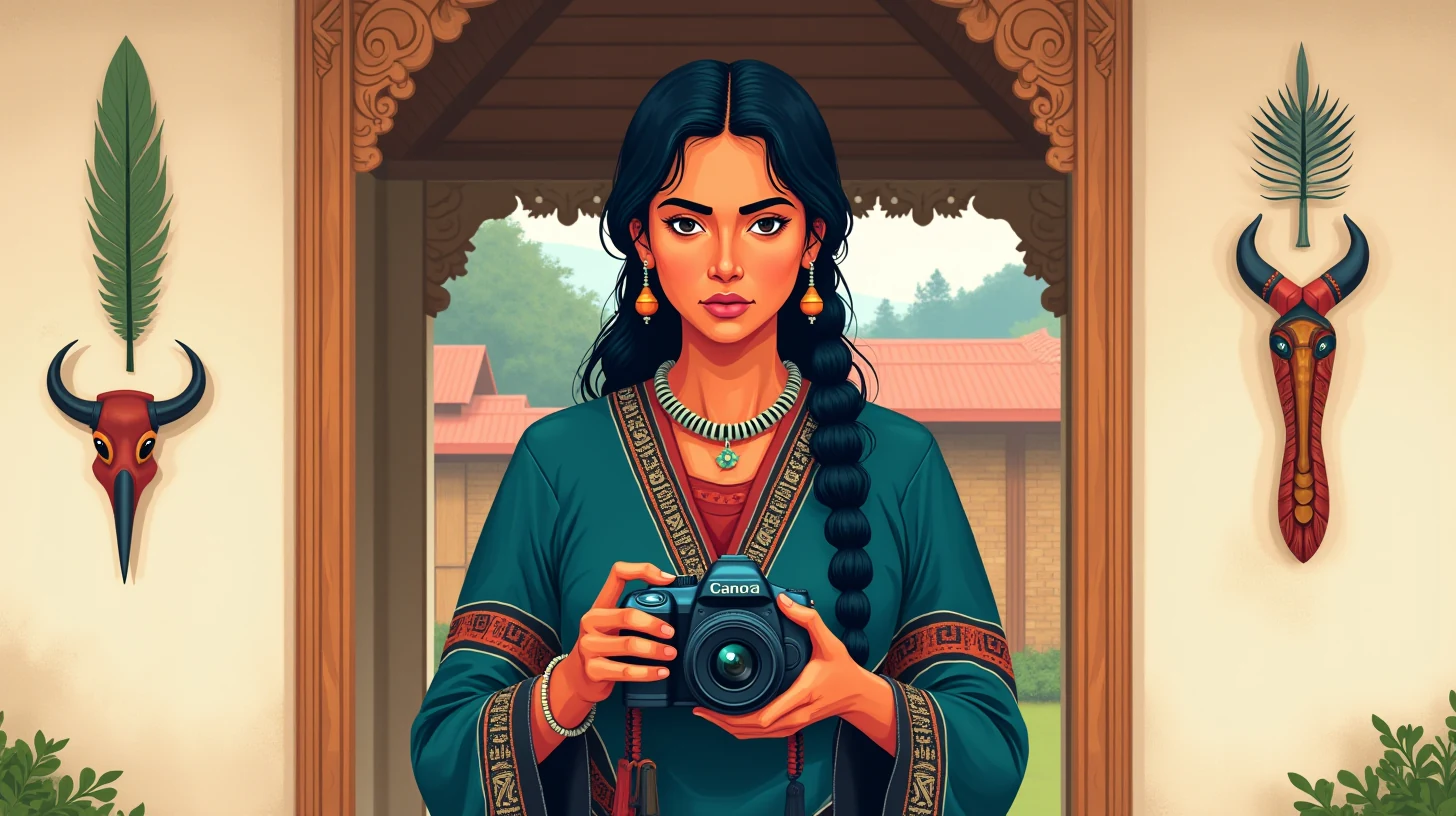
She is not a journalist, though she is sometimes mistaken for one. She is, specifically, a creator who grew up in this landscape and finds it underrepresented in a creator economy dominated by Delhi-Mumbai food and fashion content. Her monetisation is brand-collab heavy: three or four partnerships a year with travel brands, camera companies, and Northeast-focused tourism initiatives. The Hornbill Festival, which runs the first ten days of December at Kisama Heritage Village, fourteen kilometres from Kohima, is her annual centrepiece — the one event that brings international attention to Nagaland in a concentrated window, and the one event that Neisenuo has covered every year since she was twenty-three.
For the 2025 Hornbill Festival, she had arranged something different. A German travel creator, Marcus, with 280,000 YouTube subscribers and a reputation for Northeast India content, had agreed to a collab shoot: two days at Kisama Heritage Village, one day at Khonoma village (the first declared green village in Nagaland), and a final day shooting traditional weaving at Neisenuo's mother's village near Touphema. The collab would produce two videos — one on each channel — and would be pitched to a European travel media partnership as a showcase of Nagaland's cultural tourism. Marcus had arrived in Guwahati on December 1st, taken the overnight bus to Dimapur, and reached Kohima on the morning of December 2nd. He had a valid Indian tourist visa. He did not have an Inner Line Permit.
On December 3rd, the second day of the Hornbill Festival, Nagaland Police stopped the shoot at Kisama Heritage Village at 9:47 in the morning. Neisenuo's DSLR was confiscated. The SD card with two and a half hours of festival footage was held as evidence. The compounding fee — the administrative fine for the ILP violation — was ₹10,000. Marcus was given forty-eight hours to regularise his status or leave the state. The village council of Kisama had not been approached for tribal-land filming approval. That was a second, separate problem, and it came up before they had solved the first.
🗓️ The annual ritual
The Inner Line Permit system governing Nagaland has its legislative roots in the Bengal Eastern Frontier Regulation 1873 — a colonial-era statute designed to regulate British subjects entering territories along the northeastern frontier, originally to stop British traders from encroaching on tribal lands. The irony — that a colonial instrument of containment now serves as a tribal protective framework in sovereign India — is not lost on Naga commentators, and it is not lost on Neisenuo either.
What the Regulation established, and what Nagaland maintains through its own ILP framework, is a simple requirement: anyone who is not a permanent resident of Nagaland must obtain an Inner Line Permit before entering. Indian citizens apply online at nagaland.gov.in, or in person at ILP counters in Dimapur, Kohima, and the Nagaland Bhavans in Delhi, Kolkata, and Guwahati. For foreign nationals, the framework is more layered. A tourist visa does not substitute for an ILP. Foreign nationals require, separately, a Protected Area Permit (PAP) from the Ministry of Home Affairs Foreigners Division in addition to the state ILP endorsement. Most international creators researching India check that their visa covers Nagaland as Indian territory and proceed. The PAP requirement is not prominently flagged in general visa guidance. It is, however, enforced — and the Nagaland Police enforces it.
- ⚖️
Step 1 — India Tourist Visa (Embassy / VFS Global)
The foreign national obtains a standard Indian tourist visa from the Indian Embassy or consulate in their home country. This permits entry into India. It does not, by itself, permit entry into Nagaland, Arunachal Pradesh, or Mizoram — the three Inner Line Permit states.
- 📋
Step 2 — Protected Area Permit (MHA Foreigners Division)
Foreign nationals must additionally obtain a Protected Area Permit from India's Ministry of Home Affairs. This is applied for separately — in person at MHA's Foreigners Division in New Delhi, or through the Indian Embassy abroad in some cases. Processing time: 2–5 working days. The PAP specifies districts permitted.
- 📨
Step 3 — State ILP Endorsement (Nagaland Home Department)
On arrival at Dimapur (rail-head) or the Nagaland border check-posts, the foreign national registers their PAP with the State ILP counter and receives a Nagaland ILP endorsement. Both documents must be carried at all times. Hotel check-ins at Kohima and Kisama record both.
- 📋
Step 4 — Commercial / Filming Permit (Nagaland Tourism)
Any commercial shoot — brand content, monetised YouTube, sponsored travel content — requires a separate filming clearance from the Nagaland Tourism Department via nagatourism.gov.in, independent of the ILP. For Hornbill Festival shoots, this clearance should be obtained before December 1st. Village-council approval (separate again) must be arranged through the respective village council.
The Naga Village Council authority is a second and distinct layer. Tribal land in Nagaland is governed by customary law. Kisama Heritage Village, while purpose-built in 2003 for the Hornbill Festival, sits in the jurisdiction of the Kisama Village Council. Filming on tribal land — at a heritage site, a morung, or a working village — requires the council's explicit permission. This is not a tourism bureaucracy requirement. It is a customary-law instrument rooted in Naga communities' inherited governance authority over their land and the cultural imagery produced on it. A shoot crew without council approval can expect to be stopped. It is not a technicality. It is a principle.
Neisenuo knew the village council requirement. She had always approached the Kisama Village Council herself, through a family connection, for her own shoots. What she had not done, for the 2025 collab, was verify that Marcus's presence — as a foreign national, with commercial shoot footage intended for an internationally monetised YouTube channel — created a different category of engagement than her own. She had assumed the council permission she always carried covered the collaboration. It covered her. It did not cover a foreign commercial shooter.
⚠️ What very nearly happened
The confiscated DSLR was Neisenuo's own Nikon Z6 II, with a 24-70mm f/2.8 S and a 70-200mm f/2.8 S — roughly ₹3.8 lakh in equipment. The SD card held two and a half hours of Hornbill Festival footage: tribal warrior dances from the opening ceremony, a full Chakhesang tribe performance, fire-pit cooking at the Poumai Naga pavilion, and an extended interview with a master weaver from the Lotha tribe about the significance of the shawl patterns. None of it was the collab footage — Marcus had been setting up his own camera during the performances. The confiscated SD card was Neisenuo's editorial footage, the backbone of her annual Hornbill reel.
The ₹10,000 compounding fee was, financially, manageable. The reputational exposure was not. By 9:53 a.m. — six minutes after the police stopped the shoot — Neisenuo had received four WhatsApp messages from other creators at Kisama who had seen the police stop. By noon, a Nagaland-based news site had a brief item: "German creator detained at Kisama, ILP violation." It did not name Neisenuo, but the Kohima creator community is small enough that by 2 p.m. she had received eleven messages asking if she was the one involved. She had not posted anything. Her absence from the festival — visible to anyone checking her Instagram Story history — was its own announcement.
Marcus was in a separate bind. Without regularised ILP status, he could not return to the festival venue. His return flight from Guwahati was on December 9th. He had come eight thousand kilometres for a collab shoot. He had six days and a problem he had not known existed when he booked the ticket.
"Nu puo sei nu lo tenie — kevi zu chükie, chü küme asei."— Do not blame the river for flowing — learn its course before you cross.
What very nearly happened was the complete loss of the SD card footage. The police station held it as evidence of the ILP violation — not because the footage itself was illegal, but because it documented filming activity on tribal land without the proper clearances in place. If the case had escalated to a formal FIR rather than a compounding, the footage could have remained impounded for months, through a legal process that nobody in the situation had the resources or appetite for. The ₹10,000 compounding fee resolved the ILP violation; it did not automatically return the SD card. That required a separate letter from the Kisama Village Council — an acknowledgment that they had now retroactively received and approved Neisenuo's shoot request, that the footage was cultural documentation by a resident Nagaland creator, and that the council had no objection to its return. Without a direct line to the council, that letter could have taken days. She did not, on the morning of December 3rd, have a direct line.
🌗 What changed
The call came at 1:17 p.m., while Neisenuo was sitting at a table outside a tea stall near the Kohima town market, with her phone charging off a power bank and Marcus across from her reading every website he could find about PAP applications. The caller was her village elder's nephew — Kevitho, twenty-six, who works as an administrative assistant at the Nagaland Tourism Department in Kohima. She had known him since he was twelve, when he used to fetch water at her mother's house during her school vacations. He had seen the news item. He had already made two calls.
He arrived at the tea stall at 2:05 p.m., in a government ID lanyard over a blue check shirt, carrying a paper printout that turned out to be the Nagaland Tourism Department's commercial filming clearance application — pre-stamped with the current window, annotated in his handwriting. He sat down across from Neisenuo and Marcus, switched between Nagamese and English without noticing, and began.
"Ekheni ase — cha government-side bhi connected hain. ILP side mein, compounding fee paid hona chahiye, jo hua. Ab Marcus-ji ko PAP chahiye — Dimapur mein MHA Foreigners counter hai, same-day processing ho sakta hai agar kal subah pahuncho. Filming permit Nagaland Tourism se chahiye — main yeh form abhi dal sakta hoon, 24 ghante mein clear hoga. Village council letter Kisama Council se chahiye — main Zehevi uncle ko call karunga, woh sarpanch ke office mein hain. Shaam tak letter milega agar abhi baat karun."
(Alright — we are connected on the government side. On the ILP side, the compounding fee has been paid — that is done. Marcus needs a PAP next — there is an MHA Foreigners counter in Dimapur, same-day processing is possible if you arrive tomorrow morning. The filming permit from Nagaland Tourism is needed — I can submit this form right now, clearance will come in 24 hours. The village council letter from Kisama is also needed — I will call uncle Zehevi, he is at the sarpanch office. If I call now, the letter will come by evening.)
Neisenuo had not installed the agent before Kevitho called. She installed it at the tea stall while Marcus was writing down the Dimapur bus schedule. She opened it, typed in Nagamese — slowly, because she uses Nagamese less at the keyboard than she speaks it — and asked it to confirm whether a compounding fee settlement ended the formal ILP violation, or whether a separate FIR process could still be initiated.
"ILP violation under Bengal Eastern Frontier Regulation 1873 — compounding fee payment generally closes the administrative action at the sub-divisional level. It does not automatically trigger FIR unless the enforcing authority chose to register a separate criminal complaint before accepting the compounding. You should request written confirmation from the issuing authority that the compounding settlement has been accepted and the case is closed. This protects both you and your collaborator if the matter is raised again. The Nagaland state portal at nagaland.gov.in has the current schedule of compounding fees for Regulation violations — verify that ₹10,000 matches the applicable fee tier for first-time foreign-national violations. If it does not match, the acceptance may be informal rather than formal."
Neisenuo passed the phone to Kevitho. He read it, nodded once, and said — in Nagamese, to her — that he would get the written confirmation. He knew the officer. He would visit the station in the morning.
The SD card came back at 6:44 p.m. that evening. Zehevi, the Kisama sarpanch contact, had issued the council letter through Kevitho in two hours. The police station accepted it, attached it to the compounding record, and released the card. Two and a half hours of Hornbill footage, intact.
Marcus reached Dimapur the next morning at 8:15. The MHA Foreigners counter processed the PAP documentation by noon — three working hours, because Kevitho had sent ahead a covering note from the Tourism Department flagging the case as an ongoing cultural collaboration with a Nagaland resident creator. By December 5th, with the filming permit issued by Nagaland Tourism, Marcus had two legally clear days at Kisama before his departure on the 9th. The collab footage — three tribal performances, the Lotha weaving interview, the December 7th morung fire — was shot with all clearances in place.
Inner Line Permit (ILP)
State Home Dept — nagaland.gov.inRequired for any non-resident entering Nagaland — Indian or foreign. For foreign nationals, the ILP is typically issued as an endorsement alongside the MHA Protected Area Permit. Apply before travel; available at Nagaland Bhavans in Delhi, Kolkata, Guwahati, or the Dimapur ILP counter.
Protected Area Permit (PAP)
MHA Foreigners Division — mha.gov.inExclusive requirement for foreign nationals entering restricted/protected area states. Applied for at MHA's Foreigners Division, New Delhi, or through the Indian Embassy at the destination country. The Indian tourist visa does not substitute for this. Same-day Dimapur processing exists but is informal — do not plan around it.
Commercial Filming Permit
Nagaland Tourism — nagatourism.gov.inRequired for any footage intended for monetised or brand-sponsored use — YouTube, Instagram reels with paid partnerships, sponsored travel content. Separate from ILP and PAP. Village council approval for tribal-land scenes is an additional, separate instrument — it must be arranged directly with the relevant council.
🧭 Why we built it
Neisenuo is not an edge case. She is a template for the fastest-growing segment of Indian creator culture: regional and indigenous-culture creators from states with regulatory frameworks that mainstream creator-economy advice — GST, ITR-3, Section 194R, platform terms of service — does not address at all. A creator in Mumbai who brings a foreign collab guest has no ILP system to navigate. A creator in Kohima does. A creator in Arunachal Pradesh does. A creator in Mizoram does. The three Inner Line Permit states represent some of the richest cultural creation in India — and they operate on a legal infrastructure that no YouTube video about "creator compliance" has ever discussed.
The ₹10,000 compounding fee is a recoverable number. The SD card footage is not, if the case escalates. The Kisama Village Council's goodwill is not, if it is bypassed without correction. Neisenuo had covered seventeen villages across Nagaland without a council problem, because she grew up navigating this landscape. She had assumed that navigation was transferable to a foreign collaborator. It was not.
Every Northeast creator who brings an international collaborator faces this exposure — and every international creator who books Nagaland, Arunachal, or Mizoram on a standard tourist visa faces it without knowing it exists. The ILP requirement is not buried law. It is enforced law, at the Dimapur check-post, at the Kisama festival venue, at the Arunachal border crossing. A valid tourist visa and a DSLR at a cultural festival is not sufficient clearance. That combination has, at multiple points, ended in confiscation.
The agent does not navigate the village council. It does not have Kevitho's number or know Zehevi. What it does is verify the statutory basis — confirm the compounding settlement is complete, that the PAP is distinct from the ILP, that the filming permit is a third and separate instrument — so that when Kevitho arrives at the tea stall, Neisenuo is working from verification rather than confusion.
🌱 What we hope happens
In mid-January, Neisenuo published the Hornbill 2025 reel. It reached 1.2 million accounts in the first four days — her largest reel to date. Marcus's collab video, published the same week on his channel, brought 34,000 new subscribers to his Nagaland coverage. The European travel media partnership they had planned came through: a four-part collaborative feature on Naga cultural preservation, with commissioning fees that covered her camera equipment insurance for two years.
She sent a message to Kevitho with a voucher for the Nagaland Hornbill ticketed heritage dinner — the one held on December 7th inside the chief minister's pandal, for which tickets are not easy to come by. He replied in Nagamese that he had been to it twice already, but thank you. His uncle Zehevi had not, he added. She sent a second voucher.
What we hope happens is less visible than a 1.2-million reel. It is the next Naga creator — the twenty-three-year-old from Wokha who is building an Ao-tribe weaving channel, the twenty-six-year-old from Mokokchung who posts Ao warrior dance content, the photographer in Tuensang who has started getting international collab requests for Hornbill 2026 coverage — opening the agent before they book the tickets. Asking what permits their collaborator needs. Getting the list: PAP from MHA, ILP endorsement from state, filming permit from Nagaland Tourism, village council approval from the relevant council. Understanding that each is separate, each has a timeline, and none of them is automatically covered by an Indian tourist visa.
The Inner Line Permit was designed to protect Naga land, Naga communities, and the customary governance structures that Naga society has maintained through colonialism, state-integration negotiations, and five decades of political complexity. It is not an obstacle. It is a framework — one that creators operating from this landscape are best placed to navigate, if they know it exists before the police arrive at 9:47 in the morning.
The agent cannot give them Kevitho. But it can give them the thirty minutes of verified statutory reading that makes the difference between confusion and a working question.