
The Patna Bhojpuri creator and the IPRS licensing strike
Anjali Mishra is twenty-seven years old. She lives in Kankarbagh — the quiet residential inner side of Patna, where the lanes are wide enough for two autos to pass and every third building has a tuition centre on the ground floor. Her flat is on the third floor: four rooms, her parents, a younger brother in Class Twelve, and a practice room that used to be the spare bedroom. The mirror came from her maternal uncle's shop near Boring Road; she installed it herself one Saturday. The practice room has orange floral curtains that the afternoon sun turns gold, which is why every reel she has ever posted has the same warm quality of light — not a ring light, just the right window at the right hour.
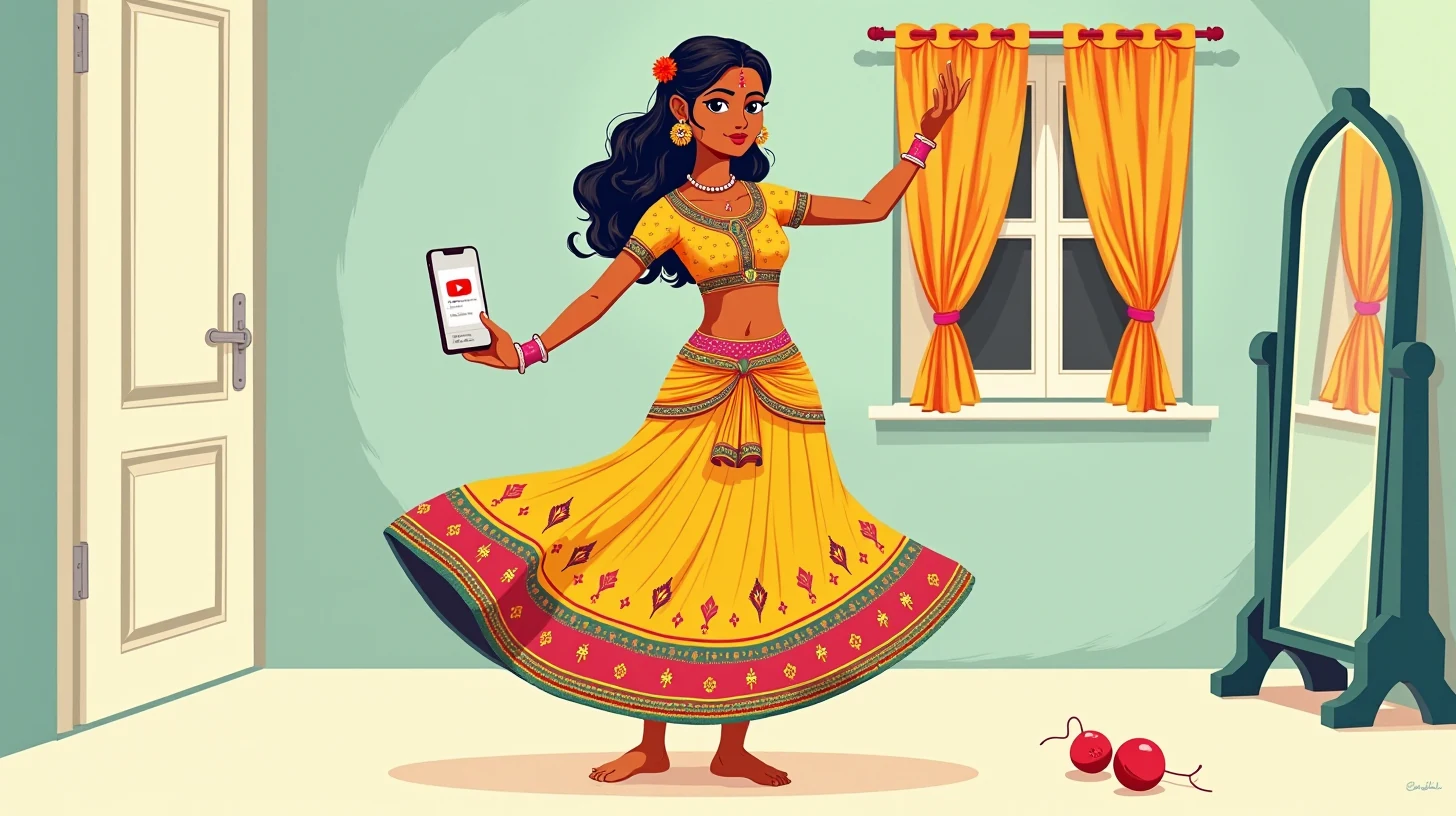
Pooja Singh is also twenty-seven, also from Patna, and lives eleven minutes away by scooty in Rajendra Nagar. They met at a Navratri garba circle in 2019 and have choreographed Bhojpuri wedding-song covers together ever since — first for friends' mehendi nights, then for a cousin's wedding video that got four thousand shares in Bhojpur district alone, then for the account that now has seven lakh Instagram followers and three lakh twenty thousand on YouTube Shorts. Anjali handles the camera, the edit, the caption. Pooja is the one who can execute a full thumka sequence in a two-by-three-metre space without stepping on the ghungroo.
Their income, when everything worked, came from brand collaborations with lehenga stores, beauty brands, and wedding-planning services (eight to twelve collabs a month at ₹18,000 to ₹45,000 per post), YouTube Shorts ad revenue of roughly ₹22,000 a month at peak, and commission from a dupatta-and-jewellery resale platform they photographed for. Total monthly: ₹1.1 to ₹1.8 lakh, depending on the quarter. For two young women operating out of Patna — not Mumbai, not Delhi — this was four years of consistent, specific, regional creative work that no one else in Bhojpuri digital content was doing quite the same way.
The notice arrived in a brown envelope via registered post on a Tuesday morning in March 2026, addressed to Anjali by name, with the IPRS letterhead in red at the top and a demand for ₹85,000 in backdated performance royalties under Section 33A of the Copyright Act 1957.
🗓️ The annual ritual
The Bhojpuri music economy runs on two parallel rights mechanisms that most creators never hear about until a letter arrives. T-Series Bhojpuri, Wave Music, and Zee Music Bhojpuri hold master-recording rights to the majority of commercially successful Bhojpuri wedding catalogues. On YouTube, those rights are enforced through Content ID: if a creator uploads a video using an original studio track, the audio is fingerprinted, and the ad revenue is redirected to the label rather than a strike being issued. Most creators interpret this as a lower CPM, not as a rights-holder claim running in the background.
Alongside the master-recording right sits a separate right in the underlying musical composition — the melody and lyrics of the song — administered in India by IPRS (Indian Performing Right Society). A creator who records their own dance cover, using the original studio audio, is triggering both: the PPL claim on the master recording and the IPRS claim on the composition. Most creators assume there is one kind of licence. There are two, from two different bodies, billed at two different tariff schedules.
- 📱
Content ID match — monetisation transfer
YouTube's automated system detects the fingerprinted audio in the uploaded video. The rights holder receives the ad revenue. The video stays live. No strike is issued. This is the default behaviour for most T-Series Bhojpuri catalogue content.
- ⚠️
Manual copyright claim — video-level restriction
The rights holder manually reviews the video and files a copyright claim outside of Content ID. The video may be blocked in specific countries or globally. No strike yet — but monetisation is fully blocked and visibility drops.
- 🛑
Copyright strike — channel-level warning
A formal copyright takedown notice under DMCA / YouTube's Copyright Policy. The video is removed. One strike: 90-day warning period, features restricted. Three strikes: channel terminated. Strikes expire after 90 days if no new strikes are received.
- ⚖️
Channel termination + legal notice
If a channel receives three strikes within 90 days, YouTube terminates it and all content is deleted. Rights holders may additionally pursue civil or criminal copyright infringement complaints independently of the platform action.
Anjali had been using original studio recordings — downloaded from streaming platforms and used as audio in her dance reels — for three years. For most of that time, YouTube's Content ID redirected her ad revenue to T-Series and Wave Music rather than issuing strikes. It had looked like a lower CPM, not an ongoing rights-holder claim. In late January 2026, T-Series Bhojpuri filed a commercial-use complaint separately from Content ID, asserting that Anjali's account was a monetised commercial operation using their masters without a PPL licence. Three manual strikes followed within thirty-one days: a bridal sangeet choreography to Piya Ghar Aaihen (4.2 lakh views), a mehendi reel to Aaihein Babul Ka Angna (2.9 lakh views), and a bridal-dance tutorial to Tohar Dulha Hau (1.8 lakh views). The third strike arrived February 12th. YouTube demonetised the channel that afternoon.
⚠️ What very nearly happened
The ₹85,000 was not arbitrary. The IPRS Tariff Schedule specifies rates for "background music in user-generated content monetised on digital platforms." Three quarters of backdated liability — April 2025 through February 2026 — came to ₹75,000 at the tariff rate applied to Anjali's declared gross revenue, plus a ₹10,000 administrative charge. The letter stated that failure to pay within thirty days and submit a Statement of Use would result in referral under Section 63 of the Copyright Act — a criminal provision. Wilful copyright infringement carries six months to three years' imprisonment and a fine of ₹50,000 to ₹2 lakh.
"हम गाना बजाइनी थे, नाचे — सोचनी ही नाहीं रहे कि कागज लागी।"— We played the song, we danced — it never crossed our minds that paperwork was involved.
Pooja found out via a voice note that evening and did not type back for a long while. Two lehenga brands had paused their March payment pending the channel's monetisation status. A Lucknow wedding-planning agency that had been about to sign a three-month ambassador deal had not replied to the last three WhatsApp messages. Combined income that month: heading toward ₹28,000, down from ₹1.3 lakh the month before.
What very nearly happened was a default on the demand — not from stubbornness but from the paralysis of having no framework for understanding whether ₹85,000 was the final number or the opening bid, whether paying it would stop the criminal referral, and whether the channel — four hundred and twelve videos, seven lakh followers — was recoverable at all. Neither Anjali nor Pooja had a lawyer. Their accountant, Pooja's uncle on Boring Road, handled their ITR-4 filings and said plainly on the phone that copyright was outside his scope.
🌗 What changed
Aman Mishra is twenty-five years old, Anjali's first cousin, a junior advocate at a civil-and-commercial chamber on Boring Road, Patna. He passed the Bihar State Bar Council examination in 2024. He does not specialise in intellectual property. But he had read enough of the Copyright Act to know that a Section 33A demand is not the same as a criminal complaint, and that the distinction mattered very much.
He came to Anjali's flat on the Sunday after the IPRS letter arrived. He sat at the dining table with the letter, a printout of the YouTube strike notifications, and his phone, and he installed the AI agent on Anjali's laptop.
He typed in Hindi, asking whether the IPRS demand was legally valid and what to do first.
"Aman bhai, teen cheezein abhi zaroori hain: YouTube ke strikes ka 90-din ke andar appeal karein; IPRS ko Statement of Use submit karein — mandatory hai, na dene se Section 63 ka risk hai; aur IPRS ke published Tariff Schedule se ₹85,000 ka calculation verify karein."
(Aman bhai, three things immediately: appeal the YouTube strikes within the 90-day window; submit the Statement of Use to IPRS — mandatory, and not submitting raises the Section 63 risk; and verify the ₹85,000 calculation against IPRS's published Tariff Schedule.)
Aman asked the agent to retrieve the Tariff Schedule.
The applicable rate was 20% of the channel's net ad revenue — not gross, as IPRS had applied. Anjali's YouTube revenue statements showed ₹2.84 lakh gross over three quarters; net of YouTube's 45% platform cut, the IPRS-attributable base was approximately ₹1.56 lakh. Twenty percent of ₹1.56 lakh: ₹31,200. Not ₹75,000.
"Aman bhai, IPRS ne gross par calculation ki hai — published tariff net revenue (platform deduction ke baad) par applicable hai. Revised calculation ₹31,200 honi chahiye, plus administrative charge. Demand ₹41,200 se zyada hai. Formal dispute letter bhejein IPRS ke registered email par, YouTube revenue statements ke saath, aur 30-din ki extension maangein."
(Aman bhai, IPRS calculated on gross revenue — the published tariff applies to net after the platform deduction. The revised calculation is ₹31,200 plus the administrative charge. The demand is overstated by ₹41,200. Send a formal dispute letter to IPRS's registered email with the revenue statements, and request a 30-day extension.)
IPRS demand — ₹85,000
Revised to ₹41,200IPRS calculated on gross ad revenue. Published tariff applies to net revenue after YouTube's 45% platform cut. Agent surfaced the calculation error from the IPRS Tariff Schedule. Written dispute submitted with revenue statements attached.
Three YouTube copyright strikes
One reversed on appealAgent identified that Strike 1 (the *Piya Ghar Aaihen* reel) was a manual claim filed outside Content ID — appealable within 90 days on the basis that the video had already been demonetised via Content ID before the manual strike was filed. YouTube reversed that strike.
PPL India licence — missing
₹12,000/year going forwardAgent identified the PPL India Online Creator Licence for channels earning under ₹5 lakh annually — a flat-rate licence covering the master-recording right for uploaded content. Annual cost: ₹12,000. Applicable retroactively from the current licence year, not backdated three years.
Aman filed the IPRS written dispute, attaching YouTube revenue statements and the Tariff Schedule, citing the net-revenue basis. He submitted the Statement of Use — all videos using IPRS-registered compositions, dates and view counts from YouTube Studio — within the thirty-day window. Anjali appealed Strike 1 through YouTube's copyright centre: the appeal cited the original Content ID claim date, four months before the manual strike, as duplicative enforcement. YouTube reversed Strike 1 eleven days later.
With one strike reversed, the channel was out of the three-strike terminal zone. The remaining two would expire within ninety days. IPRS placed the demand on review and extended the response period by sixty days. The PPL India licence was purchased for ₹12,000, valid from April 2026.
🧭 Why we built it
There are, by reasonable estimate, forty to sixty thousand active Bhojpuri-language content creators on YouTube and Instagram in Bihar, Uttar Pradesh, and the diaspora. The large majority operate the way Anjali did: they download the studio recording, choreograph to it, post it. They have never heard of PPL India. They encounter IPRS, if at all, as fine print in a Terms of Service they agreed to at account creation and have not re-read since.
The complexity is structural. Content ID is a rights-holder tool, not a creator tool — it tells the creator nothing about what they owe, to whom, or at what rate. IPRS's Tariff Schedule is a public document but forty-seven pages long. The distinction between the composition right (IPRS) and the master-recording right (PPL) is not instinctively obvious; most creators assume one licence from one institution covers everything. The agent does not give legal advice. What it did was surface the Tariff Schedule, calculate the net-versus-gross discrepancy, identify the strike-reversal window, and name the PPL Online Creator Licence — four facts from public documents across three institutions, retrieved in three minutes.
What it does
- 🔍Retrieved the IPRS Tariff Schedule for digital platforms and identified that the ₹85,000 demand used gross revenue rather than the net-revenue basis the tariff specifies.
- 🗂️Cross-referenced the date of the Content ID claim with the date of the manual copyright strike, identifying the ground for Strike 1's appeal.
- 📋Identified the PPL India Online Creator Licence — a flat-rate annual licence for small-scale digital creators — which Anjali had not known existed.
What it does not do
- ⚖️Did not provide legal advice on whether to settle the IPRS demand or contest it — Aman made that decision and drafted the dispute letter.
- 🔒Never submitted the Statement of Use, filed the YouTube appeal, or signed any document — every submission was made by Anjali or Aman explicitly, after reviewing the content.
- ✅Did not assess whether any of Anjali's videos qualified as fair dealing under Section 52 of the Copyright Act — that analysis requires legal judgment the agent named as out of scope.
Every regional-music creator posting dance covers to original studio recordings carries a version of this liability and does not know what it looks like until a registered envelope arrives. The Tariff Schedule is public. The licence exists. The appeal window is documented. None of it is hidden. All of it is inaccessible at the moment it matters.
🌱 What we hope happens
In late April 2026, IPRS issued a revised demand of ₹41,500 — net-revenue calculation plus the administrative charge. Anjali paid it. The two remaining YouTube strikes aged out on May 3rd. The channel was re-monetised on May 5th.
Pooja sent a voice note that morning — in Bhojpuri, because that is the language they use when something actually matters — which said, roughly: it came back. Anjali was mid-shoot for a lehenga collab. She paused, listened, went back to the ring light.
The account now runs a PPL India licence and an IPRS annual licence. Total annual cost: ₹30,000. Not ₹85,000 in backdated demand. Not a criminal section. Not a terminated channel. ₹30,000 per year and the right to use Bhojpuri wedding music professionally, with paperwork in place.
Aman told us later that what surprised him was not the complexity but the availability. The Tariff Schedule, the appeal procedure, the PPL licence product page — all on the public internet. The problem was not that the information was hidden. It was that three separate institutions held three separate pieces of what felt, from Kankarbagh, like a single emergency.
If you use original studio recordings in your dance covers and have not heard of IPRS or PPL India — the agent is available free at gabforge.in. We support Hindi, Bhojpuri, Bengali, Tamil, Telugu, Kannada, Marathi, Odia, Gujarati, and Punjabi. We read the Tariff Schedule with you, find the licence, check the appeal deadline, and name the discrepancy. Then you — or your cousin the junior lawyer — decide what to do next. We will be quiet about the rest.