
The Port Blair scuba creator and the CRZ Andaman tourism permit
Arnav Ghosh is thirty years old. He lives on the first floor of a lime-washed building near Aberdeen Bazaar in Port Blair — the building his grandfather, who came from Midnapore district in 1973 as part of the Bengal settler resettlement scheme, bought with thirty years of savings from the fisheries cooperative. The flat smells of salt and drying neoprene. Three wetsuits hang on the balcony railing above a view of the Aberdeen Bazaar lane, which at six in the morning carries fish vendors and at six in the evening carries tourists who have discovered that the best sunset in Port Blair is not from Cellular Jail but from the roof of an old Bengali family's building if you know someone. Arnav's grandmother still lives on the ground floor. She calls him by his childhood nickname, Biku.
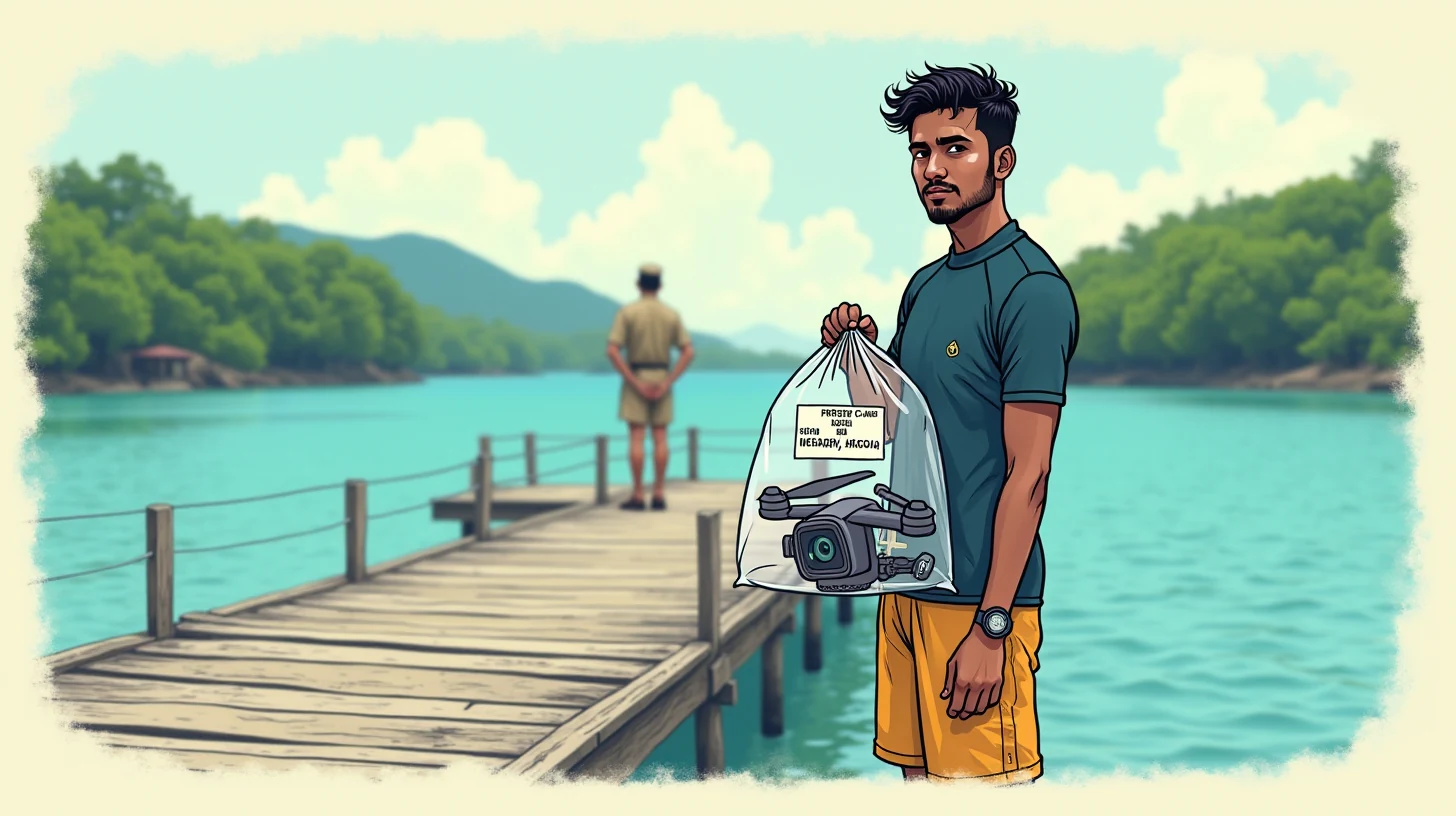
He has been diving since he was fourteen, when a cousin took him out on a glass-bottom boat off Corbyn's Cove and he paid a resort dive master ₹400 to borrow a mask and fins. He got his PADI Open Water certification at twenty-one, his Advanced Open Water at twenty-three, and his Divemaster at twenty-six. Since twenty-seven he has been doing what the Andaman dive industry calls a "water rat" life: guiding tourist dives through one of the registered operators at Havelock, moonlighting on his own channel where he films coral structures and pelagic fish life with a GoPro Hero 12 and, for topside and aerial transition shots, a DJI Mavic 3. His YouTube channel, Arnav Dives Deep, has 140,000 subscribers. His Instagram has 65,000. He earns roughly ₹60,000 a month from YouTube ad revenue and brand collaborations — Decathlon dive gear, reef-safe sunscreen brands, one recurring deal with a liveaboard dive operator that covers three trips a year.
The work is real: his coral-health series, documenting the bleaching events of 2023 and the partial recovery at Lighthouse Beach on Havelock by 2025, is cited in the comments by dive researchers from Delhi and Singapore. He replies to every one. He has never thought of himself as an activist, but the comment sections of his videos run long on people who write things like bhaisaab ek baar coral bleaching ka data share karo — roughly, share the bleaching data once, brother — and he does, linking to the Zoological Survey of India reports he reads on his phone during the ferry ride between Havelock and Neil Island.
What happened last November on the Havelock jetty at Govind Nagar took forty-five seconds and changed the arithmetic of the next six months of his life.
🗓️ The regulation that was always there
The Coastal Regulation Zone Notification 2019, issued by the Ministry of Environment, Forest and Climate Change under the Environment Protection Act 1986, divides India's coastline into four zone classifications. CRZ-I covers ecologically sensitive areas — mangroves, coral reefs, wetlands, and areas within the high tide line. CRZ-II covers developed land along the coastline, CRZ-III covers rural and undeveloped coastal areas, and CRZ-IV covers the island territories. For the Andaman and Nicobar Islands, CRZ-IV applies to the island chain itself; however, the islands are also designated as ecologically sensitive under MoEFCC Notification S.O. 2492(E) 2011, and the surrounding marine protected areas — including the Mahatma Gandhi Marine National Park adjacent to Wandoor and the waters around Havelock and Neil Island — carry additional CRZ-IA restrictions equivalent to the most protected mainland classification.
What this means in practice for a creator filming underwater on Havelock: any commercial filming activity within the CRZ requires prior environmental clearance from MoEFCC or its delegated authority, plus a commercial-shoot permit from the Andaman Tourism Department, plus — critically — a filming permit from the ANI Forest Department if the footage involves protected species. Corals listed under the Wildlife Protection Act 1972 Schedule I (Phylum Cnidaria, including the staghorn corals, brain corals, and pillar corals that Arnav had been filming for three years) are legally equivalent to tigers and elephants. Filming them for commercial purposes without a research permit from the Chief Wildlife Warden of Andaman and Nicobar Islands is an offence under Section 9 of WPA 1972 — "hunting," which the Act defines broadly enough to include harassment, disturbance, and photographing for commercial gain.
Green sea turtles (Chelonia mydas) and hawksbill turtles (Eretmochelys imbricata) are Schedule I animals. Arnav had three videos on his channel — totalling 4.1 lakh cumulative views — where turtles appear prominently while he narrates their feeding behaviour. He had filmed them legally in the sense that he was in the water with a mask and camera. He had filmed them illegally in the sense that he had no permit.
- ⚖️
CRZ Notification 2019 — prior clearance for commercial activity
Any commercial filming within Coastal Regulation Zone areas — including the waters off Havelock (Swaraj Dweep) and Neil Island (Shaheed Dweep) — requires MoEFCC CRZ clearance. The Parivesh portal (parivesh.nic.in) is the single-window submission point. Clearance must precede filming, not follow it.
- 📋
Andaman Tourism Dept — commercial-shoot permit + fee
The Andaman & Nicobar Islands Tourism Department requires a commercial-shoot permit for any photography or video production — including individual YouTubers — intended for monetised distribution. The permit fee schedule distinguishes between feature film, documentary, web series, and digital-creator categories. No permit = no commercial footage.
- 🔒
WPA 1972 Schedule I — corals and turtles are protected species
Schedule I of the Wildlife Protection Act 1972 includes all coral species (Phylum Cnidaria) and both sea-turtle species common around Havelock — Chelonia mydas (green turtle) and Eretmochelys imbricata (hawksbill). Commercial filming of Schedule I species requires a specific research and filming permit from the Chief Wildlife Warden, ANI. Filming without it is an offence under Section 9, punishable under Section 51 (minimum 3 years imprisonment, or ₹25,000 fine, on first conviction).
- ₹
Nov 2025 — seizure and notice
Forest officer at Havelock jetty checked Arnav's equipment bag. GoPro and DJI Mavic footage card seized pending verification. CRZ violation notice registered on Parivesh. Andaman Tourism commercial-shoot fee demand of ₹38,000 (retrospective, three years of commercial use). WLPA Schedule I investigation opened. Total exposure: ₹68,000 in fines and fees, plus potential prosecution.
Arnav had known, in a vague way, that "permits" existed. He had seen the photography permit signs at the entrance to Mahatma Gandhi Marine National Park at Wandoor. He had applied for — and paid for — day-entry permits to Radhanagar Beach through the registered dive operator he guided for. He had understood the permit structure the way a motorcycle rider understands lane discipline: as something that exists, is technically required, and is navigated with practiced inattention on roads where nobody is checking.
On Havelock, nobody had ever checked.
⚠️ What very nearly happened
The forest officer's name was Mr. Suresh Biswas, and he was from the ANI Forest Department, not the Tourism Department — a distinction that would become important later. He was not conducting a targeted inspection. He had been detailed to the Havelock jetty as part of a quarterly compliance drive that the ANI Forest Department runs in November and March, when tourist season peaks and equipment bags become large and obvious. He had asked Arnav, politely and in Hindi, what the equipment was for. Arnav had answered honestly: YouTube, he said. 140,000 subscribers, he said. Underwater coral footage, he said.
Mr. Biswas had then asked to see the commercial-shoot permit from the Tourism Department and the filming clearance from the Forest Department for Schedule I species. Arnav had said — and this is where the forty-five seconds began — that he did not have them. He had thought, he said, that he was a tourist with a camera. Mr. Biswas had been patient. He said, carefully, that a tourist with a camera had 140,000 subscribers and a brand collaboration disclosed in his Instagram bio with a dive gear company. That was not a tourist. That was a commercial operator.
The GoPro and the DJI Mavic were placed in a labeled Forest Department evidence bag. Mr. Biswas gave Arnav a receipt and a notice to appear at the Divisional Forest Officer's office in Port Blair within seven days.
"সমুদ্রের তলায় কতটা গভীরে যাওয়া যায় সেটা জানতাম — কিন্তু আইনের কতটা গভীরে আমি ডুবে গিয়েছিলাম সেটা জানতাম না।"— I knew how deep I could go underwater — but I did not know how deep I had gone into the law.
The three turtle videos — 4.1 lakh cumulative views, monetised, with ad revenue credited to Arnav's Google AdSense — were the element that worried him most. Under Section 51 of WPA 1972, a first-conviction offence involving Schedule I animals carries a mandatory minimum sentence of three years. The DFO's office would need to determine whether his turtle footage constituted "hunting" as defined in Section 2(16) of the Act — which includes "disturbing" protected animals. His dive logs showed he had maintained distance. The footage itself showed the turtles going about their feeding without apparent disruption. But the legal burden of demonstrating that was his, not the Forest Department's.
The Andaman Tourism commercial-shoot fee demand was ₹38,000, calculated retrospectively across the three years of active monetised content. The CRZ violation notice carried a potential fine of ₹5,000 per day of non-compliance or ₹1 lakh per violation, whichever was higher — though first-time individual violations without environmental damage typically resolve at the lower end. The ANI Forest Department's permit-fee demand for the footage already taken was ₹25,000.
Total exposure: ₹68,000 in fines and dues, with a separate criminal investigation file under WLPA open and pending DFO determination.
He did not tell his grandmother. He put the evidence-bag receipt in the drawer where he keeps his dive certification cards and spent two days not opening the YouTube analytics tab.
🌗 What changed
Rudra Mandal runs a marine conservation NGO called Khutnai Reef Watch out of Diglipur, in North Andaman, where the strait narrows toward Myanmar and the reefs at Smith and Ross Islands are among the least-disturbed in the Indian Ocean. Rudra is thirty-three, Tamil-origin — his grandmother came from Nagapattinam in the first-wave settlement — and he has been dealing with ANI Forest Department permit compliance for five years because every coral-monitoring expedition Khutnai Reef Watch runs requires a Schedule I research permit. He knows the DFO's office. He knows which forms go to which desk.
Arnav and Rudra had met on a dive at Lighthouse Beach two years earlier and had stayed in loose touch, the way Andaman dive community people do — occasionally exchanging messages about current conditions, bleaching reports, the arrival and departure of whale sharks at Cinque Island. When Arnav sent Rudra a voice note on WhatsApp explaining the situation, Rudra replied in forty minutes with a link to a GabFORGE agent that he had been using for the NGO's grant compliance paperwork.
"ভাই, এটা try কর। আমি এই agent দিয়ে আমাদের MoEFCC research permit application করেছিলাম — Parivesh portal এর পুরো workflow step by step জানে। তোর case টা complicated কারণ তিনটা আলাদা notice — CRZ, Tourism আর WLPA। কিন্তু এই agent সব তিনটার জন্য কী করতে হবে সেটা বলতে পারবে। Bengali তে বলবে।"
(Brother, try this. I used this agent for our MoEFCC research permit application — it knows the full Parivesh portal workflow step by step. Your case is complicated because you have three separate notices — CRZ, Tourism, and WLPA. But this agent can tell you what to do for all three. It will speak in Bengali.)
Arnav installed the agent that evening, set the language to Bengali, and typed in what had happened — the jetty, the officer, the receipt, the three notices, the turtle videos.
The agent did not reassure him. It read the situation correctly: three overlapping regulatory frameworks, a live criminal investigation under WLPA, and a seven-day appearance deadline that was now five days away. It produced a priority sequence.
"অর্ণব, তোমার সামনে তিনটা আলাদা regulatory thread আছে — সব গুলোর আলাদা timeline। সবচেয়ে urgent হলো WLPA Schedule I investigation — DFO-র কাছে appearance এর আগে একটা written response তৈরি করতে হবে যেখানে দেখাবে turtle footage-এ WPA 2(16)-এর 'disturbing' element নেই। দ্বিতীয়টা হলো CRZ violation — এটা Parivesh portal-এ compliance response file করতে হবে, MoEFCC clearance এর জন্য application সহ। তৃতীয়টা Tourism permit — ₹38,000 এর demand এর বিরুদ্ধে তিন বছরের retrospective calculation challenge করা যায়, কিন্তু সেটা তৃতীয় priority।"
(Arnav, you have three separate regulatory threads — each with its own timeline. The most urgent is the WLPA Schedule I investigation — before your DFO appearance you need to prepare a written response demonstrating that the turtle footage does not contain the "disturbing" element under WPA Section 2(16). The second is the CRZ violation — this requires filing a compliance response on the Parivesh portal, along with a clearance application for future shoots. The third is the Tourism permit — the ₹38,000 retrospective demand for three years can be challenged, but that is the third priority.)
The WLPA response was the part Arnav could contribute to directly. He pulled his dive logs — physical notebooks, one per year since 2021, with entry time, exit time, depth, visibility, and a sketch of the site layout. He pulled the GPS timestamps from the GoPro footage metadata, which placed him consistently at eight to twelve metres depth and showed the turtles swimming toward him, not away. The agent read the situation and helped him structure a written statement for the DFO: distance maintained, no feeding or touching, no nest proximity, no approach to the surface, footage intended to document natural behaviour rather than approach or attract. It flagged that his three turtle videos should be taken down temporarily from YouTube — not as admission of guilt, but to avoid the appearance of ongoing commercial exploitation of Schedule I footage while the investigation was open.
He took them down the same night. 4.1 lakh views, three years of work, private with a single click.
WLPA Schedule I (most urgent)
5-day windowWritten response to DFO demonstrating no 'disturbance' under WPA Section 2(16). Supported by dive logs, GPS metadata, and footage review. Turtle videos taken down from YouTube during investigation. DFO accepted written response; investigation ongoing but prosecution risk substantially reduced.
CRZ violation (second priority)
Parivesh portal, 30 daysCompliance response filed on parivesh.nic.in within 30-day notice period. Simultaneously, MoEFCC CRZ clearance application filed for future commercial shoots. First-time individual violation with no environmental damage typically resolved at base fine (₹5,000 per notice, not per day).
Tourism permit demand (third priority)
₹38,000 disputedThree-year retrospective commercial-shoot fee calculation challenged on grounds that creator-category permit fee schedule was not published until 2023; retrospective application disputed with Andaman Tourism Department. Ongoing — agent helped draft the formal representation.
The DFO appearance went without prosecution. Suresh Biswas had noted in his report that Arnav had been cooperative, that the dive logs showed consistent protocol, and that the footage did not show approach, feeding, or nest proximity. The investigation file remained open — it would stay open for six months pending final determination — but no prosecution notice was issued. The GoPro and Mavic footage cards were retained as evidence; the equipment itself was returned after the appearance.
Rudra drove the ferry from Diglipur to Port Blair to sit with Arnav the morning before the DFO meeting. He brought a printout of the ANI Forest Department's research permit application form — the same form Khutnai Reef Watch uses for every expedition — and suggested that Arnav apply for an annual filming permit in the research category, which carries lower fees than the commercial category and better protection against Schedule I exposure, as long as the footage is used primarily for conservation communication rather than pure brand collaboration. It was a structural suggestion, not a legal dodge: Arnav's turtle and coral content had always been conservation communication. The question was whether he formalised that in his permit structure.
🧭 Why we built it
Every coastal creator in India — not just in Andaman — is operating inside a regulatory stack that was designed for industrial projects, not for a thirty-year-old with a GoPro and 140,000 subscribers. The CRZ Notification 2019 replaced the 1991 notification with expanded zone classifications and clearer guidance, but it did not create any exception for individual creators. The commercial-shoot permit requirement in Andaman was always there; the Tourism Department simply did not enforce it aggressively against individuals until the 2023–2025 enforcement drive that began with the boom in content tourism post-Covid. The WPA 1972 was written when "filming" meant a documentary production company with a 16mm camera and a six-figure budget; the drafters could not have imagined that the same Schedule I protection language would apply to a diver with a GoPro Hero 12.
The result is a compliance gap that is, in practice, invisible until it is not. Arnav is not unusually careless. He is, by the standards of the Andaman creator community, more attentive than most — he reads ZSI reports, he maintains dive logs, he knows the difference between a hard coral and a soft coral. What he did not know was that his YouTube channel had, somewhere between 50,000 and 100,000 subscribers, become a commercial operation in the eyes of the ANI Forest Department. That threshold is not published anywhere. The department applies judgment. The judgment varies. The gap between "tourist with a camera" and "commercial operator requiring clearance" is invisible from inside it.
What the agent does in this situation is not navigate the bureaucracy for the creator. It does not file the Parivesh response, draft the DFO statement, or call the Tourism Department. What it does is hold the three regulatory threads simultaneously — CRZ Notification 2019, WPA 1972 Schedule I, Andaman Tourism commercial-shoot permit — and tell the creator which one to address first, what the timeline is, and what evidence from his own existing records is relevant to each. Arnav had the dive logs all along. The agent read the situation and told him the logs were relevant before he had thought to connect them to the WLPA exposure.
What it does
- 🔍Reads overlapping regulatory notices — CRZ, WLPA, Tourism — and identifies the timeline and priority sequence for response, so the creator addresses the highest-stakes thread first.
- 🗂️Matches the creator's existing records — dive logs, GPS metadata, shoot dates — to the specific evidentiary requirements of each regulatory framework, surfacing what is already there.
- 📞Identifies when a permit structure (research vs. commercial category) is more appropriate to the creator's actual content purpose, and explains the difference before the next permit application is filed.
What it does not do
- 🔒Never files a Parivesh application, submits a DFO written response, or communicates with the Forest Department on the creator's behalf — every submission is read and sent by the creator.
- 💳Never advises on the legal merit of a WLPA prosecution defence — the agent identifies evidence; a lawyer or the creator's own statement handles the legal argument.
- ✅Never decides whether to take down or keep up contested footage — it lays out the risk; the creator decides.
The marine creator category — scuba divers, snorkellers, boat-based filmers, reef photographers — is the fastest-growing subset of the Indian outdoor creator economy, and the most legally exposed. Coastal India has 7,500 kilometres of coastline, fifty-plus marine protected areas, and a CRZ notification that classifies coral reefs, mangroves, and intertidal zones as the most restricted category. The creators filming that coastline — from Lakshadweep to Andaman, from Gulf of Mannar to Sundarbans — are running at an invisible compliance deficit. Most of them will never encounter a Mr. Suresh Biswas on a jetty. Some of them will. And the ones who do will face exactly what Arnav faced: three separate regulatory frameworks, a criminal investigation threshold they did not know existed, and a five-day window to understand all of it.
🌱 What we hope happens
By the second week of December 2025, Arnav had filed the CRZ compliance response on the Parivesh portal, submitted the MoEFCC clearance application for future commercial shoots, and sent the formal representation to the Andaman Tourism Department disputing the full three-year retrospective fee calculation. The DFO investigation file was open. The equipment was back. The turtle videos were still private.
In January, he applied for an ANI Forest Department annual filming permit under the research category, with a conservation-communication purpose statement drafted with Rudra's input. The permit was issued in six weeks — ₹12,000, renewable annually, covering Schedule I underwater species for non-commercial conservation documentation. His brand collaborations — Decathlon, the sunscreen brand, the liveaboard operator — needed to be restructured: the research permit does not cover footage in which a brand is visibly mentioned or in which the primary purpose is demonstrable commercial promotion. For those shoots, he would apply for commercial permits in advance, per shoot, with the Tourism Department. He has not yet done a commercial shoot under the new structure. He is preparing for the next liveaboard collaboration in June.
Rudra sent a message in February: ভাই, তুই একটা case study হয়ে গেছিস — brother, you have become a case study. Arnav replied that he preferred to be the person who avoided becoming a case study in the first place.
The GoPro footage is still in the ANI evidence room. The card has six months of reef documentation on it — the 2025 coral bleaching recovery at Lighthouse Reef, a sequence of mantarays at the cleaning station off Havelock's south point, and the three turtle videos that 4.1 lakh people had watched before he made them private. He does not know if he will get the card back. The footage may be usable as evidence in the investigation determination; it may simply be returned when the file closes. He is making peace with not knowing.
What he knows is this: the reefs around Havelock have been bleached twice in twelve years and recovered partially both times. The documentation of that recovery — the specific staghorn coral colonies at seven metres that went white in March 2023 and were flushing pink-purple polyps by November 2025 — is worth something that has nothing to do with subscribers or ad revenue. The permit structure, the compliance stack, the six weeks waiting for the research permit — none of it changes what the reef looks like at seven metres on a calm morning in November. It just determines whether he is allowed to show it to people.
If you are a coastal creator — scuba diving, shore-based filming, drone over protected areas — and you have never looked at the CRZ Notification 2019 or the WPA 1972 Schedule I list, the agent is available free at gabforge.in. It supports Bengali, Tamil, Hindi, Malayalam, Kannada, Telugu, Odia, and English, and it knows the Parivesh portal workflow, the Andaman Tourism Department permit categories, the ANI Forest Department research permit application procedure, and the WPA Schedule I species list for every coastal state. You can ask it what permits you need for your next shoot before the next ferry, not after. We will not advertise to your subscribers. We will not sell your dive logs. We will read the regulations with you — all three overlapping frameworks — and we will be quiet.