
The Srinagar Pashmina creator and the GI tag and KCC scheme
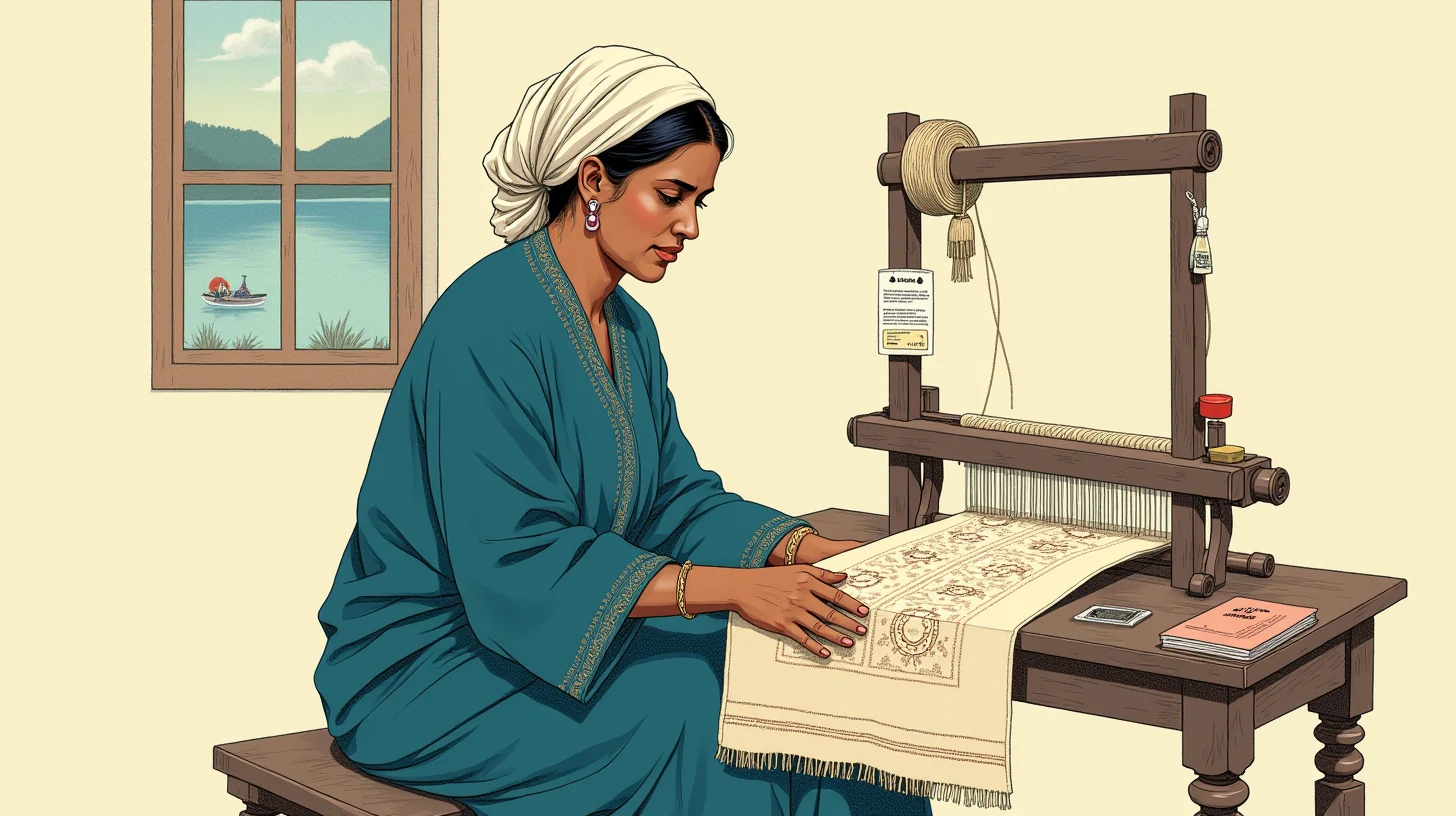
Roohi Wani is thirty-five years old. She lives in Rajbagh, the quiet residential quarter on the western shore of Dal Lake where the houses have proper lawns and the lanes are wide enough for two cars — a neighbourhood that Srinagar people describe with a mix of aspiration and matter-of-factness, the way cities describe the part where professionals settle when they stop renting. Her workroom is on the ground floor, a north-facing room with good diffused light that she chose specifically for the loom: a big traditional wooden frame, nearly two metres across, strung with fine pashmina warp threads so pale they read as white until the afternoon sun catches them and shows the thread as gold. The room smells of raw fibre and the lanolin that clings to undyed pashmina yarn even after three weeks of sorting.
She runs two things simultaneously and makes them look like one. On Instagram, 120,000 people follow her reels on weaving rhythm, natural dyeing with walnut husks and pomegranate rind, and traditional sozni embroidery — the kind of needle-drawn work that takes a skilled kaarigar four months to complete a single large shawl, which Roohi shows in time-lapse with the patience of someone who has done it herself and knows what four months looks like from inside. On YouTube, 55,000 subscribers watch longer-form videos where she explains the warp-and-weft logic of Pashmina weaving, the difference between shahtoosh (illegal) and pashmina (legitimate), the supply chain from Changthang Ladakh where the raw fibre is combed from Changthangi goats by Changpa nomads, down to Srinagar where it is spun, woven, and embroidered. The videos are careful and specific in the way that only someone who knows the whole chain can be.
The second thing is a cooperative of fourteen women weavers, all of them from Nowgam and Panthachowk on Srinagar's southwestern edge — women who were doing piecework for middlemen at rates that had not changed meaningfully since 2010. Roohi pays them a fixed monthly rate plus a quality premium on each piece that passes her inspection. She sells the finished shawls through her Shopify store and directly through Instagram. The price range runs from ₹6,800 for a plain-weave scarfweight piece to ₹1,24,000 for a full sozni-embroidered double shawl. She had, by January 2026, achieved something rare in the Kashmir craft economy: a direct-to-consumer business with visible margins and weavers who earned predictably.
Two letters arrived the second week of February 2026. One was from the Kashmir Chamber of Commerce and Industry, forwarding a notice from the GI Registry in Chennai — a formal infringement complaint under Section 22 of the Geographical Indications of Goods (Registration and Protection) Act, 1999, citing her Shopify product listings and three Instagram Reels where she used the term "Kashmiri Pashmina" without displaying an authorized-user mark or CDI certification stamp. The other letter was from J&K Bank's Rajbagh branch, where she had, three months earlier, asked about a Kisan Credit Card account for the cooperative's working capital — and never followed up. Both envelopes sat on the low table beside the loom for four days before she opened them.
🗓️ The annual ritual
Pashmina received its Geographical Indication tag in 2008, under GI Registration No. 46 — one of the earliest GI grants in India under the 1999 Act. The GI covers "Kashmir Pashmina," defined as the textile produced from the fine undercoat fibre of the Changthangi goat, hand-spun, hand-woven, and finished in the Kashmir Valley. The practical effect of a GI tag is that only producers who are registered authorized users of the mark can lawfully describe their product as "Kashmiri Pashmina" on a label, invoice, or listing — a rule that applies as clearly to an Instagram Reel as to a shopfront sign.
The body designated to administer the authorized-user system for Pashmina in J&K is the Crafts Development Institute, Srinagar, headquartered on Residency Road. CDI inspects raw fibre, yarn, and finished goods at various points in the production chain and issues what it calls the CDI Pashmina Mark — a holographic sticker with a unique batch number that can be verified at jkcdi.org. Without that mark, the producer cannot legally affix "Kashmiri Pashmina" or claim the GI denomination in any commercial communication, including social-media product listings.
- ⚖️
GI Act 1999, Section 17 — Authorized User Registration
Any producer or cooperative of producers of a GI-tagged good can apply to be registered as an authorized user. The application goes to the GI Registry, Chennai, accompanied by proof of production and the endorsement of the registered proprietor — for Pashmina, this is the J&K State Government via the Handicrafts Department.
- 🔍
CDI Inspection — fibre, yarn, and weave verification
CDI Srinagar conducts a physical inspection of the producer's raw material, spinning process, and finished goods. For cooperatives, the inspection covers the entire production chain: fibre sourcing declaration from Ladakh, yarn-quality tests, and weave-density checks. Typical inspection turnaround: four to six weeks.
- 📋
CDI Pashmina Mark issued — batch-numbered holographic sticker
Once inspection passes, CDI issues the holographic Pashmina Mark for each finished piece. The batch number is verifiable at jkcdi.org. The mark must be physically present on the product — or its image displayed on the listing — for any online sale using the GI denomination.
- ✅
Authorized-user status — legal protection + infringement standing
Registered authorized users gain both the right to use the GI mark and the standing to file complaints against infringers. Non-users who use the term 'Kashmiri Pashmina' commercially are liable under Section 22 of the GI Act — penalties include injunction, damages, and seizure of goods.
Roohi knew the GI tag existed. She had mentioned it in two YouTube videos. What she had not known — or had not followed to its conclusion — was that the authorized-user system meant the GI was not just a certification of quality but a legal condition of sale. She had been selling "Kashmiri Pashmina" since 2021. She had never applied for authorized-user status. She had never submitted her cooperative to CDI inspection. The shawls were genuine, the fibre was from Changthang, the weaving was Srinagar's own — but none of that was, under the GI Act, a defence.
The KCC story was a different kind of failure — the quieter kind. Roohi had heard of the Kisan Credit Card in October 2025 from another creator who mentioned it in a DM thread about cooperative financing. The KCC scheme, extended in 2018–19 under the PM-KISAN SamMan notification to allied activities including handicrafts, allows cooperative members to access up to ₹3 lakh each in working capital at interest rates starting at 7% per year — with a 3% interest subvention if repayment is on time, bringing the effective rate to 4%. For a cooperative of fourteen weavers, that is a potential ₹42 lakh facility. Roohi had walked into J&K Bank's Rajbagh branch in November, picked up the application form, and brought it home. It had been sitting beside the loom under a bolt of raw yarn since then.
⚠️ What very nearly happened
The GI infringement notice specified two remedies: one, cease using the GI denomination in any listing immediately; two, obtain authorized-user status or face proceedings under Sections 22 and 38 of the GI Act. Sections 22 and 38 allow a registered proprietor — or, through the GI Registry, any aggrieved party — to seek an injunction, seizure of infringing goods, and damages. For a Shopify store with active listings and an Instagram account with product-tagged Reels, "cease immediately" meant taking down her entire commercial presence until she had CDI certification.
"مہ کۆشش کۄرمہ کہ اصلی کاسُر پشمینہ بیکھو — مگر قانوناً یہ ثابت کرنہ دے لیے CDI مارک ضروری بی۔"— I tried to sell real Kashmiri Pashmina — but to prove it legally, the CDI mark was necessary.
She read the letter three times. The irony was not lost on her: she was one of the few creators in the Kashmir craft space who was actually selling genuine Pashmina — with a full supply-chain paper trail from the Changpa herder to the Srinagar loom — and she was the one receiving the infringement notice. The market is full of synthetic-blend shawls sold as Pashmina on Amazon and Meesho. The Chamber had come for the one person with a large enough following to attract attention and a Shopify store large enough to have invoices worth tracing.
The KCC form was a different kind of incomplete. Without the working-capital facility, Roohi was financing her weavers' monthly wages and raw-material purchases — raw pashmina fibre runs ₹8,000–₹12,000 per kilogram — entirely from current revenue, with no buffer. In March and April, when she acquired fibre for the summer production run, the strain showed: she delayed two weavers' payments by eleven days. They did not complain. She noticed.
Without CDI certification, she could not use the GI mark — which meant her premium-priced listings, which commanded ₹1,24,000 per shawl precisely because they carried the implicit claim of authenticity, would either need to come down or be repriced as non-GI craft. The financial model rested on the GI's implicit guarantee. She had not known it rested on a legal registration she had never filed.
🌗 What changed
In the third week of February, her cooperative's anchor weaver — a sixty-year-old woman named Fatima Bano from Nowgam — mentioned to Roohi that her nephew Imtiyaz had just joined CDI Srinagar as a documentation assistant, straight out of an arts-administration certificate course. Fatima said it with the particular Kashmiri tone of someone dropping useful information without quite making it an offer. Roohi drove to Nowgam that Sunday afternoon.
Imtiyaz was twenty-three, soft-spoken, and sat at a small table beside Fatima's loom where a half-finished pale-grey shawl was stretched on the frame. He knew the CDI process well enough to explain it simply. He had his phone out already — he had, it turned out, heard about the GI notice from Fatima and had, on his own, looked up the GI Act and the CDI inspection schedule. He asked Roohi if he could show her something he had found on an agent his college friend used for their parents' farm paperwork.
He opened the agent on his phone, switched it to Kashmiri and Urdu script, and typed, slowly:
"پشمینہ GI مارک دے لیے کۆپریٹیو یس نامز دے طریقہ کیا بی — ہمارے کول CDI Srinagar ونی جانا چھہ؟" — What is the process for a cooperative to apply for the Pashmina GI authorized-user mark — do we need to visit CDI Srinagar directly?
"جی ہاں — CDI Sرینگر (رزیڈنسی روڈ) ہیی اکلوتا باڈی چھہ جو کاسُر پشمینہ GI Reg No. 46 دے لیے inspection کرتس۔ کوپریٹیو دے لیے آپ کو پہلے J&K Handicrafts Department کول cooperative registration certificate چاہیے — اگر اوہ بنی گئی ہے تو، CDI application Form GI-AUTH-02 fill کرو، اپنا فائبر sourcing declaration (Changthang herder کا نام + district certificate), yarn quality test sample, اتے تیار شدہ ۳ پیس inspection دے لیے بھجو۔ inspection turnaround ۴–۶ ہفتے۔ اس دے بعد GI Registry Chennai کول authorized user application — Section 17 GI Act 1999۔ دونوں parallel چلا سکتے ہو۔"
(Yes — CDI Srinagar on Residency Road is the sole designated body for inspection under Kashmiri Pashmina GI Reg No. 46. For a cooperative, you first need the J&K Handicrafts Department's cooperative registration certificate — if that exists, fill CDI application Form GI-AUTH-02, attach your fibre sourcing declaration with the Changthang herder's name and district certificate, a yarn quality test sample, and send three finished pieces for inspection. Inspection turnaround is four to six weeks. After that, the authorized-user application goes to the GI Registry in Chennai under Section 17 of the GI Act 1999. Both processes can be run in parallel.)
Roohi had the cooperative's J&K Handicrafts Department registration certificate — she had filed it in 2022 for a state craft fair. She had her Changthang supplier's name and district certificate in a folder on her phone. She had three finished shawls from the current run in the workroom. She was, without knowing it, already holding most of what was required.
The agent also flagged the GI infringement notice's timeline: the standard CDI inspection cycle meant she could not get the mark before the Chamber's four-week deadline. But the notice offered an interim path — a written undertaking to the GI Registry that the producer had initiated the authorized-user application and would use the GI denomination only after receiving the CDI mark. The agent produced a draft of that undertaking in three minutes, in plain legal English, citing Section 17(1) of the GI Act.
Imtiyaz drove Roohi to CDI Srinagar on a Tuesday morning. The documentation assistant at the front desk knew Imtiyaz by name. The Form GI-AUTH-02 took forty minutes. The three shawls were logged for inspection the same afternoon.
Then Imtiyaz typed the second question:
"KCC handicraft scheme — J&K Bank Rajbagh branch — cooperative of 14 weavers — ₹3 lakh per member — application step-by-step۔"
"KCC handicraft category 2018-19 توسیع دے تحت، cooperative دے ہر ممبر ₹3 لاکھ working capital تک eligible بی — ₹42 لاکھ total facility ۱۴ ممبران لیے۔ J&K Bank دے لیے: ۱) cooperative registration certificate (J&K Handicrafts Dept) ۲) ممبران دا Aadhaar + ration card ۳) artisan identification cards (ہر ممبر) ۴) 6 ماہ دا cooperative account statement ۵) production record (last 12 months turnover)۔ interest rate 7% ہے، timely repayment تے 3% subvention — effective rate 4%۔ NABARD refinancing دے تحت J&K Bank اکیلی بینک اے جو یہ scheme کاسُر cooperatives لیے active رکھتی ہے۔ application form آپ دے کول پہلے توں چھہ — صرف documents assemble کرو۔"
(Under the KCC handicraft category 2018-19 extension, each cooperative member is eligible for up to ₹3 lakh in working capital — a total facility of ₹42 lakh for fourteen members. For J&K Bank: 1) cooperative registration certificate from J&K Handicrafts Department, 2) Aadhaar and ration card for each member, 3) artisan identification cards for each member, 4) six-month cooperative bank account statement, 5) production record showing last twelve months of turnover. Interest rate is 7%, with a 3% subvention for timely repayment — effective rate 4%. Under NABARD refinancing, J&K Bank is the only bank actively running this scheme for Kashmir cooperatives. You already have the application form — just assemble the documents.)
GI Authorized-User Registration
CDI Srinagar + GI Registry ChennaiForm GI-AUTH-02 filed at CDI Srinagar with cooperative registration certificate, fibre sourcing declaration, yarn samples, and three finished shawls. Inspection turnaround: four to six weeks. Concurrent Section 17 application to GI Registry. Interim undertaking sent to Kashmir Chamber of Commerce — infringement proceedings stayed pending inspection.
KCC Handicraft Application
₹42 lakh total facility at 4% effective rateJ&K Bank Rajbagh branch appraisal. Documents: cooperative registration certificate, Aadhaar + artisan cards for all fourteen members, six-month bank statement, twelve-month production record. NABARD refinancing eligible. Application submitted within one week of the CDI visit. First disbursement expected in five to six weeks.
Financial impact
₹8,980/month freed from bridge financingWorking capital from KCC ends the cycle of bridging raw-material purchases from revenue. At ₹10,000/kg for raw fibre and a four-month production cycle before cash realization, the cooperative's ₹42 lakh facility replaces ₹18–22 lakh per cycle of self-financed inventory. Weaver payments no longer delayed.
The artisan identification cards were the one missing piece — three of the fourteen weavers did not have them. Imtiyaz walked Roohi through the J&K Handicrafts Department's online artisan registration at kashmir.gov.in: a two-page form, an Aadhaar number, a photograph, and a production declaration. Cards for the three missing weavers were applied for the same week. The KCC application went to J&K Bank Rajbagh the following Tuesday, with all documents complete.
🧭 Why we built it
Every Kashmiri craft creator who sells online faces the same unlit junction. The GI tag for Kashmiri Pashmina is not a passive quality mark — it is a legal designation with an enforcement mechanism, active since 2008, administered by a body with the authority to refer infringers to the GI Registry. The problem is not that creators do not care about authenticity. Roohi had spent four years building the most documented Pashmina supply chain on Indian social media. The problem is that the authorized-user system is a formal legal registration with a specific form number, a designated inspection body, and a parallel GI Registry application — none of which is intuitive, and none of which is explained in the CDI's or GI Registry's public-facing materials in Kashmiri or in a format that a direct-to-consumer creator naturally encounters.
What it does
- ⚖️Reads the GI Act 1999 Sections 17 and 22, identifies which section of the infringement notice requires urgent response, and surfaces the interim-undertaking pathway that stays proceedings while inspection is pending.
- 🗂️Matches the cooperative's existing documents — J&K Handicrafts registration certificate, Changthang sourcing declaration — to the exact CDI Form GI-AUTH-02 requirements, so no unnecessary preparation is done.
- 📋Walks through the KCC handicraft application checklist, identifies the three missing artisan identification cards as the only gap, and explains the J&K Handicrafts Department online registration to fill it.
What it does not do
- 🔒Never submits any form to CDI, the GI Registry, or J&K Bank — every document was reviewed and signed by Roohi before Imtiyaz or Roohi filed it in person.
- 💳Never provides a legal opinion on the infringement proceedings or advises on whether to contest the notice — the agent identified the process; a local lawyer reviewed the interim undertaking before it was sent.
- ✅Never decides which weavers' documents to prioritise or how to structure the cooperative's KCC disbursement — those decisions remained with Roohi and the J&K Bank relationship manager.
The KCC scheme is, if anything, better-kept. The extension of the Kisan Credit Card framework to handicraft cooperatives in 2018-19 was a genuine policy shift — it brought weavers and artisans under a subsidised-credit system designed originally for agriculture, at interest rates that micro-finance institutions and informal moneylenders do not approach. But the scheme requires a coordinated document set from multiple departments — Handicrafts Department for cooperative registration, the artisan card system, the NABARD refinancing eligibility — and the bank branch's ability to process it depends on whether the relationship manager knows it exists. Roohi had been at the J&K Bank Rajbagh branch in November. No one had mentioned the artisan card gap. The form had come home and sat under a bolt of yarn.
Fourteen women weavers, a direct-to-consumer Pashmina business with real margins, and a two-year-old cooperative — none of it was conceptually difficult. The difficulty was administrative, fragmented across three departments and a legal registration in Chennai. The agent does not replace the CDI inspector, the GI Registry officer, or the J&K Bank appraisal committee. It finds the document gap before the deadline passes.
🌱 What we hope happens
Imtiyaz sent a message in late April. CDI had completed the inspection — all three shawls passed. The authorized-user certificate was issued, and the GI Registry application had been acknowledged. Roohi's Shopify listings were back up, this time with the CDI Pashmina Mark batch number in each product description. The Kashmir Chamber of Commerce closed the infringement proceeding.
The KCC disbursement had not arrived yet — J&K Bank's appraisal was in its fifth week. But the application was complete, the NABARD eligibility had been confirmed, and the relationship manager had called once to clarify one line of the cooperative's bank statement. Imtiyaz said Roohi was calm about the wait in a way she had not been in February.
There is a specific kind of work that takes years to build in the Kashmir craft economy — the relationships with Changpa herders, the trained hand of a sozni embroiderer who cannot be replaced in a season, the direct-consumer trust built reel by reel over four years — and a specific kind of administrative gap that can undo it in a single notice. The GI Act's authorized-user system exists precisely to protect producers like Roohi from the synthetic-blend sellers who flood the mass market. The irony is that the protection mechanism itself requires a navigation process that the people it is designed to protect are least likely to know exists.
If you have a craft creator or cooperative in J&K, Himachal Pradesh, or any GI-tagged production region — Chanderi sarees, Pochampally ikat, Mysore silk, Darjeeling tea — the agent is available free at gabforge.in. We support Kashmiri (Nastaliq), Urdu, Hindi, and English, and the routing knows the GI Act's authorized-user framework, the CDI Srinagar inspection process, the KCC handicraft application sequence, and the artisan identification card system across states. You can run it on a phone in twenty minutes. We will not advertise to your weavers. We will not sell your sourcing declaration to a brand. We will read the infringement notice with you — all three pages of it — and find the form number and the missing document before the four-week deadline passes.