
The Itanagar Electrician and the Delayed Wages
🔧 Vivek, 32, Nyishi electrician on Arunachal Pradesh's hydropower frontier. He climbs to 3,500 metres on NHPC (National Hydro Power Corporation) sites—the Kameng Hydropower Project, the Subansiri Lower site, Trans-Arunachal Highway lighting contracts. Eighteen months of informal on-site training from a senior technician named Mohan. No ITI certificate, just altitude experience and cable-coil skill. He earns ₹750 per day—solid money for the remote northeast—working through a subcontractor named Rajesh Kumar Constructions, which employs eighteen people, holds no insurance, and operates on rolling three-month contracts.
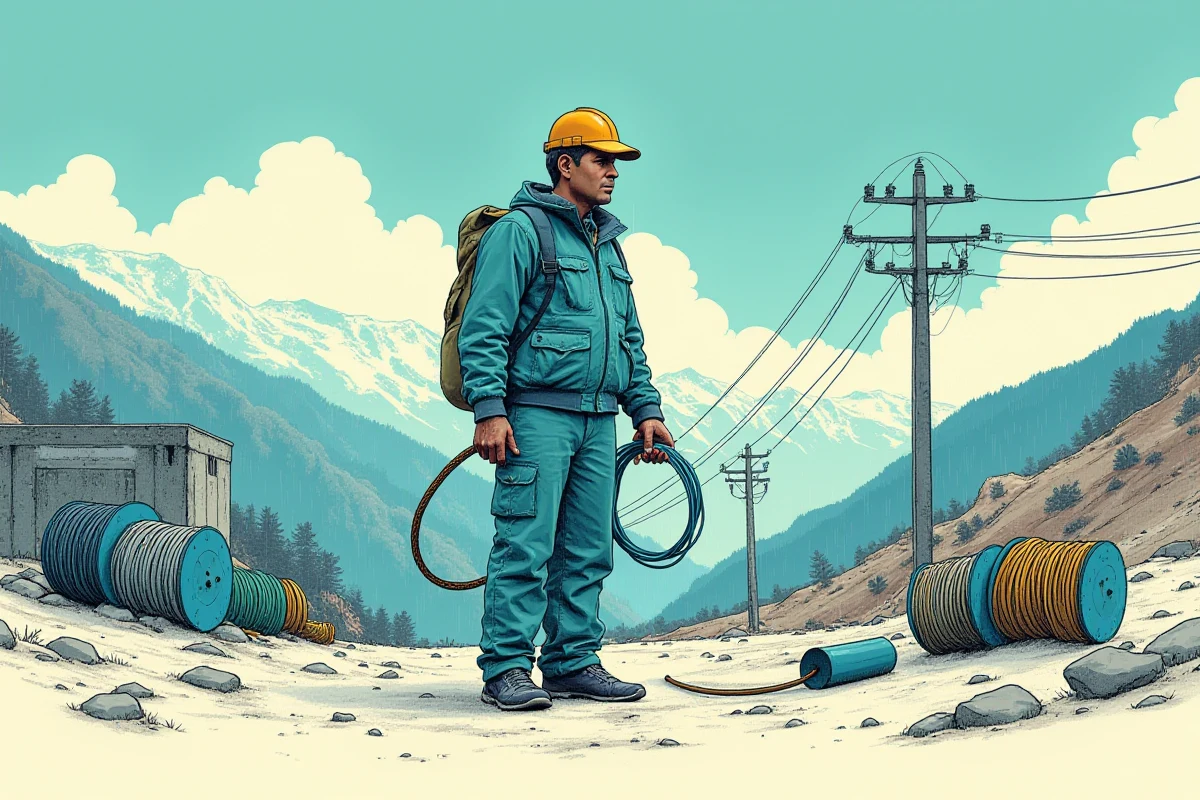
In his best year (2023), two simultaneous projects: ₹2,25,000. In his worst year (2022, project stalled): ₹67,000, sold his motorcycle. Average: ₹1,50,000 annually—just above poverty line. His wife is an ASHA volunteer (₹12,000/month). Rent in Itanagar: ₹8,000. Food, electricity, school fees: ₹23,000/month. One delayed wage payment ripples through everything.
When Spectrum Engineering (the Delhi main contractor) delayed invoices to Rajesh Kumar by 45 days, Rajesh Kumar delayed wages to Vivek. In March 2024, Vivek didn't receive ₹1,500 owed. His rent went unpaid for two weeks. His wife borrowed ₹10,000 from her ASHA supervisor. His daughters' school fees were late. By the time payment arrived, six weeks had passed and Vivek was back to zero savings.
🚨 The problem
Work at 3,500 metres operates across four systems that don't talk: (1) NHPC federal contracts (quarterly disbursement), (2) subcontracting (rolling month-to-month), (3) wage payment (cash float dependent), (4) law (BOCW should register workers; Arunachal BOCW has zero remote-site presence). Vivek sits in a legal blind spot. If he fell from the platform today and broke his legs, no insurance covers him—NHPC says it's Rajesh Kumar's responsibility, Rajesh Kumar says it's the worker's risk. Two workers injured on NHPC sites in seven years: one got ₹50,000 "rehabilitation" negotiated personally; the other (electrocuted, severe burns) got nothing and now remains in a Guwahati hospital.
Wages stall. Insurance doesn't exist. BOCW registration? Rajesh Kumar said "after the three-month contract is finalized—one thing at a time, brother." Vivek had never heard of e-SHRAM or PM Vishwakarma.
🚀 How GabFORGE helped
In September 2024, Vivek's wife attended a health meeting where an ASHA volunteer mentioned government schemes: PM Vishwakarma (₹5,000 interest-free credit for electricians), e-SHRAM (portable worker ID + accident insurance), MUDRA (loans up to ₹3 lakh for self-employed contractors).
Vivek's idea: formalize as a registered contractor, bid directly to NHPC, skip the middleman, and get paid on fixed terms instead of Rajesh Kumar's cash-float whims.
Within two weeks:
- 🔍 Registered on e-SHRAM. A CSC operator named Rina spent 45 minutes explaining: e-SHRAM gave him a national worker ID, documented his seven years on four projects, and linked him to portable insurance (PMJDY bank account, APY pension scheme, PMKVY free skill training). He received a digital multimeter and calibrated screwdriver set from PM Vishwakarma.
- 💬 Applied for MUDRA. Framed himself as "self-employed electrical contractor seeking working capital." Pitched a business plan: hire 8–10 electricians, bid for NHPC sub-contracts directly, pay weekly from a formal account, bypass middlemen. Received ₹3,00,000 (₹2,50,000 principal + ₹50,000 processing).
- 📞 Registered his team. With ₹3 lakh, Vivek registered "Vivek's Electrical Systems," rented a workshop (₹3,000/month), hired two junior electricians (₹10,000/month salary, formal), two casual workers (₹500/day, but now tracked). Enrolled all on e-SHRAM, completed free PMKVY upskilling (high-altitude electrical safety, NHPC procurement documentation). Registered with Arunachal BOCW as a contractor.
By January 2025, he submitted an official NHPC bid. Lost the Kameng contract but won Trans-Arunachal Highway Phase 3 (₹28 lakh sub-contract, 24 weeks, fixed scope). First invoice (May 2025): paid in 29 days. He paid his employees on time. By September 2025, his monthly invoicing had risen to ₹3,50,000 (from ₹1,50,000 when he was a day-labourer). His nephew, Rohan, qualified for NHPC's 12-month apprenticeship (₹12,000/month stipend) after gaining four months of project experience with Vivek's firm.
🇮🇳 Why this matters
Informal workers on India's remote projects do not lack skills or motivation. They lack visibility. NHPC contracts flow through large contractors, to dozens of subcontractors, to cash-based intermediaries—by the time a wage reaches a worker 3,500 metres up, it's passed through six hands. e-SHRAM and PM Vishwakarma exist to solve this: formalize informal workers, give them portable ID and insurance, create direct contracting pathways. But in Arunachal Pradesh, fewer than 2% of construction workers are registered. The barriers are practical: digital literacy, language (forms in English/Hindi, not Adi), travel (CSCs 80–150 km away), and trust (workers don't know if e-SHRAM protects them or just collects data for taxes).
The long version has the mountain pass climb, the March 2024 rent crisis when his landlord threatened eviction, the CSC operator Rina's patient explanation, and the moment Vivek's first official invoice arrived paid in 29 days instead of 45+.