
The Raipur folk music creator and the music-label territory clause
Anushka Sahu is twenty-eight years old. She lives in Shankar Nagar, Raipur — a residential neighbourhood of broad parallel lanes and flowering gulmohar trees that marks the boundary between Raipur's older civic centre and its newer professional belt. The house belongs to her parents: her father is a retired junior engineer from the Chhattisgarh PWD, her mother teaches Hindi at a government middle school two kilometres away. Anushka lives in a back room she has converted, incrementally over three years, into a recording space: a secondhand condenser microphone on a gooseneck stand, a dholki drum against the wall, a laptop running a digital audio workstation, and foam offcuts pinned to two walls with upholstery nails she bought from a hardware shop near the Shankar Nagar market. It does not look like a studio from the doorway. It sounds like one when the microphone is on.
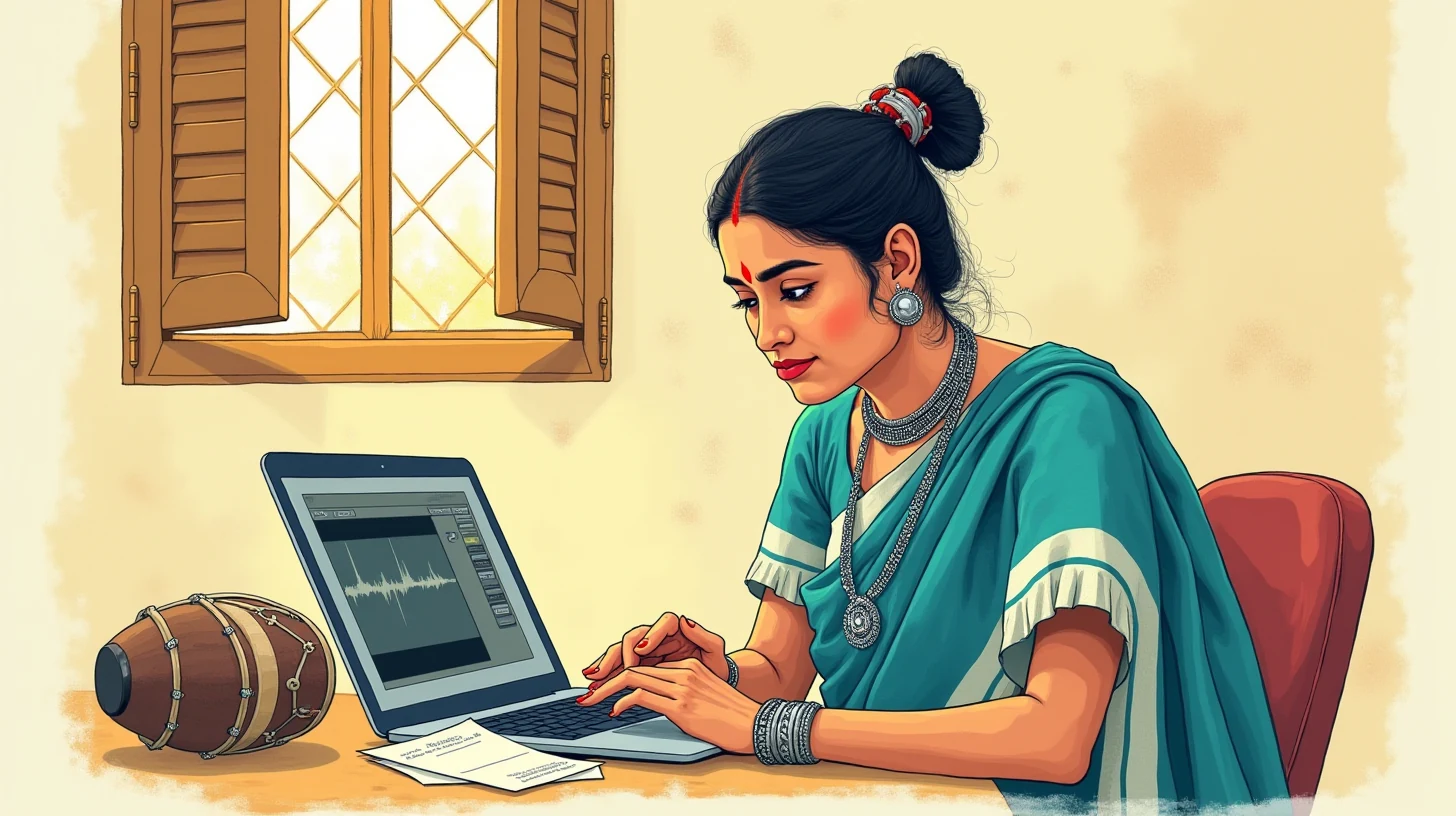
She performs and creates Pandwani-style folk-fusion music. Pandwani is the oral narrative tradition of the Mahabharata as sung in Chhattisgarh — long, declamatory, accompanied by the ektara and sometimes the tabla — associated most famously with Teejan Bai, who performed it in the folk style called Vedamati, standing and dramatic. Anushka does not do traditional Pandwani; she is not trained in the classical form and says so without apology. What she does is take the melodic and narrative architecture of Pandwani — the rhythm of Chhattisgarhi folk cadence, the ritual music of the Karma festival, the call-and-response structures of Sua Nacha — and layer them beneath and above electronic production: synthesiser pads, sampled percussion loops, occasional bass that she programs herself at three in the morning after her parents have gone to sleep. Her percussionist, Suresh, a twenty-four-year-old from Telibandha who plays the dholak with the measured restraint the fusion format requires, arrives on Sunday mornings. They record through the afternoon and eat her mother's chana dal at seven.
Her audience found her gradually and then all at once. She has 165,000 subscribers on YouTube and 70,000 on Instagram — numbers built over four years of uploading, with a spike two summers ago when a Karma-festival ritual-music video drew attention from Chhattisgarhi diaspora communities in Maharashtra and Gujarat, and a second spike when a folk-fusion cover of a traditional Sua Nacha melody was shared by a prominent regional music account. Anushka does not have a manager. She has a spreadsheet, a Google Drive folder organised by date, and a WhatsApp chat with Suresh that is mostly voice notes about tempo.
In January 2026, a speed-post envelope arrived from Raipur's Bhilai Nagar. The return address was the Chhattisgarh Sound imprint of a regional music label she had signed with eleven months earlier. Inside was a four-page breach notice.
🗓️ The label contract economy and the territory clause
Regional music labels in Chhattisgarh, Odisha, Jharkhand, and the smaller Hindi-belt states operate in a commercially specific lane. They are not T-Series or Zee Music — they do not have the infrastructure or the catalogue leverage for national distribution at scale. They are, instead, the connective tissue between a hyperlocal creative tradition and the streaming platforms and regional broadcasters that can carry it. A label like the one that signed Anushka typically holds an IPRS publisher membership for India and SAARC, maintains distribution relationships with JioSaavn, Wynk, and YouTube's Content ID system, handles mechanical licensing for the territories it covers, and takes a royalty share in exchange for production support, mastering, and distribution logistics that a solo creator working from a back room in Shankar Nagar does not have access to on her own.
The territory clause in such contracts is not accidental or boilerplate — it mirrors the label's own licensing position. When a Raipur-based label signs an IPRS publisher-membership for India and SAARC, it is licensed to sub-license and distribute within those boundaries. Anything beyond those boundaries requires separate licensing arrangements the label has not built and cannot legally grant. The contract's territory clause exists, from the label's perspective, as a faithful echo of its own upstream licensing limits.
Anushka had signed a thirty-six-month agreement in February 2025. The contract covered distribution rights for a debut EP of five folk-fusion tracks, plus a right of first refusal on her next two recorded works. The label's consideration was ₹1.2 lakh in production support, professional mastering, and a guaranteed placement on JioSaavn's Chhattisgarhi Folk playlist. The royalty split was sixty percent to Anushka after platform commissions and label operating costs. She signed at the office of Prakash Singh, the label's founder, in a room off Old Bhilai Road, on a Tuesday afternoon, with her father sitting beside her. They shook hands and took photographs.
- 📋
February 2025 — Contract signed
Anushka signs a 36-month recording and distribution agreement with Raipur's Chhattisgarh Sound label. Territory: India and SAARC. Clause 6(c) restricts distribution of any contracted or label-associated work outside the specified territory. Production support: ₹1.2 lakh. No lawyer reviews the document.
- 📱
November 2025 — Folk-fusion remix uploaded to solo channel
Anushka uploads a Karma-festival folk-fusion remix — a new arrangement of a track from the EP, with additional production elements — to her own YouTube channel. She does not adjust the distribution settings. YouTube's default distribution is global, including US, UK, Australia, Singapore, and UAE — all outside SAARC.
- 📨
January 2026 — Speed-post breach notice
The label's notice cites Clause 6(c) and YouTube's Content ID metadata confirming distribution to 47 countries outside SAARC. Claim: ₹8 lakh in liquidated damages under Clause 11(d) — ₹2 lakh per uncured territory breach, four territories cited. Threatened remedies: damages, channel claim transfer, permanent geo-blocking of her YouTube channel for all label-associated content.
- ⚖️
January 2026 — Twenty-one day response window
The notice gives Anushka twenty-one days to geo-restrict the upload to India and SAARC, pay ₹8 lakh, or respond with cause. Her family has no entertainment lawyer. Her father pulls out the contract and reads it aloud at the dining table.
Clause 6(c) was written in English legalese across sixteen lines of dense text in the fourth page of the agreement. It read, in relevant part: "The Artist shall not, directly or indirectly, cause, permit, or facilitate the distribution, broadcast, streaming, or making-available of any Work, Derivative Work, or Artist-Associated Recording in any territory outside the Licensed Territory (India and SAARC member states as defined in the SAARC Charter) through any platform, intermediary, or channel, whether or not such distribution is effected by the Artist or by any automated or algorithmic process of any platform."
The phrase "whether or not such distribution is effected by any automated or algorithmic process" was not an accident. It was the clause that caught Anushka, because she had not distributed the remix to the US, UK, or Singapore. YouTube had. The default upload setting does it automatically, everywhere, for every creator who does not manually apply geographic restrictions. Almost no creator adjusts this setting. The contract had anticipated the failure mode, in the label's favour.
⚠️ What very nearly happened
The ₹8 lakh figure landed differently from a round number. Clause 11(d) of the contract had specified ₹2 lakh per territory violation as pre-agreed liquidated damages — the label's lawyer had cited the US, UK, Singapore, and Australia as the four territories where YouTube's Content ID had confirmed availability. The arithmetic was clean: four territories, ₹2 lakh each, ₹8 lakh total. The twenty-one-day window meant that by the first week of February, Anushka needed to have either paid, removed the video, or filed a legal response.
The threatened remedy beyond damages was more alarming. YouTube's Content ID system, when a label files a channel claim transfer request backed by a legitimate distribution agreement, can administratively reassign a YouTube channel from its creator to the claiming label. It does not require a court order for the initial claim. The creator can contest it through YouTube's dispute process, but the process takes weeks and, during the dispute period, the channel's monetization is suspended. For a channel with 165,000 subscribers, built over four years of Sunday afternoon recordings with Suresh, that suspension is not abstract — it is the primary income thread.
The permanent geo-blocking threat was the third layer. Under the distribution agreement, the label held the right to apply geographic restrictions to any content associated with its catalogue through YouTube's CMS (Content Management System) tools. If the label applied a geo-block to Anushka's channel at the content-association level, every video on her channel that used any element — arrangement, melody, production — that could be linked to the label's contracted EP would be blocked outside India. That is not a temporary inconvenience; it is the erasure of the international audience that had found her through the Chhattisgarhi diaspora communities in Malaysia, Singapore, and the UK.
"मैं सोचे रहेंव — गाना बनाएव, चढ़ाएव, देश-दुनिया सुनही। ये नई जानेंव कि नक्शा में रोक देहीं।"— I thought — I made a song, I uploaded it, and the world would hear it. I did not know they could stop it on a map.
Her father sat with the contract for an evening, reading it in the careful way of a man who has processed PWD tender documents for thirty years — methodically, without panic, but without legal training either. He identified Clause 6(c) and Clause 11(d). He could not identify the counter-argument. He called Anushka's mother, who called her sister, who mentioned that her daughter Reema — Anushka's cousin, twenty-six, six months out of her LLB from Hidayatullah National Law University in Raipur — had just started a clerkship at a small commercial litigation firm in the Civil Lines area.
🌗 What changed
Reema came to Shankar Nagar on the Saturday evening after the notice arrived. She was not yet a practising advocate in her own right — she was on articleship, appearing in court only with her principal — but she had spent six months reading commercial contracts and had the institutional habit that a fresh law graduate has and that a family without legal connections rarely has access to: she knew which statute to open first.
She sat at the dining table with the contract, the notice, and Anushka's laptop. Anushka's mother brought tea twice. Reema said very little until she had read both documents completely. Then she said, in the quiet Chhattisgarhi she and Anushka had spoken since childhood: "ठीक हे, दिक्कत हे — फेर बचाव के रास्ता भी हे। एक रात देव मोला।" — Alright, there is a problem — but there is a defence too. Give me one night.
She opened the agent on Anushka's laptop, typed in the full text of Clause 6(c) and Clause 11(d), and asked it to cross-reference against the relevant Indian statutes.
"अनुष्का जी, Clause 6(c) पढ़े के बाद तीन बात धियान देहू। पहिली: Indian Contract Act 1872 के Section 74 के तहत liquidated damages तभे मिलही जब ओ 'actual loss के genuine pre-estimate' होय — label ला साबित करना परही कि US, UK, Singapore, Australia में distribution से ₹2 लाख प्रति देश के नुकसान होइस। तीन महीना में कतना revenue आइस बाहिर से? दूसरी: YouTube के automated global distribution एक 'algorithmic process' हे — Clause 6(c) खुदे ये शब्द उपयोग करे हे 'automated or algorithmic process', मतलब label ये जानत रिहिस कि YouTube ये करही। रिहिस कारण ओमन notice करे के बाद कुछु नई बोलिस — अब ये argument हे कि label ने खुद ये जोखिम माना रिहिस। तीसरी: channel claim transfer YouTube के Content ID dispute process के अधीन हे — अगर तुम 21 दिन भीतर geo-restriction लगा देव आज, claim transfer रोके जा सकत हे। Reema दीदी ला ये तीनों बात देखा देव।"
(Anushka ji, after reading Clause 6(c), three things to note. First: liquidated damages under Section 74 of the Indian Contract Act, 1872 are only due if they are "a genuine pre-estimate of actual loss" — the label must demonstrate ₹2 lakh in actual loss per territory from distribution in the US, UK, Singapore, and Australia. How much revenue arrived from those territories in three months? Second: YouTube's automated global distribution is an "algorithmic process" — Clause 6(c) itself uses those words, "automated or algorithmic process," meaning the label knew YouTube would do this. Yet they waited to send notice — there is an argument that the label had accepted this risk. Third: a channel claim transfer is subject to YouTube's Content ID dispute process — if you apply the geo-restriction within the next 21 days, the claim transfer can be forestalled. Show Reema didi all three of these points.)
Reema read it over Anushka's shoulder. She pulled up Section 74 of the Indian Contract Act, 1872 on indiacode.nic.in on her phone and read the section header aloud: "Compensation for breach of contract where penalty stipulated for — When a contract has been broken, if a sum is named in the contract as the amount to be paid in case of such breach, or if the contract contains any other stipulation by way of penalty, the party complaining of the breach is entitled, whether or not actual damage or loss is proved to have been caused thereby, to receive from the party who has broken the contract reasonable compensation not exceeding the amount so named." She underlined, on a notepad: reasonable compensation and not exceeding the amount named — two phrases the label's notice had treated as equivalent to "pay the full ₹8 lakh."
They worked until midnight. Anushka applied the geographic restriction on the YouTube upload — India and SAARC only — that same night, documenting the timestamp in a screen recording. That single action, done within the twenty-one-day window, eliminated the ongoing breach and significantly weakened the channel claim transfer application.
Section 74 ICA — Genuine pre-estimate, not a penalty
₹8L claim challengedUnder Section 74 of the Indian Contract Act, 1872, pre-agreed damages are enforceable only as 'reasonable compensation' for actual loss, not as a penalty. The label had to demonstrate ₹2 lakh in actual loss per territory. The three cited non-SAARC territories had generated a combined YouTube royalty of ₹3,840 in the three months of unintended distribution — far below the ₹8 lakh claim.
Algorithmic distribution — Known risk, late notice
Clause 6(c) read against the labelClause 6(c) expressly anticipated automated platform distribution. The label — an IPRS publisher-member with a YouTube CMS account — knew YouTube distributes globally by default. The breach notice arrived three months after the upload. Reema's reply argued the label had the means to detect and notify earlier; delayed notice supports a waiver-of-prompt-remedy argument.
Cured breach — Geo-restriction applied
Within the 21-day windowAnushka applied geographic restrictions limiting distribution to India and SAARC within the twenty-one-day notice period, with a timestamped screen recording as evidence. Under Section 39 of the Specific Relief Act, 1963, a court may decline to grant preventive injunction where the threatened act has been discontinued. The cure materially reduced the injunction risk and the channel-takeover application.
Reema sent the formal reply two days before the deadline. The reply acknowledged the territory breach, attached the geo-restriction timestamp as cure evidence, contested the ₹8 lakh quantum under Section 74 as disproportionate to actual royalty loss, and argued that the automated-distribution nature of YouTube's platform was a known risk that Clause 6(c) itself had recognised. It also served notice that any channel claim transfer application would be contested through YouTube's dispute process and, if necessary, through an application before the District Court for a declaration of the claim's invalidity.
The label did not file the claim transfer. The ₹8 lakh demand was not pressed in that form. Three weeks later, the label's founder called Reema's principal directly and indicated the label was prepared to treat the breach as cured, subject to a formal amendment to Clause 6(c) that placed the responsibility for geo-restriction explicitly on the label's CMS account rather than on Anushka's upload settings.
🧭 Why we built it
Anushka's situation is not specific to Chhattisgarh, or to folk-fusion music, or to this label. It is the structural situation of every Indian regional creator who has signed, or is considering signing, a distribution or recording agreement with a label whose licensing territory is narrower than YouTube's default distribution footprint — which is to say, every label in India that does not hold global rights.
The category is large. Regional labels in Odisha, Assam, Jharkhand, West Bengal, Rajasthan, and every state with a distinct folk music tradition are currently signing creators whose audiences have formed organically across the Indian diaspora and beyond. Bhojpuri labels sign creators with listeners in Mauritius and Fiji. Odia labels sign creators whose diaspora in the Gulf states forms a meaningful part of their audience. Assamese labels sign creators watched in Assam communities in Southeast Asia. None of these audiences live in SAARC. None of them asked to be served from a territory-restricted upload. YouTube does not ask the creator's permission before serving the listener in Singapore.
The territory clause in all these contracts reflects the label's own upstream licensing position — a position the creator has no reason to investigate and no training to interpret. The clause is standard. The YouTube default is standard. The gap between them is the breach.
What it does
- 🔍Reads the contract clause and cross-references it against Section 74 of the Indian Contract Act, Section 38 and 39 of the Specific Relief Act, and Section 17 of the Copyright Act — explains in Chhattisgarhi-accented Hindi what each provision actually means for this specific dispute.
- 🗂️Identifies the geo-restriction cure as the most urgent action within the twenty-one-day window — pinpoints the YouTube Studio distribution settings and documents the timestamp, reducing injunction and channel-transfer risk before a lawyer has even drafted a reply.
- 📞Flags the foreign-income FIRC compliance thread separately — the small USD royalty from non-SAARC distribution needs documentation as service-export income, a distinct obligation that the breach dispute does not resolve.
What it does not do
- 🔒Never contacts the label, sends correspondence, or negotiates terms — every communication went through Reema's principal, reviewed and signed by the practising advocate.
- 💳Never advises Anushka to pay or refuse the ₹8 lakh — it explains what Section 74 requires the label to prove; the decision on whether to settle remained Reema's and Anushka's.
- ✅Never determines whether the breach was material or the cure sufficient — it surfaces the statutory test; Reema applied it to the facts.
The deeper problem is that regional folk music creators are signing contracts with labels that have legitimate licensing constraints, without understanding that those constraints will be enforced by platforms — not by the creator's own choices. Anushka did not distribute to Singapore. YouTube did. The contract anticipated this and put the obligation on the creator anyway. The obligation is lawful. Section 10 of the Indian Contract Act, 1872 requires that a valid contract rest on free consent and lawful consideration — not that it be symmetrical. The creator's obligation to geo-restrict is enforceable. The creator's ability to detect a global-default distribution setting, without being told to look, is the information asymmetry that no contract fairness argument can fix but that a reading agent can close in twenty minutes.
🌱 What we hope happens
Reema has since registered as an advocate with the Chhattisgarh Bar Council. She spent two evenings after the reply was sent asking the agent about music licensing, specifically about the difference between a mechanical license and a performance right, and about what IPRS publisher membership actually grants a regional label. She wanted to understand, she said, not just this case but the framework, so she could help the next creator in Raipur who walked in with a breach notice from a label.
Anushka uploaded a new video in March — a Sua Nacha melody reimagined with an electronic bass line, performed with Suresh on a Sunday afternoon, the dholak mixed closer to the microphone than usual. She applied the geographic restriction before publishing. India and SAARC only. She did not announce it; she did not write a caption about the legal dispute. The upload has 31,000 views.
She asked the agent, the week after the reply was sent, what SAARC actually includes. The agent listed the eight member states — India, Pakistan, Bangladesh, Nepal, Bhutan, Sri Lanka, the Maldives, Afghanistan — and noted that Myanmar is not a member. She noted that two of her diaspora listeners, from a comment thread the previous year, were in Yangon. She thought about this for a moment and said nothing.
There is a specific kind of information gap in Indian folk music creator contracts that does not announce itself as a gap. The territory clause looks like a formality. YouTube's global distribution looks like a feature. The two interact in the background, silently, for months, until a speed-post envelope arrives from a label whose legal team has a CMS account and a Content ID dashboard and knows exactly which countries the track reached. By the time the envelope arrives, the breach has already happened, the twenty-one-day window is running, and the question of what to do next requires knowing at least three things: what Section 74 asks the label to prove, what the geo-restriction cure does to the injunction threat, and which YouTube Studio menu controls distribution territory. None of these things are in the contract. The agent knows all three.
If you are a regional folk, devotional, or independent music creator who has signed a recording or distribution agreement — or if you have received a territory-clause breach notice — the agent is available free at gabforge.in, in Hindi, Chhattisgarhi, and thirteen other Indian languages. It will read the contract with you. It will find the clause that costs money. It will not replace the lawyer — but it will tell you which clause to show the lawyer, which section of the Indian Contract Act to ask about, and which YouTube setting to change before the window closes.
More from anushka
The Vijayawada Telugu storytime channel and the ITR-3 vs 44ADA bind
Sahithi Vemuri is thirty years old. She lives with her parents in a two-story house in Patamata, a middle-class neighbourhood in western Vijayawada, close enough to the Krishna river that on foggy December mornings the mist reaches the rooftop and turns the upstairs balcony into something from a folk tale she might use. That particular atmospheric quality is, in a sense, an occupational resource: Sahithi runs a YouTube channel called Ammayya Kathalu — roughly, "Mother's Stories" — that publishes Telugu-language folk tales for children between three and ten years old, in a voice-acting style that uses no animators, no puppets, and no English. Just Telugu, in Sahithi's own voice, playing all the characters: the cunning jackal, the slow-moving tortoise, Birbal's measured wit, the village grandmother who knows the way through every dilemma.
A ₹2.1 lakh tax demand. The agent read the notice in Telugu.
🎙️ Sahithi Vemuri, 30, voices Panchatantra tales, Akbar-Birbal stories, and Andhra regional folk tales in Telugu from her home in Patamata, Vijayawada. Her channel Ammayya Kathalu has 4.8 lakh YouTube subscribers and three lakh Instagram followers — parents across Andhra Pradesh play her episodes to put their children to sleep. For FY 2024-25, she earned ₹17.7 lakh: ₹9.4 lakh from YouTube AdSense, ₹7.2 lakh from six brand collaborations, and ₹1.1 lakh in Instagram creator-fund payouts. Her CA filed ITR-4 under Section 44ADA with profession code 16019, claiming 50% presumptive income. In March 2026, a Section 143(1)(a) intimation arrived at 11:22 p.m. — the department had reclassified her income as business receipts, disallowed the 44ADA deduction, and issued a demand for ₹2.1 lakh in additional tax plus interest.
The Srinagar Pashmina creator and the GI tag and KCC scheme
Roohi Wani is thirty-five years old. She lives in Rajbagh, the quiet residential quarter on the western shore of Dal Lake where the houses have proper lawns and the lanes are wide enough for two cars — a neighbourhood that Srinagar people describe with a mix of aspiration and matter-of-factness, the way cities describe the part where professionals settle when they stop renting. Her workroom is on the ground floor, a north-facing room with good diffused light that she chose specifically for the loom: a big traditional wooden frame, nearly two metres across, strung with fine pashmina warp threads so pale they read as white until the afternoon sun catches them and shows the thread as gold. The room smells of raw fibre and the lanolin that clings to undyed pashmina yarn even after three weeks of sorting.
Quick read: Srinagar Pashmina creator and the GI tag and KCC scheme
Two envelopes arrived the same week in February 2026. One was from the Kashmir Chamber of Commerce, forwarding a GI infringement notice under Section 22 of the Geographical Indications of Goods (Registration and Protection) Act, 1999 — citing her Shopify listings and three Instagram Reels that used "Kashmiri Pashmina" without a CDI authorized-user mark. The other was from J&K Bank Rajbagh, about a Kisan Credit Card application for her cooperative that had been sitting half-complete for three months. Both envelopes sat on the table beside her loom for four days before she opened them.
The Shimla trek vlogger and the forest drone permit
Devraj Thakur is twenty-six years old and lives in a first-floor room in Sanjauli, a dense hillside neighbourhood in South Shimla where the houses stack three and four storeys up the slope and the streets are narrow enough that neighbours pass morning tea through adjacent windows. He moved to Sanjauli from Rampur Bushahr, two hours away, four years ago — first to study, then to stay, because Shimla is the nearest city with a reliable 4G upload speed and enough tourism to justify what he does for a living. What he does for a living is trek, film, and edit. His YouTube channel, Pahaadi Frames, has 2.9 lakh subscribers. The format is simple: he hikes a Himachal trail alone, shoots four to six hours of footage including drone aerials, and edits it down to twenty-five minutes with Hindi-Pahari commentary and a tracking shot of the dawn from the ridge. Triund, Hampta Pass, Kheerganga, Chandratal — these are the backdrops of his most-watched videos. Some are famous. One Hampta Pass video has thirty-two lakh views.
The Shimla trek vlogger and the forest drone permit — quick read
The Triund meadow does not tell you it is inside a protected zone. The signboard at the trailhead lists fire rules, not filming regulations. Devraj found out the hard way.