
The Ranchi Sohrai painter and the GI tag, MSME Udyam, and the ₹50k GST threat
Somi Murmu is thirty-two years old. She lives in Doranda, Ranchi — the residential quarter southeast of the Harmu River that most corporate visitors to Ranchi pass through on the way from the airport without registering as a neighbourhood, though for Somi it is the only address that has ever mattered. She grew up in a joint household of eleven — her parents, two uncles, their wives, and five cousins — in a single-storey brick compound with a courtyard large enough to dry paddy after the harvest and small enough to hear every conversation from the kitchen. The courtyard is where she learned Sohrai.
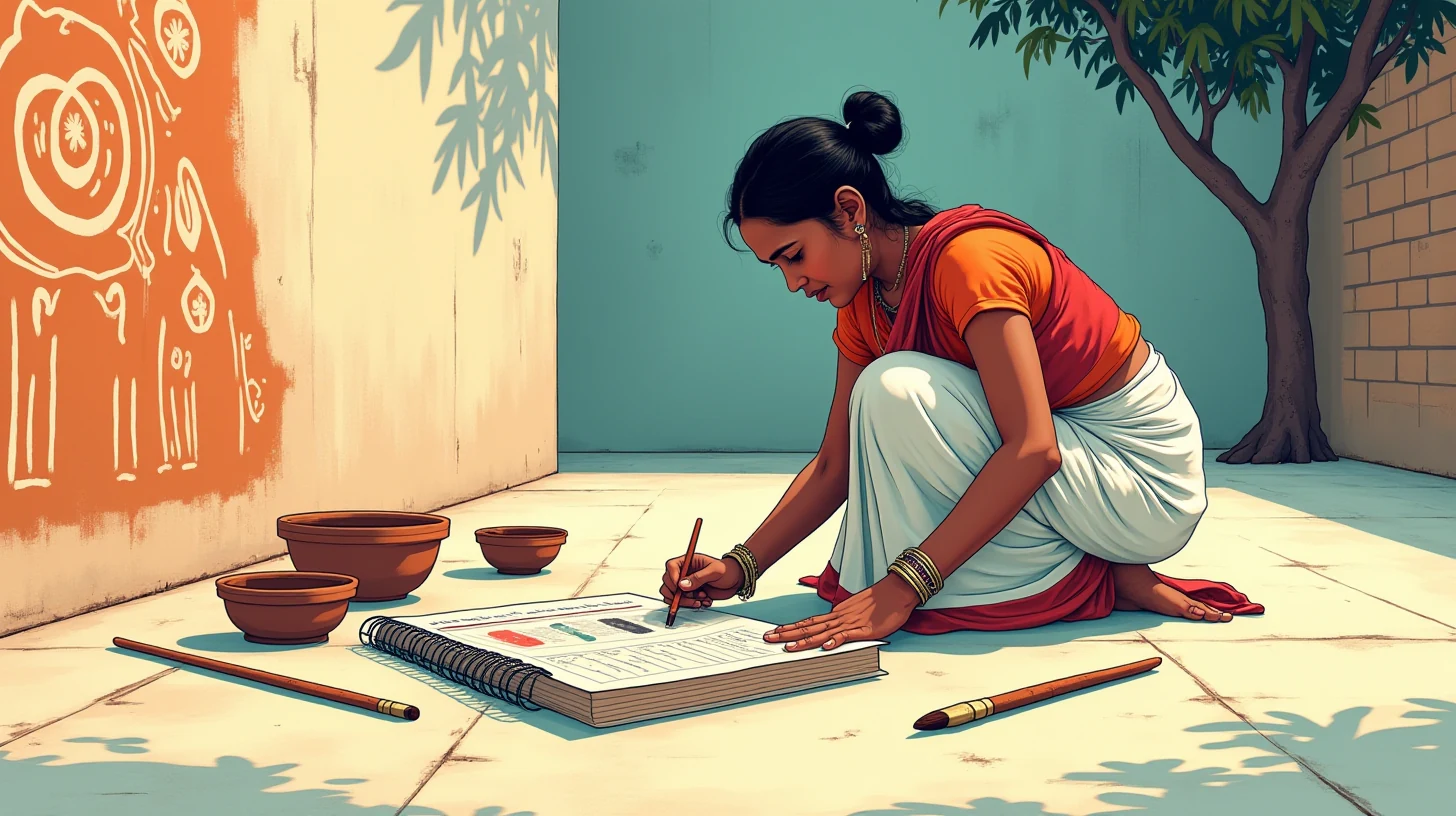
Her grandmother, Kali Murmu, was a Sohrai painter. Every year in the weeks before the Sohrai festival — the harvest celebration of the Santhali and Uraon communities in which homes are repainted with the ancestral motifs of deer, elephants, sun-wheels, and stylised birds — Kali would mix earth pigments in clay bowls, cut bamboo sticks to three brush widths, and begin from the inside wall of the inner room outward. Somi would sit on the mud floor and watch. By the time she was nine she was filling sections of deer-body; by fourteen she was composing her own panels. She has an Instagram account with 85,000 followers, a YouTube channel with 40,000, and a registered commercial business — Somi Murmu Sohrai Studio — that had, by March 2025, executed seventeen corporate mural commissions including two at Tata Steel offices in Jamshedpur and one at a Vedanta facility in the Jharkhand industrial corridor near Ranchi. Annual turnover: ₹23 lakh.
She lives now with her maternal aunt and four nieces — three in school, one in a commerce diploma at Doranda College — in the same compound. The nieces help with the studio: Priya, the eldest at nineteen, manages the Instagram DMs and the invoice book; the younger three mix pigments and prep wall surfaces on weekends. It is a genuine family operation. Somi pays herself ₹48,000 a month from the studio account, keeps a separate cash float for pigment and materials, and files no taxes she cannot verify by hand.
What arrived in the first week of March 2025 was two things, on the same morning: an email from Tata Steel's procurement office in Jamshedpur with a formal commission letter for a 40-foot lobby mural at ₹4,80,000 plus GST, and a letter from a Ranchi-based IP lawyer — copied to the Jharkhand State Industries Department — noting that her studio's invoices and Instagram posts describing murals as "Sohrai GI-tagged artwork" placed her in potential violation of the Geographical Indications of Goods (Registration and Protection) Act, 1999.
🗓️ The framework no one explains to tribal craft creators
Sohrai painting — the harvest-festival mural tradition of Jharkhand's Santhali, Uraon, and Mundari communities — received its Geographical Indication tag in 2020. GI Registration Number 612 was granted under the GI Act 1999 to the Jharkhand State, with the GI Cell under the Industries Department acting as the registered proprietor. A second GI was granted simultaneously for Khovar painting, the wedding-ritual art tradition that shares the same pigment vocabulary and artisan base. Together, they form the core of what the Jharkhand government now markets as its registered tribal-art heritage.
The GI Act 1999, as amended and administered through the Office of the Controller General of Patents, Designs and Trade Marks (CGPDTM) at IP India, creates a two-tier system. The first tier is the registered proprietor — in this case the Jharkhand State GI Cell — which holds the GI and sets the standards for what qualifies as genuine Sohrai. The second tier is the authorized user: any individual producer or business entity that has applied under Section 17 of the Act, been verified against the quality and geographic-origin criteria, and been added to the authorized-user register. Only authorized users may lawfully apply the GI mark — the phrase "Sohrai GI" or the official GI logo — to commercial goods and invoices.
- ⚖️
2020 — Sohrai GI granted (Reg No. 612)
The Government of Jharkhand received GI registration for Sohrai painting under the GI Act 1999, with the State Industries Department as registered proprietor. Only producers in specified Jharkhand districts using traditional pigments and motifs qualify. Khovar received GI 613 simultaneously.
- 📋
Section 17 — Authorized-user registration
Any producer wishing to commercially label their Sohrai work as GI-certified must apply under Section 17 of the GI Act 1999 to the State GI Cell, providing proof of origin, a production declaration, and a quality verification from an authorised body. The Cell maintains a public register of authorized users.
- 🛑
Section 21 — Infringement and complaint mechanism
Using the GI mark — or any description implying GI certification — on commercial goods, invoices, or marketing without authorized-user status is an infringement under Section 21. The State GI Cell can file a complaint with the CGPDTM. Remedies include injunction, seizure of goods, and criminal prosecution.
- ₹
GST threshold — ₹20 lakh aggregate turnover
Separately, any business whose aggregate annual turnover crosses ₹20 lakh must register for GST from the date of crossing. Late registration attracts a penalty of ₹10,000 or 10% of tax due under Section 122 of the CGST Act — whichever is higher. Somi's ₹23 lakh turnover meant she owed GST and the registration penalty.
The practical consequence of this framework for a tribal-art creator working from Doranda is that she carries two overlapping compliance obligations she was never told about. The first — GI authorized-user status — is specific to craft, heritage, and origin: it requires applying to the Jharkhand State GI Cell, submitting a production declaration showing she is a Santhali-origin producer using the traditional pigment-and-bamboo method in the notified geographic area, and waiting for verification. Without this, describing her murals as "Sohrai GI-certified" on any commercial document is Section 21 territory. The second — GST registration — is common to every business that crosses the threshold, but for a self-taught artist running a cash-heavy studio from a family compound, crossing ₹20 lakh in the financial year 2024-25 was not a planned event. It was a consequence of the Tata Jamshedpur commission succeeding, and the Vedanta commission following it, and word spreading in the Ranchi corporate facilities management community that Somi's studio did genuinely good work.
⚠️ What very nearly happened
The IP lawyer's letter was not threatening in its tone. It was, if anything, careful and educational: it named Section 17, it described the authorized-user system, and it offered, in a final paragraph, to represent Somi in applying for authorized-user status — for a fee of ₹35,000. It also noted, in a postscript, that the firm had received information suggesting her studio's aggregate turnover had crossed the GST threshold, and that late registration could attract a Section 122 penalty. The letter was copied to the Jharkhand Industries Department's GI Cell. It was not, by itself, a complaint. It was the shape of one.
What Somi did not know — and could not have known from reading it once — was that the threat had two distinct dimensions. The GI dimension was repairable: apply for Section 17 authorized-user status, get listed, continue. The GST dimension was also repairable: register, pay the outstanding tax with interest, request penalty waiver under Section 128A (the amnesty provision in force through March 2025), continue. But neither repair was free, and neither had a self-evident path. The IP lawyer was quoting ₹35,000 for the GI application alone. A separate CA would need to handle the GST registration and backdated return filing. And meanwhile, the Tata Steel commission email — ₹4,80,000, the largest single commission of her career — was sitting in her inbox asking for a GSTIN on the invoice before the procurement office could issue a purchase order.
She could not invoice without a GSTIN. She could not invoice using the phrase "Sohrai GI-certified" without authorized-user status. And she could not afford, from her ₹48,000 monthly draw, to pay two separate professionals ₹35,000 and ₹20,000 respectively on the same week she needed to order the lime plaster and natural pigment for a 40-foot wall.
"ᱟᱢ ᱥᱟᱶᱜᱮ ᱥᱟᱱᱛᱟᱲᱤ ᱨᱮᱱᱟᱜ ᱞᱮᱠᱟᱛᱮ ᱮᱴᱟᱜ ᱦᱚᱱᱚᱠ ᱮᱱᱟ ᱾ ᱱᱤᱫᱟᱹ ᱠᱟᱜᱚᱡ ᱵᱟᱵᱛᱮ ᱚᱱᱟ ᱫᱚ ᱪᱮᱫ ᱜᱮ ᱵᱟᱡᱟᱭ ᱾"— My grandmother painted for the harvest festival, not for a government certificate. Now they say without the certificate, the painting itself is the violation.
Priya, the nineteen-year-old managing the inbox, read the lawyer's letter twice, then put it face-down on the writing table and did not mention it to Somi for three days. This is the way of a good family office: the eldest niece absorbs the shock so the artist can finish the preparatory sketch for the Tata Steel lobby. It was not a sustainable arrangement. The Tata procurement officer emailed on a Friday asking for the GSTIN so the purchase order could be raised before the quarter closed. Somi replied: "We are processing registration. Request one week extension." The officer agreed. They had seven days.
🌗 What changed
Priya's school friend is Ananya Das, whose father, Ratan Das, runs a development NGO in Kanke, Ranchi — a small organisation that works with Jharkhand tribal artisan communities on livelihood documentation and market linkage. Ratan had spent three years navigating the GI Act for a different craft cluster — Dokra metal-casting from Hazaribagh — and had personal, unhappy familiarity with the authorized-user process. When Ananya mentioned Somi's situation over a Tuesday phone call, Ratan said he would come by the compound that evening.
He arrived at half past seven with his tablet and a thermos of tea. Somi, Priya, and the second niece, Bela, sat in the courtyard under the neem tree. Ratan installed the agent on his tablet, set it to Hindi, and handed it across.
"एक सवाल पूछ," he said — just ask one question.
Somi typed, slowly: "मैं रांची में सोहराई पेंटिंग बनाती हूं। मेरे invoice पर लिखा है 'GI-certified Sohrai mural'। मैंने GI Act में register नहीं किया है। क्या यह गलत है?"
"हां, यह Section 17 और Section 21 का मामला है। सोहराई को 2020 में GI Registration No. 612 मिली है — Jharkhand State GI Cell प्रोपराइटर है। GI mark या 'GI-certified' शब्द का commercial use करने के लिए Authorized User registration ज़रूरी है — Section 17 के तहत State GI Cell में apply करना होता है। बिना registration के यह Section 21 infringement है। अच्छी खबर यह है कि आप Santhali origin की हैं, Ranchi में काम करती हैं, traditional pigments use करती हैं — आप eligible हैं। Apply करें और approval तक invoices पर 'GI-certified' हटा दें।"
(Yes, this is a matter of Sections 17 and 21. Sohrai received GI Registration No. 612 in 2020 — the Jharkhand State GI Cell is the proprietor. Using the GI mark or the phrase 'GI-certified' in commercial contexts requires Authorized User registration under Section 17 by applying to the State GI Cell. Without registration, this is a Section 21 infringement. The good news is that you are Santhali-origin, work in Ranchi, and use traditional pigments — you are eligible. Apply, and remove 'GI-certified' from your invoices until approval.)
Somi read it. Then she looked at Priya. Priya had printed the lawyer's letter from her phone. The letter had said something similar, in eleven paragraphs. The agent had said it in four sentences.
The agent walked them through the GST dimension next, unprompted — Somi had mentioned the turnover number:
"₹23 lakh turnover FY 2024-25 का मतलब है GST threshold cross हो गया। Section 122 के तहत late registration penalty ₹10,000 है — लेकिन GST Council ने Section 128A amnesty March 2025 तक extend की है, जिसमें interest waiver की सुविधा है अगर आप March 31 से पहले register और return file करें। Tata Steel के लिए invoice में GSTIN डालना compulsory है — register करने के बाद यह possible होगा। Registration gst.gov.in पर होती है, आधार + PAN + bank account से — एक दिन में हो सकती है।"
(A turnover of ₹23 lakh in FY 2024-25 means the GST threshold was crossed. The late-registration penalty under Section 122 is ₹10,000 — but the GST Council extended the Section 128A amnesty through March 2025, which includes an interest waiver if you register and file your return before March 31. The Tata Steel invoice requires a GSTIN — this becomes possible after registration. Registration is at gst.gov.in with Aadhaar, PAN, and a bank account — it can be done in a day.)
It was a Tuesday. March 31 was eleven days away.
GI Authorized-User (Section 17)
6–8 weeks, no professional feeApply directly to the Jharkhand State GI Cell under the Industries Department. Required: production declaration, Santhali-origin proof, pigment and method statement, sample photographs. The agent produced a checklist in Hindi and told Somi to remove 'GI-certified' from invoices immediately — describing her work as 'traditional Sohrai painting' is accurate and legally safe while the application is pending.
GST Registration (Section 122 + 128A)
₹10,000 penalty, waived under amnestyRegister at gst.gov.in using Aadhaar + PAN + ICICI bank account before March 31. File the backdated return under the Section 128A amnesty window for interest waiver. Agent generated the GSTIN application sequence step-by-step; Priya completed it the next morning in one hour forty minutes.
Udyam Registration (MSME)
Free, one-day, unlocks contract eligibilityRegister at udyamregistration.gov.in as a micro enterprise (turnover under ₹5 crore). Required for Tata Steel's vendor-onboarding process, Jharkhand craft-subsidy eligibility, and MSME credit guarantee access. The agent identified that Udyam registration was a prerequisite Tata's procurement team would ask for — and that Somi had not done it.
The Udyam registration was the detail neither Somi nor Ratan had thought of. The agent surfaced it from Tata Steel's standard vendor-onboarding clause, which required MSME Udyam registration for contracts under ₹50 lakh. Without it, the ₹4,80,000 Tata commission would have cleared all other hurdles and then stalled at vendor onboarding. Priya registered the studio on udyamregistration.gov.in the same morning she filed the GST application — Aadhaar-based, zero cost, Udyam Registration Number issued in the same session.
By the following Monday — eight days after Ratan's courtyard visit — Somi had a GSTIN, an Udyam Registration Number, and a Section 17 authorized-user application filed with the Jharkhand State GI Cell. The Tata Steel procurement officer received the updated invoice with GSTIN and Udyam number on Tuesday morning. The purchase order was issued that afternoon.
🧭 Why we built it
There are, by the Office of the Development Commissioner (Handicrafts) records, over twelve thousand registered Sohrai and Khovar artisan households in Jharkhand — the majority in the Hazaribagh, Chatra, and Ranchi districts where the traditions are strongest. Of these, a growing fraction — Somi is not unusual — have transitioned from festival-only painting to commercial work: corporate murals, government-contract heritage installations, branded lifestyle prints sold through Instagram. For this group, the GI tag that was designed to protect them has become a documentation hazard they were not warned about.
The GI Act 1999, drafted for agricultural commodities and manufactured goods, was not written with a solo tribal-art creator in mind. Section 17's authorized-user application process requires a production declaration, a geographic-origin attestation, and in some cases a quality verification that only a state-recognised body can provide. The application form is available at ipindia.gov.in, but the instructions assume an applicant who already knows what a "registered proprietor" is and has a relationship with the State GI Cell. Somi did not know the Jharkhand State Industries Department had a GI Cell. She had not known the tag existed until she saw it mentioned in a press piece about Hazaribagh Khovar in 2022 and felt, briefly, proud.
Private IP lawyers will charge ₹30,000–₹50,000 to navigate an authorized-user application that is, by its structure, something an eligible applicant can complete herself with the right checklist and fifteen days. The GST amnesty window — Section 128A — has been extended in successive Council meetings precisely because the government knows that small businesses and artisans cross the threshold without realising and need a low-friction path to regularise. The penalty is designed as a deterrent, not a revenue line. But without someone to identify the amnesty window before it closes, the penalty sticks.
What it does
- 🔍Checks the IP India GI registry in real time — confirms the GI registration number, proprietor, authorized-user register status, and the exact Sections of the GI Act 1999 that apply to commercial use of the mark.
- 🗂️Identifies which of the creator's three overlapping compliance gaps (GI authorized-user, GST, Udyam) must be resolved in which sequence — and flags when a deadline like the Section 128A amnesty window is days away.
- 📞Produces a Hindi-language checklist for the Section 17 authorized-user application — exactly what documents to gather, where to submit, and what to stop writing on invoices while the application is pending.
What it does not do
- 🔒Never files the GI application, GST return, or Udyam registration form on her behalf — each portal action was completed by Somi or Priya, step by step, on their own login.
- 💳Never advises on the IP lawyer's fee proposal or tells Somi whether to engage an external professional — it describes the process and lets her decide.
- ✅Never certifies that the Section 17 application will succeed — it identifies eligibility criteria, not outcomes.
The question the agent answers is not "what is the GI Act" — it is "given your turnover, your geographic location, your community, your production method, and the fact that you have seven days before a procurement office closes the quarter — what do you do first, what do you do second, and what do you stop doing on your invoices tonight?" That is a different question. It is the question a lawyer would answer if you could afford a lawyer at 7:30 on a Tuesday evening in a Doranda courtyard.
🌱 What we hope happens
The Tata Steel lobby mural — forty feet of Sohrai deer and sun-wheel motifs in white, red-ochre, and black on a lime-plaster base — was completed in six weeks. Somi worked with Priya and Bela on the surface preparation; the two younger nieces made the pigment runs, driving to the Ranchi market for the specific red-ochre clay Kali Murmu had taught them to source by touch. The Tata facilities manager sent photographs to the regional head. A second commission — a conference room wall in Jamshedpur — followed four weeks later.
The Section 17 authorized-user application is moving through the Jharkhand State GI Cell. The standard processing time is six to eight weeks; Somi is in the seventh week now. When the registration comes through, she will be listed on the IP India authorized-user register — and her invoices can, for the first time, carry the GI mark that correctly describes what she has been painting since she was nine years old.
What we hope is simpler than the compliance framework: that the seven weeks between a lawyer's letter and an authorized-user application do not, for the next Somi Murmu in the next tribal-art cluster in Jharkhand, take a Ratan Das and a Tuesday courtyard visit to navigate. The GI Act's authorized-user system is not designed to exclude its own creators. It is designed to protect them. But protection that arrives only after a threat letter — and only if someone who knows NGO-sector IP practice happens to be the parent of the right school friend — is not, in practice, a protection system. It is a documentation lottery.
Sohrai will continue. The deer, the sun-wheel, the stylised birds in earth-red on whitewash: these do not depend on GI Reg No. 612, and they did not begin with it. What the GI can do, if the authorized-user pipeline is accessible to the artisans it is designed to serve, is ensure that the commercial growth of the tradition — the corporate murals, the branded prints, the Instagram audience of 85,000 who follow an art form they recognise as genuinely from somewhere — carries the weight of that origin truthfully. That Somi Murmu's invoice says "Sohrai" and means exactly what her grandmother's hands meant.
If you are a tribal-art creator in Jharkhand, Odisha, or any state with a registered craft GI, the agent is free at gabforge.in. We support Hindi, Odia, Bengali, Santali, and a growing set of regional scripts. We know the IP India registry, the Section 17 process, the GST amnesty windows, and the Udyam portal. You can sit in your courtyard on a Tuesday evening and ask the one question that matters: what do I do first?
More from somi
The Vijayawada Telugu storytime channel and the ITR-3 vs 44ADA bind
Sahithi Vemuri is thirty years old. She lives with her parents in a two-story house in Patamata, a middle-class neighbourhood in western Vijayawada, close enough to the Krishna river that on foggy December mornings the mist reaches the rooftop and turns the upstairs balcony into something from a folk tale she might use. That particular atmospheric quality is, in a sense, an occupational resource: Sahithi runs a YouTube channel called Ammayya Kathalu — roughly, "Mother's Stories" — that publishes Telugu-language folk tales for children between three and ten years old, in a voice-acting style that uses no animators, no puppets, and no English. Just Telugu, in Sahithi's own voice, playing all the characters: the cunning jackal, the slow-moving tortoise, Birbal's measured wit, the village grandmother who knows the way through every dilemma.
A ₹2.1 lakh tax demand. The agent read the notice in Telugu.
🎙️ Sahithi Vemuri, 30, voices Panchatantra tales, Akbar-Birbal stories, and Andhra regional folk tales in Telugu from her home in Patamata, Vijayawada. Her channel Ammayya Kathalu has 4.8 lakh YouTube subscribers and three lakh Instagram followers — parents across Andhra Pradesh play her episodes to put their children to sleep. For FY 2024-25, she earned ₹17.7 lakh: ₹9.4 lakh from YouTube AdSense, ₹7.2 lakh from six brand collaborations, and ₹1.1 lakh in Instagram creator-fund payouts. Her CA filed ITR-4 under Section 44ADA with profession code 16019, claiming 50% presumptive income. In March 2026, a Section 143(1)(a) intimation arrived at 11:22 p.m. — the department had reclassified her income as business receipts, disallowed the 44ADA deduction, and issued a demand for ₹2.1 lakh in additional tax plus interest.
The Srinagar Pashmina creator and the GI tag and KCC scheme
Roohi Wani is thirty-five years old. She lives in Rajbagh, the quiet residential quarter on the western shore of Dal Lake where the houses have proper lawns and the lanes are wide enough for two cars — a neighbourhood that Srinagar people describe with a mix of aspiration and matter-of-factness, the way cities describe the part where professionals settle when they stop renting. Her workroom is on the ground floor, a north-facing room with good diffused light that she chose specifically for the loom: a big traditional wooden frame, nearly two metres across, strung with fine pashmina warp threads so pale they read as white until the afternoon sun catches them and shows the thread as gold. The room smells of raw fibre and the lanolin that clings to undyed pashmina yarn even after three weeks of sorting.
Quick read: Srinagar Pashmina creator and the GI tag and KCC scheme
Two envelopes arrived the same week in February 2026. One was from the Kashmir Chamber of Commerce, forwarding a GI infringement notice under Section 22 of the Geographical Indications of Goods (Registration and Protection) Act, 1999 — citing her Shopify listings and three Instagram Reels that used "Kashmiri Pashmina" without a CDI authorized-user mark. The other was from J&K Bank Rajbagh, about a Kisan Credit Card application for her cooperative that had been sitting half-complete for three months. Both envelopes sat on the table beside her loom for four days before she opened them.
The Shimla trek vlogger and the forest drone permit
Devraj Thakur is twenty-six years old and lives in a first-floor room in Sanjauli, a dense hillside neighbourhood in South Shimla where the houses stack three and four storeys up the slope and the streets are narrow enough that neighbours pass morning tea through adjacent windows. He moved to Sanjauli from Rampur Bushahr, two hours away, four years ago — first to study, then to stay, because Shimla is the nearest city with a reliable 4G upload speed and enough tourism to justify what he does for a living. What he does for a living is trek, film, and edit. His YouTube channel, Pahaadi Frames, has 2.9 lakh subscribers. The format is simple: he hikes a Himachal trail alone, shoots four to six hours of footage including drone aerials, and edits it down to twenty-five minutes with Hindi-Pahari commentary and a tracking shot of the dawn from the ridge. Triund, Hampta Pass, Kheerganga, Chandratal — these are the backdrops of his most-watched videos. Some are famous. One Hampta Pass video has thirty-two lakh views.
The Shimla trek vlogger and the forest drone permit — quick read
The Triund meadow does not tell you it is inside a protected zone. The signboard at the trailhead lists fire rules, not filming regulations. Devraj found out the hard way.