
Monsoon arrives in seventy-two hours. He had to stretch them.
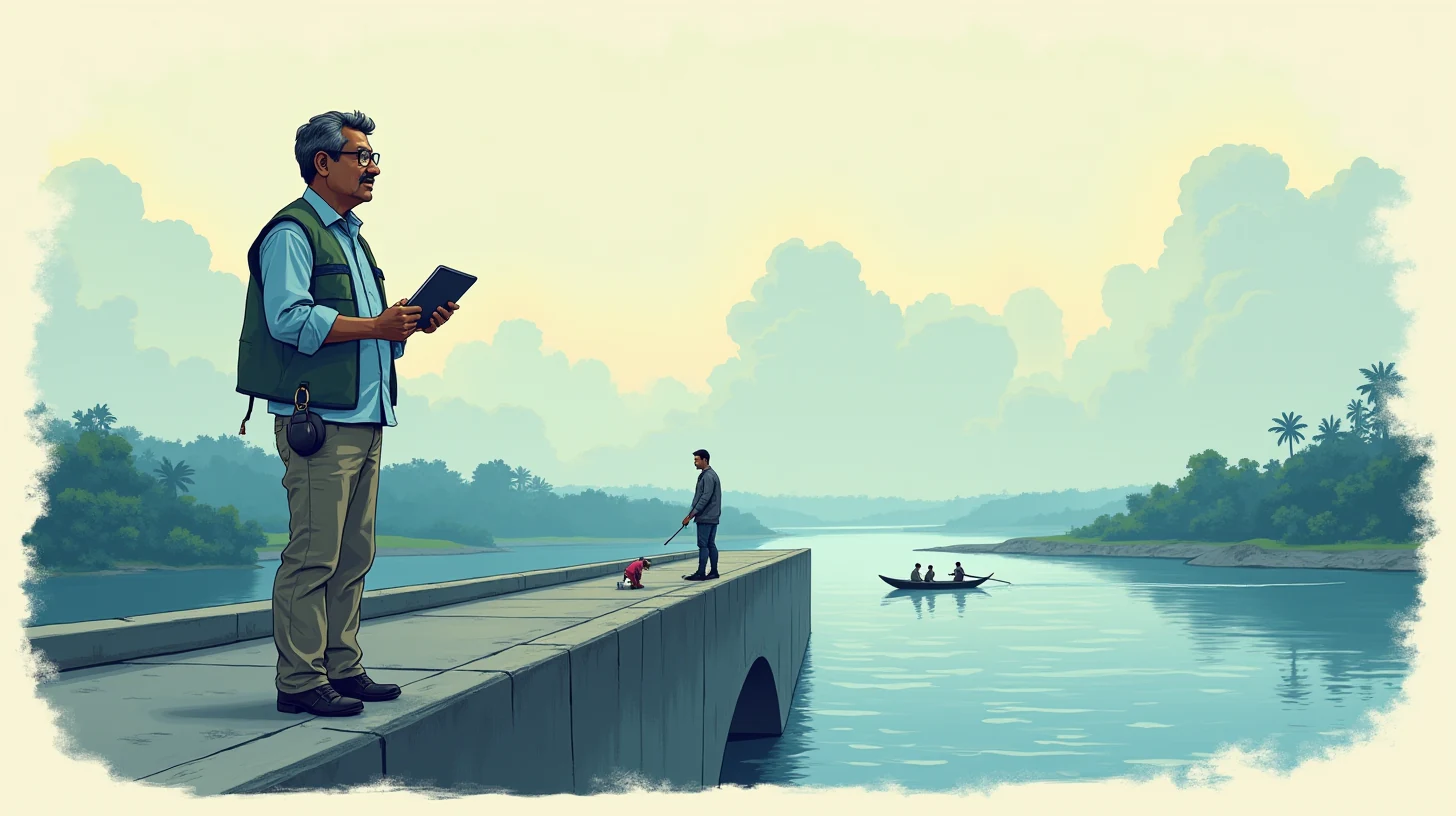
🧑🔨 Rajesh Dey, 39, is a Senior Civil Engineer for Northeast Frontier Railway's Assam Circle. He manages 4.2 km of track crossing the Brahmaputra on three major bridges. The newest, built in 2009, is 2 km long, built on 36 underwater prestressed-concrete piles planted 40 metres deep. In June, the monsoon brings 600 mm of rain and a wall of brown water. His underwater inspection window: seventy-two hours before visibility drops to zero for nine months.
🚨 The problem
The bridge-inspection protocol is comprehensive — full sonar survey every four years, visual every two years. The catch: a full sonar survey costs ₹8.5 lakh and requires a five-person team. The railway's annual budget for all 4.2 km of bridge: ₹22 lakh. For three years running, Rajesh's survey request was denied. Instead, he submitted hand-written parapet assessments — photographs from 40 metres above water that see nothing underwater. Underwater cracks cannot be detected for nine months. A hairline crack can become a spall, a spall becomes delamination, delamination leads to rebar corrosion. In April 2025, he spotted seepage on the approach embankment. In February 2026, he started researching in technical forums, knowing the May inspection window was closing and he had no way to look underwater.
🚀 How GabFORGE helped
His wife Priya gave him a tablet. He typed in Hindi: "I have a bridge over the Brahmaputra. I have only seventy-two hours before monsoon. What can I do?" The agent broke the problem into three parts: (1) stretch the time; (2) see more in that time. It found that NEEPCO's Pagladia and Kopili dams upstream release water on June 10, slowing the river's velocity for 48 hours. The Brahmaputra Board monitors water-level sensors at fifty-two points — including sensor #31 at Rajesh's bridge (coordinates: 22.4621°N, 91.7384°E). When velocity drops below 1.5 knots, a two-hour "sonar window" opens. Local fishermen rent sonar equipment — ₹2 lakh for four hours.
Cascading inspection: Dam schedule + water sensors + rented sonar = 120-hour inspection window instead of 72. He coordinated with NEEPCO, the Brahmaputra Board, and the fishermen's sonar service. On June 7, he booked a four-hour sonar run during the optimal velocity window. Result: 36 km of underwater pile imaging. Three hairline cracks detected in two piles — none critical yet, but all now mapped for monitoring. Follow-up sonar scheduled for May 2027. He filed a supplementary report with actual underwater data, not risk assessment. Approval came within two weeks.
🇮🇳 Why this matters
India has 68,000 km of mainline railway track and roughly 1,200 major river crossings; 340 cross the Brahmaputra. The inspection problem is structural, not accidental: the window when inspection should happen is when budget hasn't appeared. What makes it solvable is that all the pieces exist in separate silos — NEEPCO schedules, Brahmaputra Board sensors, informal sonar rental, railway protocols — but none live in the same place. An engineer who can stitch the silos together in 72 hours can see what was invisible.
The long version has the IIT Guwahati workshop where Rajesh first heard about underwater-inspection alternatives, the agent finding sensor #31's exact coordinates, Rajesh's wife Priya asking about other bridges, and the Reddit engineer in Meghalaya who read his reply and said: "Your nephew's agent sounds like what we actually needed."