
Leave for two years. Then decide if you return.
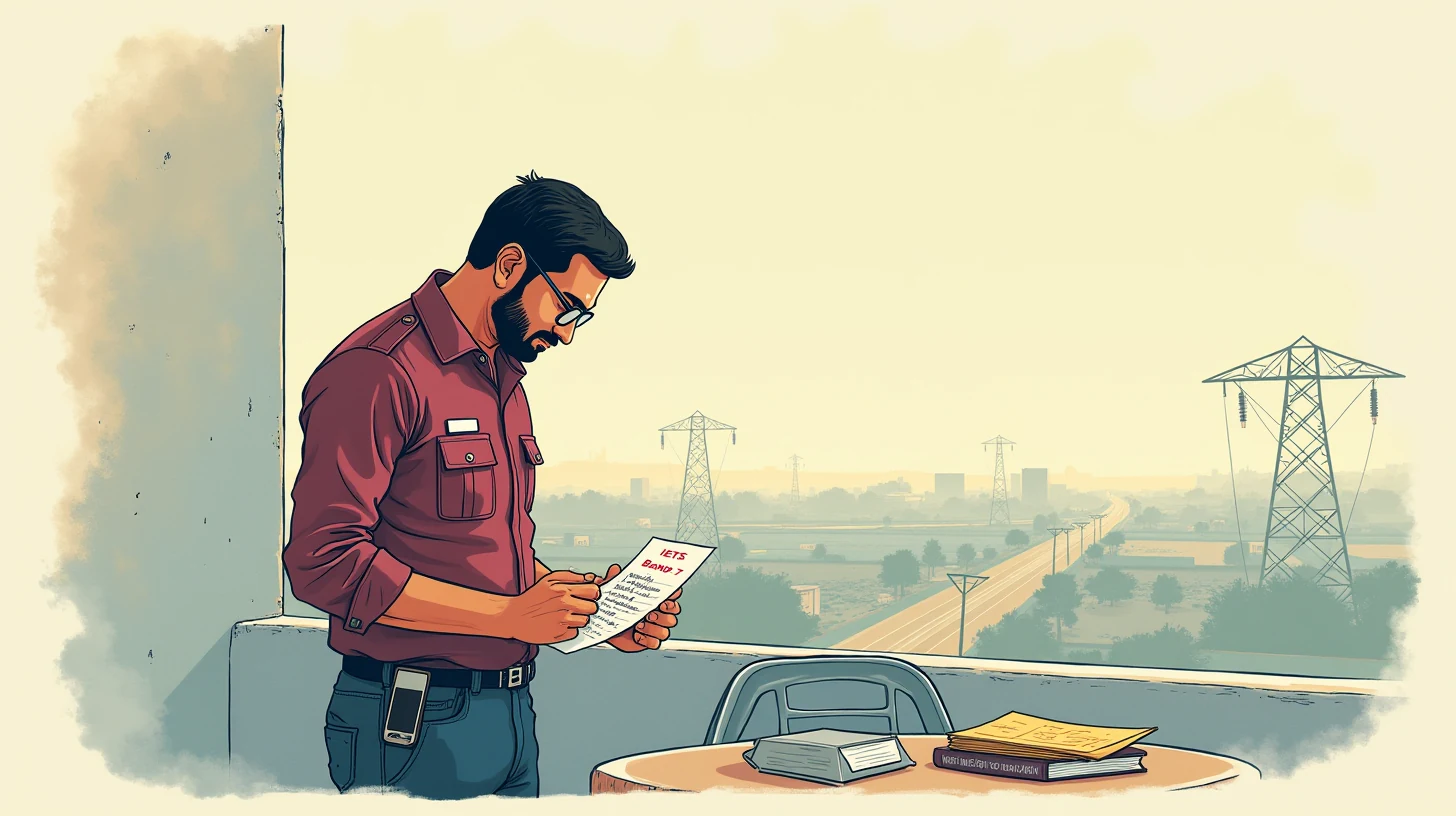
💼 Rajesh Kumar, 32, is a PSPCL (Punjab State Power Corporation) transmission engineer in Chandigarh, earning ₹68,000 per month. His wife Meera is a schoolteacher earning ₹52,000. They are buying a flat in Sector 49 still under construction since 2018. His mother has been leaving sealed envelopes on the writing table: IELTS forms, Canadian immigration matrices, a Post-it in Hindi: "Beta, tera peer nahi samjhega — your pain, others will not understand." His father did not migrate in 1990. Rajesh doesn't want to migrate now. But the path from "not wanting to" to "staying" has opened up to reveal its cost.
🚨 The problem
His mother's cousin in Toronto offers ₹77 lakh per year (CAD $140,000) to work on a utility regulation project — more than eleven times Rajesh's annual PSPCL income. The package: work permit, 18-month contract, then permanent residency pathway. His wife Meera's teaching credential transfers to Canada. The catch: "You can return after 18 months if you want, but..." The silence after that was heavier than any words. "If I go for 18 months, I'm not leaving — I'm selling home," Meera said in the kitchen. His mother heard it. The envelopes stopped. Not because the offer changed, but because the argument clarified: a home is not a place you can pause.
🚀 How GabFORGE helped
Rajesh attended a mandatory PSPCL seminar on "Grid Modernization." During a break, an older engineer named Balwant Singh said: "The PSPCL is going the same direction as every other state utility — into the past. I would tell my daughter not to do a startup if I did not see the PSPCL going the same way. The only choice left is whether to stay and watch it, or leave and pretend it didn't happen." That evening, Rajesh called PSPCL HR and asked about Leave Without Pay policy. The answer was: PSPCL allows engineers to take Leave Without Pay for up to five years. Pension contribution does not accrue, but the leave counts as continuous service for seniority. An engineer can return within five years and pick up salary and pension as if the leave never happened. A third option existed that he had never considered.
Rajesh opened the agent and typed his situation in Punjabi. The agent verified the PSPCL Leave Without Pay policy from the official website, calculated three scenarios: (1) Return after 2 years: pension ₹48,000/month at age 60, flat complete, daughter in school as planned; (2) Stay in Canada permanently: pension frozen at ₹48,000/month CAD payout at age 60, Toronto salary rising to CAD $160,000; (3) Decline, stay in Chandigarh: ₹68k locked, pension ₹95–120k at age 60, but grid transition may reduce roles by 18% after 2032. The agent also surfaced PSPCL's own transition plan: by 2035, the grid's engineer-to-automation ratio will require 18% reduction in traditional transmission roles.
Rajesh read it with Meera on a Saturday evening in the half-finished flat. She asked: "Do you want to go?" He said: "I don't know what I want. I know what my mother wants. I know what my cousin offers. I know what you want. I don't know what I want." Meera said: "Then that is what we are going to find out." The choice became visible — not black-box guilt, but three scenarios with specific numbers, dates, and unknowns. The bridge did not burn. The door stayed open.
🇮🇳 Why this matters
There are roughly 800 professionally trained engineers in Punjab's government sector. Among them, perhaps 150–200 face a similar inflection: locked into a state cadre, watching the sector undergo rapid change, facing diaspora pressure that carries family expectation. These engineers are not in crisis — they have salary, job, family. They are confused. Confusion in this segment is expensive because the default move — stay, because leaving is scary — has a hidden cost: discovering ten years later that the choice was made for you when the PSPCL restructured and the options narrowed.
The long version has his mother's handwritten letter in Punjabi, Balwant's quiet moment about staying to watch decline, Meera's one question: "If we go for 18 months, what is the point of returning?" and the moment Rajesh realized the bridge was never burned — it was just invisible.